PLASTERING
PRESENTED BY
GAYATHRY SATHEESAN
1
INTRODUCTION
 Plaster definition is - a medicated or protective
dressing that consists of a film (as of cloth or
plastic) spread with a usually medicated substance;
broadly : something applied to heal and soothe.
How to use plaster in a sentence.
2
OBJECTIVES OF PLASTERING
1. To provide an even,smooth,regular,clean and
durable finished surface.
2. To preserve and protect the surfaces from
atmospheric influences
3. To cancel the defective workmanship.
3
4. To cover up the porous materials and the joints formed in
the masonry works.
5. To provide a satisfactory base by applying whitewashing ,
painting, distempering.
6. In internal plastering, the basic objective is to protect from
dust and verminnuissance.
4
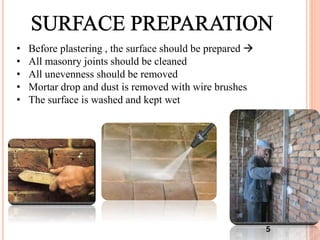
• Before plastering , the surface should be prepared 
• All masonry joints should be cleaned
• All unevenness should be removed
• Mortar drop and dust is removed with wire brushes
• The surface is washed and kept wet
5
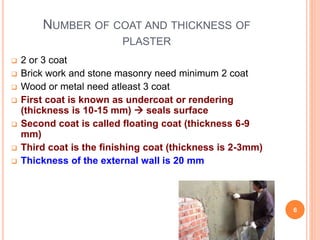
NUMBER OF COAT AND THICKNESS OF
PLASTER
 2 or 3 coat
 Brick work and stone masonry need minimum 2 coat
 Wood or metal need atleast 3 coat
 First coat is known as undercoat or rendering
(thickness is 10-15 mm)  seals surface
 Second coat is called floating coat (thickness 6-9
mm)
 Third coat is the finishing coat (thickness is 2-3mm)
 Thickness of the external wall is 20 mm
6
 Lime plaster
 Cement plaster
 Gypsum plaster
 Lime cement plaster
 Heat resistant plaster
7
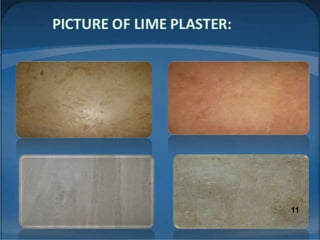
LIME PLASTER
 Lime plaster is a mixture of calcium hydroxide and
sand (or other inert fillers).
 Carbon dioxide causes the plaster to set by
transforming the calcium hydroxide into calcium
carbonate (limestone).
 Whitewash is based on the same chemistry.
 To make lime plaster, limestone (calcium carbonate)
is heated to produce quicklime (calcium oxide).
8
9
• Water is added to produce slaked lime (calcium hydroxide), 
as a wet putty or a white powder.
• Additional water is added to form a paste .
• When exposed to the atmosphere, the calcium hydroxide turn back
to calcium carbonate through reaction with carbon dioxide.
•Thus the strength of plaster increases.
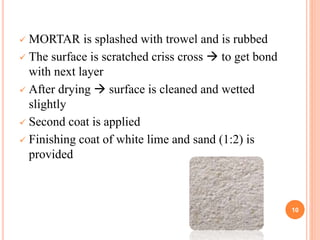
 MORTAR is splashed with trowel and is rubbed
 The surface is scratched criss cross  to get bond
with next layer
 After drying  surface is cleaned and wetted
slightly
 Second coat is applied
 Finishing coat of white lime and sand (1:2) is
provided
10
11
CEMENT PLASTER
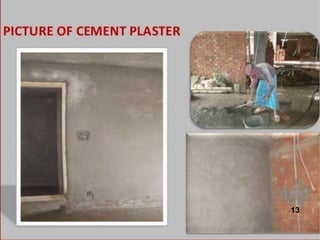
 Cement plaster  a mixture of sand + portland cement and
water .
 Ratio 1:4 - 1:6.
 Applied to masonry interiors and exteriors to achieve a
smooth surface.
 Walls constructed with stock bricks are cement plastered
while face brick walls are not plastered.
12
13
 Various cement-based plasters are also used as proprietary
spray fireproofing products.
 Heavy version of cement plasters are in use for exterior
fireproofing, to protect LPG vessels, pipe bridges and vessel
skirts.
 The advantages of cement plaster were its
 strength,
 hardness,
 quick setting time and
 durability
14
15
GYPSUM PLASTER
Gypsum plaster or plaster of paris is produced By heating
gypsum to about 150 degree celsius.
Caso4.2h2o+heatcaso40.5h2o+1.5h2o(released as steam)
Dry plaster powder mixed with water reforms into gypsum.
 The setting of plaster starts about 10 mins of mixing &
completes after 45 mins.
If gypsum is heated about 130 dc anhydrite is formed.
16
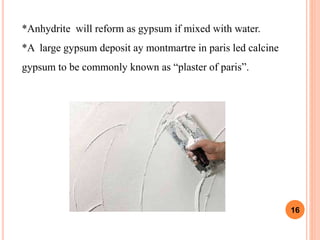
*Anhydrite will reform as gypsum if mixed with water.
*A large gypsum deposit ay montmartre in paris led calcine
gypsum to be commonly known as “plaster of paris”.
TOOLS
17
FIRE RESISTANT PLASTER
 Heat resistant plaster is a building material used for
coating walls and chimney.
 Its purpose is to replace conventional gypsum plasters in
cases where the temperature can get too high .
 Heat resistant plaster should be used in cases where the
temperature exceeds 50 °C.
18
INTERNAL WALL PLASTERING
PROCEDURE
 Surface where plastering is to be done will be
cleaned.
 Level pegs on walls will be fixed (Using centre
plumb bob and nylon thread).
 All the brick walls will be watered before pasting
mortar on walls.
 First coat mortar filling (1:4 Cement and Sand) upto
15 mm will be applied on surfaces where required
mortar thickness exceed 25mm.
 Walls and columns will be plastered 1:4 Cement and
Sand to achieve semi rough finished surface.
19
20
 Vertical joint of structural columns / walls & brick walls will
be treated by fixing 200mm width chicken mesh with wire
nails / concrete nails by centering the mesh to the vertical
wall joint.
 The embedded service lines and provisions (Conduits,
Boxes and etc. ) will be completed on brick walls .
 Joints between walls and beams will be formed up to a
maximum of 20mm and will be sealed using 30 minutes fire
rated flexible filler.
 Internal plastering on surfaces of concrete columns, beams
& walls aligned with surfaces of brick walls will be
plastered and concrete surfaces will be finished with
cement base easy plaster.
EXTERNAL WALL PLASTERING
PROCEDURE
 Level pegs on external wall surfaces will be fixed using
surveying instrument / centre plumb bobs.
 Projections on the wall surfaces will be chipped off and
cleaned after completing the level pegs on walls.
 First coat mortar filling (1:4 Cement and Sand) upto 15
mm will be applied on surfaces where required mortar
thickness exceed 25mm.
21
• Maximum width of 20mm horizontal grooves
between
walls and beams will be formed by cutting using
grinders with diamond wheels after plastering the
wall
surface.This groove will be filled with approved
weather sealant.
• External wall plaster will be finished with rough
surface.
• Cement paste on concrete surfaces will be
applied
to improve the bonding of plaster to the
concrete
surfaces .
22
PRECAUTIONS
 Precautions to be taken to avoid unevenness,
efflorescence, cracking 
 Poor workmanship
 Surface not prepared
 Presence of lime
 Too thickness
 Poor curing
23
THANK YOU….
24

Plastering ppt

  • 1.
  • 2.
    INTRODUCTION  Plaster definitionis - a medicated or protective dressing that consists of a film (as of cloth or plastic) spread with a usually medicated substance; broadly : something applied to heal and soothe. How to use plaster in a sentence. 2
  • 3.
    OBJECTIVES OF PLASTERING 1.To provide an even,smooth,regular,clean and durable finished surface. 2. To preserve and protect the surfaces from atmospheric influences 3. To cancel the defective workmanship. 3
  • 4.
    4. To coverup the porous materials and the joints formed in the masonry works. 5. To provide a satisfactory base by applying whitewashing , painting, distempering. 6. In internal plastering, the basic objective is to protect from dust and verminnuissance. 4
  • 5.
    • Before plastering, the surface should be prepared  • All masonry joints should be cleaned • All unevenness should be removed • Mortar drop and dust is removed with wire brushes • The surface is washed and kept wet 5
  • 6.
    NUMBER OF COATAND THICKNESS OF PLASTER  2 or 3 coat  Brick work and stone masonry need minimum 2 coat  Wood or metal need atleast 3 coat  First coat is known as undercoat or rendering (thickness is 10-15 mm)  seals surface  Second coat is called floating coat (thickness 6-9 mm)  Third coat is the finishing coat (thickness is 2-3mm)  Thickness of the external wall is 20 mm 6
  • 7.
     Lime plaster Cement plaster  Gypsum plaster  Lime cement plaster  Heat resistant plaster 7
  • 8.
    LIME PLASTER  Limeplaster is a mixture of calcium hydroxide and sand (or other inert fillers).  Carbon dioxide causes the plaster to set by transforming the calcium hydroxide into calcium carbonate (limestone).  Whitewash is based on the same chemistry.  To make lime plaster, limestone (calcium carbonate) is heated to produce quicklime (calcium oxide). 8
  • 9.
    9 • Water isadded to produce slaked lime (calcium hydroxide),  as a wet putty or a white powder. • Additional water is added to form a paste . • When exposed to the atmosphere, the calcium hydroxide turn back to calcium carbonate through reaction with carbon dioxide. •Thus the strength of plaster increases.
  • 10.
     MORTAR issplashed with trowel and is rubbed  The surface is scratched criss cross  to get bond with next layer  After drying  surface is cleaned and wetted slightly  Second coat is applied  Finishing coat of white lime and sand (1:2) is provided 10
  • 11.
  • 12.
    CEMENT PLASTER  Cementplaster  a mixture of sand + portland cement and water .  Ratio 1:4 - 1:6.  Applied to masonry interiors and exteriors to achieve a smooth surface.  Walls constructed with stock bricks are cement plastered while face brick walls are not plastered. 12
  • 13.
  • 14.
     Various cement-basedplasters are also used as proprietary spray fireproofing products.  Heavy version of cement plasters are in use for exterior fireproofing, to protect LPG vessels, pipe bridges and vessel skirts.  The advantages of cement plaster were its  strength,  hardness,  quick setting time and  durability 14
  • 15.
    15 GYPSUM PLASTER Gypsum plasteror plaster of paris is produced By heating gypsum to about 150 degree celsius. Caso4.2h2o+heatcaso40.5h2o+1.5h2o(released as steam) Dry plaster powder mixed with water reforms into gypsum.  The setting of plaster starts about 10 mins of mixing & completes after 45 mins. If gypsum is heated about 130 dc anhydrite is formed.
  • 16.
    16 *Anhydrite will reformas gypsum if mixed with water. *A large gypsum deposit ay montmartre in paris led calcine gypsum to be commonly known as “plaster of paris”.
  • 17.
  • 18.
    FIRE RESISTANT PLASTER Heat resistant plaster is a building material used for coating walls and chimney.  Its purpose is to replace conventional gypsum plasters in cases where the temperature can get too high .  Heat resistant plaster should be used in cases where the temperature exceeds 50 °C. 18
  • 19.
    INTERNAL WALL PLASTERING PROCEDURE Surface where plastering is to be done will be cleaned.  Level pegs on walls will be fixed (Using centre plumb bob and nylon thread).  All the brick walls will be watered before pasting mortar on walls.  First coat mortar filling (1:4 Cement and Sand) upto 15 mm will be applied on surfaces where required mortar thickness exceed 25mm.  Walls and columns will be plastered 1:4 Cement and Sand to achieve semi rough finished surface. 19
  • 20.
    20  Vertical jointof structural columns / walls & brick walls will be treated by fixing 200mm width chicken mesh with wire nails / concrete nails by centering the mesh to the vertical wall joint.  The embedded service lines and provisions (Conduits, Boxes and etc. ) will be completed on brick walls .  Joints between walls and beams will be formed up to a maximum of 20mm and will be sealed using 30 minutes fire rated flexible filler.  Internal plastering on surfaces of concrete columns, beams & walls aligned with surfaces of brick walls will be plastered and concrete surfaces will be finished with cement base easy plaster.
  • 21.
    EXTERNAL WALL PLASTERING PROCEDURE Level pegs on external wall surfaces will be fixed using surveying instrument / centre plumb bobs.  Projections on the wall surfaces will be chipped off and cleaned after completing the level pegs on walls.  First coat mortar filling (1:4 Cement and Sand) upto 15 mm will be applied on surfaces where required mortar thickness exceed 25mm. 21
  • 22.
    • Maximum widthof 20mm horizontal grooves between walls and beams will be formed by cutting using grinders with diamond wheels after plastering the wall surface.This groove will be filled with approved weather sealant. • External wall plaster will be finished with rough surface. • Cement paste on concrete surfaces will be applied to improve the bonding of plaster to the concrete surfaces . 22
  • 23.
    PRECAUTIONS  Precautions tobe taken to avoid unevenness, efflorescence, cracking   Poor workmanship  Surface not prepared  Presence of lime  Too thickness  Poor curing 23
  • 24.