By plastering we mean imparting
comparatively thin layer of cement
mortar over brick/stone/R.C.C. wall,
column, beam, slab etc which
ultimately provides protection and
plane surface.
INTRODUCTION
Special thanks to :
 MD. Jobaer Hasan
Dept. of CE , KUET
 K. A.B.M. Mohiuddin
Dept. of CE , KUET
 KUET central computer lab
 ASSET Developers .
Objectives of plastering
 To provide an even , smooth , regular & clean
surface of ceiling & walls.
 To protect the exposed surfaces from harmful
effects of atmospheric agencies such as rain , sun
, snow , wind etc.
 To cover joints & defective workmanship.
 To provide a ground for decoration , or white
or color washing & for molding , decorative &
architectural work.
Factors affecting Selection of Plaster
type
Availability of binding materials
Desired durability
Desired finishing
Atmospheric condition to which plaster
subjected
Whether plaster is to be used on exposed
or interior surfaces
Lime Plaster
Surki plaster
Cement Plaster
Mud plaster
Stucco plaster
Gypsum plaster
Paris Plaster
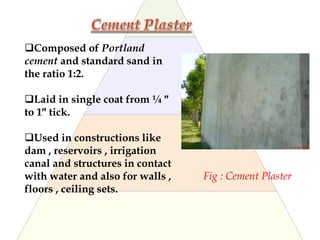
Composed of Portland
cement and standard sand in
the ratio 1:2.
Laid in single coat from ¼ ″
to 1″ tick.
Used in constructions like
dam , reservoirs , irrigation
canal and structures in contact
with water and also for walls ,
floors , ceiling sets.
Fig : Cement Plaster
 Lime plaster is a mixture of calcium
hydroxide and sand (or other inert fillers).
 Carbon dioxide in the atmosphere causes
the plaster to set by transforming the
calcium hydroxide into calcium carbonate
(limestone).
 Whitewash is based on the same
chemistry.
 Lime plaster is used for true frescoes.
 Mainly fat lime is used
 Lime : Sand = 1:1
 Sand controls the plaster
properties , such as shrinkage ,
porosity , strength , adhesiveness ,
etc.
 To make lime plaster, Limestone is heated
to produce quicklime .
 Water is then added to produce slake lime.
Additional water is added to form a paste
prior to use.
 The paste may be stored in air-tight
containers.
 Once exposed to the atmosphere, the
calcium hydroxide turns back into
limestone, causing the plaster to set.
Surki plaster consists of lime and surki
[ 1(lime) : 2(surki) ] mixed with water. It is laid on
soaked surface 0.375 – 0.5 inch thick in one
coat.
Surki Plaster
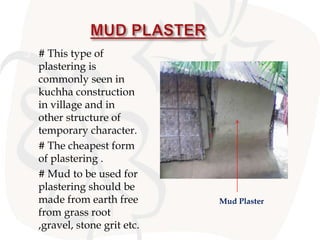
 # This type of
plastering is
commonly seen in
kuchha construction
in village and in
other structure of
temporary character.
 # The cheapest form
of plastering .
 # Mud to be used for
plastering should be
made from earth free
from grass root
,gravel, stone grit etc.
Mud Plaster
Stucco Plaster
Stucco plaster is a decorative type of plaster
with elegant finish like marble finish.
It is usually applied in 3 coats and total
thickness of the plaster is about 25 mm.
The 1st , 2nd and 3rd coats are known as the
scratch coat, finer coat or brown coat and white
coat or finishing coat respectively.
Stucco plaster can be applied for exterior or
interior surface.
 Each coat is allowed to dry before next coat is
applied.
Plaster may also be used to create complex detailing for use in
room interiors.
Paris Plaster
Plaster of Paris is obtained by heating gypsum.
It has better adhesion with wood , metal lath,
masonry and other plastering surface.
Generally used with ordinary lime to fill up the
small holes and other defects in the plastered
surface.
Gypsum plaster
First natural gypsum is crushed and
ground to fine powder and heated to a high
temperature of 125 to 140˚F.
The product thus obtained is termed as
plaster of Paris.
Gypsum plaster is prepared by mixing
plaster of Paris and sand (1:3 or 1:4) with
sufficient quantity of water to produce
required consistency.
To avoid quick setting , retarder in the
form of coir , saw dust , jute cutting etc. is
used with gypsum plaster.
Gypsum based plaster used in
spray fireproofing.
Trowel
Floats
Floating Rule
Plumb Bob
Tools of plastering
Plumb Bob
Floats
Trowel
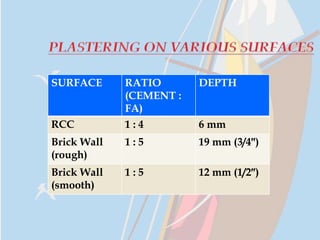
SURFACE RATIO
(CEMENT :
FA)
DEPTH
RCC 1 : 4 6 mm
Brick Wall
(rough)
1 : 5 19 mm (3/4″)
Brick Wall
(smooth)
1 : 5 12 mm (1/2″)
Preparation of Surface
Preparation of Mortar
Plastering
Finishing Test
PLASTERING PRECEDURE
Figure : Preparation of Surface
Preparation of Mortar
PLASTERING PRECEDURE
Figure : Preparation of Mortar
PLASTERING PRECEDURE
Figure : Preparation of Mortar
PLASTERING PRECEDURE
Figure : Plastering
PLASTERING PRECEDURE
Figure : Plastering
PLASTERING PRECEDURE
Figure : Finishing Test
PLASTERING PRECEDURE
Figure : Finishing Test
BEFORE PLASTER AFTER PLASTER
Defects in Plastering
Crack : plaster surface may develop cracks
which may be thin hair crack or wide open crack.
Development of the hair cracks is known as
crazing.
Falling of plaster : Sometime too much thermal
changes and imperfect bond causes falling of
plaster.
Blistering or blowing of Plaster : This defects
occurs due to slacking of unslacked lime
particles present in plaster.
Efflorescence : water used it contain soluble
salts. When newly constructed wall or newly
plastered wall dries out , the salt from of a
whitish crystalline substance , such a growth is
known as efflorescence.
Falling of plaster
Crack
 The surface to be plastered should be properly
prepared and well watered before plaster Coat is
laid over it.
 Superior quality of brick should be used for brick
wall.
 Water used for construction should be free from
soluble salts.
 Efflorescence if any should be removed by rubbing
the surface with brushes.
 Surfaces should be painted only when
efflorescence has fully ceased.
 Proper dam-proof course should be laid correctly.
 The chemical reaction occurs when plaster
is mixed with water is exothermic in
nature.
 The danger of this was illustrated in
January 2007, when a 16 year-old girl
suffered third-degree burns after encasing
her hands in plaster as part of a school art
project in Lincolnshire, England.
 In place of plaster, alginate should be used
for casting body parts.
 From the above observation we can
conclude that the plaster work is
done mainly to protect the surface
from atmospheric influences and
decorative purpose . We also noticed
that there may occur various defects
due to bad plastering . So we should
do the total plaster work properly
and carefully.
USED REFERENCE BOOKS
 A Text Book of Building Construction
By S.P. Arora & S.P. Bindra
 Building Construction Engineering
By Sinha
 Building Construction
By Sushil Kumar
 A Text Book of Engineering Materials
By M. A . Aziz
THANKS TO ALL.

Plastering_work.pptx

  • 2.
    By plastering wemean imparting comparatively thin layer of cement mortar over brick/stone/R.C.C. wall, column, beam, slab etc which ultimately provides protection and plane surface. INTRODUCTION
  • 3.
    Special thanks to:  MD. Jobaer Hasan Dept. of CE , KUET  K. A.B.M. Mohiuddin Dept. of CE , KUET  KUET central computer lab  ASSET Developers .
  • 4.
    Objectives of plastering To provide an even , smooth , regular & clean surface of ceiling & walls.  To protect the exposed surfaces from harmful effects of atmospheric agencies such as rain , sun , snow , wind etc.  To cover joints & defective workmanship.  To provide a ground for decoration , or white or color washing & for molding , decorative & architectural work.
  • 5.
    Factors affecting Selectionof Plaster type Availability of binding materials Desired durability Desired finishing Atmospheric condition to which plaster subjected Whether plaster is to be used on exposed or interior surfaces
  • 6.
    Lime Plaster Surki plaster CementPlaster Mud plaster Stucco plaster Gypsum plaster Paris Plaster
  • 7.
    Composed of Portland cementand standard sand in the ratio 1:2. Laid in single coat from ¼ ″ to 1″ tick. Used in constructions like dam , reservoirs , irrigation canal and structures in contact with water and also for walls , floors , ceiling sets. Fig : Cement Plaster
  • 8.
     Lime plasteris a mixture of calcium hydroxide and sand (or other inert fillers).  Carbon dioxide in the atmosphere causes the plaster to set by transforming the calcium hydroxide into calcium carbonate (limestone).  Whitewash is based on the same chemistry.  Lime plaster is used for true frescoes.
  • 9.
     Mainly fatlime is used  Lime : Sand = 1:1  Sand controls the plaster properties , such as shrinkage , porosity , strength , adhesiveness , etc.
  • 10.
     To makelime plaster, Limestone is heated to produce quicklime .  Water is then added to produce slake lime. Additional water is added to form a paste prior to use.  The paste may be stored in air-tight containers.  Once exposed to the atmosphere, the calcium hydroxide turns back into limestone, causing the plaster to set.
  • 11.
    Surki plaster consistsof lime and surki [ 1(lime) : 2(surki) ] mixed with water. It is laid on soaked surface 0.375 – 0.5 inch thick in one coat. Surki Plaster
  • 12.
     # Thistype of plastering is commonly seen in kuchha construction in village and in other structure of temporary character.  # The cheapest form of plastering .  # Mud to be used for plastering should be made from earth free from grass root ,gravel, stone grit etc. Mud Plaster
  • 13.
    Stucco Plaster Stucco plasteris a decorative type of plaster with elegant finish like marble finish. It is usually applied in 3 coats and total thickness of the plaster is about 25 mm. The 1st , 2nd and 3rd coats are known as the scratch coat, finer coat or brown coat and white coat or finishing coat respectively. Stucco plaster can be applied for exterior or interior surface.  Each coat is allowed to dry before next coat is applied.
  • 14.
    Plaster may alsobe used to create complex detailing for use in room interiors.
  • 15.
    Paris Plaster Plaster ofParis is obtained by heating gypsum. It has better adhesion with wood , metal lath, masonry and other plastering surface. Generally used with ordinary lime to fill up the small holes and other defects in the plastered surface.
  • 16.
    Gypsum plaster First naturalgypsum is crushed and ground to fine powder and heated to a high temperature of 125 to 140˚F. The product thus obtained is termed as plaster of Paris. Gypsum plaster is prepared by mixing plaster of Paris and sand (1:3 or 1:4) with sufficient quantity of water to produce required consistency. To avoid quick setting , retarder in the form of coir , saw dust , jute cutting etc. is used with gypsum plaster.
  • 17.
    Gypsum based plasterused in spray fireproofing.
  • 18.
  • 19.
    Tools of plastering PlumbBob Floats Trowel
  • 20.
    SURFACE RATIO (CEMENT : FA) DEPTH RCC1 : 4 6 mm Brick Wall (rough) 1 : 5 19 mm (3/4″) Brick Wall (smooth) 1 : 5 12 mm (1/2″)
  • 21.
    Preparation of Surface Preparationof Mortar Plastering Finishing Test
  • 22.
    PLASTERING PRECEDURE Figure :Preparation of Surface
  • 23.
  • 24.
    PLASTERING PRECEDURE Figure :Preparation of Mortar
  • 25.
    PLASTERING PRECEDURE Figure :Preparation of Mortar
  • 26.
  • 27.
  • 28.
  • 29.
  • 30.
  • 31.
    Defects in Plastering Crack: plaster surface may develop cracks which may be thin hair crack or wide open crack. Development of the hair cracks is known as crazing. Falling of plaster : Sometime too much thermal changes and imperfect bond causes falling of plaster. Blistering or blowing of Plaster : This defects occurs due to slacking of unslacked lime particles present in plaster. Efflorescence : water used it contain soluble salts. When newly constructed wall or newly plastered wall dries out , the salt from of a whitish crystalline substance , such a growth is known as efflorescence.
  • 32.
  • 33.
  • 34.
     The surfaceto be plastered should be properly prepared and well watered before plaster Coat is laid over it.  Superior quality of brick should be used for brick wall.  Water used for construction should be free from soluble salts.  Efflorescence if any should be removed by rubbing the surface with brushes.  Surfaces should be painted only when efflorescence has fully ceased.  Proper dam-proof course should be laid correctly.
  • 35.
     The chemicalreaction occurs when plaster is mixed with water is exothermic in nature.  The danger of this was illustrated in January 2007, when a 16 year-old girl suffered third-degree burns after encasing her hands in plaster as part of a school art project in Lincolnshire, England.  In place of plaster, alginate should be used for casting body parts.
  • 36.
     From theabove observation we can conclude that the plaster work is done mainly to protect the surface from atmospheric influences and decorative purpose . We also noticed that there may occur various defects due to bad plastering . So we should do the total plaster work properly and carefully.
  • 37.
    USED REFERENCE BOOKS A Text Book of Building Construction By S.P. Arora & S.P. Bindra  Building Construction Engineering By Sinha  Building Construction By Sushil Kumar  A Text Book of Engineering Materials By M. A . Aziz
  • 38.