NMIT,BENGALURU
DEPARTMENT OF CIVIL ENGINEERING
NAME :
USN: 1NTXYCVxxx
UNDER THE GUIDELINES OF:
Mr.-------------SIR - INTERNAL GUIDE
Mr.------------- SIR - EXTERNAL GUIDE
COMPANY: xxxxx PROJECTS PRIVATE LIMITED
XXXX PROJECTS PVT LTD
PROJECT TITLE : CONSTRUCTION WORKS ON SITE
PERIOD OF INTERNSHIP: 4WEEKS
CONTENTS
INTRODUCTION OF THE COMPANY
CEMENT PLASTERING
CUSTOMER MODIFICATION
XXXXX PROJECTS ( various
projects of company )
o BROXI - DEVANAHALLI
o ITOWERS - SANJAY NAGAR
o COPUS - DEVANAHALLI
o XAXIS - KORAMANGALA
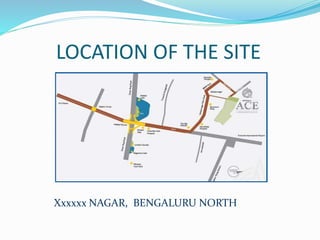
LOCATION OF THE SITE
Xxxxxx NAGAR, BENGALURU NORTH
ACE APARTMENT SITE PLAN
PUT IN PLAN PICTURE HERE!!!
ACE APARTMENTS
2 ACRES
2B+G+16
2 CLUB HOUSES
1 SWIMMING POOOL
1 COMMUNITY HALL
1 MULTI-PURPOSE HALL
LANDSCAPE GARDEN
SENIOR CITIZEN SITOUT
ACE APARTMENTS
PROJECT DETAILS :
PROJECT INITIATION : JUNE 2012
COMPLETION STATUS : FINAL STAGES
DURATION : 4 YEARS
ESTIMATED COST : 150 CRORES
ACE APARTMENTS HAS FOUR
TEAMS
SITE PLANNING TEAM - CAD PLANNING AT HEAD
OFFICE
 EXECUTION TEAM – AT THE SITE
i. Project Manager
ii. Site Engineers
iii. Supervisors
EOHS TEAM - AT THE SITE
MARKETING TEAM - AT THE SITE
PLASTERING
WHAT IS PLASTERING…??
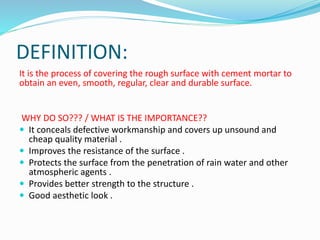
DEFINITION:
It is the process of covering the rough surface with cement mortar to
obtain an even, smooth, regular, clear and durable surface.
WHY DO SO??? / WHAT IS THE IMPORTANCE??
 It conceals defective workmanship and covers up unsound and
cheap quality material .
 Improves the resistance of the surface .
 Protects the surface from the penetration of rain water and other
atmospheric agents .
 Provides better strength to the structure .
 Good aesthetic look .
TYPES OF PLASTERS GENRALLY
USED IN INDIA
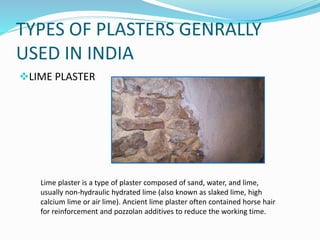
LIME PLASTER
Lime plaster is a type of plaster composed of sand, water, and lime,
usually non-hydraulic hydrated lime (also known as slaked lime, high
calcium lime or air lime). Ancient lime plaster often contained horse hair
for reinforcement and pozzolan additives to reduce the working time.
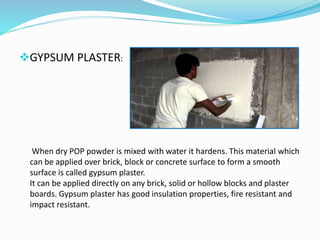
GYPSUM PLASTER:
When dry POP powder is mixed with water it hardens. This material which
can be applied over brick, block or concrete surface to form a smooth
surface is called gypsum plaster.
It can be applied directly on any brick, solid or hollow blocks and plaster
boards. Gypsum plaster has good insulation properties, fire resistant and
impact resistant.
CEMENT PLASTER:
Cement plaster is a mixture of suitable sand, portland cement and water
which is normally applied to masonry interiors and exteriors to achieve a
smooth surface. Interior surfaces sometimes receive a final layer of
gypsum plaster.

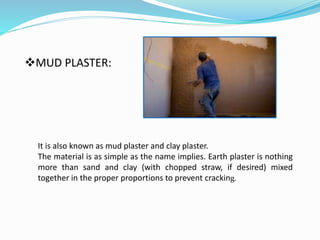
MUD PLASTER:
It is also known as mud plaster and clay plaster.
The material is as simple as the name implies. Earth plaster is nothing
more than sand and clay (with chopped straw, if desired) mixed
together in the proper proportions to prevent cracking.
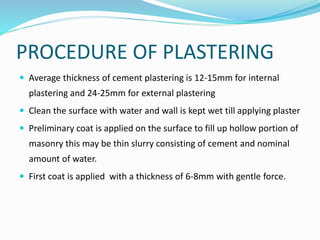
PROCEDURE OF PLASTERING
 Average thickness of cement plastering is 12-15mm for internal
plastering and 24-25mm for external plastering
 Clean the surface with water and wall is kept wet till applying plaster
 Preliminary coat is applied on the surface to fill up hollow portion of
masonry this may be thin slurry consisting of cement and nominal
amount of water.
 First coat is applied with a thickness of 6-8mm with gentle force.
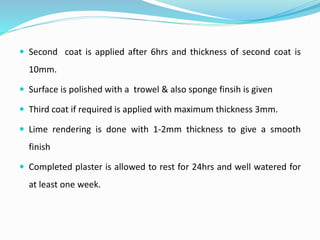
 Second coat is applied after 6hrs and thickness of second coat is
10mm.
 Surface is polished with a trowel & also sponge finsih is given
 Third coat if required is applied with maximum thickness 3mm.
 Lime rendering is done with 1-2mm thickness to give a smooth
finish
 Completed plaster is allowed to rest for 24hrs and well watered for
at least one week.
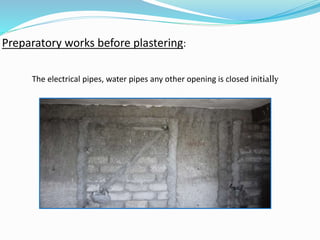
Preparatory works before plastering:
The electrical pipes, water pipes any other opening is closed initially
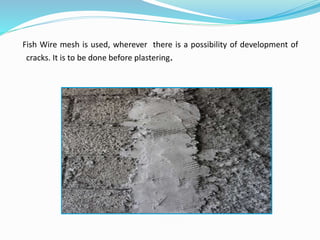
Fish Wire mesh is used, wherever there is a possibility of development of
cracks. It is to be done before plastering.
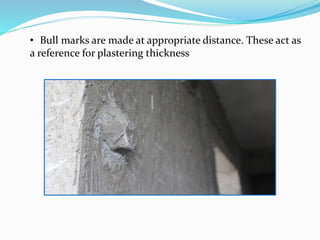
• Bull marks are made at appropriate distance. These act as
a reference for plastering thickness
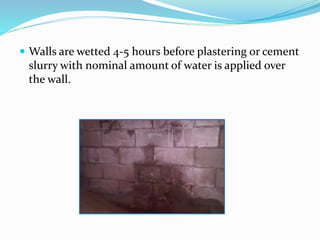
 Walls are wetted 4-5 hours before plastering or cement
slurry with nominal amount of water is applied over
the wall.
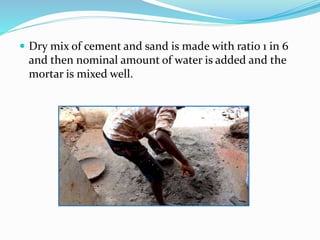
 Dry mix of cement and sand is made with ratio 1 in 6
and then nominal amount of water is added and the
mortar is mixed well.
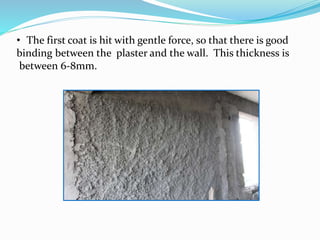
• The first coat is hit with gentle force, so that there is good
binding between the plaster and the wall. This thickness is
between 6-8mm.
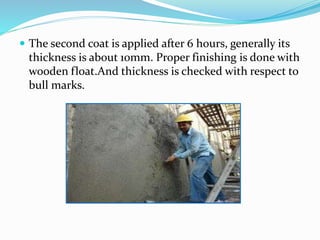
 The second coat is applied after 6 hours, generally its
thickness is about 10mm. Proper finishing is done with
wooden float.And thickness is checked with respect to
bull marks.
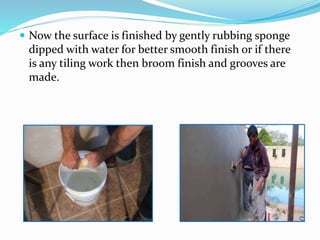
 Now the surface is finished by gently rubbing sponge
dipped with water for better smooth finish or if there
is any tiling work then broom finish and grooves are
made.
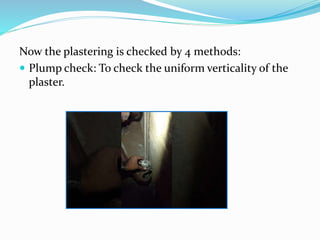
Now the plastering is checked by 4 methods:
 Plump check: To check the uniform verticality of the
plaster.
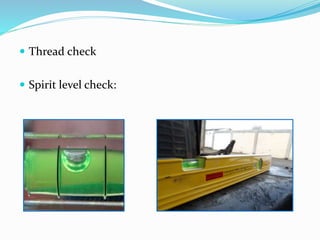
 Thread check
 Spirit level check:
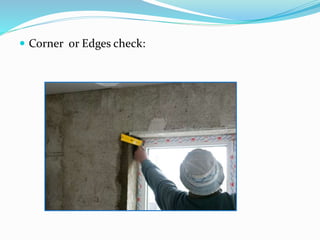
 Corner or Edges check:
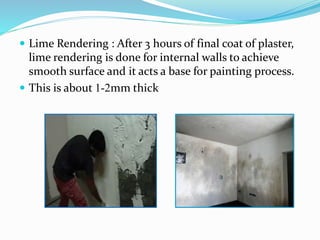
 Lime Rendering : After 3 hours of final coat of plaster,
lime rendering is done for internal walls to achieve
smooth surface and it acts a base for painting process.
 This is about 1-2mm thick
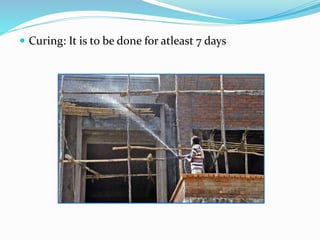
 Curing: It is to be done for atleast 7 days
 It should adhere to the background and should remain
adhered during all variations of the climatic changes.
 It should be cheap and economical
 It should be hard and durable.
 It should be possible to apply it during all weather
conditions
 It should be effectively check the entry or penetration
of moisture from the surface
 It should possess good workability
Requirement of a good plaster?
CUSTOMER MODIFICATION FORM
 Customer modification process helps you to modify an
existing work as per customer details (i.e) as per
customer requirements.
NEED FOR MODIFICATION:
 The need for modification arises because of various
reasons,such as the psycology of a person, influence from
various types of magazines,books or through television
and other sources.
PROCESS OF MODIFICATION:
 The demands come from the customers for some kinds
of changes that they require in particular area of their
flat.
 The required changes that must be made should be
informed to office with proper modification details or
specification & plans by the customer.
 from the office the site execution engineers are informed
about the modification requirements of the customer
owning a particular flat in the particular block of the
apartment.
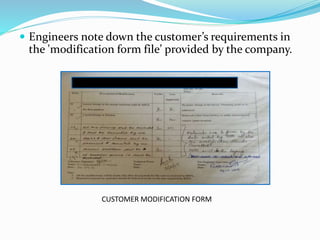
 Engineers note down the customer’s requirements in
the 'modification form file’ provided by the company.
CUSTOMER MODIFICATION FORM
 If there are minor modifications like shifting the
position of socket or addition of taps then,this can be
done easily with applicable charges.
 If there are major modification such as change in the
dimension of the room, where the space for extension
is not possible then these modifications are rejected.
NOTE: It must also be noted that the modification
orders must be given initially or immediately after the
frame work.
And if the modification work if given at final stages of
completion, then generally it is to be avoided and not
to be under taken. as it consumes a lot of time ,labor
and also adds up to the delay in construction.
Conclusion
 Through the internship at XXXX Projects Pvt Ltd, I
learnt various aspects of Civil Engineering.
 The Internship has helped me in observing and
learning various construction procedures.
 Internship gave me with an idea regarding the working
phases of construction Industry and created a link
from theoretical knowledge and its application.
 I hope this experience will surely help me in my future
progress.
THANK YOU

Cement Plastering procedure

  • 1.
    NMIT,BENGALURU DEPARTMENT OF CIVILENGINEERING NAME : USN: 1NTXYCVxxx UNDER THE GUIDELINES OF: Mr.-------------SIR - INTERNAL GUIDE Mr.------------- SIR - EXTERNAL GUIDE COMPANY: xxxxx PROJECTS PRIVATE LIMITED
  • 2.
    XXXX PROJECTS PVTLTD PROJECT TITLE : CONSTRUCTION WORKS ON SITE PERIOD OF INTERNSHIP: 4WEEKS
  • 3.
    CONTENTS INTRODUCTION OF THECOMPANY CEMENT PLASTERING CUSTOMER MODIFICATION
  • 4.
    XXXXX PROJECTS (various projects of company ) o BROXI - DEVANAHALLI o ITOWERS - SANJAY NAGAR o COPUS - DEVANAHALLI o XAXIS - KORAMANGALA
  • 5.
    LOCATION OF THESITE Xxxxxx NAGAR, BENGALURU NORTH
  • 6.
    ACE APARTMENT SITEPLAN PUT IN PLAN PICTURE HERE!!!
  • 7.
    ACE APARTMENTS 2 ACRES 2B+G+16 2CLUB HOUSES 1 SWIMMING POOOL 1 COMMUNITY HALL 1 MULTI-PURPOSE HALL LANDSCAPE GARDEN SENIOR CITIZEN SITOUT
  • 8.
    ACE APARTMENTS PROJECT DETAILS: PROJECT INITIATION : JUNE 2012 COMPLETION STATUS : FINAL STAGES DURATION : 4 YEARS ESTIMATED COST : 150 CRORES
  • 9.
    ACE APARTMENTS HASFOUR TEAMS SITE PLANNING TEAM - CAD PLANNING AT HEAD OFFICE  EXECUTION TEAM – AT THE SITE i. Project Manager ii. Site Engineers iii. Supervisors EOHS TEAM - AT THE SITE MARKETING TEAM - AT THE SITE
  • 10.
  • 11.
    DEFINITION: It is theprocess of covering the rough surface with cement mortar to obtain an even, smooth, regular, clear and durable surface. WHY DO SO??? / WHAT IS THE IMPORTANCE??  It conceals defective workmanship and covers up unsound and cheap quality material .  Improves the resistance of the surface .  Protects the surface from the penetration of rain water and other atmospheric agents .  Provides better strength to the structure .  Good aesthetic look .
  • 12.
    TYPES OF PLASTERSGENRALLY USED IN INDIA LIME PLASTER Lime plaster is a type of plaster composed of sand, water, and lime, usually non-hydraulic hydrated lime (also known as slaked lime, high calcium lime or air lime). Ancient lime plaster often contained horse hair for reinforcement and pozzolan additives to reduce the working time.
  • 13.
    GYPSUM PLASTER: When dryPOP powder is mixed with water it hardens. This material which can be applied over brick, block or concrete surface to form a smooth surface is called gypsum plaster. It can be applied directly on any brick, solid or hollow blocks and plaster boards. Gypsum plaster has good insulation properties, fire resistant and impact resistant.
  • 14.
    CEMENT PLASTER: Cement plasteris a mixture of suitable sand, portland cement and water which is normally applied to masonry interiors and exteriors to achieve a smooth surface. Interior surfaces sometimes receive a final layer of gypsum plaster.
  • 15.
    MUD PLASTER: It isalso known as mud plaster and clay plaster. The material is as simple as the name implies. Earth plaster is nothing more than sand and clay (with chopped straw, if desired) mixed together in the proper proportions to prevent cracking.
  • 16.
    PROCEDURE OF PLASTERING Average thickness of cement plastering is 12-15mm for internal plastering and 24-25mm for external plastering  Clean the surface with water and wall is kept wet till applying plaster  Preliminary coat is applied on the surface to fill up hollow portion of masonry this may be thin slurry consisting of cement and nominal amount of water.  First coat is applied with a thickness of 6-8mm with gentle force.
  • 17.
     Second coatis applied after 6hrs and thickness of second coat is 10mm.  Surface is polished with a trowel & also sponge finsih is given  Third coat if required is applied with maximum thickness 3mm.  Lime rendering is done with 1-2mm thickness to give a smooth finish  Completed plaster is allowed to rest for 24hrs and well watered for at least one week.
  • 18.
    Preparatory works beforeplastering: The electrical pipes, water pipes any other opening is closed initially
  • 19.
    Fish Wire meshis used, wherever there is a possibility of development of cracks. It is to be done before plastering.
  • 21.
    • Bull marksare made at appropriate distance. These act as a reference for plastering thickness
  • 22.
     Walls arewetted 4-5 hours before plastering or cement slurry with nominal amount of water is applied over the wall.
  • 23.
     Dry mixof cement and sand is made with ratio 1 in 6 and then nominal amount of water is added and the mortar is mixed well.
  • 24.
    • The firstcoat is hit with gentle force, so that there is good binding between the plaster and the wall. This thickness is between 6-8mm.
  • 25.
     The secondcoat is applied after 6 hours, generally its thickness is about 10mm. Proper finishing is done with wooden float.And thickness is checked with respect to bull marks.
  • 26.
     Now thesurface is finished by gently rubbing sponge dipped with water for better smooth finish or if there is any tiling work then broom finish and grooves are made.
  • 27.
    Now the plasteringis checked by 4 methods:  Plump check: To check the uniform verticality of the plaster.
  • 28.
     Thread check Spirit level check:
  • 29.
     Corner orEdges check:
  • 30.
     Lime Rendering: After 3 hours of final coat of plaster, lime rendering is done for internal walls to achieve smooth surface and it acts a base for painting process.  This is about 1-2mm thick
  • 31.
     Curing: Itis to be done for atleast 7 days
  • 32.
     It shouldadhere to the background and should remain adhered during all variations of the climatic changes.  It should be cheap and economical  It should be hard and durable.  It should be possible to apply it during all weather conditions  It should be effectively check the entry or penetration of moisture from the surface  It should possess good workability Requirement of a good plaster?
  • 33.
    CUSTOMER MODIFICATION FORM Customer modification process helps you to modify an existing work as per customer details (i.e) as per customer requirements. NEED FOR MODIFICATION:  The need for modification arises because of various reasons,such as the psycology of a person, influence from various types of magazines,books or through television and other sources.
  • 34.
    PROCESS OF MODIFICATION: The demands come from the customers for some kinds of changes that they require in particular area of their flat.  The required changes that must be made should be informed to office with proper modification details or specification & plans by the customer.  from the office the site execution engineers are informed about the modification requirements of the customer owning a particular flat in the particular block of the apartment.
  • 35.
     Engineers notedown the customer’s requirements in the 'modification form file’ provided by the company. CUSTOMER MODIFICATION FORM
  • 36.
     If thereare minor modifications like shifting the position of socket or addition of taps then,this can be done easily with applicable charges.  If there are major modification such as change in the dimension of the room, where the space for extension is not possible then these modifications are rejected. NOTE: It must also be noted that the modification orders must be given initially or immediately after the frame work. And if the modification work if given at final stages of completion, then generally it is to be avoided and not to be under taken. as it consumes a lot of time ,labor and also adds up to the delay in construction.
  • 37.
    Conclusion  Through theinternship at XXXX Projects Pvt Ltd, I learnt various aspects of Civil Engineering.  The Internship has helped me in observing and learning various construction procedures.  Internship gave me with an idea regarding the working phases of construction Industry and created a link from theoretical knowledge and its application.  I hope this experience will surely help me in my future progress.
  • 38.