

Brick work & Plastering
By builtify
What is brickwork?
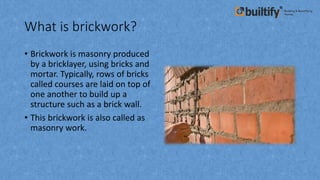
• Brickwork is masonry produced
by a bricklayer, using bricks and
mortar. Typically, rows of bricks
called courses are laid on top of
one another to build up a
structure such as a brick wall.
• This brickwork is also called as
masonry work.
Types Of Masonry
The masonry work can be divided
into 4 categories.
• Brick masonry
• Stone Masonry
• Reinforced masonry
• composite masonry
Materials used for brickwork
• brick
• sand
• cement
• water
But before that the material used for brick work should be chosen
wisely.So we are going to discuss the types of brick first as it is the main
component of brick.
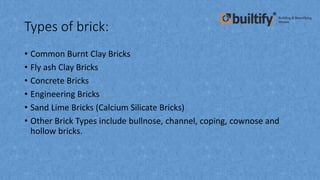
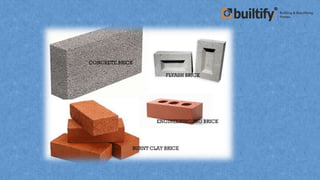
Types of brick:
• Common Burnt Clay Bricks
• Fly ash Clay Bricks
• Concrete Bricks
• Engineering Bricks
• Sand Lime Bricks (Calcium Silicate Bricks)
• Other Brick Types include bullnose, channel, coping, cownose and
hollow bricks.
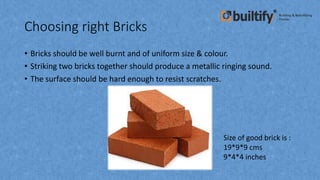
Choosing right Bricks
• Bricks should be well burnt and of uniform size & colour.
• Striking two bricks together should produce a metallic ringing sound.
• The surface should be hard enough to resist scratches.
Size of good brick is :
19*9*9 cms
9*4*4 inches
• Should not break ,if dropped from 1 m above ground level.
• Bricks must be soaked in water for a minimum of 8 hours before use;
else it will absorb moisture from mortar.
• A Good brick shouldn’t absorb more than 20% moisture by weight
.For example ,a brick weighing 2 kg should not weigh more than 2.4
kg if kept immersed in water for 24 hours.
• After choosing right brick the next process is the brick work.For
brickwork process different tools & equipment are required .
Tools & Equipment
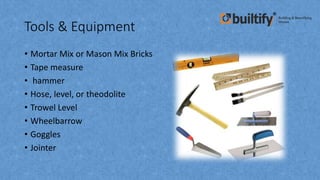
• Mortar Mix or Mason Mix Bricks
• Tape measure
• hammer
• Hose, level, or theodolite
• Trowel Level
• Wheelbarrow
• Goggles
• Jointer
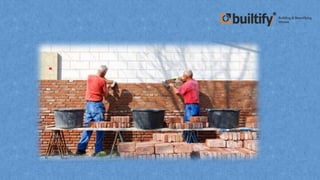
Brickwork or Masonry work:-
• A systematic bond must be maintained throughout the brickwork.
Vertical joints shouldn’t be continuous but staggered.
• Joint thickness should not exceed 1 centimetre .It should be
thoroughly filled with cement mortar 1:4 to 1:6 (by volume)
depending upon the thickness of the wall and size of sand particles.
• All bricks should be placed upon on their bed .The depression on top
provides space for the mortar to bond well. Line-string, plumb bob,
and spirit level should be used for alignment ,vertically ,and
horizontally for construction.
• Work should commence at the corners,first to a height of 3 or 4 layers
with base extending in steps.
• Joints should be raked and properly finished with a trowel or float.
• A maximum of 1 metre wall height should be constructed in a day .
• Brickwork should be properly cured for at last 10 days.
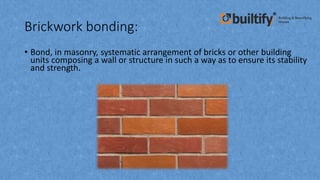
Brickwork bonding:
• Bond, in masonry, systematic arrangement of bricks or other building
units composing a wall or structure in such a way as to ensure its stability
and strength.
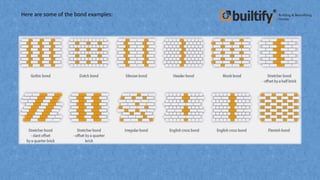
brickwork bonding types
• Stretcher Bond / Running Bond
• Header Bond
• English Bond
• Flemish Bond
• Stack Bond
• Dutch Bond
• Common Bond / American Bond
• Diagonal Bond
Here are some of the bond examples:
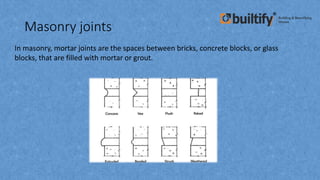
Masonry joints
In masonry, mortar joints are the spaces between bricks, concrete blocks, or glass
blocks, that are filled with mortar or grout.
Recommended mortar proportion for brick work:
• 4” central partition wall 1:4 (1 part cement & 4 parts sand by volume)
• 9” exterior wall 1:6 (1 part cement and 6 parts sand by volume)
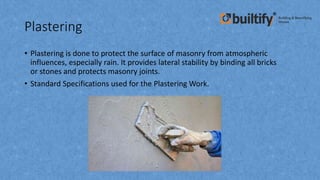
Plastering
• Plastering is done to protect the surface of masonry from atmospheric
influences, especially rain. It provides lateral stability by binding all bricks
or stones and protects masonry joints.
• Standard Specifications used for the Plastering Work.
Standard Specifications used for the Plastering
Work.
There are Indian standards which need to be followed during plastering work:
• Indian Standard (BIS codes)
• IS 383 Specification for coarse and fine aggregates for natural sources for
concrete.
• IS 1542 Specifications for sand for plaster
• IS 2645 Specifications for integral cement waterproofing compound
• IS 8112 Specification for 43 grade OPC
• IS 269 Specification for 33 grade OPC
• IS 1489 Specification for Portland Pozzolana Cement
Procedure of Plastering Work:-
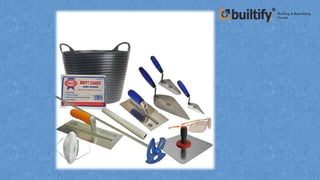
• For preparing the plaster work first arrange the tools required for
plaster:
• Trowel-A trowel is an important plastering tool that allows you to
smooth the plaster after applying it to the wall.
• Hawk-A hawk is used by the professionals to carry the plaster with
them as they move down the wall.
• Mud Pan-A mud pan can be used instead of a hawk for the less
experienced plasterer.
• Sponge/Sandpaper-To clean the wall for plastering
• Jointing Knife-A utility knife or scissors will help cut plaster tape to
size. The utility knife is employed to square out the edge of the hole
to be plastered over if repairing damaged walls.
• Step Ladder-to reach the height
• Bucket-for water
Preparation of surface for plastering:
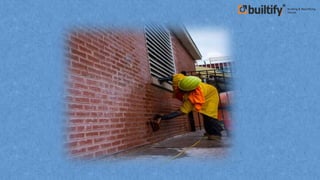
• First clean the surface perfectly ,remove any debris or extra mortar is there.
• Then roughen the wall so that the mortar can adhere with the brick masonry
perfectly.
• If there is any hole then fill it with appropriate material before plastering.
• Before plastering cure the wall perfectly at least 6 hours before.
Process of plastering work:
• After this prepare the mortar mix
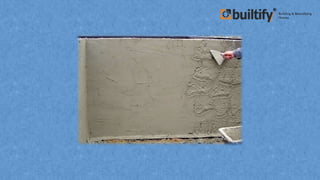
• Then put dots on the wall to make sure even layering of plasters on
the wall.
• These dots are patch of plasters.
• Then put the first layer of plaster coat on wall & then second layer.
• Then level the surface by flat wooden edges.
Points to remember :-
• Remove loose mortar from joints and moisten the surface before
plastering.
• And remove loose mortar from joints and moisten the surface before
plastering.
• Use a 1:4 ratio mortar of cement and fine sand. For coarse sand, the
ratio can be changed to 1:4 mix is preferred for best results.
• Ensure that the entire mix for the day is not prepared at one go.
• It is advisable to use the prepared mix within 1 hour. However,you can prepare
and keep the dry mix ready.
• Ensure that the dry mix is uniform in colour before adding water.
• Use chicken wire mesh while plastering joints between concrete work &
brickwork.
• Use a wooden float for finishing rather than steel float.
• Ensure continuous curing for 10 to 14 days.
Types of plaster finshes
• Smooth cast finish
• Rough cast finish
• Sand faced finish
• Pebble dash finish
• Scrapped finish
• Depeter finish
• Textured finish
Thank You

Brickwork and plastering

  • 1.
    Brick work &Plastering By builtify
  • 2.
    What is brickwork? •Brickwork is masonry produced by a bricklayer, using bricks and mortar. Typically, rows of bricks called courses are laid on top of one another to build up a structure such as a brick wall. • This brickwork is also called as masonry work.
  • 3.
    Types Of Masonry Themasonry work can be divided into 4 categories. • Brick masonry • Stone Masonry • Reinforced masonry • composite masonry
  • 4.
    Materials used forbrickwork • brick • sand • cement • water But before that the material used for brick work should be chosen wisely.So we are going to discuss the types of brick first as it is the main component of brick.
  • 5.
    Types of brick: •Common Burnt Clay Bricks • Fly ash Clay Bricks • Concrete Bricks • Engineering Bricks • Sand Lime Bricks (Calcium Silicate Bricks) • Other Brick Types include bullnose, channel, coping, cownose and hollow bricks.
  • 7.
    Choosing right Bricks •Bricks should be well burnt and of uniform size & colour. • Striking two bricks together should produce a metallic ringing sound. • The surface should be hard enough to resist scratches. Size of good brick is : 19*9*9 cms 9*4*4 inches
  • 8.
    • Should notbreak ,if dropped from 1 m above ground level. • Bricks must be soaked in water for a minimum of 8 hours before use; else it will absorb moisture from mortar. • A Good brick shouldn’t absorb more than 20% moisture by weight .For example ,a brick weighing 2 kg should not weigh more than 2.4 kg if kept immersed in water for 24 hours. • After choosing right brick the next process is the brick work.For brickwork process different tools & equipment are required .
  • 9.
    Tools & Equipment •Mortar Mix or Mason Mix Bricks • Tape measure • hammer • Hose, level, or theodolite • Trowel Level • Wheelbarrow • Goggles • Jointer
  • 10.
    Brickwork or Masonrywork:- • A systematic bond must be maintained throughout the brickwork. Vertical joints shouldn’t be continuous but staggered. • Joint thickness should not exceed 1 centimetre .It should be thoroughly filled with cement mortar 1:4 to 1:6 (by volume) depending upon the thickness of the wall and size of sand particles.
  • 11.
    • All bricksshould be placed upon on their bed .The depression on top provides space for the mortar to bond well. Line-string, plumb bob, and spirit level should be used for alignment ,vertically ,and horizontally for construction. • Work should commence at the corners,first to a height of 3 or 4 layers with base extending in steps. • Joints should be raked and properly finished with a trowel or float. • A maximum of 1 metre wall height should be constructed in a day . • Brickwork should be properly cured for at last 10 days.
  • 13.
    Brickwork bonding: • Bond,in masonry, systematic arrangement of bricks or other building units composing a wall or structure in such a way as to ensure its stability and strength.
  • 14.
    brickwork bonding types •Stretcher Bond / Running Bond • Header Bond • English Bond • Flemish Bond • Stack Bond • Dutch Bond • Common Bond / American Bond • Diagonal Bond
  • 15.
    Here are someof the bond examples:
  • 16.
    Masonry joints In masonry,mortar joints are the spaces between bricks, concrete blocks, or glass blocks, that are filled with mortar or grout.
  • 17.
    Recommended mortar proportionfor brick work: • 4” central partition wall 1:4 (1 part cement & 4 parts sand by volume) • 9” exterior wall 1:6 (1 part cement and 6 parts sand by volume)
  • 18.
    Plastering • Plastering isdone to protect the surface of masonry from atmospheric influences, especially rain. It provides lateral stability by binding all bricks or stones and protects masonry joints. • Standard Specifications used for the Plastering Work.
  • 19.
    Standard Specifications usedfor the Plastering Work. There are Indian standards which need to be followed during plastering work: • Indian Standard (BIS codes) • IS 383 Specification for coarse and fine aggregates for natural sources for concrete. • IS 1542 Specifications for sand for plaster • IS 2645 Specifications for integral cement waterproofing compound • IS 8112 Specification for 43 grade OPC • IS 269 Specification for 33 grade OPC • IS 1489 Specification for Portland Pozzolana Cement
  • 20.
    Procedure of PlasteringWork:- • For preparing the plaster work first arrange the tools required for plaster: • Trowel-A trowel is an important plastering tool that allows you to smooth the plaster after applying it to the wall. • Hawk-A hawk is used by the professionals to carry the plaster with them as they move down the wall.
  • 21.
    • Mud Pan-Amud pan can be used instead of a hawk for the less experienced plasterer. • Sponge/Sandpaper-To clean the wall for plastering • Jointing Knife-A utility knife or scissors will help cut plaster tape to size. The utility knife is employed to square out the edge of the hole to be plastered over if repairing damaged walls. • Step Ladder-to reach the height • Bucket-for water
  • 23.
    Preparation of surfacefor plastering: • First clean the surface perfectly ,remove any debris or extra mortar is there. • Then roughen the wall so that the mortar can adhere with the brick masonry perfectly. • If there is any hole then fill it with appropriate material before plastering. • Before plastering cure the wall perfectly at least 6 hours before.
  • 25.
    Process of plasteringwork: • After this prepare the mortar mix • Then put dots on the wall to make sure even layering of plasters on the wall. • These dots are patch of plasters. • Then put the first layer of plaster coat on wall & then second layer. • Then level the surface by flat wooden edges.
  • 27.
    Points to remember:- • Remove loose mortar from joints and moisten the surface before plastering. • And remove loose mortar from joints and moisten the surface before plastering. • Use a 1:4 ratio mortar of cement and fine sand. For coarse sand, the ratio can be changed to 1:4 mix is preferred for best results.
  • 28.
    • Ensure thatthe entire mix for the day is not prepared at one go. • It is advisable to use the prepared mix within 1 hour. However,you can prepare and keep the dry mix ready. • Ensure that the dry mix is uniform in colour before adding water. • Use chicken wire mesh while plastering joints between concrete work & brickwork. • Use a wooden float for finishing rather than steel float. • Ensure continuous curing for 10 to 14 days.
  • 29.
    Types of plasterfinshes • Smooth cast finish • Rough cast finish • Sand faced finish • Pebble dash finish • Scrapped finish • Depeter finish • Textured finish
  • 30.