This document classifies costs in several ways:
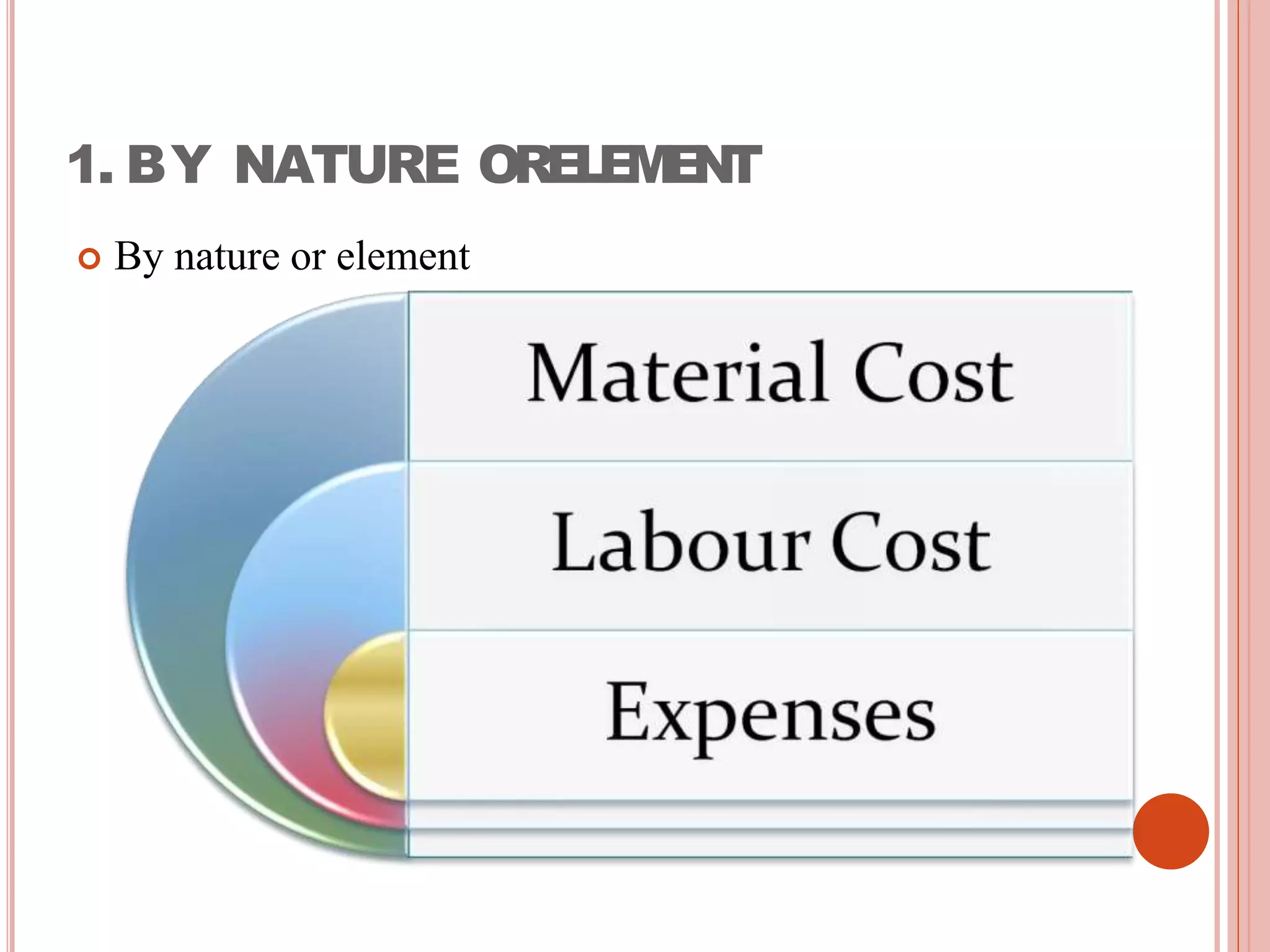
1. By nature - material, labor, expenses
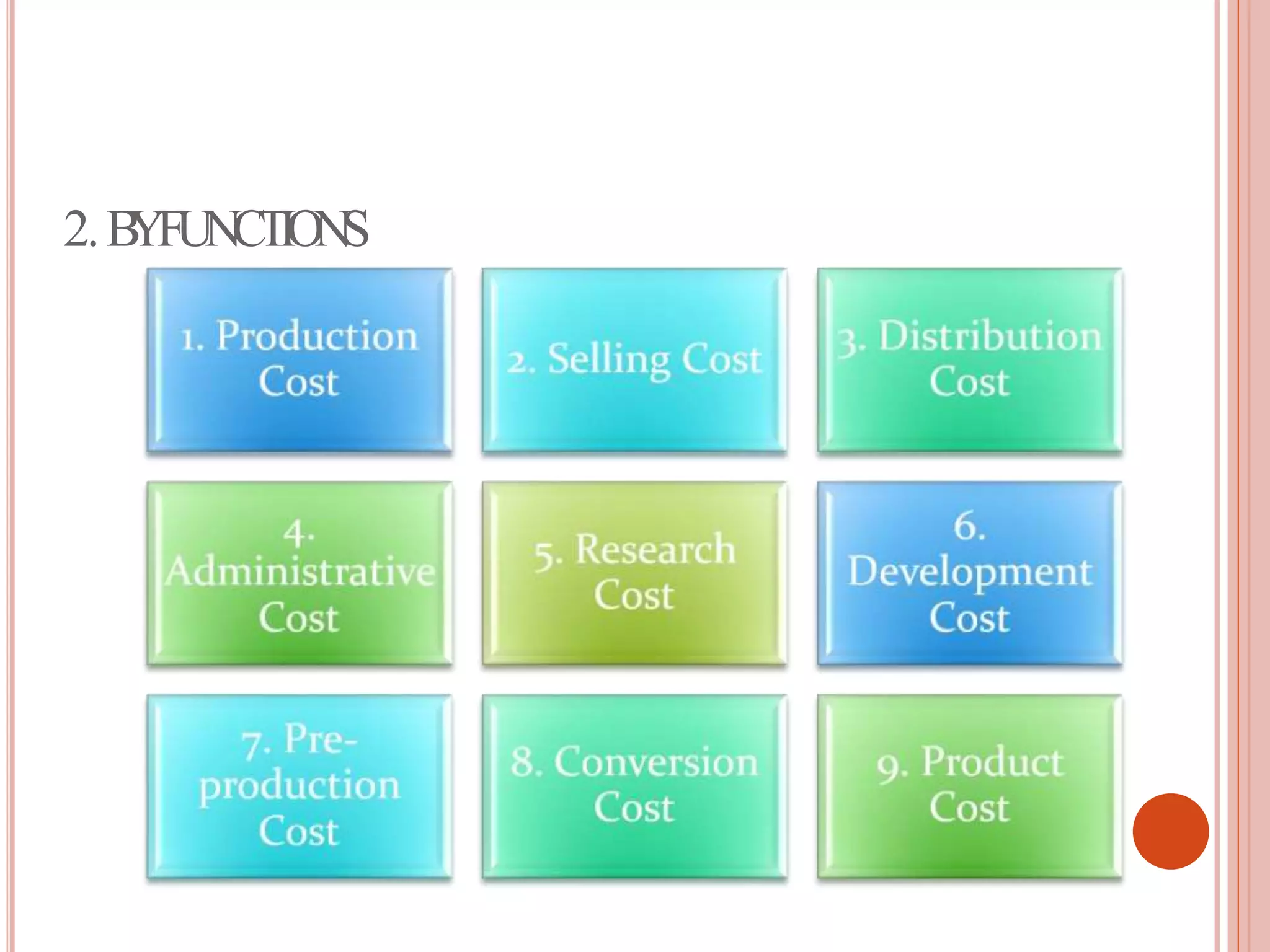
2. By function - production, selling, distribution, administrative
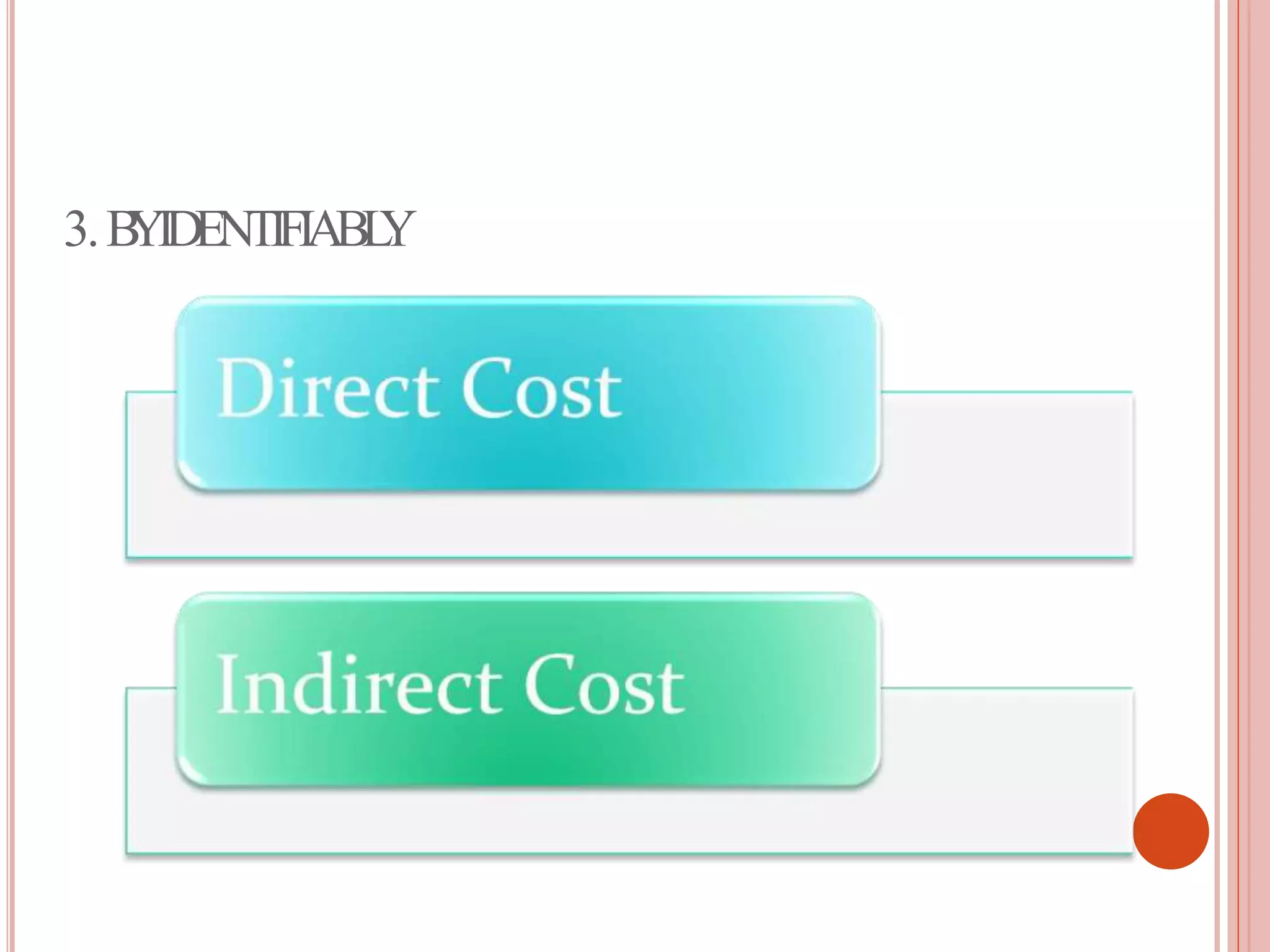
3. By identifiability - direct, indirect
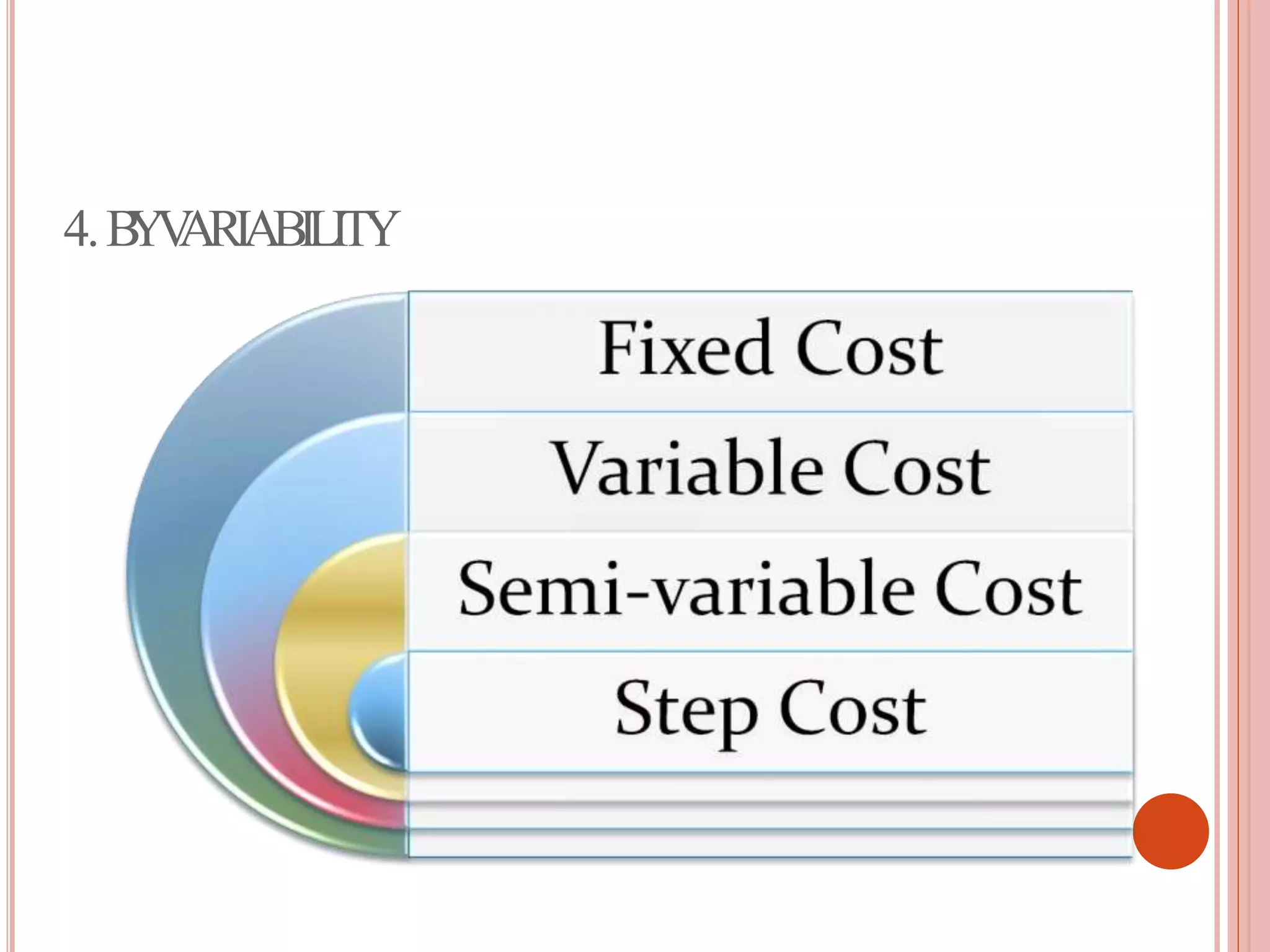
4. By variability - fixed, variable, semi-variable, step
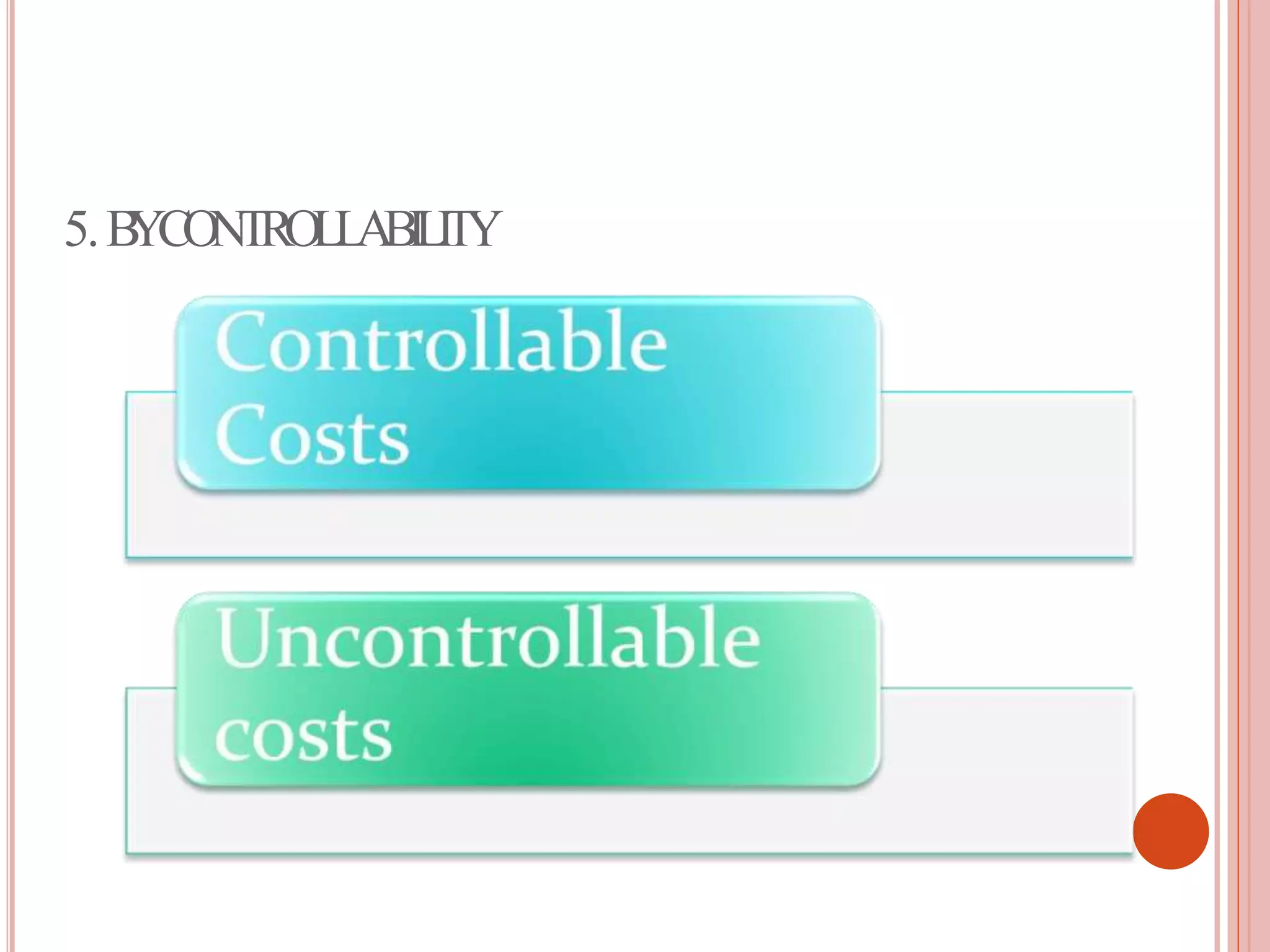
5. By controllability - controllable, uncontrollable
It also discusses other cost classifications such as product vs period costs, relevant vs irrelevant costs, normal vs abnormal costs, and more. The document provides definitions and examples for each cost classification.
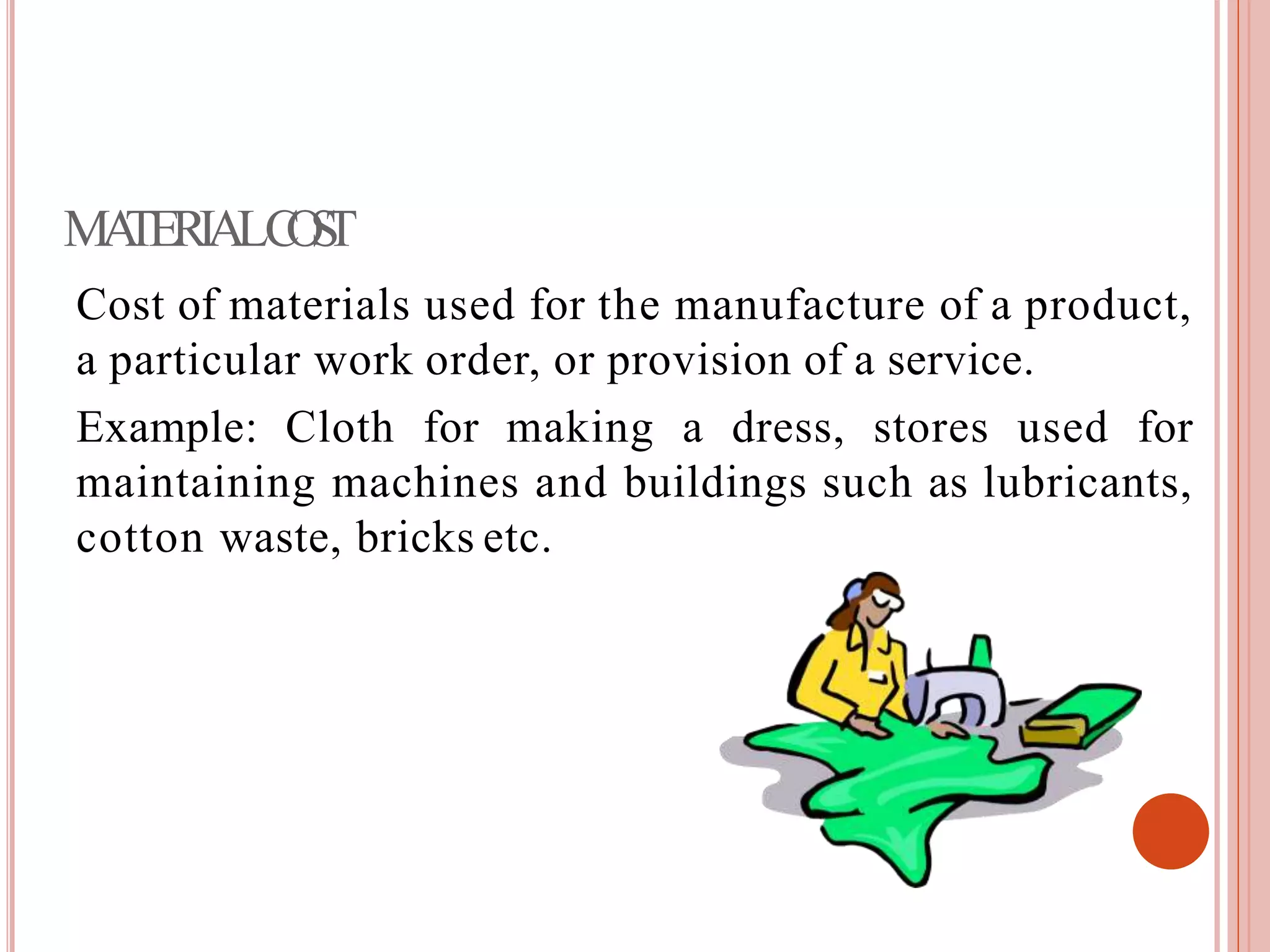
MATERIALCOST
Cost of materialsused for the manufacture of a product,
a particular work order, or provision of a service.
Example: Cloth for making a dress, stores used for
maintaining machines and buildings such as lubricants,
cotton waste, bricks etc.
4.
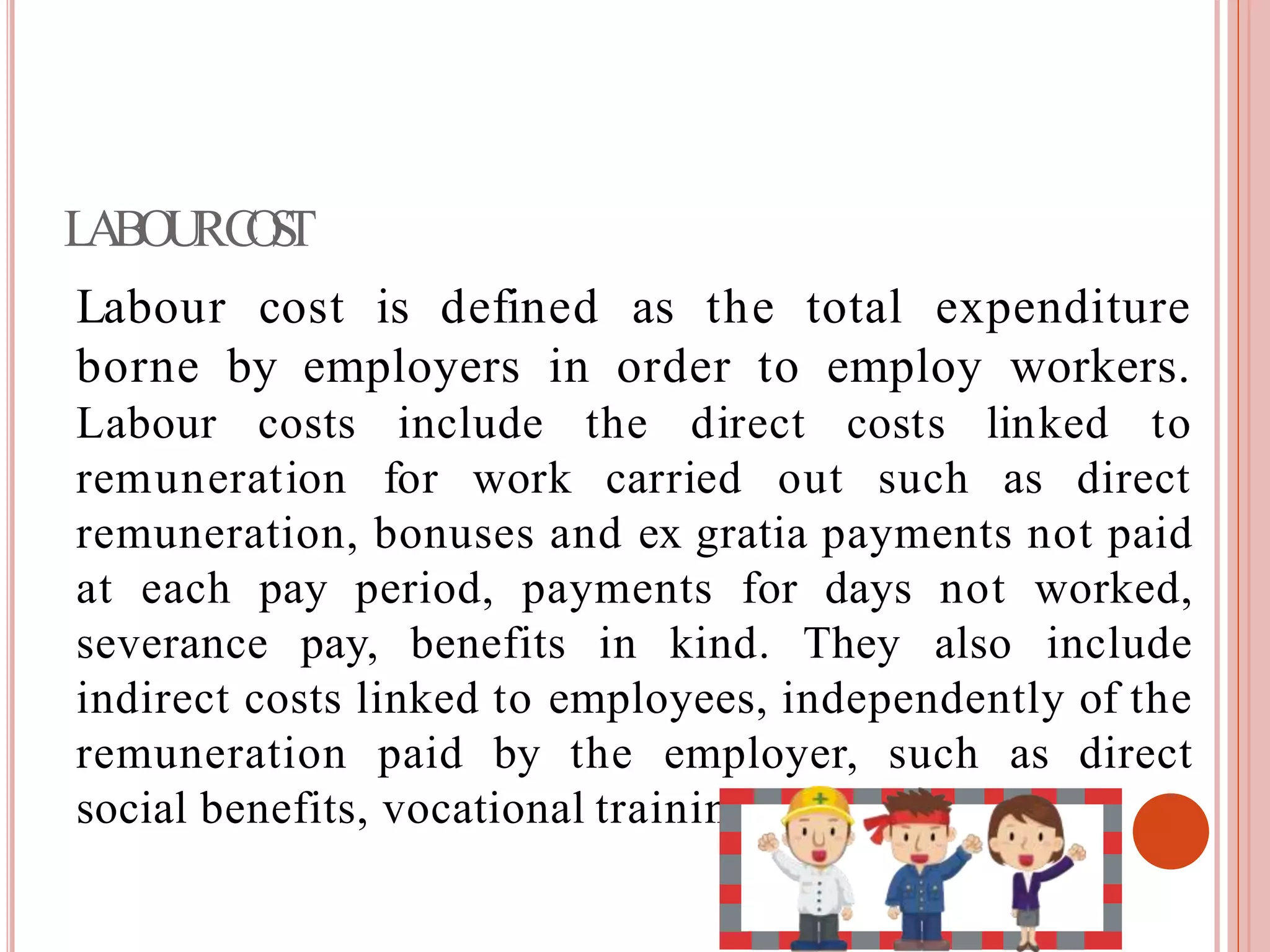
LABOURCOST
Labour cost isdefined as the total expenditure
borne by employers in order to employ workers.
direct costs linked toLabour costs include the
remuneration for work carried out such as direct
remuneration, bonuses and ex gratia payments not paid
at each pay period, payments for days not worked,
severance pay, benefits in kind. They also include
indirect costs linked to employees, independently of the
remuneration paid by the employer, such as direct
social benefits, vocational training costs and soon.
5.
EXPENSES
Expense is definedas money expended or cost incurred
in a firm's efforts to generate revenue, representing cost
of doing business. They may be in the form of actual
cash payments (such as wages and salaries), a computed
'expired' portion (depreciation) of an asset, or an
amount taken out of the firm's earnings (such as bad
debts).
Whereas all expenses are costs, not all costs (such as
those incurred in acquisition of income generating
assets) are expenses.
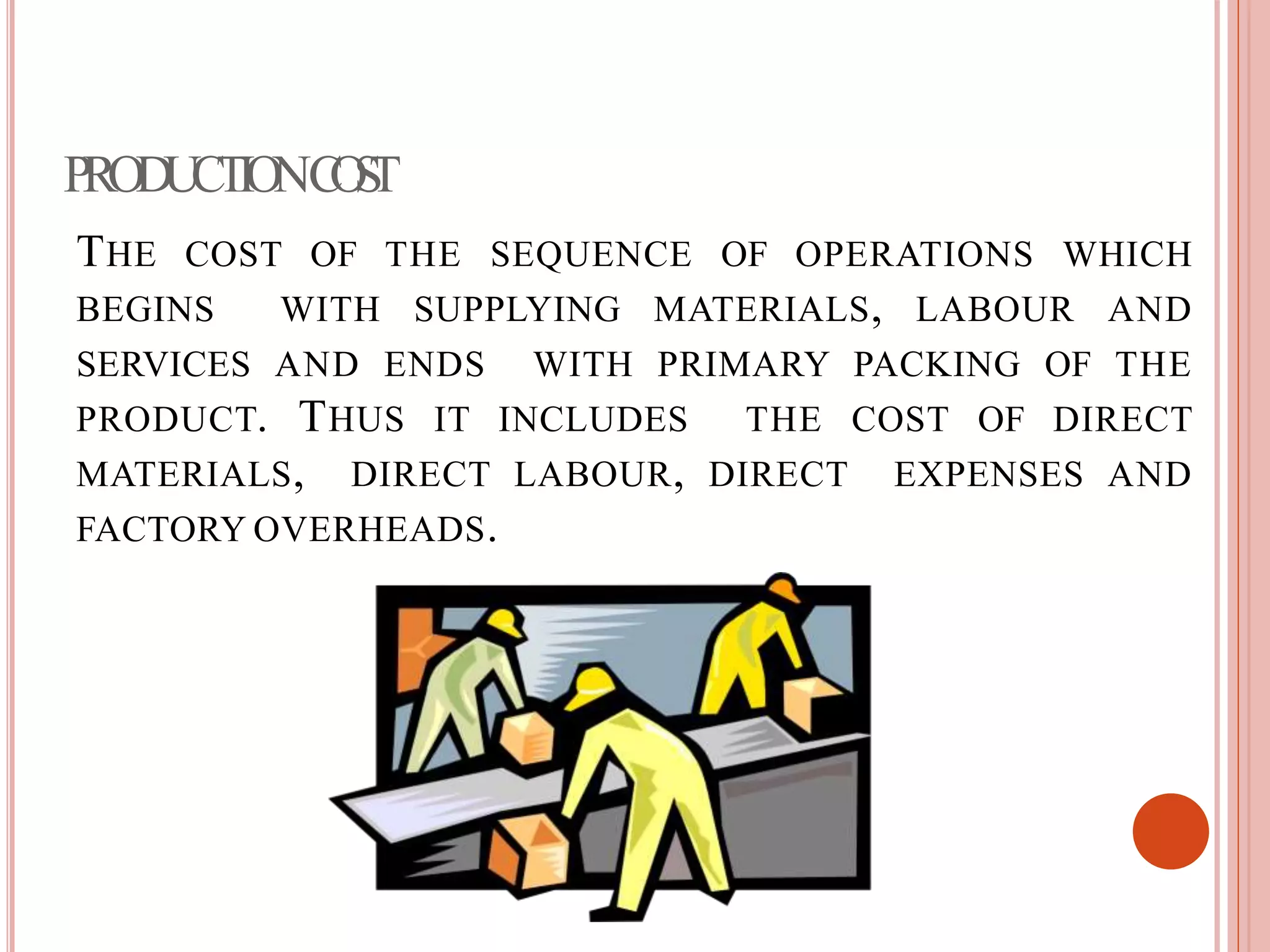
PRODUCTIONCOST
THE COST OFTHE SEQUENCE OF OPERATIONS WHICH
BEGINS WITH SUPPLYING MATERIALS, LABOUR AND
SERVICES AND ENDS WITH PRIMARY PACKING OF THE
PRODUCT. THUS IT INCLUDES THE COST OF DIRECT
MATERIALS, DIRECT LABOUR, DIRECT EXPENSES AND
FACTORY OVERHEADS.
8.
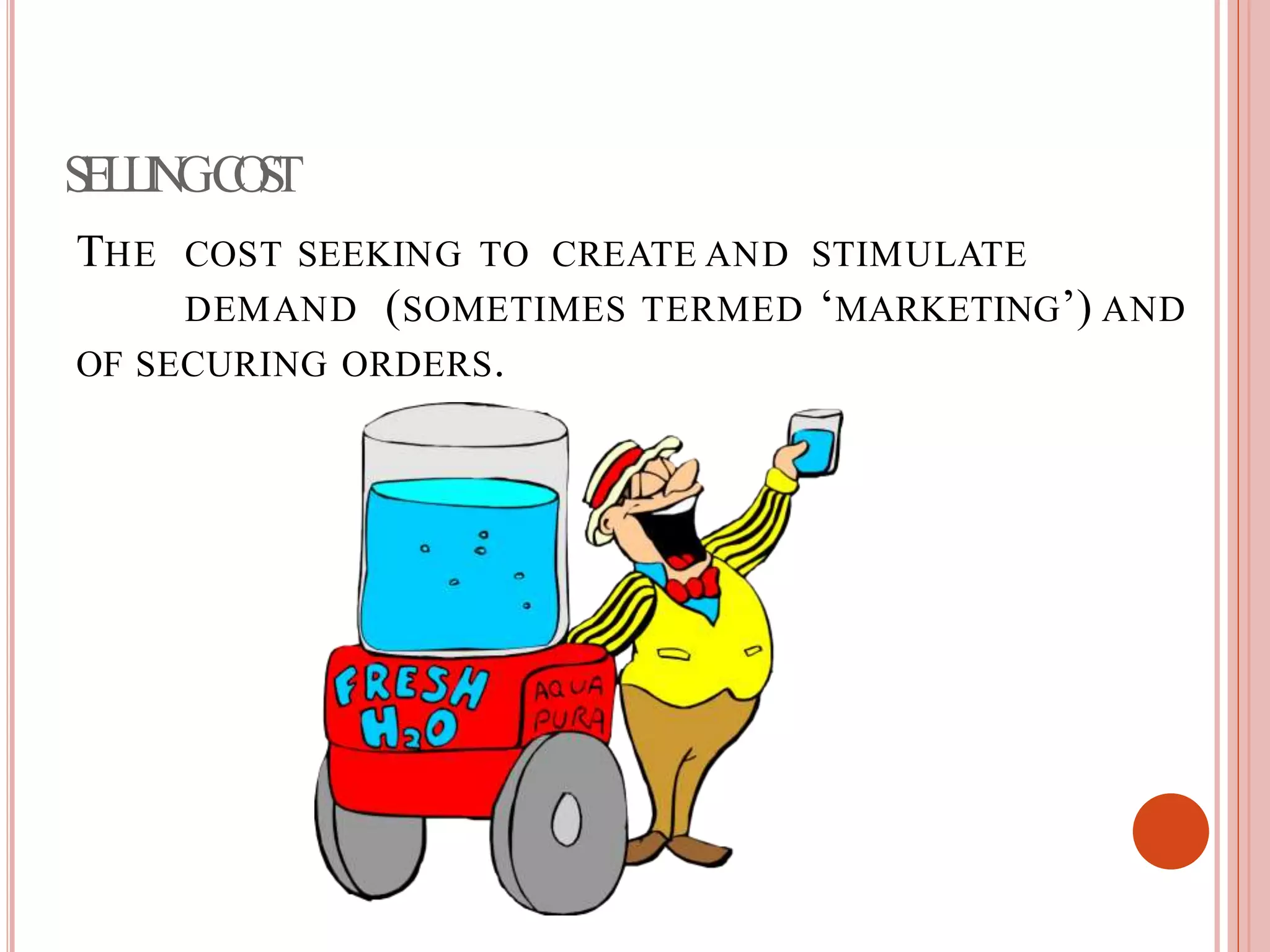
SELLINGCOST
THE COST SEEKINGTO CREATE AND STIMULATE
DEMAND (SOMETIMES TERMED ‘MARKETING’) AND
OF SECURING ORDERS.
9.
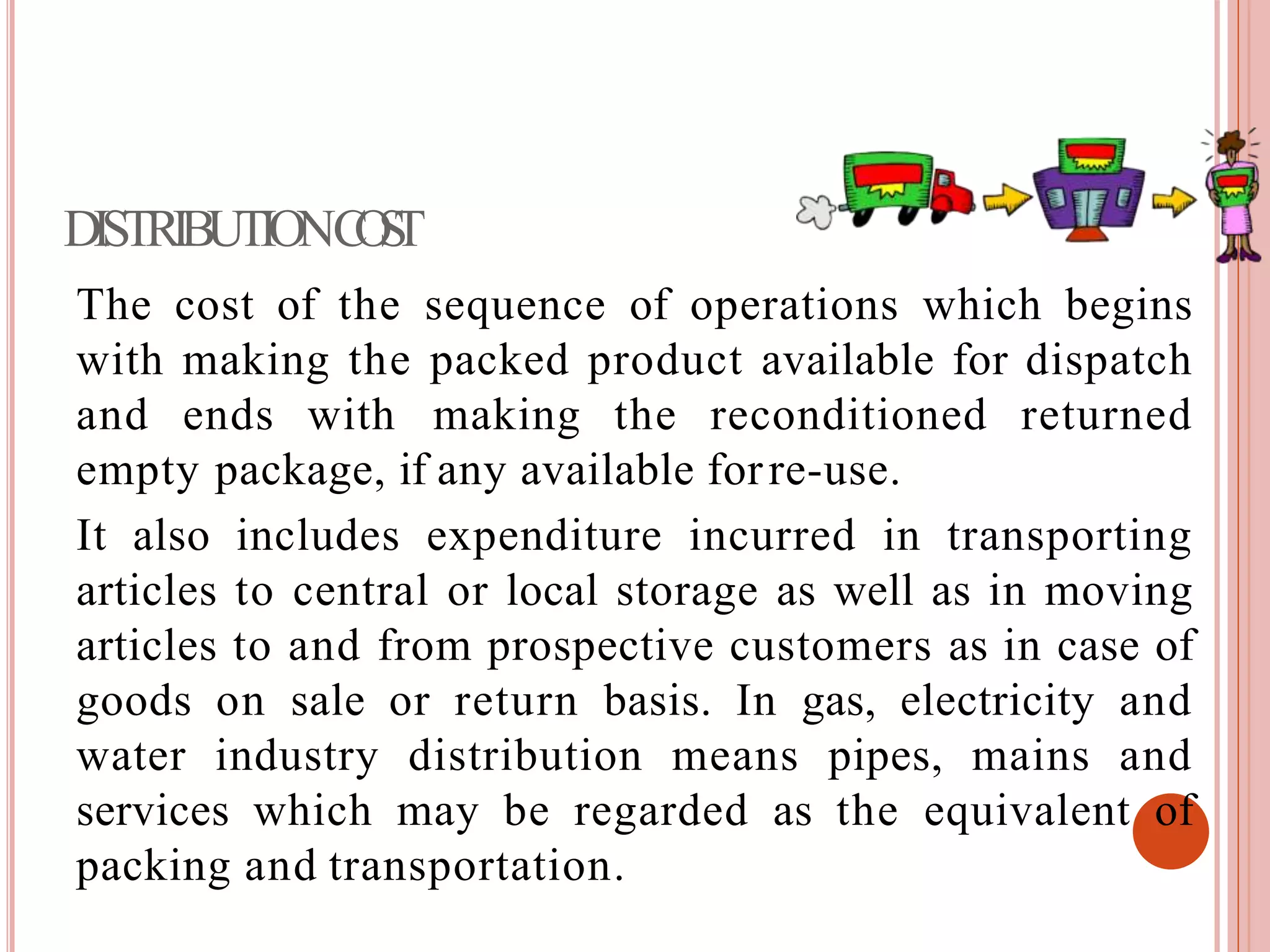
DISTRIBUTIONCOST
The cost ofthe sequence of operations which begins
with making the packed product available for dispatch
and ends with making the reconditioned returned
empty package, if any available forre-use.
It also includes expenditure incurred in transporting
articles to central or local storage as well as in moving
articles to and from prospective customers as in case of
goods on sale or return basis. In gas, electricity and
water industry distribution means pipes, mains and
services which may be regarded as the equivalent of
packing and transportation.
10.
ADMINISTRATIVECOST
The cost offormulating the policy, directing the
and controlling the operationsorganization
undertaking
production,
which
selling
is not
& distribution, research
of an
related directly to a
or
development activity or function.
11.
RESEARCHCOST
THE COST OFRESEARCHING FOR NEW OR IMPROVED
PRODUCTS, NEW APPLICATIONS OF MATERIALS, OR
IMPROVEDMETHODS.
12.
DEVELOPMENTCOST
The cost ofthe process which
implementation of a decision to
begins with the
produce a new or
improved product or to employ a new or improved
formalmethod and ends with commencement of
production of that product or by that method.
13.
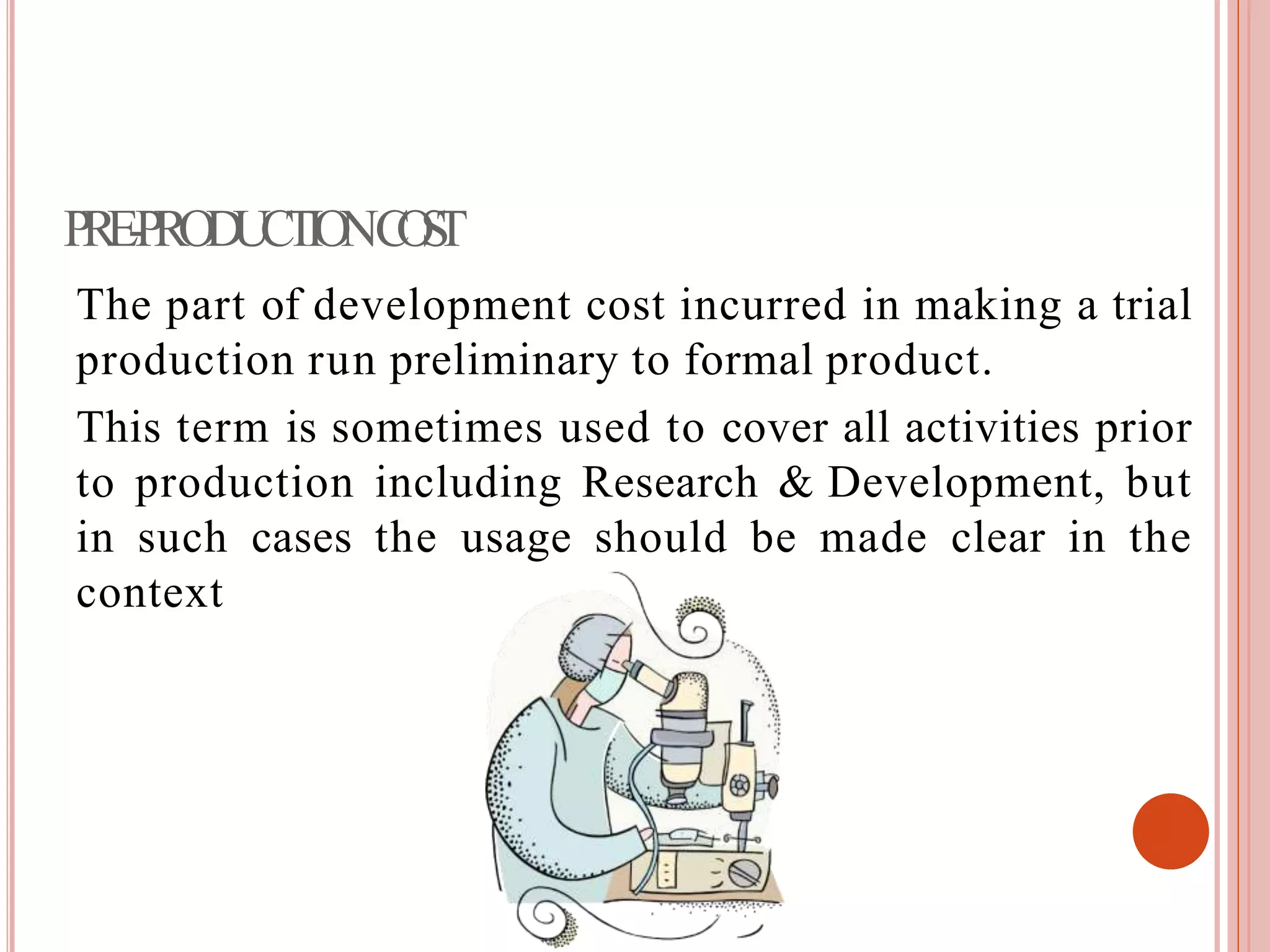
PRE-PRODUCTIONCOST
The part ofdevelopment cost incurred in making a trial
production run preliminary to formal product.
This term is sometimes used to cover all activities prior
to production including Research & Development, but
in such cases the usage should be made clear in the
context
14.
CONVERSIONCOST
The sum ofdirect wages, direct expenses and overhead
cost of converting raw materials to the finished stage or
converting a material from one stage of production to
the next.
In some cases this also includes any excess material cost
or loss of material incurred at the particular stage of
production.
15.
PRODUCTCOST
THESE ARE INVENTORIABLECOST. THESE ARE THE COSTS
WHICH ARE ASSIGNED TO THE PRODUCT. UNDER
MARGINAL COSTING VARIABLE MANUFACTURING COST
AND UNDER ABSORPTION COSTING, TOTAL
MANUFACTURING COST CONSTITUTES PRODUCT COST.
DIRECTCOST
The expenses onmaterial and labour economically and
considered as direct costs. In the process
easily traceable to a product, service or job are
of
manufacture or production of articles, materials are
purchased, labourers are employed and the wages are
paid to them, certain other expenses are also incurred
directly. Since all these take an active and direct part in
the manufacture of a particular commodity, hence are
called direct costs.
WITH EX:
18.
INDIRECTCOST
The expenses incurredon those items which are not
directly chargeable to production are known as indirect
costs. Example: In production, salaries of timekeepers,
storekeepers, foremen are paid, certain expenses for
running the administration are incurred. All of these
cannot be conveniently allocated to production and
hence are called indirect costs.
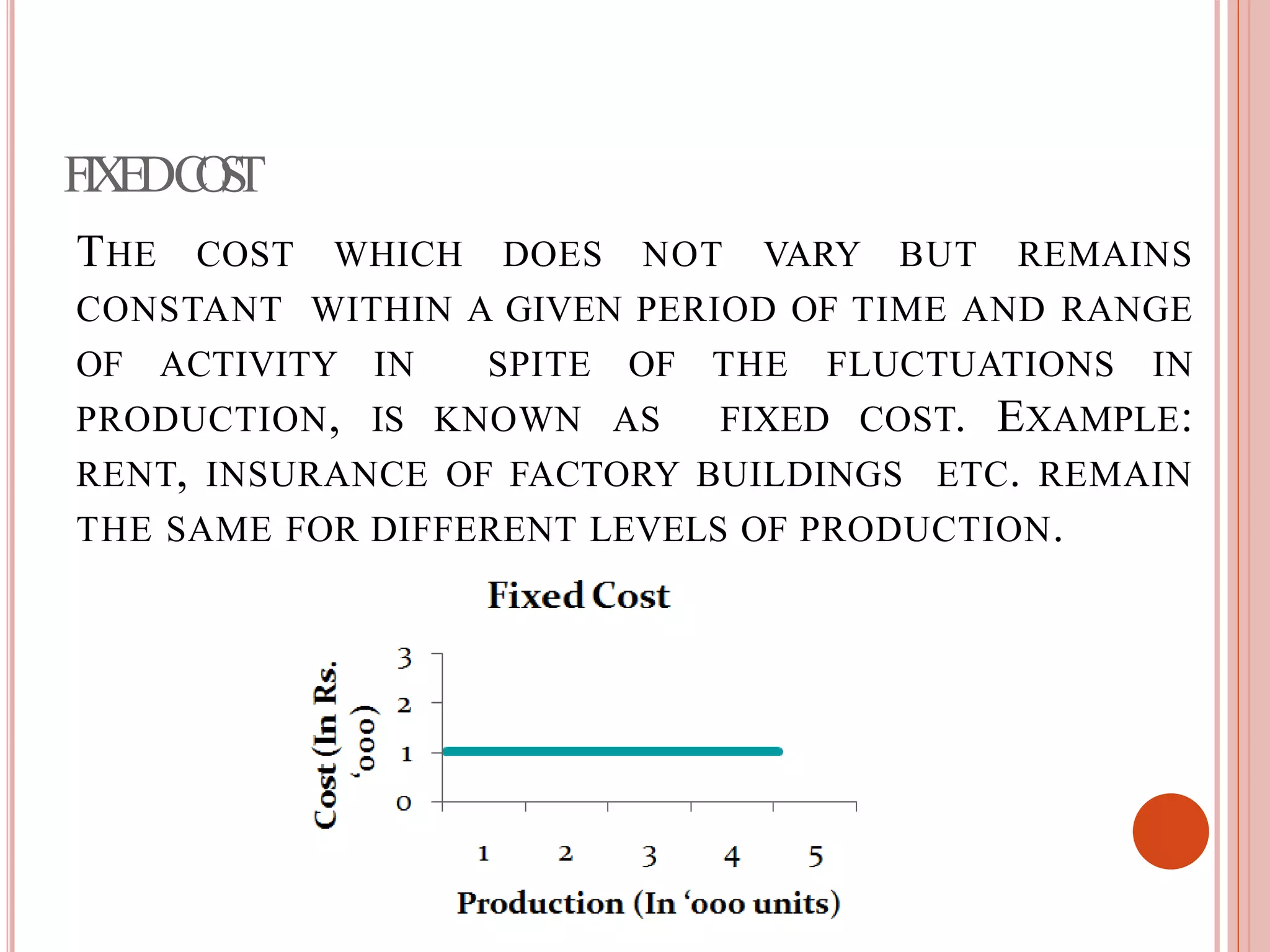
FIXEDCOST
THE COST WHICHDOES NOT VARY BUT REMAINS
CONSTANT WITHIN A GIVEN PERIOD OF TIME AND RANGE
OF ACTIVITY IN SPITE OF THE FLUCTUATIONS IN
PRODUCTION, IS KNOWN AS FIXED COST. EXAMPLE:
RENT, INSURANCE OF FACTORY BUILDINGS ETC. REMAIN
THE SAME FOR DIFFERENT LEVELS OF PRODUCTION.
21.
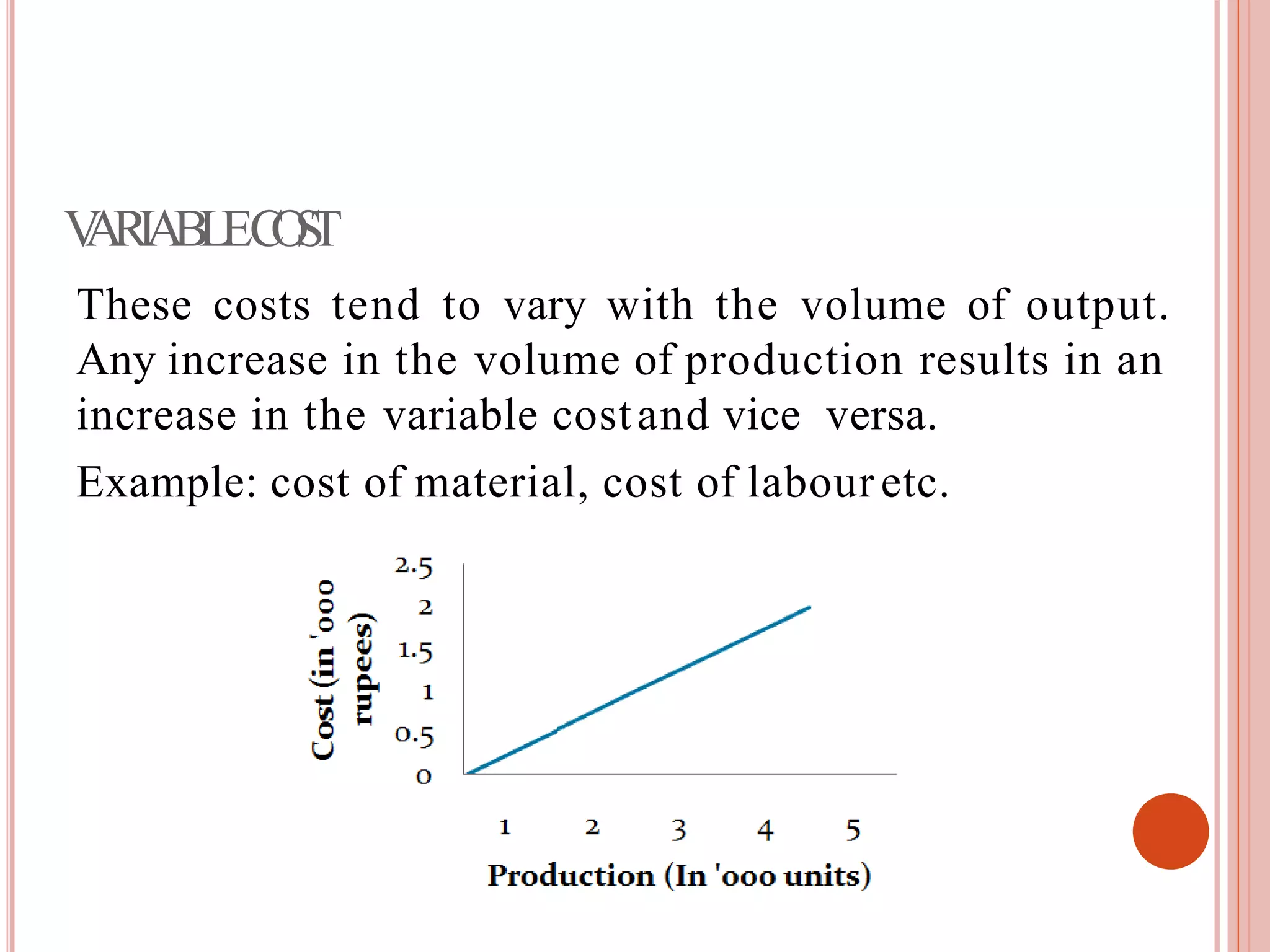
VARIABLECOST
These costs tendto vary with the volume of output.
Any increase in the volume of production results in an
increase in the variable costand vice versa.
Example: cost of material, cost of labouretc.
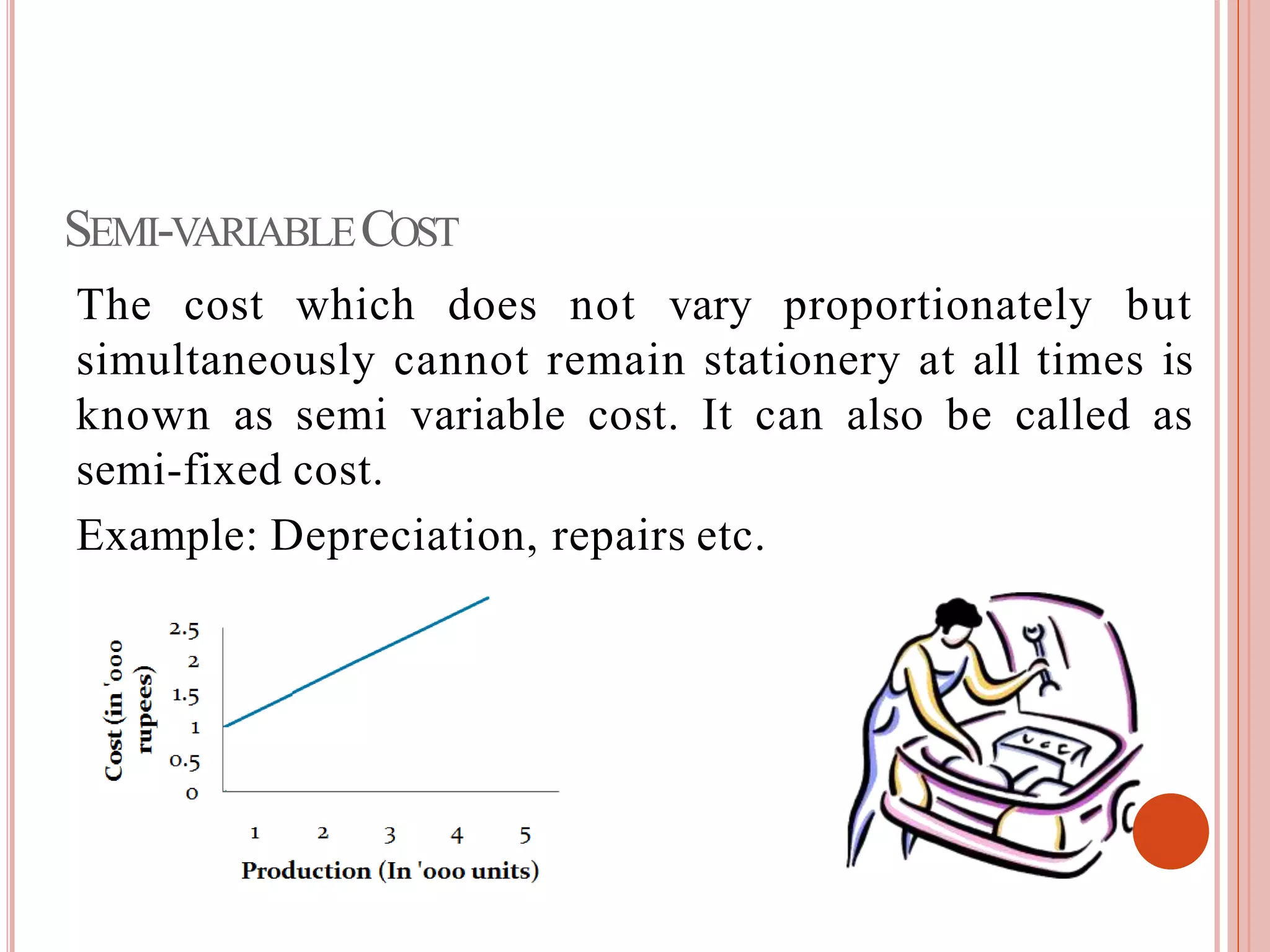
22.
SEMI-VARIABLECOST
The cost whichdoes not vary proportionately but
simultaneously cannot remain stationery at all times is
known as semi variable cost. It can also be called as
semi-fixed cost.
Example: Depreciation, repairs etc.
23.
STEPCOSTS
Fixed cost canbe further classified into committed fixed
costs and discretionary fixedcosts.
Committed fixed costs are unavoidable in the short
term if the organization has to function. Examples are
depreciation, rent, pay etc,
Discretionary fixed costs are those which are set at a
fixed amount for specific time periods by management .
Examples are research and development costs,
advertisement and market researchexpenses
24.
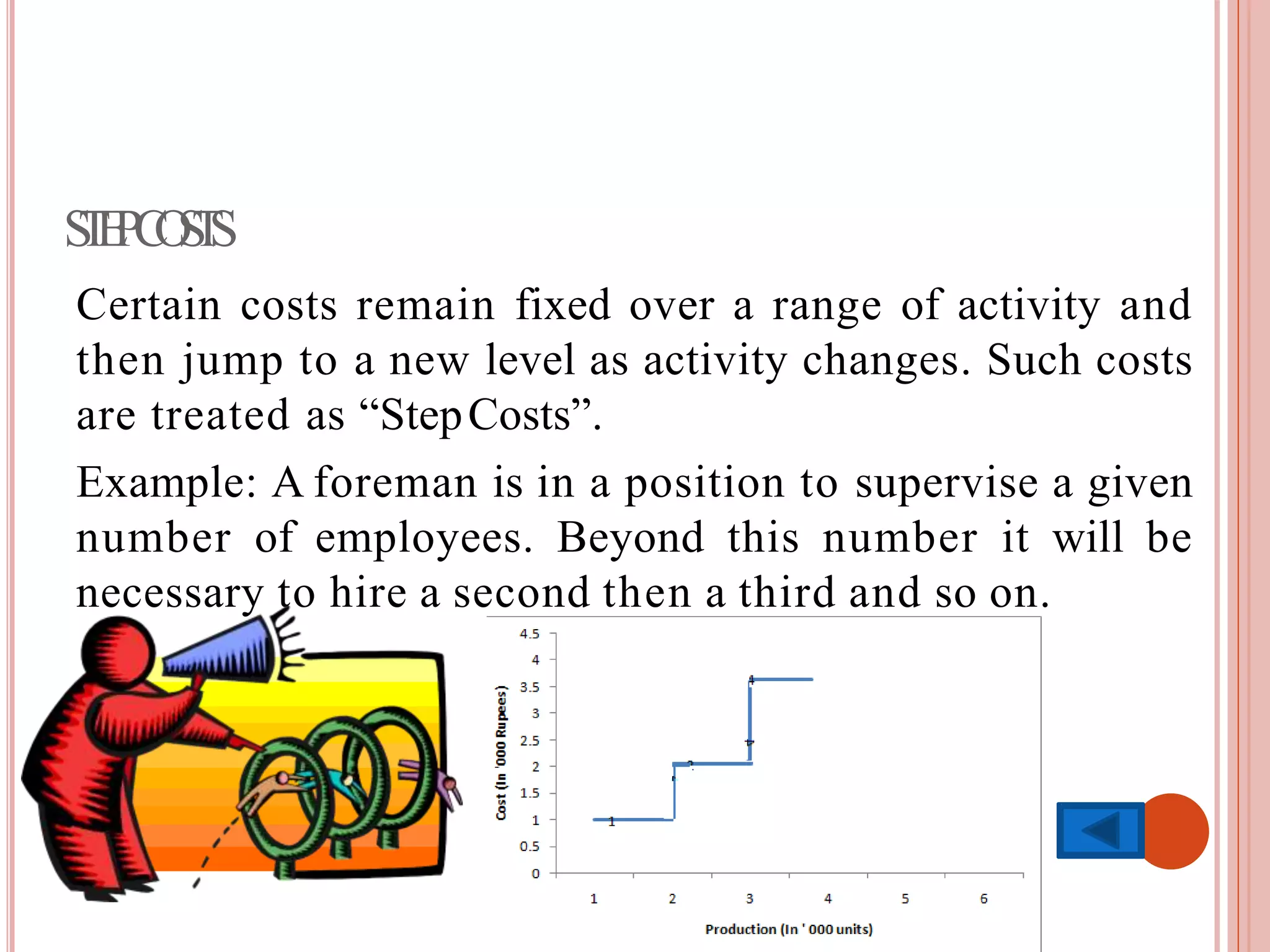
STEPCOSTS
Certain costs remainfixed over a range of activity and
then jump to a new level as activity changes. Such costs
are treated as “StepCosts”.
Example: A foreman is in a position to supervise a given
number of employees. Beyond this number it will be
necessary to hire a second then a third and so on.
CONTROLLABLECOSTS
THESE ARE THECOSTS WHICH CAN BE INFLUENCED BY
THE ACTION OF A SPECIFIED MEMBER OF AN
UNDERTAKING. A BUSINESS ORGANIZATION IS USUALLY
DIVIDED INTO A NUMBER OF RESPONSIBILITY CENTRES
AND EACH CENTRE IS HEADED BY AN EXECUTIVE. THE
EXECUTIVE CAN THUS CONTROL THE COSTS INCURRED
IN THAT PARTICULAR RESPONSIBILITY CENTRE.
27.
UNCONTROLLABLECOSTS
Costs which cannotbe influenced by the action of a
specified member of an undertaking.
Example: Expenditure incurred by the tool room is
controllable by the foreman in charge of that section
but the share of the tool room expenditure which is
apportioned to a machine shop is not to be controlled
by the machine shop foreman
.
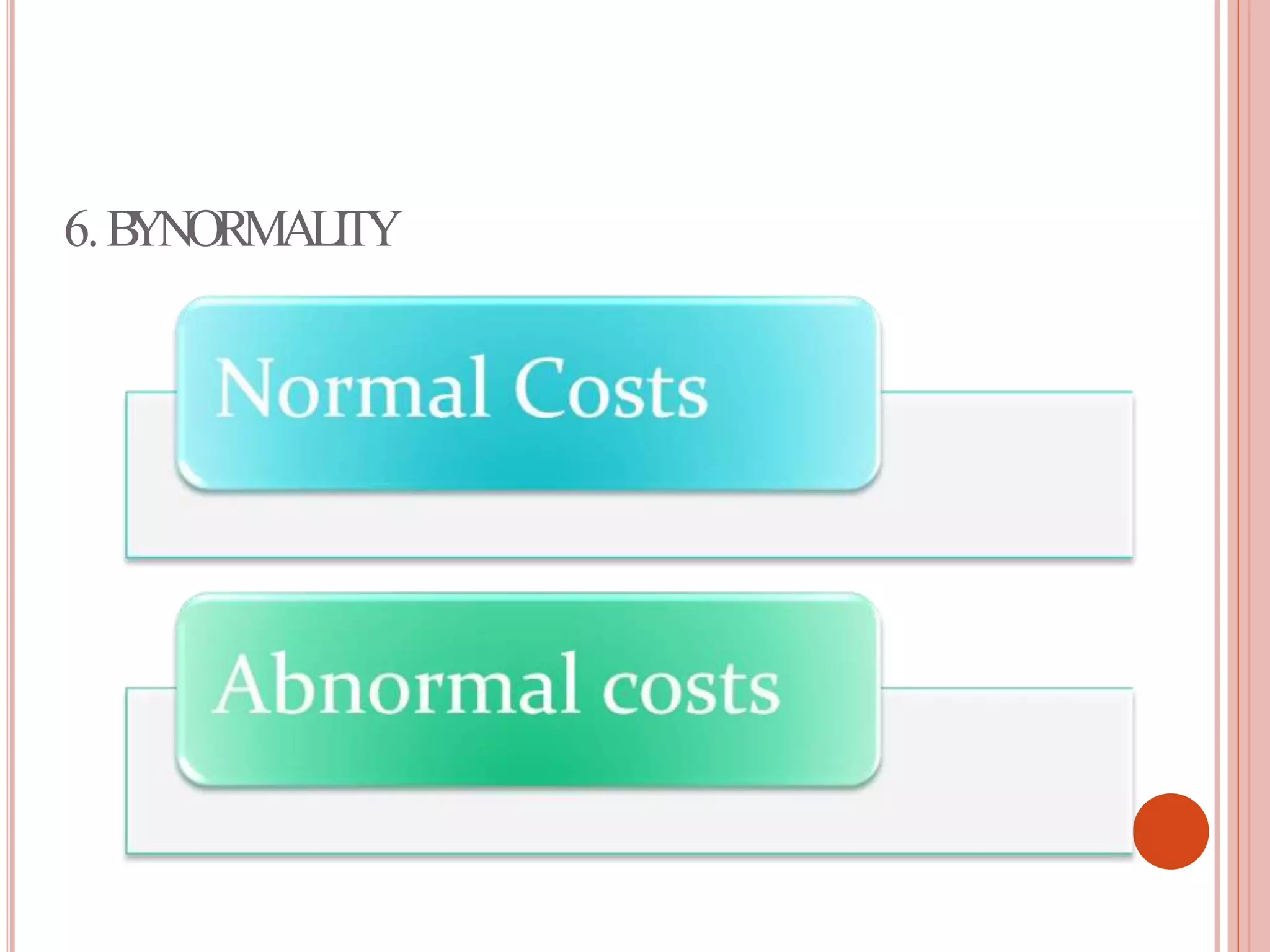
NORMALCOSTS
It is thecost which is normally incurred at a given level
of output under the conditions in which that level of
output is normally attained.
ABNORMALCOSTS
It is the cost which is not normally incurred at a given
level of output in the conditions in which that level of
output is normally attained.
30.
7.OTHERCOSTS
Product Costsand Period Costs
Decision making Costs and Accounting Costs
Relevant and IrrelevantCosts
Shutdown and SunkCosts
Avoidable / Escapable and Unavoidable / Inescapable
Imputed orHypothetical Costs
Differential, Incremental or Decremental Cost
O u t of Pocket Costs
Opportunity Cost
Traceable, Untraceable Costs
Joint Costs and Common Costs
31.
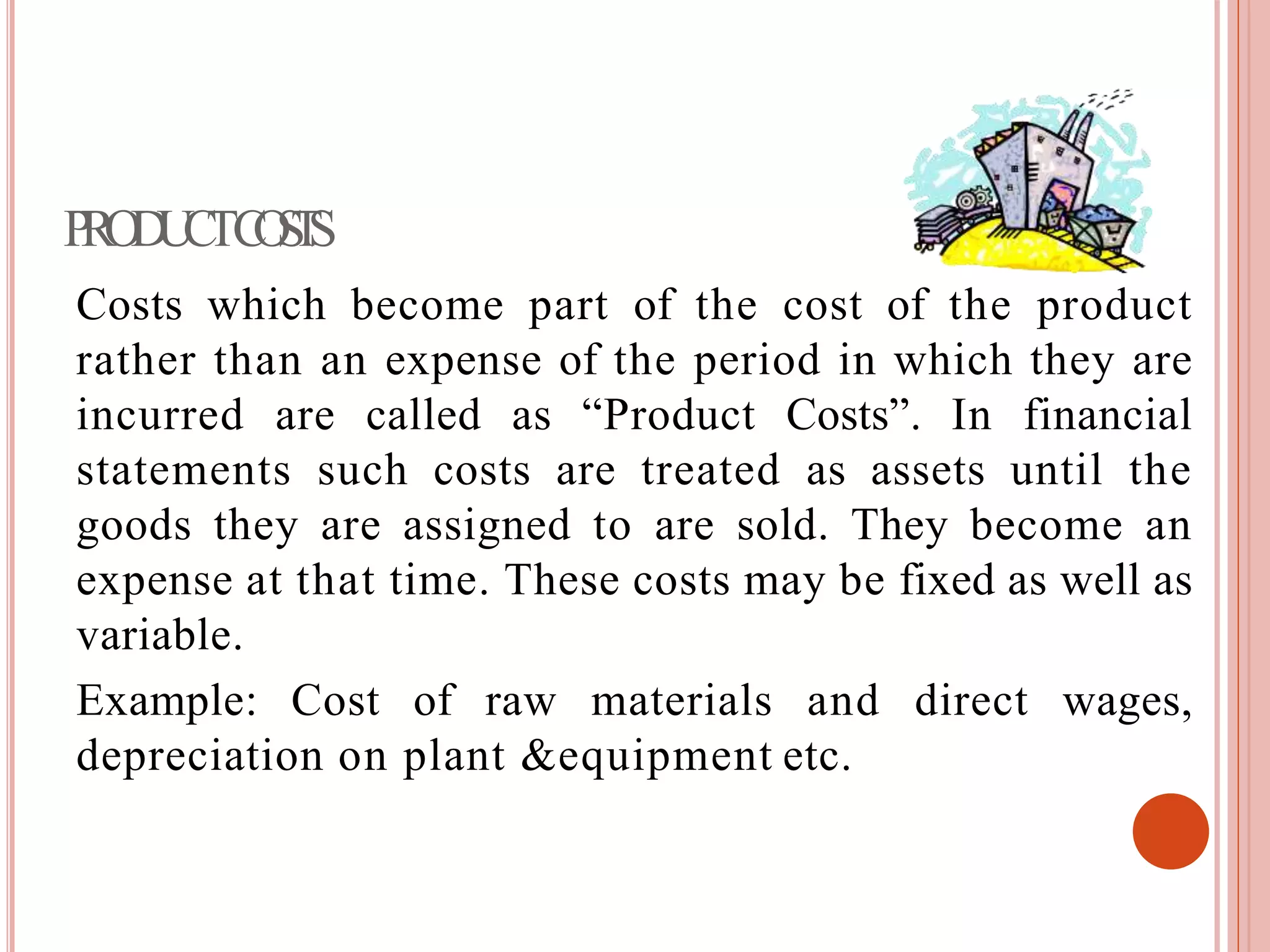
PRODUCTCOSTS
Costs which becomepart of the cost of the product
rather than an expense of the period in which they are
incurred are called as “Product Costs”. In financial
statements such costs are treated as assets until the
goods they are assigned to are sold. They become an
expense at that time. These costs may be fixed as well as
variable.
Example: Cost of raw materials and direct wages,
depreciation on plant &equipment etc.
32.
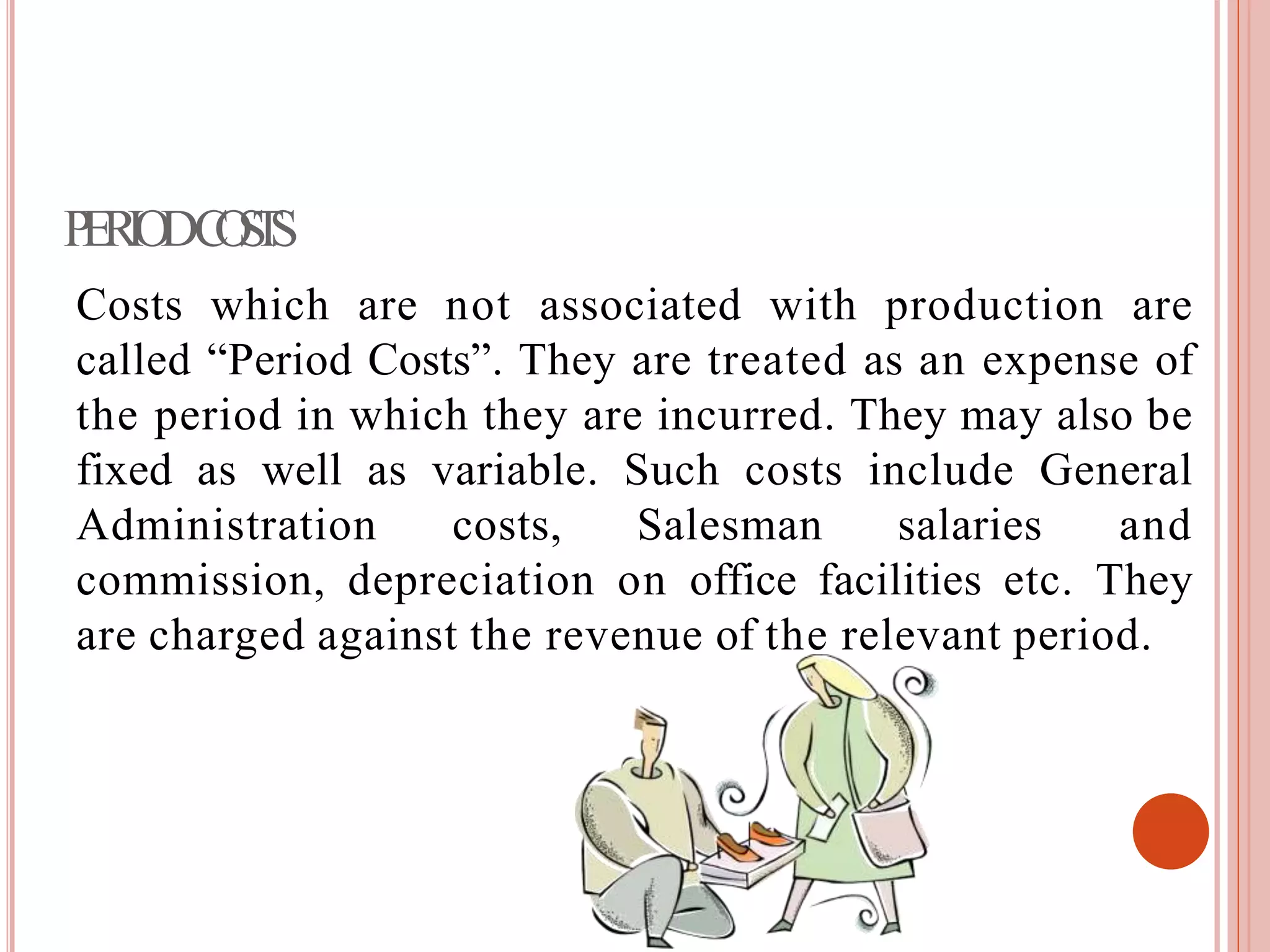
PERIODCOSTS
Costs which arenot associated with production are
called “Period Costs”. They are treated as an expense of
the period in which they are incurred. They may also be
fixed as well as variable. Such costs include General
Administration costs, Salesman salaries and
commission, depreciation on office facilities etc. They
are charged against the revenue of the relevant period.
33.
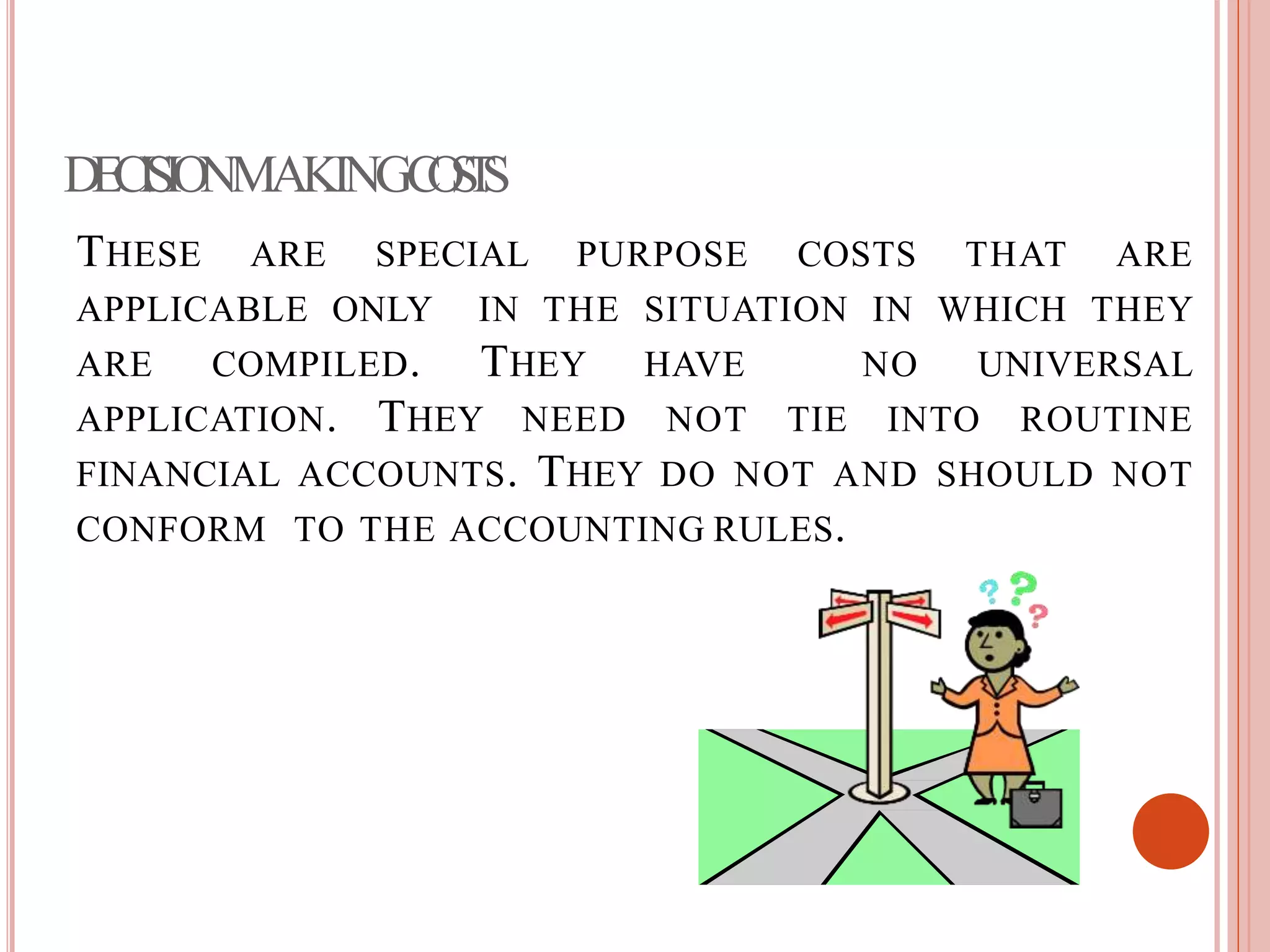
DECISIONMAKINGCOSTS
THESE ARE SPECIALPURPOSE COSTS THAT ARE
APPLICABLE ONLY IN THE SITUATION IN WHICH THEY
ARE COMPILED. THEY HAVE NO UNIVERSAL
APPLICATION. THEY NEED NOT TIE INTO ROUTINE
FINANCIAL ACCOUNTS. THEY DO NOT AND SHOULD NOT
CONFORM TO THE ACCOUNTING RULES.
34.
ACCOUNTINGCOSTS
These costs arecompiled primarily from financial
statements. They have to be altered before they can be
used for decision making. Moreover they are historical
costs and show what has happened under an existing
set of circumstances, while decision making costs are
future costs.
Example: Accounting costs may show the cost of the
product when the operations are manual, while
decision making costs might be calculated to show the
costs when theoperations are mechanised.
35.
RELEVANT& IRRELEVANTCOST
Relevant costsare those costs which would be changed
by the managerial decision, while irrelevant costs are
those which would not be affected by the decision.
Example: If a manufacturer is considering closing down
of an unprofitable retail sales shop, wages payable to
the workers of the shop are relevant in this connection
since they will disappear on closing down of the shop.
But prepaid rent for the shop or unrecovered costs of
any equipment which will have to be scrapped, will be
irrelevant costs which must beignored.
36.
SHUTDOWNCOSTS
A manufacturer oran organization rendering service
may have to suspend its operations for a period on
account of some temporary difficulties such as shortage
of raw materials, non availability of labour etc. During
this period though no work is done yet certain fixed
costs such as rent and insurance of buildings,
depreciation etc. for the entire plant will have to be
incurred. Such costs of the idle plant are known as shut
down costs.
37.
SUNKCOSTS
THESE ARE COSTSWHICH HAVE BEEN CREATED BY A
DECISION THAT WAS MADE IN THE PAST THAT CANNOT
BE CHANGED BY ANY DECISION THAT WILL BE MADE IN
THE FUTURE. INVESTMENT IN PLANT & MACHINERY ARE
PRIME EXAMPLES OF SUCH COSTS. SINCE SUNK COSTS
CANNOT BE ALTERED BY LATER DECISIONS, THEY ARE
IRRELEVANT FOR DECISION MAKING.
38.
EXAMPLE1
ABC Ltd. Purchaseda machine for Rs. 30,000 with an
operating life of 5 years and no scrap value. Soon after
making the purchase the management of ABC Ltd.
Feels that the machine should not have been purchased
since it cannot yield the operating advantage originally
contemplated. It is expected to result in saving in
operating costs of Rs. 18,000 over a period of 5 years.
The machine can be sold immediately for a sum of Rs.
22,000.
39.
SOLUTION1
In taking thedecision whether the machine should be
sold or be used, the relevant amounts to be compared
are Rs. 18,000 in cost savings over 5 years and Rs. 22,000
that can be realized in case it is immediately disposed
off. Rs. 30,000 invested in the asset is not relevant since
it is the same in both the cases. The amount is the sunk
cost. ABC Ltd. Should therefore sell the machinery for
Rs. 22,000 since it will result in an extra profit of
Rs.4,000 as compared to keeping and using it.
40.
AVOIDABLEAND
UNAVOIDABLE
Avoidable costs arethose which will be eliminated if a
segment of the business with which they are directly
related is discontinued. Unavoidable costs are those
which will not be eliminated with the segment. Such
costs are merely reallocated if the segment is
discontinued.
Example: In case a product is discontinued, salary of the
factory manager or factory rent cannot be eliminated. It
will simply mean that certain other products will have
to absorb a higher amount of such overheads. However
salary of clerks or bad debts traceable to the product
would be eliminated.
41.
DIFFERENTIALCOSTS
The difference intotal costs between two alternatives is
termed as ‘differential costs’. In case the choice of an
alternative results in increase in total costs, such
increase in costs is known as ‘incremental costs.’ In
case the choice results in decrease in total costs, such
decrease in total costs is termed as ‘decremental costs’.
While assessing the profitability of a proposed change
the incremental costs are matched with incremental
revenue and vice versa. The proposed change is taken
only when it isprofitable.
42.
OUT-OF-POCKETCOST
This means thepresent or future cash expenditure
regarding a certain decision which varies depending
upon the natureof decision made.
Example: A company has its own trucks for transporting
raw materials and finished products from one place to
another. It seeks to replace these trucks by employment
of public carrier of goods. In making this decision of
course , the depreciation of the trucks is not to be
considered, but the management must take into
account the present expenditure on fuel, salary to
drivers and maintenance. Such costs are termed as out-
of-pocket expenses.
43.
OPPORTUNITYCOST
This cost refersto the advantage, in measurable terms,
which has been foregone on account of not using the
facilities in the manner originally planned.
Example: If an owned building is proposed to be
utilized for housing a new project plant, the likely
revenue which the building could fetch if rented out is
the opportunity cost which should be taken into
account while evaluating the profitability of the project.
44.
TRACEABLEORUNTRACEABLECOSTS
Costs which canbe easily identified with a department,
process or product are termed as traceable costs.
Example: the cost of direct material, direct labour etc.
Costs which cannot be so identified are termed as
untraceable or common costs.
In other words common costs are costs incurred
collectively for a number of cost centres and are to be
suitably apportioned for determining the cost of
individual cost centres. Example: overheads incurred
for a factory as a wholeetc.
45.
JOINTCOSTS
These are asort of common costs. When two or more
products are produced out of one and the same material
or process, the costs of such material or process are
called joint costs.
Example: When cotton seeds and cotton fibre are
produced from the same raw materials, the cost
incurred till split off or separation point will be joint
costs.
46.
COMMONCOSTS
Common costs arethose which are incurred for more
than one product, job, territory or any other specific
costing unit. They are not capable of being identified
with individual product, and are therefore apportioned
on a suitable basis.
Example: Rent, lighting and supervision costs are
common costs to all departments located in the factory.




![7_C's_OF_COMMUNIOCATION[1].pptx](https://cdn.slidesharecdn.com/ss_thumbnails/7csofcommuniocation1-230801063320-9af405b3-thumbnail.jpg?width=640&height=640&fit=bounds)


