Meristematic Tissues 
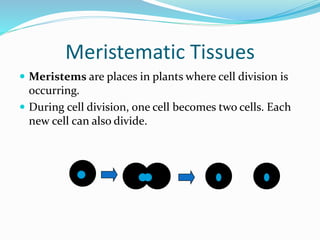
 Meristems are places in plants where cell division is 
occurring. 
 During cell division, one cell becomes two cells. Each 
new cell can also divide.
Meristematic Tissues 
 In this class we will discuss three kinds of meristems: 
 Apical Meristems 
 Intercalary Meristems 
 Lateral Meristems
Apical Meristems 
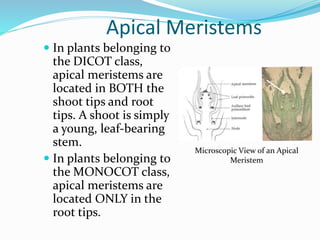
 In plants belonging to 
the DICOT class, 
apical meristems are 
located in BOTH the 
shoot tips and root 
tips. A shoot is simply 
a young, leaf-bearing 
stem. 
 In plants belonging to 
the MONOCOT class, 
apical meristems are 
located ONLY in the 
root tips. 
Microscopic View of an Apical 
Meristem
Apical Meristems 
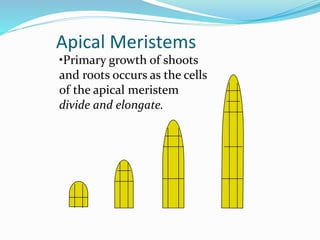
•Primary growth of shoots 
and roots occurs as the cells 
of the apical meristem 
divide and elongate.
Intercalary Meristems 
 In addition to the apical meristems located in their 
root tips, plants in the MONOCOT class have special 
meristems called intercalary meristems. 
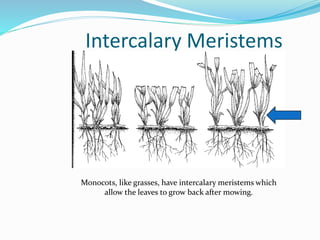
 Intercalary meristems are located on monocots where 
the leaf bases connect to the stem of the plant.
Intercalary Meristems 
Monocots, like grasses, have intercalary meristems which 
allow the leaves to grow back after mowing.
Lateral Meristems 
 In addition to the 
apical meristems 
located in the shoot 
and root tips, plants in 
the DICOT class have 
lateral meristems. 
 Lateral meristems 
cause SECONDARY 
GROWTH. 
 Secondary growth 
causes stems and roots 
to grow larger in 
diameter. 
Lateral Meristems cause an increase 
in stem diameter
Lateral Meristems 
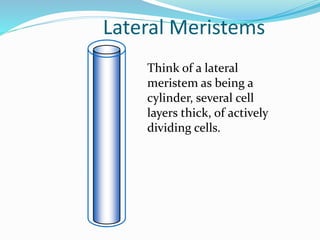
Think of a lateral 
meristem as being a 
cylinder, several cell 
layers thick, of actively 
dividing cells.
Permanent Tissues 
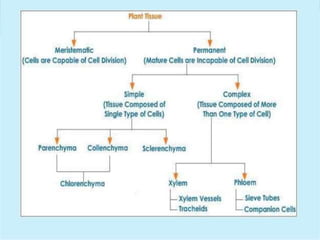
Permanent tissues are of two types; 
Simple permanent tissue 
Complex permanent tissue
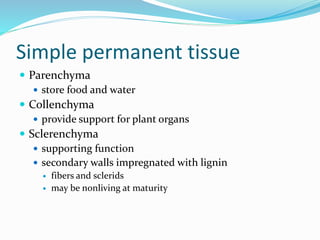
Simple permanent tissue 
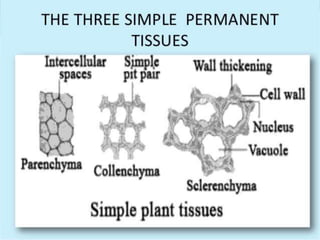
 Parenchyma 
 store food and water 
 Collenchyma 
 provide support for plant organs 
 Sclerenchyma 
 supporting function 
 secondary walls impregnated with lignin 
 fibers and sclerids 
 may be nonliving at maturity
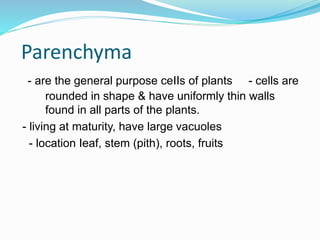
Parenchyma 
- are the general purpose ceIIs of plants - cells are 
rounded in shape & have uniformly thin walls 
found in all parts of the plants. 
- living at maturity, have large vacuoles 
- location Ieaf, stem (pith), roots, fruits
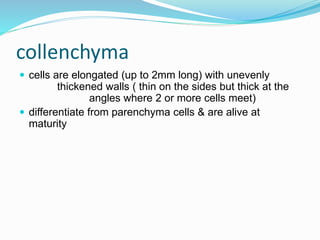
collenchyma 
 cells are elongated (up to 2mm long) with unevenly 
thickened walls ( thin on the sides but thick at the 
angles where 2 or more cells meet) 
 differentiate from parenchyma cells & are alive at 
maturity
sclerenchyma 
 - sclerenchyma cells which are non-living and lack 
protoplasts at maturity 
Types: 
1. scIereids or stone cells 
2. fibers
Complex Permanent Tissues 
Vascular Tissues 
- specialized for long-distance transport of water 
and dissolved substances. 
- contain transfer ceIIs, fibers in addition to 
parenchyma and conducting ceIIs 
- location, the veins in Ieaves 
 types 
1. Xylem 
2. phloem
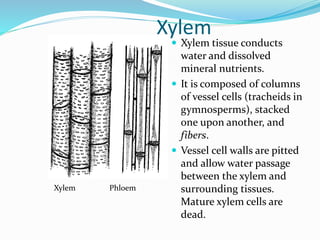
Xylem 
 Xylem tissue conducts 
water and dissolved 
mineral nutrients. 
 It is composed of columns 
of vessel cells (tracheids in 
gymnosperms), stacked 
one upon another, and 
fibers. 
 Vessel cell walls are pitted 
and allow water passage 
between the xylem and 
surrounding tissues. 
Mature xylem cells are 
dead. 
Xylem Phloem
 Xylary elements – the conducting cells in xylem 
- 2 kinds of xylary elements: 
 tracheids – the only water conducting cells 
in most woody, non flowering plants. 
 vessel elements – occur in several groups of 
plants, including angiosperm. 
- both are elongated, dead at maturity, lignified secondary cell 
walls
Phloem 
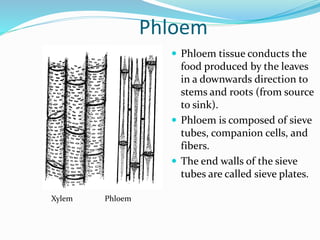
 Phloem tissue conducts the 
food produced by the leaves 
in a downwards direction to 
stems and roots (from source 
to sink). 
 Phloem is composed of sieve 
tubes, companion cells, and 
fibers. 
 The end walls of the sieve 
tubes are called sieve plates. 
Xylem Phloem
Sieve tube elements – main conducting ceIIs 
of phloem 
- elongated and non-nucleated 
- uniformly thin walled with the end walls 
perforated to from the sieve plate. 
- sieve tube element are attached end to end 
to form the sieve tube.
PLANT TISSUES