CClliicckkBBiioollooggyy 
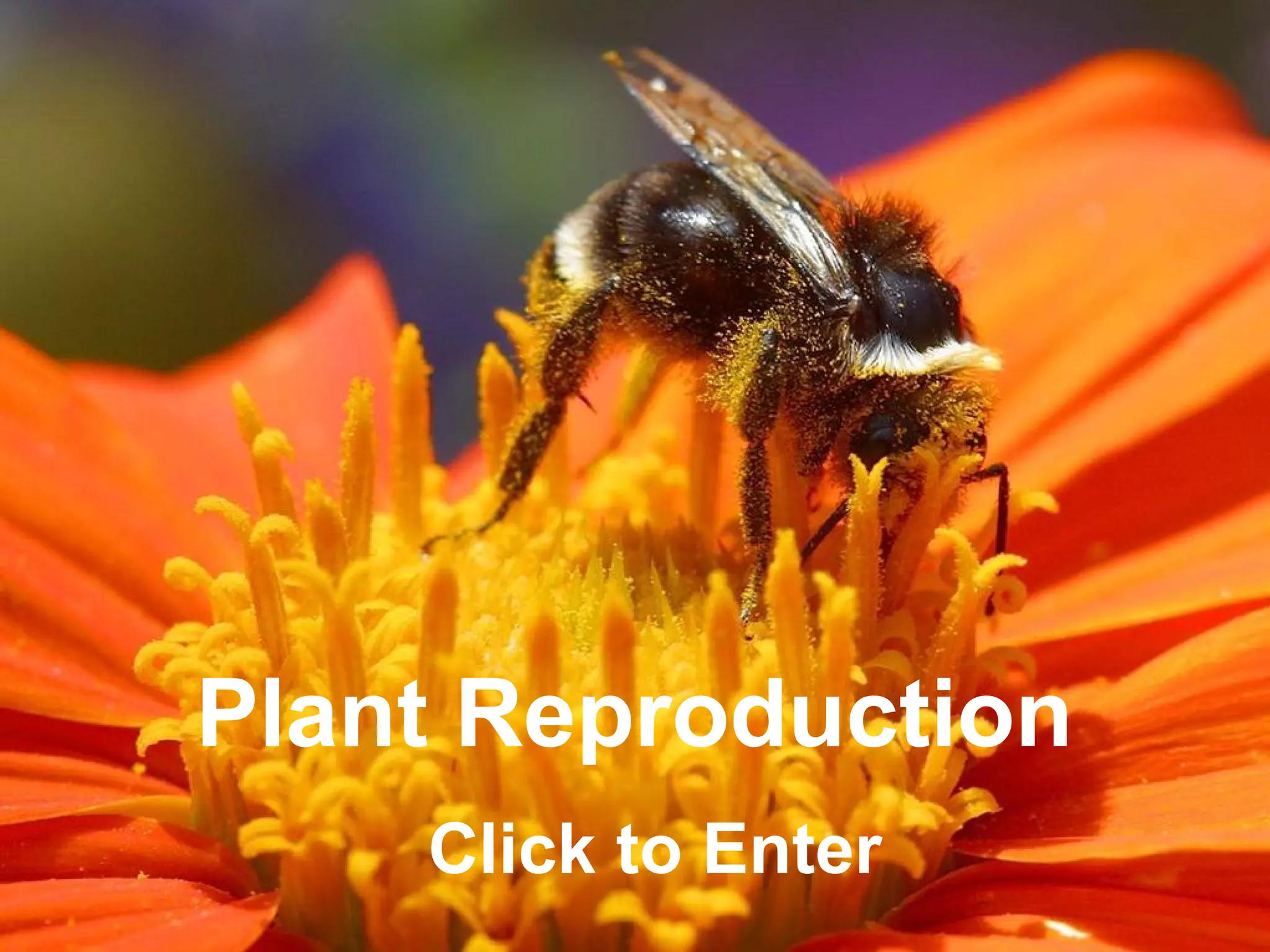
Plant Reproduction 
Click to Enter
CClliicckkBBiioollooggyy 
Instructions 
• Ensure that you complete all activities and worksheets when instructed to do so. 
The pad icon will indicate when you should fill in your worksheet. 
• Work your way through the presentation by clicking on the background to move 
to the next page or to activate an animation. The mouse icon will indicate that a 
click will activate an animation or require buttons to be pressed in the quizzes. 
• You can navigate around the presentation by using the arrow links that appear 
when you place your cursor on the lower left hand part of the screen. 
• Some slides have embedded movies which will start when you click on the 
image. The video camera symbol tells you when a movie is available. There is 
sound so you may want to wear headphones if people are working near you. 
• You can return to the home page by clicking on the clickbiology icon. 
• At the end of the module there is a test that will provide a results page which you 
will print off and hand in to your teacher. 
• The speaker symbol means that there are some audio explanation available for 
the slide 
CClliicckkBBiioollooggyy
CClliicckkBBiioollooggyy 
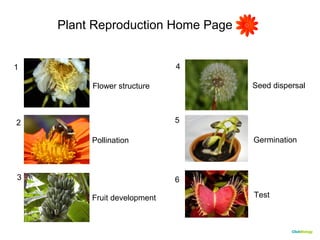
Plant Reproduction Home Page 
Flower structure 
Pollination 
Fruit development 
Seed dispersal 
Germination 
Test 
1 
2 
3 
4 
5 
6
CClliicckkBBiioollooggyy 
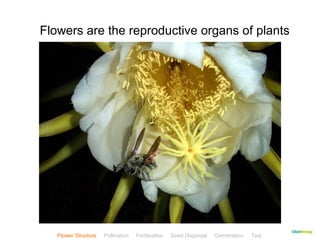
Flowers are the reproductive organs of plants 
Flower Structure Pollination Fertilisation Seed Dispersal Germination Test
CClliicckkBBiioollooggyy 
Click image to view a video on plant reproduction 
If the hyperlink does not work then copy and paste this url into a new 
browser window and you can watch the video then, url: 
http://vimeo.com/1594037?pg=embed&sec=1594037 
Flower Structure Pollination Fertilisation Seed Dispersal Germination Test
CClliicckkBBiioollooggyy 
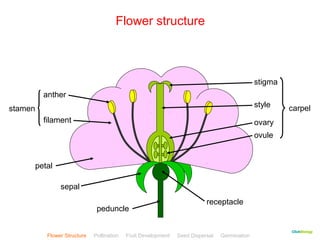
Flower structure 
stigma 
style 
ovary 
ovule 
carpel 
anther 
filament 
stamen 
petal 
sepal 
receptacle 
peduncle 
Flower Structure Pollination Fruit Development Seed Dispersal Germination 
Test
CClliicckkBBiioollooggyy 
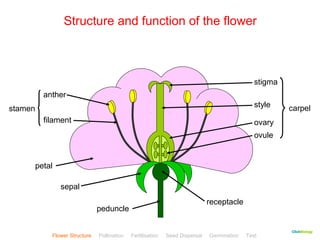
Structure and function of the flower 
stigma 
style 
ovary 
ovule 
carpel 
anther 
filament 
stamen 
petal 
sepal 
receptacle 
peduncle 
Flower Structure Pollination Fertilisation Seed Dispersal Germination Test
CClliicckkBBiioollooggyy 
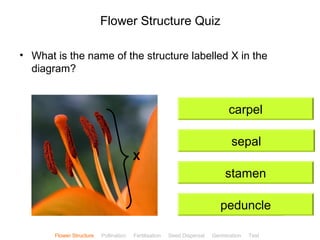
Flower Structure Quiz 
• What is the name of the structure labelled X in the 
diagram? 
carpel 
sepal 
stamen 
peduncle 
X 
Flower Structure Pollination Fertilisation Seed Dispersal Germination Test
CClliicckkBBiioollooggyy 
Flower Structure Quiz 
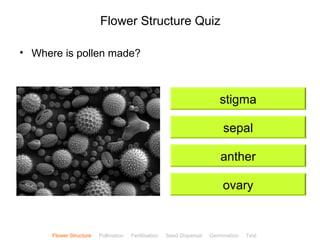
• Where is pollen made? 
stigma 
sepal 
anther 
ovary 
Flower Structure Pollination Fertilisation Seed Dispersal Germination Test
CClliicckkBBiioollooggyy 
Flower Structure Quiz 
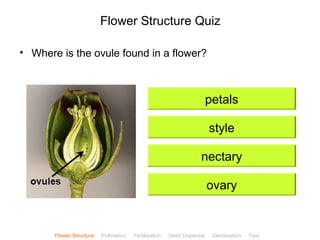
• Where is the ovule found in a flower? 
petals 
style 
nectary 
ovary 
Flower Structure Pollination Fertilisation Seed Dispersal Germination Test
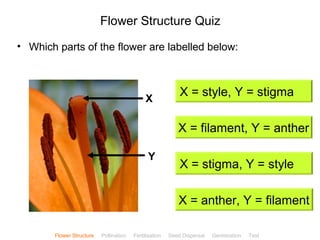
X = style, Y = stigma 
CClliicckkBBiioollooggyy 
Flower Structure Quiz 
• Which parts of the flower are labelled below: 
X = filament, Y = anther 
X 
Y X = stigma, Y = style 
X = anther, Y = filament 
Flower Structure Pollination Fertilisation Seed Dispersal Germination Test
CClliicckkBBiioollooggyy 
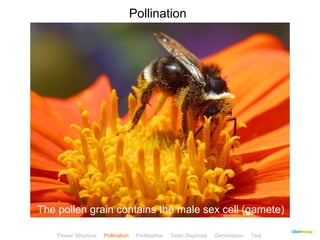
Pollination 
The pollen grain contains the male sex cell (gamete) 
Flower Structure Pollination Fertilisation Seed Dispersal Germination Test
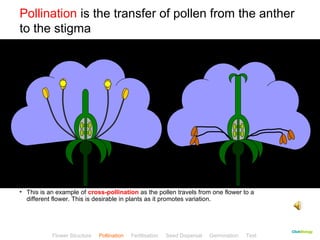
Pollination is the transfer of pollen from the anther 
to the stigma 
CClliicckkBBiioollooggyy 
• This is an example of cross-pollination as the pollen travels from one flower to a 
different flower. This is desirable in plants as it promotes variation. 
Flower Structure Pollination Fertilisation Seed Dispersal Germination Test
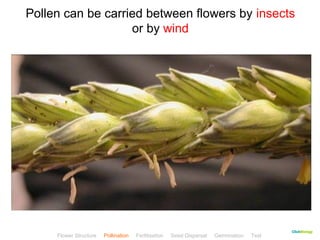
Pollen can be carried between flowers by insects 
CClliicckkBBiioollooggyy 
or by wind 
Flower Structure Pollination Fertilisation Seed Dispersal Germination Test
CClliicckkBBiioollooggyy 
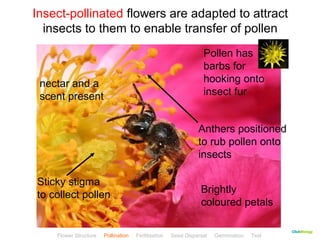
Insect-pollinated flowers are adapted to attract 
insects to them to enable transfer of pollen 
Sticky stigma 
to collect pollen Brightly 
coloured petals 
nectar and a 
scent present 
Pollen has 
barbs for 
hooking onto 
insect fur 
Anthers positioned 
to rub pollen onto 
insects 
Flower Structure Pollination Fertilisation Seed Dispersal Germination Test
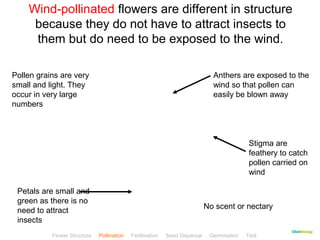
Wind-pollinated flowers are different in structure 
because they do not have to attract insects to 
them but do need to be exposed to the wind. 
Anthers are exposed to the 
wind so that pollen can 
easily be blown away 
CClliicckkBBiioollooggyy 
Petals are small and 
green as there is no 
need to attract 
insects 
Stigma are 
feathery to catch 
pollen carried on 
wind 
Pollen grains are very 
small and light. They 
occur in very large 
numbers 
No scent or nectary 
Flower Structure Pollination Fertilisation Seed Dispersal Germination Test
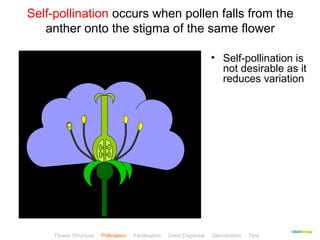
Self-pollination occurs when pollen falls from the 
CClliicckkBBiioollooggyy 
anther onto the stigma of the same flower 
• Self-pollination is 
not desirable as it 
reduces variation 
Flower Structure Pollination Fertilisation Seed Dispersal Germination Test
CClliicckkBBiioollooggyy 
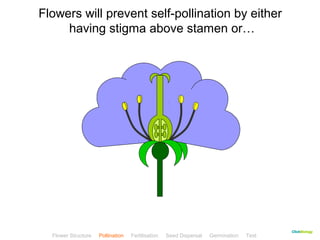
Flowers will prevent self-pollination by either 
having stigma above stamen or… 
Flower Structure Pollination Fertilisation Seed Dispersal Germination Test
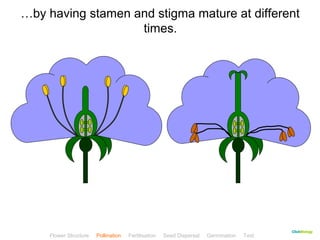
…by having stamen and stigma mature at different 
CClliicckkBBiioollooggyy 
times. 
Flower Structure Pollination Fertilisation Seed Dispersal Germination Test
If the hyperlink does not work then copy and paste 
this url into a new browser window and you can 
watch the video then, url: 
http://www.youtube.com/watch?v=bZ3J4UWwd2Q 
If the hyperlink does not work then copy and paste 
this url into a new browser window and you can 
watch the video then, url: 
http://www.youtube.com/watch?v=ge3EM8AERV0 
CClliicckkBBiioollooggyy 
Click on the icons below to view the 
summary videos on pollination 
Pollination (9 minutes) 
Insect pollination (1 minute) 
Flower Structure Pollination Fertilisation Seed Dispersal Germination Test
CClliicckkBBiioollooggyy 
Pollination Quiz 
• Pollination is the transfer from….? 
the stigma to anther 
style to stamen 
ovule to filament 
anther to stigma 
Flower Structure Pollination Fruit Development Seed Dispersal Germination 
Test
CClliicckkBBiioollooggyy 
Pollination Quiz 
• The two mechanisms for pollination are? 
Wind and water 
Insect and wind 
Insect and water 
Wind and birds 
Flower Structure Pollination Fertilisation Seed Dispersal Germination Test
CClliicckkBBiioollooggyy 
Pollination Quiz 
• Cross-pollination… 
Increases variation 
Decreases variation 
Is only performed by insects 
Is only performed by wind 
Flower Structure Pollination Fertilisation Seed Dispersal Germination Test
CClliicckkBBiioollooggyy 
Pollination Quiz 
• Flowers are adapted for wind-pollination by… 
Having bright petals and a scent 
Having a nectary 
Having feathery stigmas 
Having sticky stigmas 
Flower Structure Pollination Fruit Development Seed Dispersal Germination 
Test
CClliicckkBBiioollooggyy 
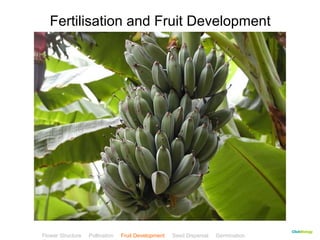
Fertilisation and Fruit Development 
Flower Structure Pollination Fruit Development Seed Dispersal Germination 
Test
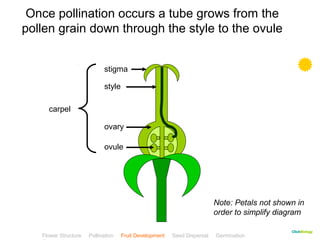
Note: Petals not shown in 
order to simplify diagram 
CClliicckkBBiioollooggyy 
Once pollination occurs a tube grows from the 
pollen grain down through the style to the ovule 
stigma 
style 
ovary 
ovule 
carpel 
Flower Structure Pollination Fruit Development Seed Dispersal Germination 
Test
CClliicckkBBiioollooggyy 
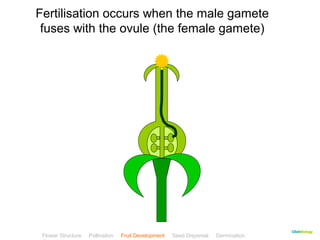
Fertilisation occurs when the male gamete 
fuses with the ovule (the female gamete) 
Flower Structure Pollination Fruit Development Seed Dispersal Germination 
Test
Watch this short introductory video to review 
CClliicckkBBiioollooggyy 
fertilisation (1 minute) 
If the hyperlink does not work then copy and paste this url into a new browser 
window and you can watch the video then, url: 
http://www.youtube.com/watch?v=pVhH2GPlckE
CClliicckkBBiioollooggyy 
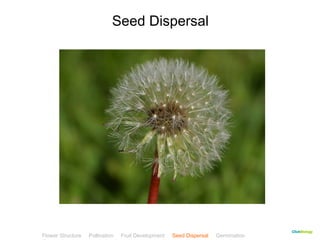
Seed Dispersal 
Flower Structure Pollination Fruit Development Seed Dispersal Germination 
Test
CClliicckkBBiioollooggyy 
Watch the video on seed dispersal 
(lasts just under 10 minutes) 
If the hyperlink does not work then copy and paste this url into a new 
browser window and you can watch the video then, url: 
http://www.youtube.com/watch?v=zbQ1jWl3AOM
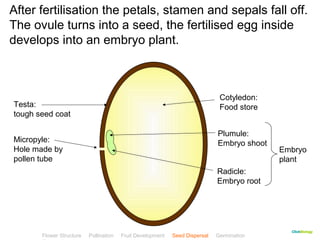
After fertilisation the petals, stamen and sepals fall off. 
The ovule turns into a seed, the fertilised egg inside 
develops into an embryo plant. 
CClliicckkBBiioollooggyy 
Testa: 
tough seed coat 
Micropyle: 
Hole made by 
pollen tube 
Embryo 
plant 
Cotyledon: 
Food store 
Plumule: 
Embryo shoot 
Radicle: 
Embryo root 
Flower Structure Pollination Fruit Development Seed Dispersal Germination 
Test
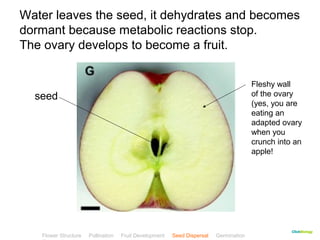
Water leaves the seed, it dehydrates and becomes 
dormant because metabolic reactions stop. 
The ovary develops to become a fruit. 
CClliicckkBBiioollooggyy 
seed 
Fleshy wall 
of the ovary 
(yes, you are 
eating an 
adapted ovary 
when you 
crunch into an 
apple! 
Flower Structure Pollination Fruit Development Seed Dispersal Germination 
Test
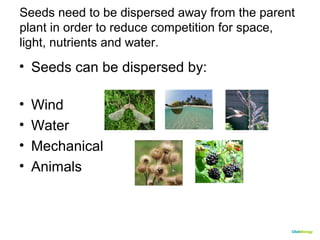
Seeds need to be dispersed away from the parent 
plant in order to reduce competition for space, 
light, nutrients and water. 
• Seeds can be dispersed by: 
• Wind 
• Water 
• Mechanical 
• Animals 
CClliicckkBBiioollooggyy
CClliicckkBBiioollooggyy 
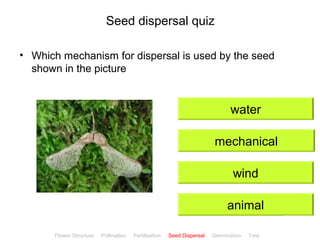
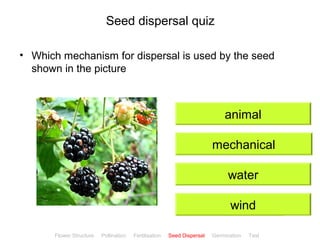
Seed dispersal quiz 
• Which mechanism for dispersal is used by the seed 
shown in the picture 
water 
mechanical 
wind 
animal 
Flower Structure Pollination Fertilisation Seed Dispersal Germination Test
CClliicckkBBiioollooggyy 
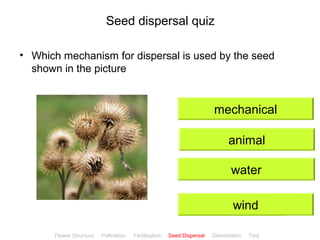
Seed dispersal quiz 
• Which mechanism for dispersal is used by the seed 
shown in the picture 
mechanical 
animal 
water 
wind 
Flower Structure Pollination Fertilisation Seed Dispersal Germination Test
CClliicckkBBiioollooggyy 
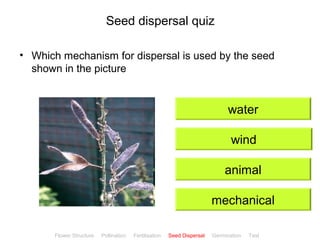
Seed dispersal quiz 
• Which mechanism for dispersal is used by the seed 
shown in the picture 
water 
wind 
animal 
mechanical 
Flower Structure Pollination Fertilisation Seed Dispersal Germination Test
CClliicckkBBiioollooggyy 
Seed dispersal quiz 
• Which mechanism for dispersal is used by the seed 
shown in the picture 
animal 
mechanical 
water 
wind 
Flower Structure Pollination Fertilisation Seed Dispersal Germination Test
CClliicckkBBiioollooggyy 
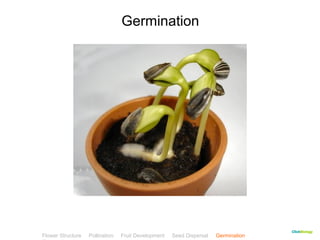
Germination 
Flower Structure Pollination Fruit Development Seed Dispersal Germination 
Test
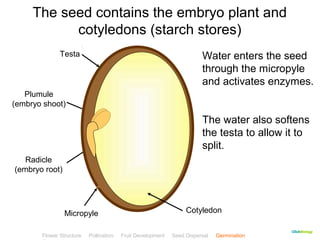
The seed contains the embryo plant and 
cotyledons (starch stores) 
Water enters the seed 
through the micropyle 
and activates enzymes. 
The water also softens 
the testa to allow it to 
split. 
CClliicckkBBiioollooggyy 
Plumule 
Testa 
(embryo shoot) 
Radicle 
(embryo root) 
Micropyle 
Cotyledon 
Flower Structure Pollination Fruit Development Seed Dispersal Germination 
Test
CClliicckkBBiioollooggyy 
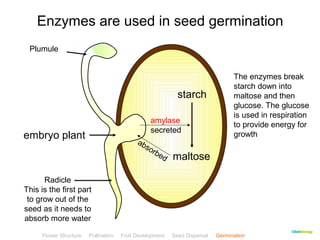
Enzymes are used in seed germination 
starch 
embryo plant 
amylase 
secreted 
maltose 
absorbed 
The enzymes break 
starch down into 
maltose and then 
glucose. The glucose 
is used in respiration 
to provide energy for 
growth 
Plumule 
Radicle 
This is the first part 
to grow out of the 
seed as it needs to 
absorb more water 
Flower Structure Pollination Fruit Development Seed Dispersal Germination 
Test
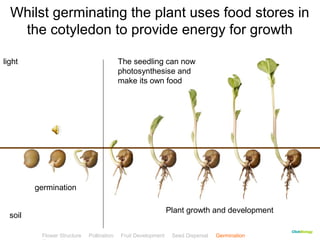
Whilst germinating the plant uses food stores in 
the cotyledon to provide energy for growth 
CClliicckkBBiioollooggyy 
The seedling can now 
photosynthesise and 
make its own food 
Flower Structure Pollination Fruit Development Seed Dispersal Germination 
Test 
light 
soil 
germination 
Plant growth and development
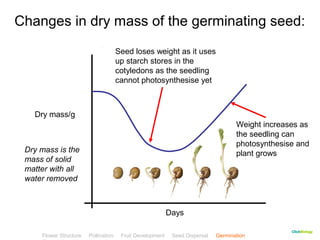
Changes in dry mass of the germinating seed: 
Weight increases as 
the seedling can 
photosynthesise and 
plant grows 
CClliicckkBBiioollooggyy 
Seed loses weight as it uses 
up starch stores in the 
cotyledons as the seedling 
cannot photosynthesise yet 
Days 
Dry mass/g 
Dry mass is the 
mass of solid 
matter with all 
water removed 
Flower Structure Pollination Fruit Development Seed Dispersal Germination 
Test
CClliicckkBBiioollooggyy 
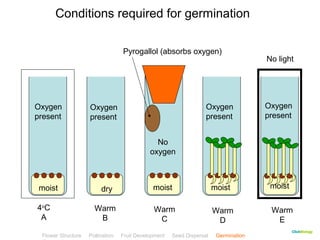
Conditions required for germination 
moist dry moist moist moist 
4oC 
A 
Warm 
B 
Warm 
C 
Warm 
D 
Flower Structure Pollination Fruit Development Seed Dispersal Germination 
Test 
Warm 
E 
Oxygen 
present 
Oxygen 
present 
Oxygen 
present 
Oxygen 
present 
No 
oxygen 
No light 
Pyrogallol (absorbs oxygen)
CClliicckkBBiioollooggyy 
END 
www.clickbiology.com

Plant reproduction

  • 1.
  • 2.
    CClliicckkBBiioollooggyy Instructions •Ensure that you complete all activities and worksheets when instructed to do so. The pad icon will indicate when you should fill in your worksheet. • Work your way through the presentation by clicking on the background to move to the next page or to activate an animation. The mouse icon will indicate that a click will activate an animation or require buttons to be pressed in the quizzes. • You can navigate around the presentation by using the arrow links that appear when you place your cursor on the lower left hand part of the screen. • Some slides have embedded movies which will start when you click on the image. The video camera symbol tells you when a movie is available. There is sound so you may want to wear headphones if people are working near you. • You can return to the home page by clicking on the clickbiology icon. • At the end of the module there is a test that will provide a results page which you will print off and hand in to your teacher. • The speaker symbol means that there are some audio explanation available for the slide CClliicckkBBiioollooggyy
  • 3.
    CClliicckkBBiioollooggyy Plant ReproductionHome Page Flower structure Pollination Fruit development Seed dispersal Germination Test 1 2 3 4 5 6
  • 4.
    CClliicckkBBiioollooggyy Flowers arethe reproductive organs of plants Flower Structure Pollination Fertilisation Seed Dispersal Germination Test
  • 5.
    CClliicckkBBiioollooggyy Click imageto view a video on plant reproduction If the hyperlink does not work then copy and paste this url into a new browser window and you can watch the video then, url: http://vimeo.com/1594037?pg=embed&sec=1594037 Flower Structure Pollination Fertilisation Seed Dispersal Germination Test
  • 6.
    CClliicckkBBiioollooggyy Flower structure stigma style ovary ovule carpel anther filament stamen petal sepal receptacle peduncle Flower Structure Pollination Fruit Development Seed Dispersal Germination Test
  • 7.
    CClliicckkBBiioollooggyy Structure andfunction of the flower stigma style ovary ovule carpel anther filament stamen petal sepal receptacle peduncle Flower Structure Pollination Fertilisation Seed Dispersal Germination Test
  • 8.
    CClliicckkBBiioollooggyy Flower StructureQuiz • What is the name of the structure labelled X in the diagram? carpel sepal stamen peduncle X Flower Structure Pollination Fertilisation Seed Dispersal Germination Test
  • 9.
    CClliicckkBBiioollooggyy Flower StructureQuiz • Where is pollen made? stigma sepal anther ovary Flower Structure Pollination Fertilisation Seed Dispersal Germination Test
  • 10.
    CClliicckkBBiioollooggyy Flower StructureQuiz • Where is the ovule found in a flower? petals style nectary ovary Flower Structure Pollination Fertilisation Seed Dispersal Germination Test
  • 11.
    X = style,Y = stigma CClliicckkBBiioollooggyy Flower Structure Quiz • Which parts of the flower are labelled below: X = filament, Y = anther X Y X = stigma, Y = style X = anther, Y = filament Flower Structure Pollination Fertilisation Seed Dispersal Germination Test
  • 12.
    CClliicckkBBiioollooggyy Pollination Thepollen grain contains the male sex cell (gamete) Flower Structure Pollination Fertilisation Seed Dispersal Germination Test
  • 13.
    Pollination is thetransfer of pollen from the anther to the stigma CClliicckkBBiioollooggyy • This is an example of cross-pollination as the pollen travels from one flower to a different flower. This is desirable in plants as it promotes variation. Flower Structure Pollination Fertilisation Seed Dispersal Germination Test
  • 14.
    Pollen can becarried between flowers by insects CClliicckkBBiioollooggyy or by wind Flower Structure Pollination Fertilisation Seed Dispersal Germination Test
  • 15.
    CClliicckkBBiioollooggyy Insect-pollinated flowersare adapted to attract insects to them to enable transfer of pollen Sticky stigma to collect pollen Brightly coloured petals nectar and a scent present Pollen has barbs for hooking onto insect fur Anthers positioned to rub pollen onto insects Flower Structure Pollination Fertilisation Seed Dispersal Germination Test
  • 16.
    Wind-pollinated flowers aredifferent in structure because they do not have to attract insects to them but do need to be exposed to the wind. Anthers are exposed to the wind so that pollen can easily be blown away CClliicckkBBiioollooggyy Petals are small and green as there is no need to attract insects Stigma are feathery to catch pollen carried on wind Pollen grains are very small and light. They occur in very large numbers No scent or nectary Flower Structure Pollination Fertilisation Seed Dispersal Germination Test
  • 17.
    Self-pollination occurs whenpollen falls from the CClliicckkBBiioollooggyy anther onto the stigma of the same flower • Self-pollination is not desirable as it reduces variation Flower Structure Pollination Fertilisation Seed Dispersal Germination Test
  • 18.
    CClliicckkBBiioollooggyy Flowers willprevent self-pollination by either having stigma above stamen or… Flower Structure Pollination Fertilisation Seed Dispersal Germination Test
  • 19.
    …by having stamenand stigma mature at different CClliicckkBBiioollooggyy times. Flower Structure Pollination Fertilisation Seed Dispersal Germination Test
  • 20.
    If the hyperlinkdoes not work then copy and paste this url into a new browser window and you can watch the video then, url: http://www.youtube.com/watch?v=bZ3J4UWwd2Q If the hyperlink does not work then copy and paste this url into a new browser window and you can watch the video then, url: http://www.youtube.com/watch?v=ge3EM8AERV0 CClliicckkBBiioollooggyy Click on the icons below to view the summary videos on pollination Pollination (9 minutes) Insect pollination (1 minute) Flower Structure Pollination Fertilisation Seed Dispersal Germination Test
  • 21.
    CClliicckkBBiioollooggyy Pollination Quiz • Pollination is the transfer from….? the stigma to anther style to stamen ovule to filament anther to stigma Flower Structure Pollination Fruit Development Seed Dispersal Germination Test
  • 22.
    CClliicckkBBiioollooggyy Pollination Quiz • The two mechanisms for pollination are? Wind and water Insect and wind Insect and water Wind and birds Flower Structure Pollination Fertilisation Seed Dispersal Germination Test
  • 23.
    CClliicckkBBiioollooggyy Pollination Quiz • Cross-pollination… Increases variation Decreases variation Is only performed by insects Is only performed by wind Flower Structure Pollination Fertilisation Seed Dispersal Germination Test
  • 24.
    CClliicckkBBiioollooggyy Pollination Quiz • Flowers are adapted for wind-pollination by… Having bright petals and a scent Having a nectary Having feathery stigmas Having sticky stigmas Flower Structure Pollination Fruit Development Seed Dispersal Germination Test
  • 25.
    CClliicckkBBiioollooggyy Fertilisation andFruit Development Flower Structure Pollination Fruit Development Seed Dispersal Germination Test
  • 26.
    Note: Petals notshown in order to simplify diagram CClliicckkBBiioollooggyy Once pollination occurs a tube grows from the pollen grain down through the style to the ovule stigma style ovary ovule carpel Flower Structure Pollination Fruit Development Seed Dispersal Germination Test
  • 27.
    CClliicckkBBiioollooggyy Fertilisation occurswhen the male gamete fuses with the ovule (the female gamete) Flower Structure Pollination Fruit Development Seed Dispersal Germination Test
  • 28.
    Watch this shortintroductory video to review CClliicckkBBiioollooggyy fertilisation (1 minute) If the hyperlink does not work then copy and paste this url into a new browser window and you can watch the video then, url: http://www.youtube.com/watch?v=pVhH2GPlckE
  • 29.
    CClliicckkBBiioollooggyy Seed Dispersal Flower Structure Pollination Fruit Development Seed Dispersal Germination Test
  • 30.
    CClliicckkBBiioollooggyy Watch thevideo on seed dispersal (lasts just under 10 minutes) If the hyperlink does not work then copy and paste this url into a new browser window and you can watch the video then, url: http://www.youtube.com/watch?v=zbQ1jWl3AOM
  • 31.
    After fertilisation thepetals, stamen and sepals fall off. The ovule turns into a seed, the fertilised egg inside develops into an embryo plant. CClliicckkBBiioollooggyy Testa: tough seed coat Micropyle: Hole made by pollen tube Embryo plant Cotyledon: Food store Plumule: Embryo shoot Radicle: Embryo root Flower Structure Pollination Fruit Development Seed Dispersal Germination Test
  • 32.
    Water leaves theseed, it dehydrates and becomes dormant because metabolic reactions stop. The ovary develops to become a fruit. CClliicckkBBiioollooggyy seed Fleshy wall of the ovary (yes, you are eating an adapted ovary when you crunch into an apple! Flower Structure Pollination Fruit Development Seed Dispersal Germination Test
  • 33.
    Seeds need tobe dispersed away from the parent plant in order to reduce competition for space, light, nutrients and water. • Seeds can be dispersed by: • Wind • Water • Mechanical • Animals CClliicckkBBiioollooggyy
  • 34.
    CClliicckkBBiioollooggyy Seed dispersalquiz • Which mechanism for dispersal is used by the seed shown in the picture water mechanical wind animal Flower Structure Pollination Fertilisation Seed Dispersal Germination Test
  • 35.
    CClliicckkBBiioollooggyy Seed dispersalquiz • Which mechanism for dispersal is used by the seed shown in the picture mechanical animal water wind Flower Structure Pollination Fertilisation Seed Dispersal Germination Test
  • 36.
    CClliicckkBBiioollooggyy Seed dispersalquiz • Which mechanism for dispersal is used by the seed shown in the picture water wind animal mechanical Flower Structure Pollination Fertilisation Seed Dispersal Germination Test
  • 37.
    CClliicckkBBiioollooggyy Seed dispersalquiz • Which mechanism for dispersal is used by the seed shown in the picture animal mechanical water wind Flower Structure Pollination Fertilisation Seed Dispersal Germination Test
  • 38.
    CClliicckkBBiioollooggyy Germination FlowerStructure Pollination Fruit Development Seed Dispersal Germination Test
  • 39.
    The seed containsthe embryo plant and cotyledons (starch stores) Water enters the seed through the micropyle and activates enzymes. The water also softens the testa to allow it to split. CClliicckkBBiioollooggyy Plumule Testa (embryo shoot) Radicle (embryo root) Micropyle Cotyledon Flower Structure Pollination Fruit Development Seed Dispersal Germination Test
  • 40.
    CClliicckkBBiioollooggyy Enzymes areused in seed germination starch embryo plant amylase secreted maltose absorbed The enzymes break starch down into maltose and then glucose. The glucose is used in respiration to provide energy for growth Plumule Radicle This is the first part to grow out of the seed as it needs to absorb more water Flower Structure Pollination Fruit Development Seed Dispersal Germination Test
  • 41.
    Whilst germinating theplant uses food stores in the cotyledon to provide energy for growth CClliicckkBBiioollooggyy The seedling can now photosynthesise and make its own food Flower Structure Pollination Fruit Development Seed Dispersal Germination Test light soil germination Plant growth and development
  • 42.
    Changes in drymass of the germinating seed: Weight increases as the seedling can photosynthesise and plant grows CClliicckkBBiioollooggyy Seed loses weight as it uses up starch stores in the cotyledons as the seedling cannot photosynthesise yet Days Dry mass/g Dry mass is the mass of solid matter with all water removed Flower Structure Pollination Fruit Development Seed Dispersal Germination Test
  • 43.
    CClliicckkBBiioollooggyy Conditions requiredfor germination moist dry moist moist moist 4oC A Warm B Warm C Warm D Flower Structure Pollination Fruit Development Seed Dispersal Germination Test Warm E Oxygen present Oxygen present Oxygen present Oxygen present No oxygen No light Pyrogallol (absorbs oxygen)
  • 44.