11
REPRODUCTION IN PLANTS
y
r. Arshad Keethadath
PLANT PARTS
REPRODUCTION IN PLANTS
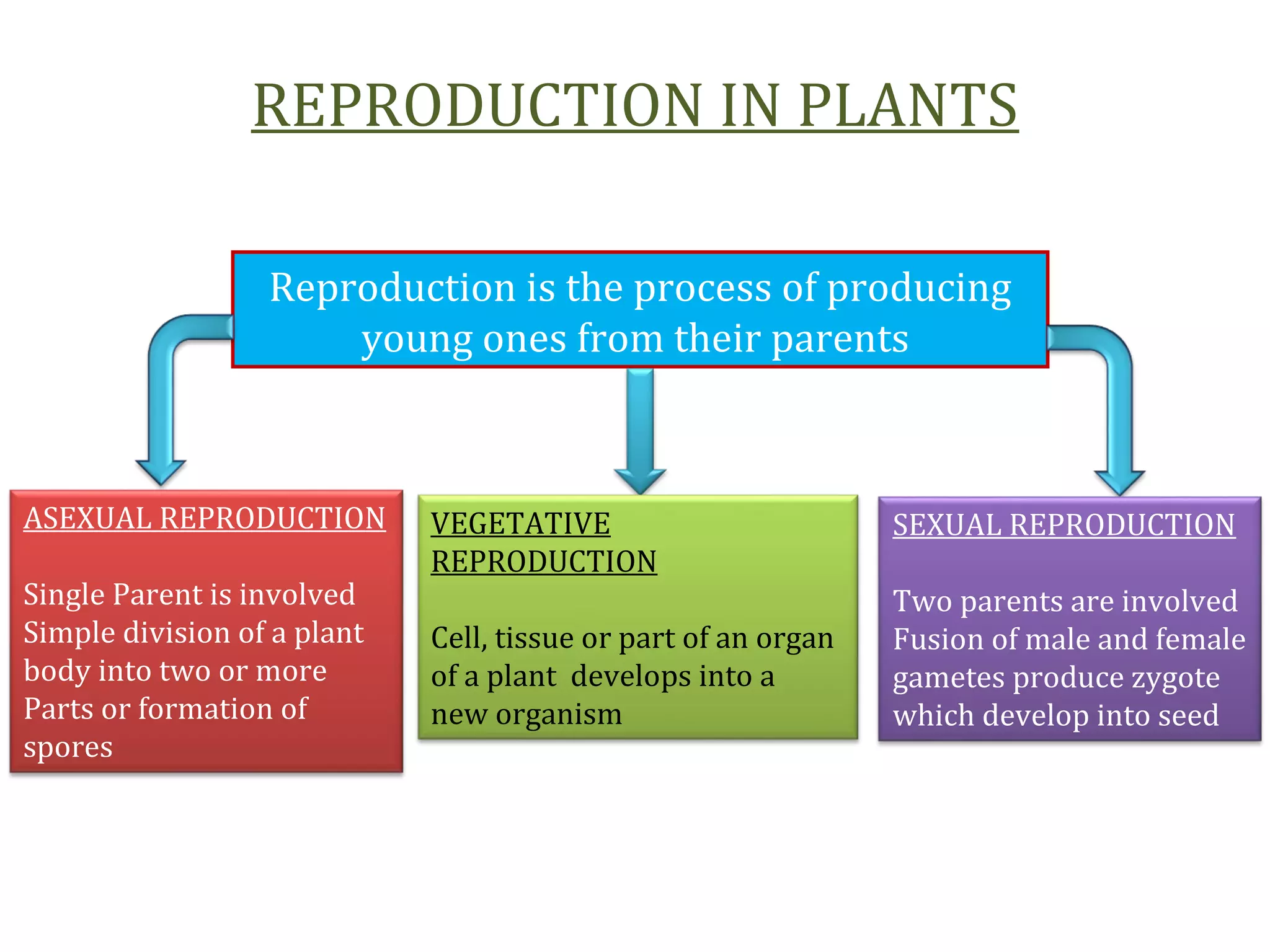
Reproduction is the process of producing
young ones from their parents
ASEXUAL REPRODUCTION
Single Parent is involved
Simple division of a plant
body into two or more
Parts or formation of
spores
SEXUAL REPRODUCTION
Two parents are involved
Fusion of male and female
gametes produce zygote
which develop into seed
VEGETATIVE
REPRODUCTION
Cell, tissue or part of an organ
of a plant develops into a
new organism
ASEXUAL REPRODUCTION
Formation of new plants from the cells of a single
parent
BUDDING
A small bulb-like cellular
out growth, called bud is
formed on parent cell
that develops into an
independent organism.
YEAST
BUDDING
A small bulb-like cellular
out growth, called bud is
formed on parent cell
that develops into an
independent organism.
YEAST
SPORE FORMATION
Parent plant produce
microscopic single or
multi -celled spherical
bodies which germinate
into new plants during
favourable condition.
Ferns, Mosses
SPORE FORMATION
Parent plant produce
microscopic single or
multi -celled spherical
bodies which germinate
into new plants during
favourable condition.
Ferns, Mosses
FRAGMENTATION
The adult organism breaks
up into two or more pieces
called fragments, which
grows to become a new
plant
Algae – Spirogyra, Fucus
FRAGMENTATION
The adult organism breaks
up into two or more pieces
called fragments, which
grows to become a new
plant
Algae – Spirogyra, Fucus
VEGETATIVE REPRODUCTION
Plants vegetative parts such as root, stem and leaf is
used to produce new plants
NATURAL METHOD
Roots
Stems
(Rhizomes
Bulbs
Tubers
Corms)
Leaves
NATURAL METHOD
Roots
Stems
(Rhizomes
Bulbs
Tubers
Corms)
Leaves
ARTIFICIAL METHOD
Cutting
Grafting
Layering
Tissue culture
ARTIFICIAL METHOD
Cutting
Grafting
Layering
Tissue culture
ROOTS
Tuberous roots of Dahlia, sweet potato and Asparagus
STEMS
Most common for vegetative propagation
Different kinds
STEMS
Most common for vegetative propagation
Different kinds
Runners
Runners
Underground Stem
Underground Stem
Oxalis and grass
Oxalis and grass
Chrysanthemum and mint
Vallisneria
Vallisneria
Rhizomes
Rhizomes
Bulbs
Bulbs
Tubers
Tubers
Coms
Coms
Oxalis and grass
Oxalis and grass
Horizontal stems will produce new roots
at nodes and then shoot grow upwards
forming new plants at frequent intervals
Chrysanthemum and mint
Horizontal stems arise from the base of
the erect shoot come out to form new
aerial shoots and it become independent
plants
Vallisneria
Vallisneria
Arched stems which cross over small obstacles
develop small plantlets at their nodes
Runners
Runners
Underground Stem
Underground Stem
Rhizomes
Rhizomes
Bulbs
Bulbs
Ginger, turmeric and banana
Onions
Tubers
Tubers
Coms
Coms
Buds in the eyes give rise to new plants - Potato
Lots of rhizomes joined which
develop into new plants
- Gladiolus
LEAVES
Leaves develop small buds called adventitious buds, on their
margin. This grow into new plant once get touch with soil
Bryophyllum
LEAVES
Leaves develop small buds called adventitious buds, on their
margin. This grow into new plant once get touch with soil
Bryophyllum
ARTIFICIAL METHODS
• CUTTING
• GRAFTING
• LAYERING
• TISSUE CULTURE
SEXUAL REPRODUCTION
• Carried out by flowering plants
• Flowers are the reproductive organs of a plant
The sexual reproduction is the formation of new plants
through the fusion of male and female gametes
The sexual reproduction is the formation of new plants
through the fusion of male and female gametes
Complete or Bisexual Flowers
Contains both male and female
reproductive cells
Have all the four parts
-Sepals
-Petals
-Stamens
-Pistils
Complete or Bisexual Flowers
Contains both male and female
reproductive cells
Have all the four parts
-Sepals
-Petals
-Stamens
-Pistils
Incomplete or unisexual Flowers
Contains either male or female
reproductive cells
Have only three parts
-Sepals
-Petals
-Stamens or Pistils
Incomplete or unisexual Flowers
Contains either male or female
reproductive cells
Have only three parts
-Sepals
-Petals
-Stamens or Pistils
Example: Hibiscus, Citrus
Example: papaya, corn
STAMENS (Male Organ)
Bear Anthers – contain pollen
grains which produce male
cells/gametes
STAMENS (Male Organ)
Bear Anthers – contain pollen
grains which produce male
cells/gametes
PISTLE (Female Organ)
Composed of Stigma, style and
ovary.
The ovary produce female
cells/gametes
PISTLE (Female Organ)
Composed of Stigma, style and
ovary.
The ovary produce female
cells/gametes
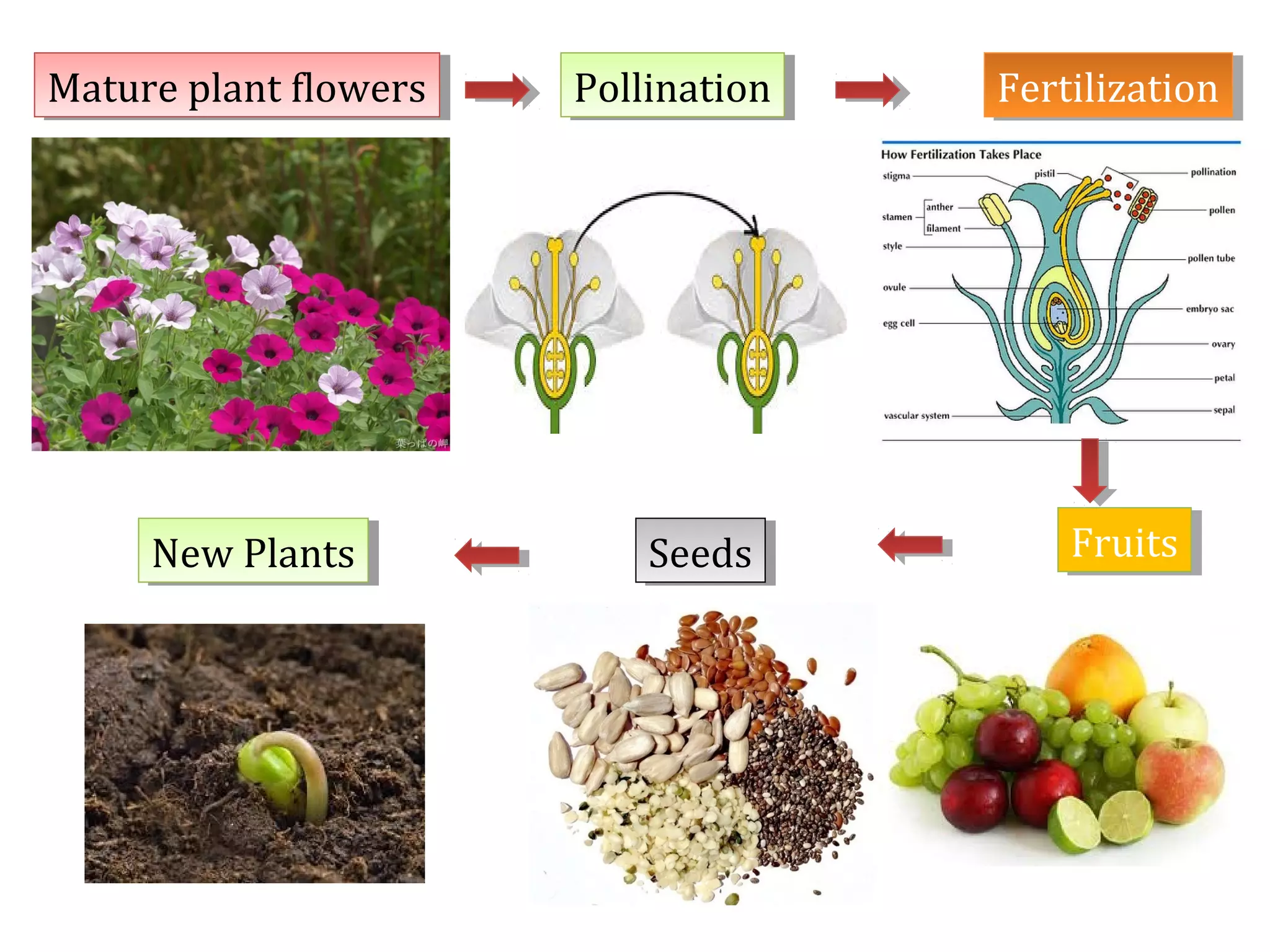
Mature plant flowers
Mature plant flowers Pollination
Pollination Fertilization
Fertilization
Fruits
Fruits
Seeds
Seeds
New Plants
New Plants
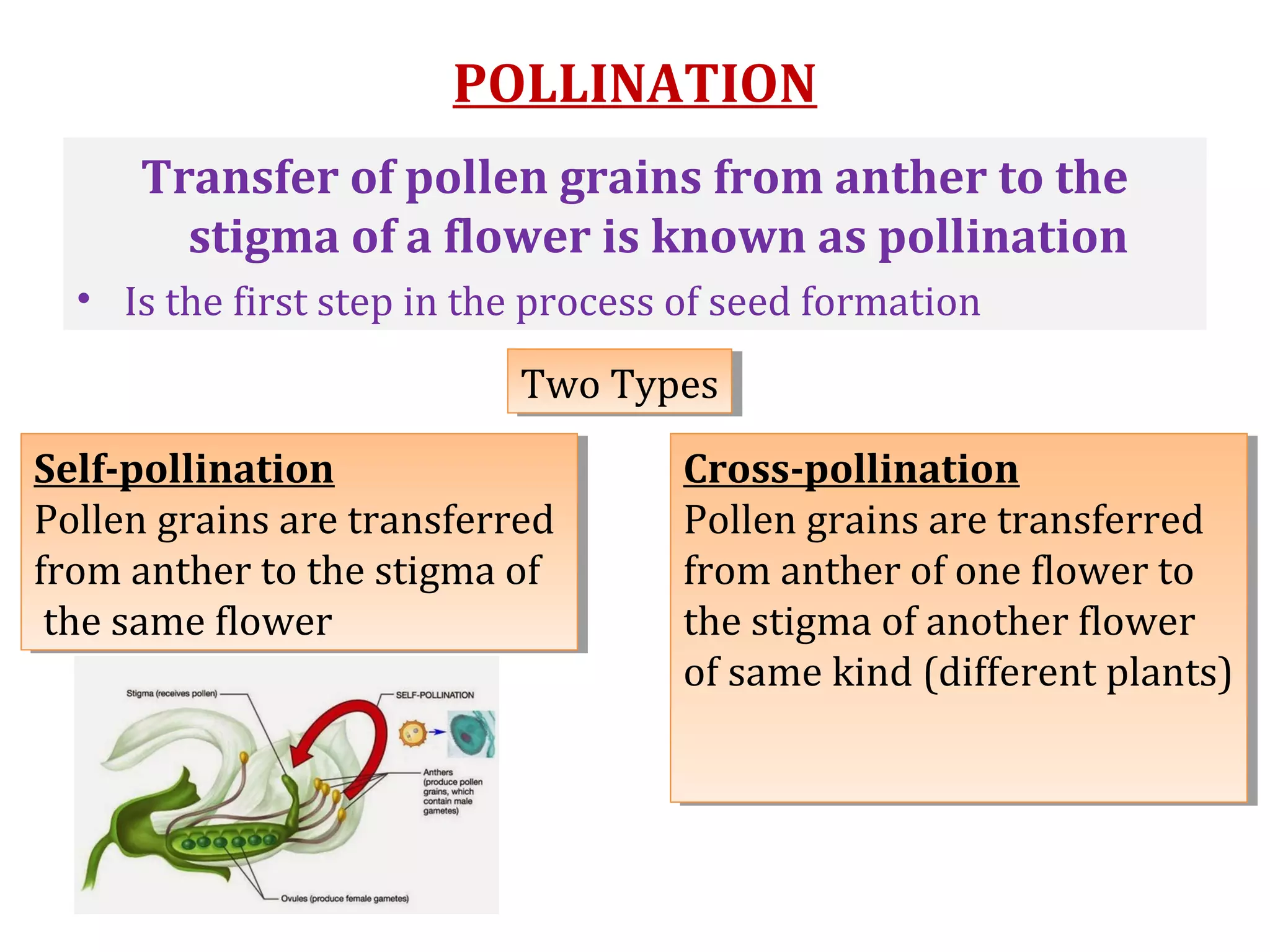
POLLINATION
Transfer of pollen grains from anther to the
stigma of a flower is known as pollination
• Is the first step in the process of seed formation
Two Types
Two Types
Cross-pollination
Pollen grains are transferred
from anther of one flower to
the stigma of another flower
of same kind (different plants)
Cross-pollination
Pollen grains are transferred
from anther of one flower to
the stigma of another flower
of same kind (different plants)
Self-pollination
Pollen grains are transferred
from anther to the stigma of
the same flower
Self-pollination
Pollen grains are transferred
from anther to the stigma of
the same flower
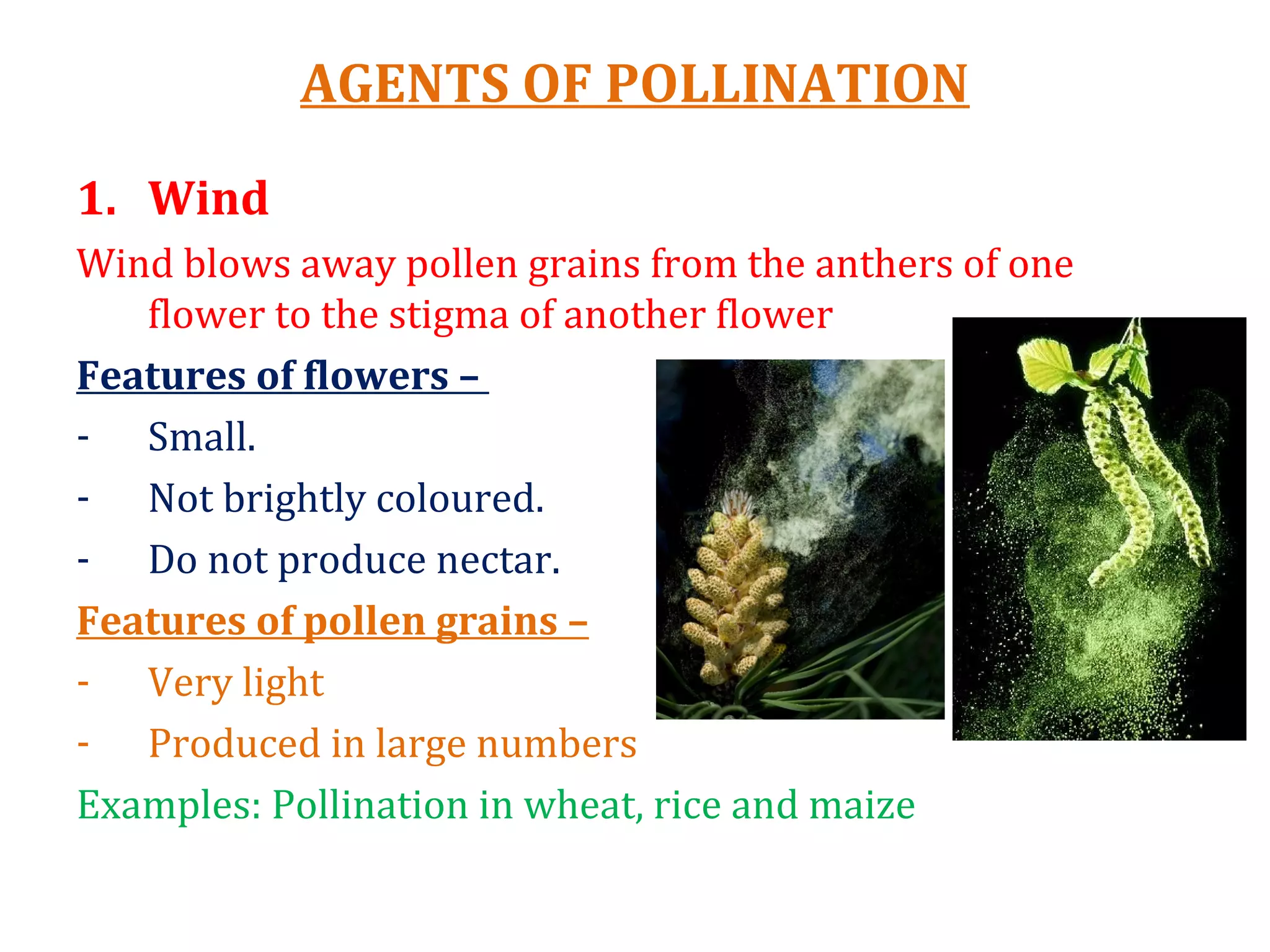
AGENTS OF POLLINATION
1. Wind
Wind blows away pollen grains from the anthers of one
flower to the stigma of another flower
Features of flowers –
- Small.
- Not brightly coloured.
- Do not produce nectar.
Features of pollen grains –
- Very light
- Produced in large numbers
Examples: Pollination in wheat, rice and maize
2. Water
Pollen grains are released into the water are carried out by
water current to other flowers.
Example: Aquatic plants such as sea grass and Vallisnaria
3. Insects
Insects visit flowers for nectar – Some pollen grains stick to
the body parts of these insects – when these insects visit
another flower, the pollen grains fall on the stigma
Features of flowers –
- Sweet smell.
- Brightly coloured petals
for diurnal insects. Eg. Rose,
sun flower
- White/light green petals
for nocturnal insects. Eg. Jasmine
and Cacti
- Rich in nectar.
Features of pollen grains
- Sticky pollen grains
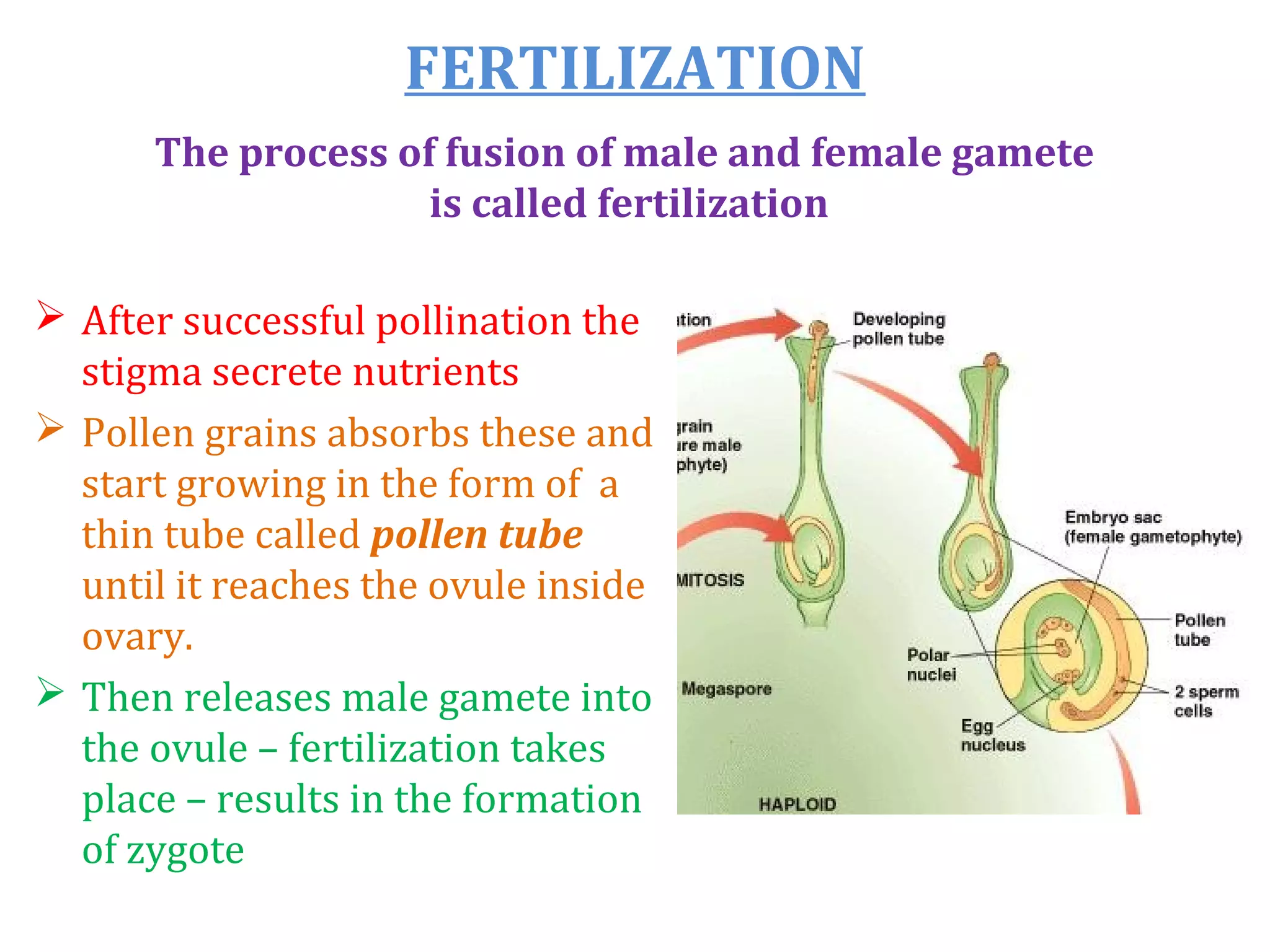
FERTILIZATION
 After successful pollination the
stigma secrete nutrients
 Pollen grains absorbs these and
start growing in the form of a
thin tube called pollen tube
until it reaches the ovule inside
ovary.
 Then releases male gamete into
the ovule – fertilization takes
place – results in the formation
of zygote
The process of fusion of male and female gamete
is called fertilization
FRUIT AND SEED FORMATION
• After Fertilization ovary
enlarges to form the fruit
• The wall of the ovary become
the fruit wall
• The ovules become seeds – a
fruit may have one or more
seeds
• Petals, sepals and other parts
of the flower usually dry up
and fall off
The fruit is the seed-bearing part
or the ripened ovary of the
flowering plant
The fruit is the seed-bearing part
or the ripened ovary of the
flowering plant
The seed is the ripened ovule
which contains an embryo and is
a covered by a protective coat
The seed is the ripened ovule
which contains an embryo and is
a covered by a protective coat
The process by which the embryo
in the seed becomes active and
begins to grow into a new plant is
called germination
The process by which the embryo
in the seed becomes active and
begins to grow into a new plant is
called germination
SEED DISPERSAL
The process by which seeds or fruits are scattered is
called dispersal
Dispersal takes place by several mechanism
• Dispersal by Explosion:
Pea plants, castor and balsam
• Dispersal by Wind:
Dandelion, drumstick and maple
• Dispersal by Water: Coconut
• Dispersal by Animals:
Plants having fleshy fruits

cbsegrade7-chapter11reproductioninplants-170308085837 (1).pdf

  • 1.
  • 2.
  • 3.
    REPRODUCTION IN PLANTS Reproductionis the process of producing young ones from their parents ASEXUAL REPRODUCTION Single Parent is involved Simple division of a plant body into two or more Parts or formation of spores SEXUAL REPRODUCTION Two parents are involved Fusion of male and female gametes produce zygote which develop into seed VEGETATIVE REPRODUCTION Cell, tissue or part of an organ of a plant develops into a new organism
  • 4.
    ASEXUAL REPRODUCTION Formation ofnew plants from the cells of a single parent BUDDING A small bulb-like cellular out growth, called bud is formed on parent cell that develops into an independent organism. YEAST BUDDING A small bulb-like cellular out growth, called bud is formed on parent cell that develops into an independent organism. YEAST SPORE FORMATION Parent plant produce microscopic single or multi -celled spherical bodies which germinate into new plants during favourable condition. Ferns, Mosses SPORE FORMATION Parent plant produce microscopic single or multi -celled spherical bodies which germinate into new plants during favourable condition. Ferns, Mosses FRAGMENTATION The adult organism breaks up into two or more pieces called fragments, which grows to become a new plant Algae – Spirogyra, Fucus FRAGMENTATION The adult organism breaks up into two or more pieces called fragments, which grows to become a new plant Algae – Spirogyra, Fucus
  • 5.
    VEGETATIVE REPRODUCTION Plants vegetativeparts such as root, stem and leaf is used to produce new plants NATURAL METHOD Roots Stems (Rhizomes Bulbs Tubers Corms) Leaves NATURAL METHOD Roots Stems (Rhizomes Bulbs Tubers Corms) Leaves ARTIFICIAL METHOD Cutting Grafting Layering Tissue culture ARTIFICIAL METHOD Cutting Grafting Layering Tissue culture
  • 6.
    ROOTS Tuberous roots ofDahlia, sweet potato and Asparagus
  • 7.
    STEMS Most common forvegetative propagation Different kinds STEMS Most common for vegetative propagation Different kinds Runners Runners Underground Stem Underground Stem Oxalis and grass Oxalis and grass Chrysanthemum and mint Chrysanthemum and mint Vallisneria Vallisneria Rhizomes Rhizomes Bulbs Bulbs Tubers Tubers Coms Coms
  • 8.
    Oxalis and grass Oxalisand grass Horizontal stems will produce new roots at nodes and then shoot grow upwards forming new plants at frequent intervals Chrysanthemum and mint Chrysanthemum and mint Horizontal stems arise from the base of the erect shoot come out to form new aerial shoots and it become independent plants Vallisneria Vallisneria Arched stems which cross over small obstacles develop small plantlets at their nodes Runners Runners
  • 9.
  • 10.
    Tubers Tubers Coms Coms Buds in theeyes give rise to new plants - Potato Lots of rhizomes joined which develop into new plants - Gladiolus
  • 11.
    LEAVES Leaves develop smallbuds called adventitious buds, on their margin. This grow into new plant once get touch with soil Bryophyllum LEAVES Leaves develop small buds called adventitious buds, on their margin. This grow into new plant once get touch with soil Bryophyllum
  • 12.
  • 13.
  • 14.
    SEXUAL REPRODUCTION • Carriedout by flowering plants • Flowers are the reproductive organs of a plant The sexual reproduction is the formation of new plants through the fusion of male and female gametes The sexual reproduction is the formation of new plants through the fusion of male and female gametes Complete or Bisexual Flowers Contains both male and female reproductive cells Have all the four parts -Sepals -Petals -Stamens -Pistils Complete or Bisexual Flowers Contains both male and female reproductive cells Have all the four parts -Sepals -Petals -Stamens -Pistils Incomplete or unisexual Flowers Contains either male or female reproductive cells Have only three parts -Sepals -Petals -Stamens or Pistils Incomplete or unisexual Flowers Contains either male or female reproductive cells Have only three parts -Sepals -Petals -Stamens or Pistils Example: Hibiscus, Citrus Example: Hibiscus, Citrus Example: papaya, corn Example: papaya, corn
  • 16.
    STAMENS (Male Organ) BearAnthers – contain pollen grains which produce male cells/gametes STAMENS (Male Organ) Bear Anthers – contain pollen grains which produce male cells/gametes PISTLE (Female Organ) Composed of Stigma, style and ovary. The ovary produce female cells/gametes PISTLE (Female Organ) Composed of Stigma, style and ovary. The ovary produce female cells/gametes
  • 17.
    Mature plant flowers Matureplant flowers Pollination Pollination Fertilization Fertilization Fruits Fruits Seeds Seeds New Plants New Plants
  • 18.
    POLLINATION Transfer of pollengrains from anther to the stigma of a flower is known as pollination • Is the first step in the process of seed formation Two Types Two Types Cross-pollination Pollen grains are transferred from anther of one flower to the stigma of another flower of same kind (different plants) Cross-pollination Pollen grains are transferred from anther of one flower to the stigma of another flower of same kind (different plants) Self-pollination Pollen grains are transferred from anther to the stigma of the same flower Self-pollination Pollen grains are transferred from anther to the stigma of the same flower
  • 20.
    AGENTS OF POLLINATION 1.Wind Wind blows away pollen grains from the anthers of one flower to the stigma of another flower Features of flowers – - Small. - Not brightly coloured. - Do not produce nectar. Features of pollen grains – - Very light - Produced in large numbers Examples: Pollination in wheat, rice and maize
  • 21.
    2. Water Pollen grainsare released into the water are carried out by water current to other flowers. Example: Aquatic plants such as sea grass and Vallisnaria
  • 22.
    3. Insects Insects visitflowers for nectar – Some pollen grains stick to the body parts of these insects – when these insects visit another flower, the pollen grains fall on the stigma Features of flowers – - Sweet smell. - Brightly coloured petals for diurnal insects. Eg. Rose, sun flower - White/light green petals for nocturnal insects. Eg. Jasmine and Cacti - Rich in nectar. Features of pollen grains - Sticky pollen grains
  • 23.
    FERTILIZATION  After successfulpollination the stigma secrete nutrients  Pollen grains absorbs these and start growing in the form of a thin tube called pollen tube until it reaches the ovule inside ovary.  Then releases male gamete into the ovule – fertilization takes place – results in the formation of zygote The process of fusion of male and female gamete is called fertilization
  • 24.
    FRUIT AND SEEDFORMATION • After Fertilization ovary enlarges to form the fruit • The wall of the ovary become the fruit wall • The ovules become seeds – a fruit may have one or more seeds • Petals, sepals and other parts of the flower usually dry up and fall off
  • 25.
    The fruit isthe seed-bearing part or the ripened ovary of the flowering plant The fruit is the seed-bearing part or the ripened ovary of the flowering plant The seed is the ripened ovule which contains an embryo and is a covered by a protective coat The seed is the ripened ovule which contains an embryo and is a covered by a protective coat The process by which the embryo in the seed becomes active and begins to grow into a new plant is called germination The process by which the embryo in the seed becomes active and begins to grow into a new plant is called germination
  • 26.
    SEED DISPERSAL The processby which seeds or fruits are scattered is called dispersal Dispersal takes place by several mechanism • Dispersal by Explosion: Pea plants, castor and balsam • Dispersal by Wind: Dandelion, drumstick and maple • Dispersal by Water: Coconut • Dispersal by Animals: Plants having fleshy fruits