Ecology and the Environment
Section 4: Ecology and the environment
a) The organism in the environment
Students will be assessed on their ability to:
4.1 understand the terms population, community, habitat and ecosystem
4.2 recall the use of quadrats to estimate the population size of an organism in two
different areas
4.3 describe the use of quadrats as a technique for sampling the distribution of organisms
in their habitats.
b) Feeding relationships
Students will be assessed on their ability to:
4.4 recall the names given to different trophic levels to include producers, primary,
secondary and tertiary consumers and decomposers
4.5 understand the concepts of food chains, food webs, pyramids of number, pyramids of
biomass and pyramids of energy transfer
4.6 understand the transfer of substances and of energy along a food chain
4.7 explain why about only 10% of energy is transferred from one trophic level to the
next.
Key words
Producer Consumer Primary
Secondary Tertiary Pyramids
Numbers Biomass Energy
10 February 2015
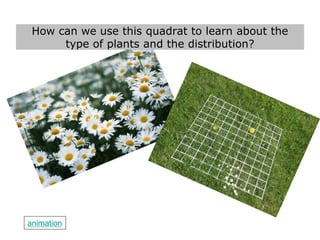
How can we use this quadrat to learn about the
type of plants and the distribution?
animation
Food chains
• http://www.youtube.com/watch?v=TE6wqG4nb3
M
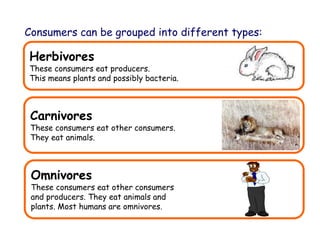
Consumers can be grouped into different types:
Carnivores
These consumers eat other consumers.
They eat animals.
Herbivores
These consumers eat producers.
This means plants and possibly bacteria.
Omnivores
These consumers eat other consumers
and producers. They eat animals and
plants. Most humans are omnivores.
Feeding types
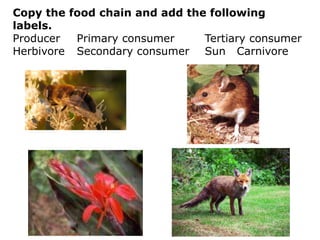
What is the food chain in this habitat?
Copy the food chain and add the following
labels.
Producer Primary consumer Tertiary consumer
Herbivore Secondary consumer Sun Carnivore
Copy the
food chains
and then
label the
rank of the
consumers
blue tit
chiffchaff
aphid
moth larva
vole
stoat
owl
spider
ladybird
plants
Questions
1. Explain what the arrows in the food chain
represent?
2. Not all energy is passed from one level to
the next. Explain how it can be lost along
the way.
Thinking time
• How many zebra do you think a lion eats in a
month?
• How many grass plants do you think a zebra
eats in a month?
Pyramid of numbers
• The arrows in a food chain show the flow of energy
• In a day, one crab would eat more than one mussel, and
each mussel would eat more than one seaweed plant
Seaweed  Mussels  Crab
• If you count the number of crabs, mussels and seaweed
plants you can draw a scale diagram. You can represent
the size of a population by a bar
SEAWEED
MUSSELS
CRABS
Draw pyramids of numbers using a scale for the following
food chains
Tertiary 1 cat 100 fleas
Consumer
Secondary 5 thrushes 5 robins
consumer
Primary 20 slugs 100 caterpillars
consumer
Producer 5 cabbages 1 oak tree
Questions
 Draw the following pyramids of numbers
to scale on graph paper.
15 nettle plants  12 caterpillars  1
robin
5 rose bushes  100 greenfly  25
ladybirds
50 lettuce  20 slugs  1 thrush
Pyramid of numbers
• The size of each block
represents the number of
organisms
• Each level in the pyramid
represents a trophic level
• Has its shape because
there is less energy
available as you go up
the trophic levels
therefore there are fewer
organisms at each level
Interdependence
Make 5 correct sentences by choosing a word or
phrase from each column
A food
chain
A food web
A pyramid of
numbers
shows how food chains
energy
flows
many
organisms
depend on
each other
for energy
link to each
other
from one
organism to
another
organisms
there are at
each stage in
the food
chain
You have 30 seconds to talk through this diagram
• Plants utilise only about 1 percent of the
energy the earth receives from the sun.
• Where does the other energy go? , make a
list where you think it goes.
Starter
Efficiency
Energy Transfers
• Energy comes into an ecosystem from sunlight and is fixed
by plants by photosynthesis.
• There is another process called chemosynthesis (involves
bacteria).
• The energy stored in the plants can be passed onto other
organisms along food chains.
• Each link in a food chain is called a trophic level.
• During this process a lot of energy is lost – dissipation.
Key Points
• Plants are not very efficient at capturing energy from the
sun.
• The products of photosynthesis can be used to increase
the biomass of plants.
• This biomass can be eaten by herbivores
• Most of the biomass eaten by the primary consumer is
used in respiration to
– Move
– Maintain body temperature
Key points
• Some biomass will be undigested and pass
through the animal without being used.
• The only biomass available to consumers at the
next level is that that is used for growth.
• This process happens at each trophic level in
the pyramids of biomass
– There is less and less biomass available at each
subsequent level.
• The energy in all ecosystems originally
come from the sun.
• Most of the sunlight that falls on leaves is
not absorbed and used.
• Some is reflected by the leafs surface.
• Some passes through the leaf.
• Only part of the light is useful and can be
absorbed by the chlorophyll.
You have 30 seconds to talk through this diagram
• Transfer of food energy from producers to
primary consumers also involves wastage.
• For every 100g of plant material available
only about 10g ends up as part of the
herbivores body.
• Reasons for 90% energy wastage:
• Some food may not be eaten.
• Some food passes through the body of the
herbivore without being digested.
Energy flow through consumers
• A lot of food is used in respiration.
• Similar losses in food energy occur
between other trophic levels.
• Some carnivores are able to achieve a
20% conversion effeincey. So for every
100g of herbivore that they eat 20g ends
up as part of their body.
Pyramids of biomass
• The mass of living things
at each stage in the food
chain
• Measured in dry mass
• The size of each box
represents the mass of
each kind of organism
• Always makes a pyramid
shape (a pyramid of
numbers can be upside
down)
Difficulties with food pyramids
• Many organisms eat lots of things
• Could be at different levels
• Calculating dry mass involves killing and drying
organisms
Numbers or Biomass?
Plenary
• Pyramids of numbers tell us the number of
predators-prey at each feeding level, however,
they do not give a very good indication of the
energy transferred.
• Can you think of a better way of measuring how
much energy is transferred between stages in
the food chains? What other quantity could we
use in a pyramid instead of number of
animals/plants?
Food chains
• http://www.youtube.com/watch?v=TE6wqG4nb3
M
1. Give three ways in which fish are adapted to live
underwater.
2. Explain how a polar bear is adapted to its
environment.
3. Explain how a camel is adapted to its environment.
Extension: How is a tree adapted to its environment?
Life on land - Mammals
What features does a
mammal have?
Warm blood
Fur
Lungs
Gives birth to live young
Produces milk
What adaptations do you think
mammals have to be able to
survive in:
1. Desert conditions
2. Arctic conditions
Life in water - Fish
How is a fish
adapted to live in
water?
• Think about its shape,
how it moves through
the water.
• How does it get oxygen?
• What protects it from
skin infections?
Adaptation and competition
• Animals, plants and other organisms are
adapted to their environment.
• Where there are limited resources,
individuals must compete for resources.
• Individuals that are unable to compete will
die out and not pass their genes onto the
next generation.
Exponential growth
• When resources
are unlimited, the
population will
grow
The population will double in every
period of time
Time
Numberofindividuals
T1 T2 T3 T4
10
100
1000
1 ???
Limited resources
Competition between
individuals
• The population is limited by the
amount of resources
• Strongest individuals survive to the
next generation
Competing for resources
List the resources that each
of the following compete
for:
• Animals
• Plants
When limits are reached
Numberofindividuals
T1 T2 T3 T4
10
100
1000
1 ???
Numberofindividuals
T1 T2 T3 T4
10
100
1000
1 ???
Population CrashPopulation growth limited
Lynx and Snowshoe Hare Pop. Data (n
x 1000)
Year Lynx Hare
1845 30 20
1850 10 80
1855 35 82
1860 10 15
1865 75 130
1870 55 100
1875 20 15
1880 84 135
1885 20 40
1890 58 82
1895 63 65
1900 5 40
1905 52 10
1910 12 85
1915 62 5
Plot a graph of year against
population. Plot lynx in one
colour and hare in another.
1. What is the relationship between
number of lynx and number of
hare?
2. Explain why this happens.
3. Extension: Which is the predator?
How can you tell from the graph?
Lynx and Snowshoe Hare Pop. Data (n
x 1000)
Year Lynx Hare
1845 30 20
1850 10 80
1855 35 82
1860 10 15
1865 75 130
1870 55 100
1875 20 15
1880 84 135
1885 20 40
1890 58 82
1895 63 65
1900 5 40
1905 52 10
1910 12 85
1915 62 5
Plot a graph of year against
population. Plot lynx in one
colour and hare in another.
1. What is the relationship between
number of lynx and number of
hare?
2. Explain why this happens.
3. Extension: Which is the predator?
How can you tell from the graph?

Sampling and Ecosystems

  • 1.
    Ecology and theEnvironment Section 4: Ecology and the environment a) The organism in the environment Students will be assessed on their ability to: 4.1 understand the terms population, community, habitat and ecosystem 4.2 recall the use of quadrats to estimate the population size of an organism in two different areas 4.3 describe the use of quadrats as a technique for sampling the distribution of organisms in their habitats. b) Feeding relationships Students will be assessed on their ability to: 4.4 recall the names given to different trophic levels to include producers, primary, secondary and tertiary consumers and decomposers 4.5 understand the concepts of food chains, food webs, pyramids of number, pyramids of biomass and pyramids of energy transfer 4.6 understand the transfer of substances and of energy along a food chain 4.7 explain why about only 10% of energy is transferred from one trophic level to the next. Key words Producer Consumer Primary Secondary Tertiary Pyramids Numbers Biomass Energy 10 February 2015
  • 2.
    How can weuse this quadrat to learn about the type of plants and the distribution? animation
  • 3.
  • 4.
    Consumers can begrouped into different types: Carnivores These consumers eat other consumers. They eat animals. Herbivores These consumers eat producers. This means plants and possibly bacteria. Omnivores These consumers eat other consumers and producers. They eat animals and plants. Most humans are omnivores.
  • 5.
  • 6.
    What is thefood chain in this habitat?
  • 7.
    Copy the foodchain and add the following labels. Producer Primary consumer Tertiary consumer Herbivore Secondary consumer Sun Carnivore
  • 9.
    Copy the food chains andthen label the rank of the consumers
  • 11.
  • 12.
    Questions 1. Explain whatthe arrows in the food chain represent? 2. Not all energy is passed from one level to the next. Explain how it can be lost along the way.
  • 13.
    Thinking time • Howmany zebra do you think a lion eats in a month? • How many grass plants do you think a zebra eats in a month?
  • 14.
    Pyramid of numbers •The arrows in a food chain show the flow of energy • In a day, one crab would eat more than one mussel, and each mussel would eat more than one seaweed plant Seaweed  Mussels  Crab • If you count the number of crabs, mussels and seaweed plants you can draw a scale diagram. You can represent the size of a population by a bar SEAWEED MUSSELS CRABS
  • 15.
    Draw pyramids ofnumbers using a scale for the following food chains Tertiary 1 cat 100 fleas Consumer Secondary 5 thrushes 5 robins consumer Primary 20 slugs 100 caterpillars consumer Producer 5 cabbages 1 oak tree
  • 16.
    Questions  Draw thefollowing pyramids of numbers to scale on graph paper. 15 nettle plants  12 caterpillars  1 robin 5 rose bushes  100 greenfly  25 ladybirds 50 lettuce  20 slugs  1 thrush
  • 19.
    Pyramid of numbers •The size of each block represents the number of organisms • Each level in the pyramid represents a trophic level • Has its shape because there is less energy available as you go up the trophic levels therefore there are fewer organisms at each level
  • 20.
    Interdependence Make 5 correctsentences by choosing a word or phrase from each column A food chain A food web A pyramid of numbers shows how food chains energy flows many organisms depend on each other for energy link to each other from one organism to another organisms there are at each stage in the food chain
  • 21.
    You have 30seconds to talk through this diagram
  • 22.
    • Plants utiliseonly about 1 percent of the energy the earth receives from the sun. • Where does the other energy go? , make a list where you think it goes. Starter
  • 23.
  • 24.
    Energy Transfers • Energycomes into an ecosystem from sunlight and is fixed by plants by photosynthesis. • There is another process called chemosynthesis (involves bacteria). • The energy stored in the plants can be passed onto other organisms along food chains. • Each link in a food chain is called a trophic level. • During this process a lot of energy is lost – dissipation.
  • 25.
    Key Points • Plantsare not very efficient at capturing energy from the sun. • The products of photosynthesis can be used to increase the biomass of plants. • This biomass can be eaten by herbivores • Most of the biomass eaten by the primary consumer is used in respiration to – Move – Maintain body temperature
  • 26.
    Key points • Somebiomass will be undigested and pass through the animal without being used. • The only biomass available to consumers at the next level is that that is used for growth. • This process happens at each trophic level in the pyramids of biomass – There is less and less biomass available at each subsequent level.
  • 27.
    • The energyin all ecosystems originally come from the sun. • Most of the sunlight that falls on leaves is not absorbed and used. • Some is reflected by the leafs surface. • Some passes through the leaf. • Only part of the light is useful and can be absorbed by the chlorophyll.
  • 28.
    You have 30seconds to talk through this diagram
  • 29.
    • Transfer offood energy from producers to primary consumers also involves wastage. • For every 100g of plant material available only about 10g ends up as part of the herbivores body. • Reasons for 90% energy wastage: • Some food may not be eaten. • Some food passes through the body of the herbivore without being digested. Energy flow through consumers
  • 30.
    • A lotof food is used in respiration. • Similar losses in food energy occur between other trophic levels. • Some carnivores are able to achieve a 20% conversion effeincey. So for every 100g of herbivore that they eat 20g ends up as part of their body.
  • 31.
    Pyramids of biomass •The mass of living things at each stage in the food chain • Measured in dry mass • The size of each box represents the mass of each kind of organism • Always makes a pyramid shape (a pyramid of numbers can be upside down)
  • 32.
    Difficulties with foodpyramids • Many organisms eat lots of things • Could be at different levels • Calculating dry mass involves killing and drying organisms
  • 34.
  • 35.
    Plenary • Pyramids ofnumbers tell us the number of predators-prey at each feeding level, however, they do not give a very good indication of the energy transferred. • Can you think of a better way of measuring how much energy is transferred between stages in the food chains? What other quantity could we use in a pyramid instead of number of animals/plants?
  • 36.
  • 37.
    1. Give threeways in which fish are adapted to live underwater. 2. Explain how a polar bear is adapted to its environment. 3. Explain how a camel is adapted to its environment. Extension: How is a tree adapted to its environment?
  • 38.
    Life on land- Mammals What features does a mammal have? Warm blood Fur Lungs Gives birth to live young Produces milk What adaptations do you think mammals have to be able to survive in: 1. Desert conditions 2. Arctic conditions
  • 39.
    Life in water- Fish How is a fish adapted to live in water? • Think about its shape, how it moves through the water. • How does it get oxygen? • What protects it from skin infections?
  • 40.
    Adaptation and competition •Animals, plants and other organisms are adapted to their environment. • Where there are limited resources, individuals must compete for resources. • Individuals that are unable to compete will die out and not pass their genes onto the next generation.
  • 41.
    Exponential growth • Whenresources are unlimited, the population will grow
  • 42.
    The population willdouble in every period of time Time Numberofindividuals T1 T2 T3 T4 10 100 1000 1 ???
  • 43.
    Limited resources Competition between individuals •The population is limited by the amount of resources • Strongest individuals survive to the next generation
  • 44.
    Competing for resources Listthe resources that each of the following compete for: • Animals • Plants
  • 45.
    When limits arereached Numberofindividuals T1 T2 T3 T4 10 100 1000 1 ??? Numberofindividuals T1 T2 T3 T4 10 100 1000 1 ??? Population CrashPopulation growth limited
  • 46.
    Lynx and SnowshoeHare Pop. Data (n x 1000) Year Lynx Hare 1845 30 20 1850 10 80 1855 35 82 1860 10 15 1865 75 130 1870 55 100 1875 20 15 1880 84 135 1885 20 40 1890 58 82 1895 63 65 1900 5 40 1905 52 10 1910 12 85 1915 62 5 Plot a graph of year against population. Plot lynx in one colour and hare in another. 1. What is the relationship between number of lynx and number of hare? 2. Explain why this happens. 3. Extension: Which is the predator? How can you tell from the graph?
  • 47.
    Lynx and SnowshoeHare Pop. Data (n x 1000) Year Lynx Hare 1845 30 20 1850 10 80 1855 35 82 1860 10 15 1865 75 130 1870 55 100 1875 20 15 1880 84 135 1885 20 40 1890 58 82 1895 63 65 1900 5 40 1905 52 10 1910 12 85 1915 62 5 Plot a graph of year against population. Plot lynx in one colour and hare in another. 1. What is the relationship between number of lynx and number of hare? 2. Explain why this happens. 3. Extension: Which is the predator? How can you tell from the graph?