Bennettitalean
Theory
Dr. Vasanta I. Kahalkar
Department of Botany
M. G. College, Armori
ORIGIN AND EVOLUTION OF ANGIOSPERMS
• In Cretaceous age of angiosperms appeared suddenly. According to Charles Darwin,
this sudden appearance of angiosperm in lower or upper cretaceous was abominable
mystery. When angiosperms appeared in the cretaceous period, they were fully
fledged like the trees and the herbs of today. However, some workers do not agree
with the doctrine of abominable mystery. Grand Eury (1906) believes that the
angiosperms came into existence through mutation. Lotsy says that hybridization is
the key to evolution of angiosperms. There is a very considerable but scattered
literature on the origin and phylogeny of angiosperms. Some of the theory proposed
from time to time in this connection. These theories are Bennettitalean theory, mean
theory, Pteridospermean theory, Coniferae-Ameniiferae theory, Ganetales-
Casuarinales theory and Caytoniales angiosperm theory.
Bennettitalean Theory:
• Bennettitalean theory is also called as Anthostrobillus theory proposed by Weiland
(1906) and Arber and Parkin (1907). The Cycadoidea, extinct group of
gymnosperms are to be the possible ancestors angiosperms. It was further supported
by Haller and Hutchinson (1959).
• According to this theory the angiosperm flower is interpreted as being derived from
an unbranched bisexual strobilus bearing spirally arranged ovulate and pollen organs,
similar to the bisexsual reproductive structure of some extinct bennettitalean
gymnosperm. The bennettitales includes plants which were common throughout the
Mesozoic.
• The fossil specimens reveal that the plant body resembled with living cycads, some
have stout trunks, but all crowned with cycad-like leaves. The most remarkable
structure is strobilus (cone).
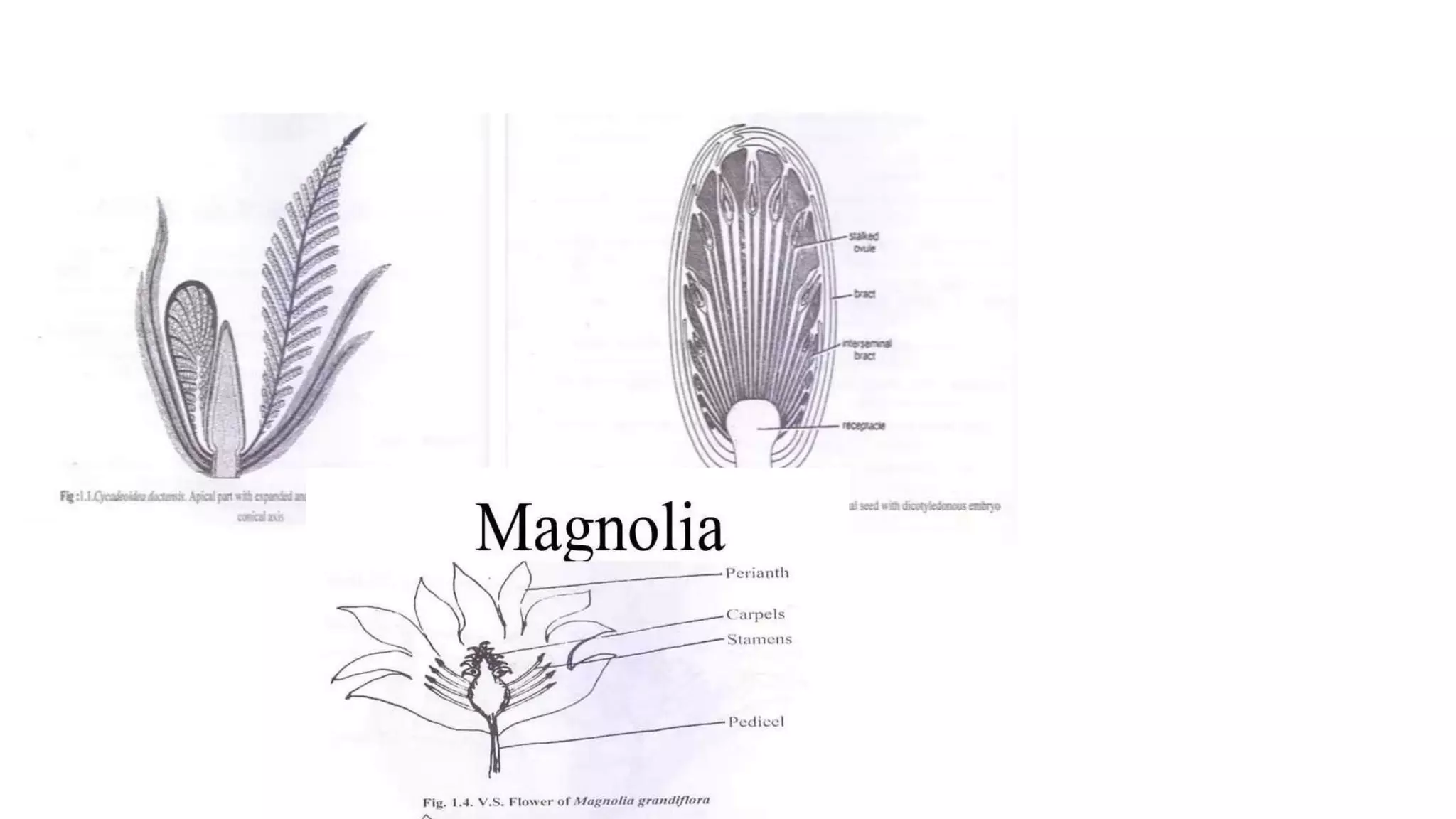
The cones are borne on lateral shoots instead of the stem apex as in the cycads. Each cone or
strobilus consists of a conical central receptacle covered with whorl of megasporophylls or
carpel, each bearing an ovule; around this from lower portion of receptacle a whorl of
compound microsporophylls or stamens present and the whorl is covered by overlapping
pinnate spirally arranged bract. These bracts were covered by dense mass of ramental scales.
The above arrangement of parts in the strobilus is so much like that of the more
primitive angiosperm flower Magnolia having nine perienths arranged in three whorls. Stamens
are numerous arranged spirally on a receptacle. Carpels arranged spirally on a receptacle that
has suggested that bennettitales may be ancestral to the modern angiosperms.
The resemblance of the flower of Magnolia to the cone of Cycadoidea is close
enough to make this conclusion possible, but the vegetative bodies of the two group are very
unlike.
• Arber and Parkin suggested a theory based on existence of imaginary group
Hemiangiospermae have Cycadeoid type flowers linking two groups ie
Gymnosperm and Angiosperm. From the imaginary group the Ranalian type
flower might have originated Cycadoidea had reproductive organs that were
superficially like the flower of an angiosperm have been pointed out by these
workers.
Draw backs of Bennettitalean theory:
• 1. The microsporophylls (stamens) of Magnolia are free and are spirally arranged on the axis but in
bennettitales they are whorled and mostly connate.
• 2. In bennettitales (cycadeoidales) the megasporophylls are greatly reduced, simplified stalk-like
structures, each bearing a solitary terminal erect ovule. Sterile scales (interseminal scale) are
present between megasporophylls. No such structure found in Magnolia,
• 3. Micropyler tube found in bennettitales is absent in angiosperms.
• 4. The seeds of bennettitales are non-endospermic with large embryos while those of primitive
angiospermic seeds are endospermic with small embryos.
• 5. Bennettitales stem has large pith, small vascular bundles and thick
cortex while the stem of
angiosperm has small pith, large vascular bundles and small cortex.
• 6. There are also important differences in the wood structure.
All these fact indicate that bennettitales cannot have been ancestors of
angiosperms, but the similarities with Angiosperm might have developed
due to a common origin and parallel evolution.

Origin and bennettitalean theory

  • 1.
    Bennettitalean Theory Dr. Vasanta I.Kahalkar Department of Botany M. G. College, Armori
  • 2.
    ORIGIN AND EVOLUTIONOF ANGIOSPERMS • In Cretaceous age of angiosperms appeared suddenly. According to Charles Darwin, this sudden appearance of angiosperm in lower or upper cretaceous was abominable mystery. When angiosperms appeared in the cretaceous period, they were fully fledged like the trees and the herbs of today. However, some workers do not agree with the doctrine of abominable mystery. Grand Eury (1906) believes that the angiosperms came into existence through mutation. Lotsy says that hybridization is the key to evolution of angiosperms. There is a very considerable but scattered literature on the origin and phylogeny of angiosperms. Some of the theory proposed from time to time in this connection. These theories are Bennettitalean theory, mean theory, Pteridospermean theory, Coniferae-Ameniiferae theory, Ganetales- Casuarinales theory and Caytoniales angiosperm theory.
  • 3.
    Bennettitalean Theory: • Bennettitaleantheory is also called as Anthostrobillus theory proposed by Weiland (1906) and Arber and Parkin (1907). The Cycadoidea, extinct group of gymnosperms are to be the possible ancestors angiosperms. It was further supported by Haller and Hutchinson (1959). • According to this theory the angiosperm flower is interpreted as being derived from an unbranched bisexual strobilus bearing spirally arranged ovulate and pollen organs, similar to the bisexsual reproductive structure of some extinct bennettitalean gymnosperm. The bennettitales includes plants which were common throughout the Mesozoic. • The fossil specimens reveal that the plant body resembled with living cycads, some have stout trunks, but all crowned with cycad-like leaves. The most remarkable structure is strobilus (cone).
  • 4.
    The cones areborne on lateral shoots instead of the stem apex as in the cycads. Each cone or strobilus consists of a conical central receptacle covered with whorl of megasporophylls or carpel, each bearing an ovule; around this from lower portion of receptacle a whorl of compound microsporophylls or stamens present and the whorl is covered by overlapping pinnate spirally arranged bract. These bracts were covered by dense mass of ramental scales. The above arrangement of parts in the strobilus is so much like that of the more primitive angiosperm flower Magnolia having nine perienths arranged in three whorls. Stamens are numerous arranged spirally on a receptacle. Carpels arranged spirally on a receptacle that has suggested that bennettitales may be ancestral to the modern angiosperms. The resemblance of the flower of Magnolia to the cone of Cycadoidea is close enough to make this conclusion possible, but the vegetative bodies of the two group are very unlike.
  • 6.
    • Arber andParkin suggested a theory based on existence of imaginary group Hemiangiospermae have Cycadeoid type flowers linking two groups ie Gymnosperm and Angiosperm. From the imaginary group the Ranalian type flower might have originated Cycadoidea had reproductive organs that were superficially like the flower of an angiosperm have been pointed out by these workers.
  • 7.
    Draw backs ofBennettitalean theory: • 1. The microsporophylls (stamens) of Magnolia are free and are spirally arranged on the axis but in bennettitales they are whorled and mostly connate. • 2. In bennettitales (cycadeoidales) the megasporophylls are greatly reduced, simplified stalk-like structures, each bearing a solitary terminal erect ovule. Sterile scales (interseminal scale) are present between megasporophylls. No such structure found in Magnolia, • 3. Micropyler tube found in bennettitales is absent in angiosperms. • 4. The seeds of bennettitales are non-endospermic with large embryos while those of primitive angiospermic seeds are endospermic with small embryos.
  • 8.
    • 5. Bennettitalesstem has large pith, small vascular bundles and thick cortex while the stem of angiosperm has small pith, large vascular bundles and small cortex. • 6. There are also important differences in the wood structure. All these fact indicate that bennettitales cannot have been ancestors of angiosperms, but the similarities with Angiosperm might have developed due to a common origin and parallel evolution.