
Sub.:- Fundamentals of Plant Breeding
Course No. :- APB- 5211
Credit hours:- 3(2+1)
Lec. Topic :- Introduction & Acclimatization
Presentedby:-
Lt. Roshan Parihar, Asstt. Professor
Deptt.ofGenetics& PlantBreeding
Indira Gandhi Krishi Vishwavidyalaya
Raipur, C.G.
BTC College of Agriculture & Research Station
,Sarkanda, Bilaspur,(CG)-495001
(अनुकू लन और पुरःस्थापन)
Definition of Introduction
 Introduction or growing of a genotype or
a group of genotypes into a new place or
environment where they were not grown
previously.
 It involve new varieties of a crop already grown in that
area, a wild relative of the crop species or totally a
new crop species for that area.
 It is a method of breeding crops.
Eg. Grape cultivation in Haryana,
Introduction of wheat in West Bengal, Rice in Punjab ,
Introduction of lRRl rice varieties.
History of Plant Introduction
Mung, mustard, pear, apple and walnut were introduced from the
Central Asian Center of origin
Sesame, Jowar, arhar, Asian Cotton and finger millet originated in
Africa and traveled to India
Muslim invaders introduced cherries and grapes from Afghanistan
by 1300 A.D in India
Portuguese introduced Maize, groundnut, chillies, potato, sweet
potato, guava pineapple, papaya, cashew nut and Tobacco.
East India Company brought tea, litchi, and loquat from China.
Cabbage, cauliflower and other vegetables from the Mediterranean;
Annatto and mahogany from West Indies in the last quarter of 18th
century.
Kew botanic gardens, England arranged introduction of quinine and
rubber trees from South America into India.
Types of Plant Introduction
 Based on adaptation
 Primary Introduction - Variety is well adopted to the new environment,
released for commercial cultivation without any alteration in the original
genotype. Taichung Native 1 (TN-1), IR-8, Jaya, IR 20, IR 34
 Secondary Introduction - Introduced variety may be subjected to selection &
hybridisation to isolate a superior variety. Wheat varieties Kalyan Sona and
sonalika were selected from Mexican wheat varieties.
 Based on utilization
 Direct Introduction –new variety takes no time for establishment.
 Indirect Introduction –new variety takes some time for
establishment.
 Exotic variety – foreign variety directly recommended for
commercial cultivation in newenvironment.
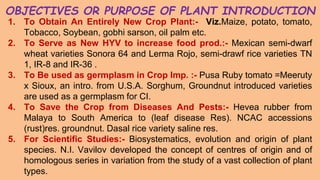
OBJECTIVES OR PURPOSE OF PLANT INTRODUCTION
1. To Obtain An Entirely New Crop Plant:- Viz.Maize, potato, tomato,
Tobacco, Soybean, gobhi sarson, oil palm etc.
2. To Serve as New HYV to increase food prod.:- Mexican semi-dwarf
wheat varieties Sonora 64 and Lerma Rojo, semi-drawf rice varieties TN
1, IR-8 and IR-36 .
3. To Be used as germplasm in Crop Imp. :- Pusa Ruby tomato =Meeruty
x Sioux, an intro. from U.S.A. Sorghum, Groundnut introduced varieties
are used as a germplasm for CI.
4. To Save the Crop from Diseases And Pests:- Hevea rubber from
Malaya to South America to (leaf disease Res). NCAC accessions
(rust)res. groundnut. Dasal rice variety saline res.
5. For Scientific Studies:- Biosystematics, evolution and origin of plant
species. N.I. Vavilov developed the concept of centres of origin and of
homologous series in variation from the study of a vast collection of plant
types.
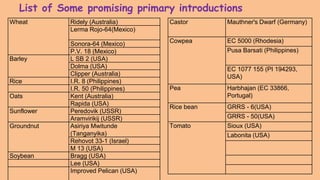
Wheat Ridely (Australia)
Lerma Rojo-64(Mexico)
Sonora-64 (Mexico)
P.V. 18 (Mexico)
Barley L SB 2 (USA)
Dolma (USA)
Clipper (Australia)
Rice I.R. 8 (Philippines)
I.R. 50 (Philippines)
Oats Kent (Australia)
Rapida (USA)
Sunflower Peredovik (USSR)
Aramvirikij (USSR)
Groundnut Asiriya Mwitunde
(Tanganyika)
Rehovot 33-1 (Israel)
M 13 (USA)
Soybean Bragg (USA)
Lee (USA)
Improved Pelican (USA)
Castor Mauthner's Dwarf (Germany)
Cowpea EC 5000 (Rhodesia)
Pusa Barsati (Philippines)
EC 1077 155 (PI 194293,
USA)
Pea Harbhajan (EC 33866,
Portugal)
Rice bean GRRS - 6(USA)
GRRS - 50(USA)
Tomato Sioux (USA)
Labonita (USA)
List of Some promising primary introductions
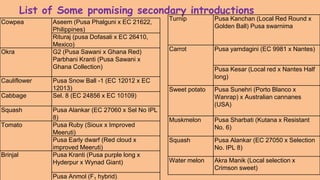
List of Some promising secondary introductions
Cowpea Aseem (Pusa Phalguni x EC 21622,
Philippines)
Rituraj (pusa Dofasali x EC 26410,
Mexico)
Okra G2 (Pusa Sawani x Ghana Red)
Parbhani Kranti (Pusa Sawani x
Ghana Collection)
Cauliflower Pusa Snow Ball -1 (EC 12012 x EC
12013)
Cabbage Sel. 8 (EC 24856 x EC 10109)
Squash Pusa Alankar (EC 27060 x Sel No IPL
8)
Tomato Pusa Ruby (Sioux x Improved
Meeruti)
Pusa Early dwarf (Red cloud x
improved Meeruti)
Brinjal Pusa Kranti (Pusa purple long x
Hyderpur x Wynad Giant)
Pusa Anmol (F1 hybrid)
Turnip Pusa Kanchan (Local Red Round x
Golden Ball) Pusa swarnima
Carrot Pusa yamdagini (EC 9981 x Nantes)
Pusa Kesar (Local red x Nantes Half
long)
Sweet potato Pusa Sunehri (Porto Blanco x
Wanrap) x Australian cannanes
(USA)
Muskmelon Pusa Sharbati (Kutana x Resistant
No. 6)
Squash Pusa Alankar (EC 27050 x Selection
No. IPL 8)
Water melon Akra Manik (Local selection x
Crimson sweet)
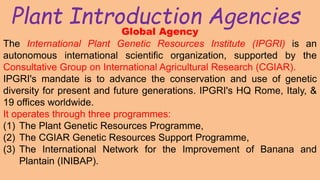
Plant Introduction Agencies
Global Agency
The International Plant Genetic Resources Institute (IPGRI) is an
autonomous international scientific organization, supported by the
Consultative Group on International Agricultural Research (CGIAR).
IPGRI's mandate is to advance the conservation and use of genetic
diversity for present and future generations. IPGRI's HQ Rome, Italy, &
19 offices worldwide.
It operates through three programmes:
(1) The Plant Genetic Resources Programme,
(2) The CGIAR Genetic Resources Support Programme,
(3) The International Network for the Improvement of Banana and
Plantain (INIBAP).
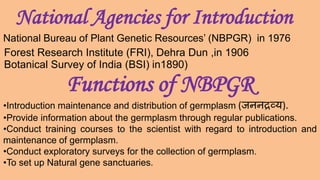
National Agencies for Introduction
National Bureau of Plant Genetic Resources’ (NBPGR) in 1976
Forest Research Institute (FRI), Dehra Dun ,in 1906
Botanical Survey of India (BSI) in1890)
•Introduction maintenance and distribution of germplasm (जननद्रव्य).
•Provide information about the germplasm through regular publications.
•Conduct training courses to the scientist with regard to introduction and
maintenance of germplasm.
•Conduct exploratory surveys for the collection of germplasm.
•To set up Natural gene sanctuaries.
Functions of NBPGR
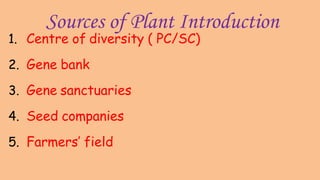
Sources of Plant Introduction
1. Centre of diversity ( PC/SC)
2. Gene bank
3. Gene sanctuaries
4. Seed companies
5. Farmers’ field
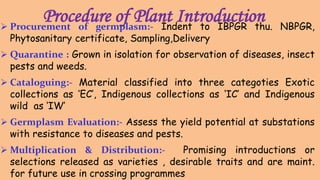
Procedure of Plant Introduction Procurement of germplasm:- Indent to IBPGR thu. NBPGR,
Phytosanitary certificate, Sampling,Delivery
 Quarantine : Grown in isolation for observation of diseases, insect
pests and weeds.
 Cataloguing:- Material classified into three categoties Exotic
collections as ‘EC’, Indigenous collections as ‘IC’ and Indigenous
wild as ‘IW’
 Germplasm Evaluation:- Assess the yield potential at substations
with resistance to diseases and pests.
 Multiplication & Distribution:- Promising introductions or
selections released as varieties , desirable traits and are maint.
for future use in crossing programmes
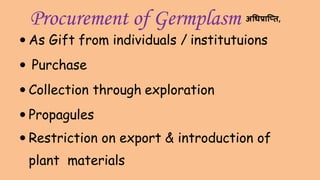
Procurement of Germplasm
 As Gift from individuals / institutuions
 Purchase
 Collection through exploration
 Propagules
 Restriction on export & introduction of
plant materials
अधिप्राप्ति,
Quarantine
 Keeping materials in isolation to prevent thespread of
diseases.
 Fumigation or other treatments (if necessary).
 According to destructive insects & pests act, 1914,
quarantine for different group of plant produce is carried
out by different agencies.
 Quarantine & fumigation centres atSea-ports(8),
Airports(7) & at entry point of landroutes(7).
संगरोि
Cataloguing
 Accession number is given to a new introduced material
 Information regarding nameof species & variety, place of
origin, adaptation & its various features are also recorded.
 Cataloguing of germplasm collections is published by gene
bank.
 The introduced materials are of 3 types & given a prefix-
 EC – Exotic Collection
 IC – Indigenous Collection
 IW –Indigenous Wild
कै टलॉधगंग/ सूचीपत्र
To assess the yield potential of new introductions,
their performance is evaluated at different substations
of the Bureau.
Simla, Jodhpur, Kanya Kumari, Akola, Shillong
In case of those crops for which Central Research
Institutes are functioning, e.g., rice, sugarcane, potato,
Tobacco etc., the introduced materials are evaluated and
maintained by these institutes under epiphytotic
conditions.
Evaluation : मूल्ांकन
•Promising introductions or selections from the
introductions may be increased and released as
varieties after the necessary trials.
• Most of the introductions, however, are
characterized for desirable traits and are maintained
for future use.
•Such materials are used in crossing programmes and
are readily supplied by the bureau on request.
Multiplication and Distribution :
गुणन और वितरण
Important Achievements
 Crops are cultivated extensively after their
introduction as new crop species.
 Introductions have been directly released as variety.
 Varieties selected from introduction
 Introduction helps to develop varieties through
hybridization.
Merits of Plant Introduction
It provides new crop plants or high yieldingvarieties, used directly.
Eg. Maize, potato, tomato, groundnut, papaya, pineapple, triticale
etc.
Provides parent materials for genetic improvement of economic
crops.
Enriching the existing germplasm and increasing the variability.
Introduction and exploration protect variability from genetic
erosion.
It is very quick & economical method of crop improvement,
particularly when the introductions are released as superior
varieties either directly or after a simple selection.
Introduction may protect certain plant species in to newer area
will save them from diseases. E.g. Coffee and Rubber.
Demerits of Plant Introduction
•Introduction of new weed unknowingly.E.g. Argemone
Mexicana, Eichornia and Parthenium.
•Introduction of new diseases: Late blight of potato from
Europe and Bunchy top of banana from Sri Lanka.
•Introduction of new New pests: Potato tuber moth came
from Italy.
•Introduction of new Ornamentals becoming weeds: Lantana
camara.
•Introduction may cause ecological imbalance
E.g.Eucalyptus.30
Acclimatization (अनुकू लन)
It is the process in which an individual organism adjust
to a change in its enviromment, allowing it to maintain
performance across a range of environmental conditions.
(such as a change in altitude, temperature, humidity,
photoperiod, or pH), allowing it to maintain performance
across a range of environmental conditions.
Example, low pressure of oxygen (hypoxia) in high
mountains, animals, including man, improve the capacity of
blood to transport oxygen by increasing the number of
red blood cells (polycythemia); in the chronic disease
emphysema, the inadequate supply of oxygen to the lungs
Performance of a variety is picked up in the new
environment improves with the number of
generations grown there.
Thus acclimatization is the self regulating ability
of crop variety to become adapted to new climatic
and edaphic conditions.
The process of acclimatization follows an increase
in the frequency of better adapted genotypes to the
new environment.
Thus acclimatization is essentially natural
selection.
Causes of acclimatization:
Existence and magnitude of genetic variation.
Duration of life cycle.
Mode of reproduction.
Intensity of stress.
Presence of heterozygosity. Eg. Cross pollinated
crops, multiline, composites, synthetics.
Mode of pollination. Cross pollinated crops are readily
acclimatized than self pollinated crops.
Presence of genetic variation on the introduced material
out of which successful genotypes are increased in
frequency to give the acceptable performance.
Factors governing acclimatization: (कारक)
(कारण)
Thanks

Plant introduction and acclimatization

  • 1.
    Sub.:- Fundamentals ofPlant Breeding Course No. :- APB- 5211 Credit hours:- 3(2+1) Lec. Topic :- Introduction & Acclimatization Presentedby:- Lt. Roshan Parihar, Asstt. Professor Deptt.ofGenetics& PlantBreeding Indira Gandhi Krishi Vishwavidyalaya Raipur, C.G. BTC College of Agriculture & Research Station ,Sarkanda, Bilaspur,(CG)-495001 (अनुकू लन और पुरःस्थापन)
  • 2.
    Definition of Introduction Introduction or growing of a genotype or a group of genotypes into a new place or environment where they were not grown previously.  It involve new varieties of a crop already grown in that area, a wild relative of the crop species or totally a new crop species for that area.  It is a method of breeding crops. Eg. Grape cultivation in Haryana, Introduction of wheat in West Bengal, Rice in Punjab , Introduction of lRRl rice varieties.
  • 3.
    History of PlantIntroduction Mung, mustard, pear, apple and walnut were introduced from the Central Asian Center of origin Sesame, Jowar, arhar, Asian Cotton and finger millet originated in Africa and traveled to India Muslim invaders introduced cherries and grapes from Afghanistan by 1300 A.D in India Portuguese introduced Maize, groundnut, chillies, potato, sweet potato, guava pineapple, papaya, cashew nut and Tobacco. East India Company brought tea, litchi, and loquat from China. Cabbage, cauliflower and other vegetables from the Mediterranean; Annatto and mahogany from West Indies in the last quarter of 18th century. Kew botanic gardens, England arranged introduction of quinine and rubber trees from South America into India.
  • 4.
    Types of PlantIntroduction  Based on adaptation  Primary Introduction - Variety is well adopted to the new environment, released for commercial cultivation without any alteration in the original genotype. Taichung Native 1 (TN-1), IR-8, Jaya, IR 20, IR 34  Secondary Introduction - Introduced variety may be subjected to selection & hybridisation to isolate a superior variety. Wheat varieties Kalyan Sona and sonalika were selected from Mexican wheat varieties.  Based on utilization  Direct Introduction –new variety takes no time for establishment.  Indirect Introduction –new variety takes some time for establishment.  Exotic variety – foreign variety directly recommended for commercial cultivation in newenvironment.
  • 5.
    OBJECTIVES OR PURPOSEOF PLANT INTRODUCTION 1. To Obtain An Entirely New Crop Plant:- Viz.Maize, potato, tomato, Tobacco, Soybean, gobhi sarson, oil palm etc. 2. To Serve as New HYV to increase food prod.:- Mexican semi-dwarf wheat varieties Sonora 64 and Lerma Rojo, semi-drawf rice varieties TN 1, IR-8 and IR-36 . 3. To Be used as germplasm in Crop Imp. :- Pusa Ruby tomato =Meeruty x Sioux, an intro. from U.S.A. Sorghum, Groundnut introduced varieties are used as a germplasm for CI. 4. To Save the Crop from Diseases And Pests:- Hevea rubber from Malaya to South America to (leaf disease Res). NCAC accessions (rust)res. groundnut. Dasal rice variety saline res. 5. For Scientific Studies:- Biosystematics, evolution and origin of plant species. N.I. Vavilov developed the concept of centres of origin and of homologous series in variation from the study of a vast collection of plant types.
  • 6.
    Wheat Ridely (Australia) LermaRojo-64(Mexico) Sonora-64 (Mexico) P.V. 18 (Mexico) Barley L SB 2 (USA) Dolma (USA) Clipper (Australia) Rice I.R. 8 (Philippines) I.R. 50 (Philippines) Oats Kent (Australia) Rapida (USA) Sunflower Peredovik (USSR) Aramvirikij (USSR) Groundnut Asiriya Mwitunde (Tanganyika) Rehovot 33-1 (Israel) M 13 (USA) Soybean Bragg (USA) Lee (USA) Improved Pelican (USA) Castor Mauthner's Dwarf (Germany) Cowpea EC 5000 (Rhodesia) Pusa Barsati (Philippines) EC 1077 155 (PI 194293, USA) Pea Harbhajan (EC 33866, Portugal) Rice bean GRRS - 6(USA) GRRS - 50(USA) Tomato Sioux (USA) Labonita (USA) List of Some promising primary introductions
  • 7.
    List of Somepromising secondary introductions Cowpea Aseem (Pusa Phalguni x EC 21622, Philippines) Rituraj (pusa Dofasali x EC 26410, Mexico) Okra G2 (Pusa Sawani x Ghana Red) Parbhani Kranti (Pusa Sawani x Ghana Collection) Cauliflower Pusa Snow Ball -1 (EC 12012 x EC 12013) Cabbage Sel. 8 (EC 24856 x EC 10109) Squash Pusa Alankar (EC 27060 x Sel No IPL 8) Tomato Pusa Ruby (Sioux x Improved Meeruti) Pusa Early dwarf (Red cloud x improved Meeruti) Brinjal Pusa Kranti (Pusa purple long x Hyderpur x Wynad Giant) Pusa Anmol (F1 hybrid) Turnip Pusa Kanchan (Local Red Round x Golden Ball) Pusa swarnima Carrot Pusa yamdagini (EC 9981 x Nantes) Pusa Kesar (Local red x Nantes Half long) Sweet potato Pusa Sunehri (Porto Blanco x Wanrap) x Australian cannanes (USA) Muskmelon Pusa Sharbati (Kutana x Resistant No. 6) Squash Pusa Alankar (EC 27050 x Selection No. IPL 8) Water melon Akra Manik (Local selection x Crimson sweet)
  • 8.
    Plant Introduction Agencies GlobalAgency The International Plant Genetic Resources Institute (IPGRI) is an autonomous international scientific organization, supported by the Consultative Group on International Agricultural Research (CGIAR). IPGRI's mandate is to advance the conservation and use of genetic diversity for present and future generations. IPGRI's HQ Rome, Italy, & 19 offices worldwide. It operates through three programmes: (1) The Plant Genetic Resources Programme, (2) The CGIAR Genetic Resources Support Programme, (3) The International Network for the Improvement of Banana and Plantain (INIBAP).
  • 9.
    National Agencies forIntroduction National Bureau of Plant Genetic Resources’ (NBPGR) in 1976 Forest Research Institute (FRI), Dehra Dun ,in 1906 Botanical Survey of India (BSI) in1890) •Introduction maintenance and distribution of germplasm (जननद्रव्य). •Provide information about the germplasm through regular publications. •Conduct training courses to the scientist with regard to introduction and maintenance of germplasm. •Conduct exploratory surveys for the collection of germplasm. •To set up Natural gene sanctuaries. Functions of NBPGR
  • 10.
    Sources of PlantIntroduction 1. Centre of diversity ( PC/SC) 2. Gene bank 3. Gene sanctuaries 4. Seed companies 5. Farmers’ field
  • 11.
    Procedure of PlantIntroduction Procurement of germplasm:- Indent to IBPGR thu. NBPGR, Phytosanitary certificate, Sampling,Delivery  Quarantine : Grown in isolation for observation of diseases, insect pests and weeds.  Cataloguing:- Material classified into three categoties Exotic collections as ‘EC’, Indigenous collections as ‘IC’ and Indigenous wild as ‘IW’  Germplasm Evaluation:- Assess the yield potential at substations with resistance to diseases and pests.  Multiplication & Distribution:- Promising introductions or selections released as varieties , desirable traits and are maint. for future use in crossing programmes
  • 12.
    Procurement of Germplasm As Gift from individuals / institutuions  Purchase  Collection through exploration  Propagules  Restriction on export & introduction of plant materials अधिप्राप्ति,
  • 13.
    Quarantine  Keeping materialsin isolation to prevent thespread of diseases.  Fumigation or other treatments (if necessary).  According to destructive insects & pests act, 1914, quarantine for different group of plant produce is carried out by different agencies.  Quarantine & fumigation centres atSea-ports(8), Airports(7) & at entry point of landroutes(7). संगरोि
  • 14.
    Cataloguing  Accession numberis given to a new introduced material  Information regarding nameof species & variety, place of origin, adaptation & its various features are also recorded.  Cataloguing of germplasm collections is published by gene bank.  The introduced materials are of 3 types & given a prefix-  EC – Exotic Collection  IC – Indigenous Collection  IW –Indigenous Wild कै टलॉधगंग/ सूचीपत्र
  • 15.
    To assess theyield potential of new introductions, their performance is evaluated at different substations of the Bureau. Simla, Jodhpur, Kanya Kumari, Akola, Shillong In case of those crops for which Central Research Institutes are functioning, e.g., rice, sugarcane, potato, Tobacco etc., the introduced materials are evaluated and maintained by these institutes under epiphytotic conditions. Evaluation : मूल्ांकन
  • 16.
    •Promising introductions orselections from the introductions may be increased and released as varieties after the necessary trials. • Most of the introductions, however, are characterized for desirable traits and are maintained for future use. •Such materials are used in crossing programmes and are readily supplied by the bureau on request. Multiplication and Distribution : गुणन और वितरण
  • 17.
    Important Achievements  Cropsare cultivated extensively after their introduction as new crop species.  Introductions have been directly released as variety.  Varieties selected from introduction  Introduction helps to develop varieties through hybridization.
  • 18.
    Merits of PlantIntroduction It provides new crop plants or high yieldingvarieties, used directly. Eg. Maize, potato, tomato, groundnut, papaya, pineapple, triticale etc. Provides parent materials for genetic improvement of economic crops. Enriching the existing germplasm and increasing the variability. Introduction and exploration protect variability from genetic erosion. It is very quick & economical method of crop improvement, particularly when the introductions are released as superior varieties either directly or after a simple selection. Introduction may protect certain plant species in to newer area will save them from diseases. E.g. Coffee and Rubber.
  • 19.
    Demerits of PlantIntroduction •Introduction of new weed unknowingly.E.g. Argemone Mexicana, Eichornia and Parthenium. •Introduction of new diseases: Late blight of potato from Europe and Bunchy top of banana from Sri Lanka. •Introduction of new New pests: Potato tuber moth came from Italy. •Introduction of new Ornamentals becoming weeds: Lantana camara. •Introduction may cause ecological imbalance E.g.Eucalyptus.30
  • 20.
    Acclimatization (अनुकू लन) Itis the process in which an individual organism adjust to a change in its enviromment, allowing it to maintain performance across a range of environmental conditions. (such as a change in altitude, temperature, humidity, photoperiod, or pH), allowing it to maintain performance across a range of environmental conditions. Example, low pressure of oxygen (hypoxia) in high mountains, animals, including man, improve the capacity of blood to transport oxygen by increasing the number of red blood cells (polycythemia); in the chronic disease emphysema, the inadequate supply of oxygen to the lungs
  • 21.
    Performance of avariety is picked up in the new environment improves with the number of generations grown there. Thus acclimatization is the self regulating ability of crop variety to become adapted to new climatic and edaphic conditions. The process of acclimatization follows an increase in the frequency of better adapted genotypes to the new environment. Thus acclimatization is essentially natural selection.
  • 22.
    Causes of acclimatization: Existenceand magnitude of genetic variation. Duration of life cycle. Mode of reproduction. Intensity of stress. Presence of heterozygosity. Eg. Cross pollinated crops, multiline, composites, synthetics. Mode of pollination. Cross pollinated crops are readily acclimatized than self pollinated crops. Presence of genetic variation on the introduced material out of which successful genotypes are increased in frequency to give the acceptable performance. Factors governing acclimatization: (कारक) (कारण)
  • 23.