Domestication, Acclimatization
and Plant Introduction
Presentation
on
Prepared by
Dr. Amita Sharma
Assistant Professor
Deptt. Of Genetics & Plant Breeding
CoA, Balaghat (M.P.)
What is Domestication?
Domestication is the process of bringing wild species under human management.
Selection under Domestication
When different genotypes present in a population reproduce at different rates, it is called as selection. A
population may be defined as a group of individuals which mate or can mate freely with each other. Thus,
population consists of individuals of a single species growing in the same locality. Selection is known as
natural or artificial depending on the agency responsible for it.
1. Natural selection: Selection due to natural forces like climate, soil, biological factors eg., Disease,
pests etc. and other factors of the environment is called as natural selection. It occurs in natural
populations, i.e. wild forms and wild species and determines the course of their evolution. In 1962,
Nicholson proposed that natural selection may be seen to operate through two mechanisms viz.,
environmental selection, and competition. Environmental selection acts against all such genotypes that
are unable to cope with the environmental stresses.
As a result, the population consists ultimately of only those genotypes that are capable of surviving the
prevalent environmental stresses and are able to reproduce. Natural selection through competition occurs
in crop populations where a plant takes up more water, nutrients or light than another and at the expense
of the other. Therefore, the more successful is a plant in exploiting resources, the greater will be its
potential to be represented in the succeeding generations and it will select through competition.
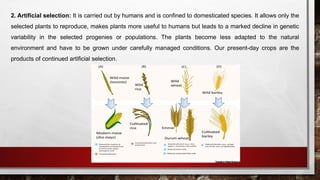
2. Artificial selection: It is carried out by humans and is confined to domesticated species. It allows only the
selected plants to reproduce, makes plants more useful to humans but leads to a marked decline in genetic
variability in the selected progenies or populations. The plants become less adapted to the natural
environment and have to be grown under carefully managed conditions. Our present-day crops are the
products of continued artificial selection.
Types of Selection
Selection is grouped into three types depending on the type of phenotypic class favored by it:
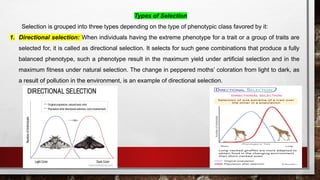
1. Directional selection: When individuals having the extreme phenotype for a trait or a group of traits are
selected for, it is called as directional selection. It selects for such gene combinations that produce a fully
balanced phenotype, such a phenotype result in the maximum yield under artificial selection and in the
maximum fitness under natural selection. The change in peppered moths’ coloration from light to dark, as
a result of pollution in the environment, is an example of directional selection.
2. Stabilizing selection: When selection favors the intermediate
phenotype and acts against the extreme phenotypes, it is termed as
stabilizing selection. For example, if plants that are too short don’t get
enough sunlight and plants that are too tall are susceptible to damage
from wind, plants of medium height would be more likely to survive
and pass on their genetic information.
For eg. Birth weight in human babies is a common example—babies
with too low a birth weight are more susceptible to cold and disease,
and larger babies are more difficult to deliver. This means that the
distribution of birth weight in human babies looks like a normal
distribution curve (aka. a bell curve), with most babies being born with
weights that fall in the middle of the range.
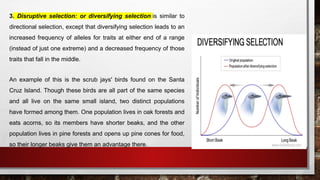
3. Disruptive selection: or diversifying selection is similar to
directional selection, except that diversifying selection leads to an
increased frequency of alleles for traits at either end of a range
(instead of just one extreme) and a decreased frequency of those
traits that fall in the middle.
An example of this is the scrub jays' birds found on the Santa
Cruz Island. Though these birds are all part of the same species
and all live on the same small island, two distinct populations
have formed among them. One population lives in oak forests and
eats acorns, so its members have shorter beaks, and the other
population lives in pine forests and opens up pine cones for food,
so their longer beaks give them an advantage there.
Plant Introduction
Plant introduction consists of taking a genotype or a group of genotypes of plants into a new area
or a region where they were not being grown before.
Introduction may involve new varieties of a crop already grown in the area, wild relatives of the crop
species or a totally new crop species. Mostly materials are introduced from other countries or continents.
But movement of crop varieties from one environment into another within a country is also introduction.
Some examples of within the country introduction are popularization of grape cultivation in Haryana,
Introduction of wheat in West Bengal, Rice in Punjab etc.
There are two types of introduction:
1. Primary Introduction: When the introduced variety is well suited to the new environment, it is
released for commercial cultivation without any alteration in the original genotype, this is called
primary introduction. Primary introduction is less common, particularly in countries having well
organized crop improvement programmes.
Introduction of semi dwarf wheat varieties Sonora 64, Lerma Roja and of semi dwarf rice varieties
Taichung Native 1 (TN-1), IR-8 and IR-36 are some examples of primary introductions.
2. Secondary Introduction: The introduced variety may be subjected to selection to isolate a
superior variety or it may be hybridized with local varieties to transfer one or few characters from this
variety to the local ones this is called as secondary introduction.
Secondary introduction is much more common than primary introduction. Examples of
secondary introduction are Kalyan Sona and sonalika wheat varieties selected from material
introduced from CIMMYT, Mexico.
Plant Introduction Agencies in India
A centralized plant introduction agency was initiated in 1946 at the Indian Agricultural Research Institute
(IARI), New Delhi. The agency began as a plant introduction scheme in the Division of Botany and was
funded by ICAR. In 1956, during the second five-year plan, the scheme was expanded as the Plant
Introduction and Exploration Organization. Subsequently in 1961, it was made an independent division in
IARI, the Division of Plant Introduction. The division was reorganized as National Bureau of Plant
Genetic Resources (NBPGR) in 1976. The bureau is responsible for the introduction and maintenance of
germplasm of agricultural and horticultural plants.
Procedure of Plant Introduction:
Introduction consists of the following steps: Procurement, quarantine, cataloguing, evaluation,
acclimatization and distribution.
1. Procurement: Introduction of germplasm in India by outside is known as Procurement. Procure
means to acquire or to get. The procurement is routed through NBPGR.
2. Quarantine: Quarantine means to keep materials in isolation to prevent the spread of diseases etc.
All the introduced plant propagules are thoroughly inspected for contamination with weeds, diseases
and insect pests. Materials that are suspected to be contaminated are fumigated or are given other
treatments to get rid of the contamination. If necessary, the materials are grown in isolation for
observation of diseases, insect pests and weeds. The entire process is known as quarantine and the
rules prescribing them are known as quarantine rules.
3. Cataloguing: When an introduction is received, it is given an entry number. Further, information
regarding name of the species, variety, place of origin, adaptation and its various characteristics are
recorded. The plant materials are classified into three groups.
a. Exotic collections are given the prefix ‘EC’
b. Indigenous collections are designated as ‘IC’ and
c. Indigenous wild collections are marked as ‘IW’
4. Evaluation: To assess the potential of new introductions, their performance is evaluated at different
substations of the Bureau.
Acclimatization: Generally, the introduced varieties perform poorly because they are often not adapted
to the new environment. Sometimes, the performance of a variety in the new environment improves with
the number of generations grown there. The process that leads to the adaptation of a variety to a
new environment is known as acclimatization.
Acclimatization is brought about by a faster multiplication of those genotypes (present in the original
population) that are better adapted to the new environment. Thus, acclimatization is actually natural
selection. Variability must be present in the original population for acclimatization to occur. Therefore,
land varieties are likely to get acclimatized, while pure lines are not.
The extent of acclimatization is determined by;
(1) the mode of pollination, for eg. Cross-pollination leads to far greater gene recombination than
self-pollination. As a result cross-pollination is much more helpful in acclimatization than self-
pollination.
(2) the range of genetic variability present in the original population: wide genetic variability is
better than narrow genetic variability.
(3) the duration of life cycle of the crop: short duration crops will reproduce faster and multiply faster
than long duration crops.
5. Multiplication and Distribution: Promising introductions or selections from the introductions may
be increased and released as varieties after the necessary trials. most of the introductions, however,
are characterized for desirable traits and are maintained for future use. Such materials are used in
crossing programmes and are readily supplied by the bureau on request.
PURPOSE OF PLANT INTRODUCTION
The main purpose of plant introduction is to improve the plant wealth of the country,
1. To obtain an entirely new crop plant. Plant introductions may provide an entirely new crop
species. Many of our important crops, e.g., Maize, potato, tomato, Tobacco, etc., are introductions.
Some recently introduced crops are Soybean, gobhi sarson, oil palm etc.
2. To serve as new varieties. Sometimes introductions are directly released as superior commercial
varieties. The Mexican semi dwarf wheat varieties Sonora 64 and Lerma Rojo semi dwarf rice varieties
TN 1, IR-8 and IR-36 are more recent examples of this type.
3. To be used in crop improvement programmes. Often the introduced material is used for
hybridization with local varieties to develop improved varieties. Pusa Ruby tomato was derived from a
cross between Meeruty and Sioux, an introduction from U.S.A.
4. To save the crop from pests and diseases. Sometimes a crop is introduced into a new area to

protect it from diseases and pests. Coffee was introduced in South America from Africa to prevent
losses from leaf rust. Hevea rubber, on the other hand, was brought to Malaya from South America to
protect it from a leaf disease.
5. For scientific studies. Collections of plants have been used for studies on biosystematics, evolution
and origin of plant species. N.I. Vavilov developed the concept of centres of origin and that of
homologous series in variation from the study of a vast collection of plant types.
6. For aesthetic values. Ornamentals, shrubs and lawn grasses are used for decoration and are of
great value in social life.
7. Varieties selected from Introductions. Many varieties have been developed through selection from
introductions. Two varieties of wheat, Kalyan Sona and Sonalika, were selected from introductions from
CIMMYT, Mexico.
8. Varieties Developed through Hybridization. Introductions have contributed immensely to the
development of crop varieties through hybridization. All the semi dwarf wheat varieties are derived from
crosses with Mexican semi-dwarf wheat. All semi dwarf rice varieties possess the dwarfing gene from
Dee-geo-woo-gen through either TN1 or IR 8. All the sugarcane varieties have been derived from the
introduced noble canes.
Merits of Plant Introduction
1. It provides entirely new crop plants.
2. It provides superior varieties either directly or after selection & hybridization.
3. Introduction and exploration are the only feasible means of collecting germplasm and to protect
variability from genetic erosion.
4. It is very quick & economical method of crop improvement, particularly when the introductions are
released as varieties either directly or after a simple selection.
5. Plants may be introduced in new disease free areas to protect them from damage, e.g., coffee and
rubber.
Demerits of Plant Introduction
The disadvantages of plant introduction are associated with the introduction of weeds, diseases and
pests.
presentation on domestication, acclimatization and selection.pptx

presentation on domestication, acclimatization and selection.pptx

  • 1.
    Domestication, Acclimatization and PlantIntroduction Presentation on Prepared by Dr. Amita Sharma Assistant Professor Deptt. Of Genetics & Plant Breeding CoA, Balaghat (M.P.)
  • 2.
    What is Domestication? Domesticationis the process of bringing wild species under human management. Selection under Domestication When different genotypes present in a population reproduce at different rates, it is called as selection. A population may be defined as a group of individuals which mate or can mate freely with each other. Thus, population consists of individuals of a single species growing in the same locality. Selection is known as natural or artificial depending on the agency responsible for it.
  • 3.
    1. Natural selection:Selection due to natural forces like climate, soil, biological factors eg., Disease, pests etc. and other factors of the environment is called as natural selection. It occurs in natural populations, i.e. wild forms and wild species and determines the course of their evolution. In 1962, Nicholson proposed that natural selection may be seen to operate through two mechanisms viz., environmental selection, and competition. Environmental selection acts against all such genotypes that are unable to cope with the environmental stresses. As a result, the population consists ultimately of only those genotypes that are capable of surviving the prevalent environmental stresses and are able to reproduce. Natural selection through competition occurs in crop populations where a plant takes up more water, nutrients or light than another and at the expense of the other. Therefore, the more successful is a plant in exploiting resources, the greater will be its potential to be represented in the succeeding generations and it will select through competition.
  • 4.
    2. Artificial selection:It is carried out by humans and is confined to domesticated species. It allows only the selected plants to reproduce, makes plants more useful to humans but leads to a marked decline in genetic variability in the selected progenies or populations. The plants become less adapted to the natural environment and have to be grown under carefully managed conditions. Our present-day crops are the products of continued artificial selection.
  • 5.
    Types of Selection Selectionis grouped into three types depending on the type of phenotypic class favored by it: 1. Directional selection: When individuals having the extreme phenotype for a trait or a group of traits are selected for, it is called as directional selection. It selects for such gene combinations that produce a fully balanced phenotype, such a phenotype result in the maximum yield under artificial selection and in the maximum fitness under natural selection. The change in peppered moths’ coloration from light to dark, as a result of pollution in the environment, is an example of directional selection.
  • 6.
    2. Stabilizing selection:When selection favors the intermediate phenotype and acts against the extreme phenotypes, it is termed as stabilizing selection. For example, if plants that are too short don’t get enough sunlight and plants that are too tall are susceptible to damage from wind, plants of medium height would be more likely to survive and pass on their genetic information. For eg. Birth weight in human babies is a common example—babies with too low a birth weight are more susceptible to cold and disease, and larger babies are more difficult to deliver. This means that the distribution of birth weight in human babies looks like a normal distribution curve (aka. a bell curve), with most babies being born with weights that fall in the middle of the range.
  • 7.
    3. Disruptive selection:or diversifying selection is similar to directional selection, except that diversifying selection leads to an increased frequency of alleles for traits at either end of a range (instead of just one extreme) and a decreased frequency of those traits that fall in the middle. An example of this is the scrub jays' birds found on the Santa Cruz Island. Though these birds are all part of the same species and all live on the same small island, two distinct populations have formed among them. One population lives in oak forests and eats acorns, so its members have shorter beaks, and the other population lives in pine forests and opens up pine cones for food, so their longer beaks give them an advantage there.
  • 8.
    Plant Introduction Plant introductionconsists of taking a genotype or a group of genotypes of plants into a new area or a region where they were not being grown before. Introduction may involve new varieties of a crop already grown in the area, wild relatives of the crop species or a totally new crop species. Mostly materials are introduced from other countries or continents. But movement of crop varieties from one environment into another within a country is also introduction. Some examples of within the country introduction are popularization of grape cultivation in Haryana, Introduction of wheat in West Bengal, Rice in Punjab etc.
  • 9.
    There are twotypes of introduction: 1. Primary Introduction: When the introduced variety is well suited to the new environment, it is released for commercial cultivation without any alteration in the original genotype, this is called primary introduction. Primary introduction is less common, particularly in countries having well organized crop improvement programmes. Introduction of semi dwarf wheat varieties Sonora 64, Lerma Roja and of semi dwarf rice varieties Taichung Native 1 (TN-1), IR-8 and IR-36 are some examples of primary introductions. 2. Secondary Introduction: The introduced variety may be subjected to selection to isolate a superior variety or it may be hybridized with local varieties to transfer one or few characters from this variety to the local ones this is called as secondary introduction. Secondary introduction is much more common than primary introduction. Examples of secondary introduction are Kalyan Sona and sonalika wheat varieties selected from material introduced from CIMMYT, Mexico.
  • 10.
    Plant Introduction Agenciesin India A centralized plant introduction agency was initiated in 1946 at the Indian Agricultural Research Institute (IARI), New Delhi. The agency began as a plant introduction scheme in the Division of Botany and was funded by ICAR. In 1956, during the second five-year plan, the scheme was expanded as the Plant Introduction and Exploration Organization. Subsequently in 1961, it was made an independent division in IARI, the Division of Plant Introduction. The division was reorganized as National Bureau of Plant Genetic Resources (NBPGR) in 1976. The bureau is responsible for the introduction and maintenance of germplasm of agricultural and horticultural plants.
  • 11.
    Procedure of PlantIntroduction: Introduction consists of the following steps: Procurement, quarantine, cataloguing, evaluation, acclimatization and distribution. 1. Procurement: Introduction of germplasm in India by outside is known as Procurement. Procure means to acquire or to get. The procurement is routed through NBPGR. 2. Quarantine: Quarantine means to keep materials in isolation to prevent the spread of diseases etc. All the introduced plant propagules are thoroughly inspected for contamination with weeds, diseases and insect pests. Materials that are suspected to be contaminated are fumigated or are given other treatments to get rid of the contamination. If necessary, the materials are grown in isolation for observation of diseases, insect pests and weeds. The entire process is known as quarantine and the rules prescribing them are known as quarantine rules.
  • 12.
    3. Cataloguing: Whenan introduction is received, it is given an entry number. Further, information regarding name of the species, variety, place of origin, adaptation and its various characteristics are recorded. The plant materials are classified into three groups. a. Exotic collections are given the prefix ‘EC’ b. Indigenous collections are designated as ‘IC’ and c. Indigenous wild collections are marked as ‘IW’ 4. Evaluation: To assess the potential of new introductions, their performance is evaluated at different substations of the Bureau.
  • 13.
    Acclimatization: Generally, theintroduced varieties perform poorly because they are often not adapted to the new environment. Sometimes, the performance of a variety in the new environment improves with the number of generations grown there. The process that leads to the adaptation of a variety to a new environment is known as acclimatization. Acclimatization is brought about by a faster multiplication of those genotypes (present in the original population) that are better adapted to the new environment. Thus, acclimatization is actually natural selection. Variability must be present in the original population for acclimatization to occur. Therefore, land varieties are likely to get acclimatized, while pure lines are not.
  • 14.
    The extent ofacclimatization is determined by; (1) the mode of pollination, for eg. Cross-pollination leads to far greater gene recombination than self-pollination. As a result cross-pollination is much more helpful in acclimatization than self- pollination. (2) the range of genetic variability present in the original population: wide genetic variability is better than narrow genetic variability. (3) the duration of life cycle of the crop: short duration crops will reproduce faster and multiply faster than long duration crops.
  • 15.
    5. Multiplication andDistribution: Promising introductions or selections from the introductions may be increased and released as varieties after the necessary trials. most of the introductions, however, are characterized for desirable traits and are maintained for future use. Such materials are used in crossing programmes and are readily supplied by the bureau on request.
  • 16.
    PURPOSE OF PLANTINTRODUCTION The main purpose of plant introduction is to improve the plant wealth of the country, 1. To obtain an entirely new crop plant. Plant introductions may provide an entirely new crop species. Many of our important crops, e.g., Maize, potato, tomato, Tobacco, etc., are introductions. Some recently introduced crops are Soybean, gobhi sarson, oil palm etc. 2. To serve as new varieties. Sometimes introductions are directly released as superior commercial varieties. The Mexican semi dwarf wheat varieties Sonora 64 and Lerma Rojo semi dwarf rice varieties TN 1, IR-8 and IR-36 are more recent examples of this type. 3. To be used in crop improvement programmes. Often the introduced material is used for hybridization with local varieties to develop improved varieties. Pusa Ruby tomato was derived from a cross between Meeruty and Sioux, an introduction from U.S.A.
  • 17.
    4. To savethe crop from pests and diseases. Sometimes a crop is introduced into a new area to protect it from diseases and pests. Coffee was introduced in South America from Africa to prevent losses from leaf rust. Hevea rubber, on the other hand, was brought to Malaya from South America to protect it from a leaf disease. 5. For scientific studies. Collections of plants have been used for studies on biosystematics, evolution and origin of plant species. N.I. Vavilov developed the concept of centres of origin and that of homologous series in variation from the study of a vast collection of plant types. 6. For aesthetic values. Ornamentals, shrubs and lawn grasses are used for decoration and are of great value in social life.
  • 18.
    7. Varieties selectedfrom Introductions. Many varieties have been developed through selection from introductions. Two varieties of wheat, Kalyan Sona and Sonalika, were selected from introductions from CIMMYT, Mexico. 8. Varieties Developed through Hybridization. Introductions have contributed immensely to the development of crop varieties through hybridization. All the semi dwarf wheat varieties are derived from crosses with Mexican semi-dwarf wheat. All semi dwarf rice varieties possess the dwarfing gene from Dee-geo-woo-gen through either TN1 or IR 8. All the sugarcane varieties have been derived from the introduced noble canes.
  • 19.
    Merits of PlantIntroduction 1. It provides entirely new crop plants. 2. It provides superior varieties either directly or after selection & hybridization. 3. Introduction and exploration are the only feasible means of collecting germplasm and to protect variability from genetic erosion. 4. It is very quick & economical method of crop improvement, particularly when the introductions are released as varieties either directly or after a simple selection. 5. Plants may be introduced in new disease free areas to protect them from damage, e.g., coffee and rubber. Demerits of Plant Introduction The disadvantages of plant introduction are associated with the introduction of weeds, diseases and pests.

Editor's Notes