

Dr. NAVEENKUMAR K.L
Assistant Professor
Dept. Of Genetics and Plant Breeding
UAHS Shivamogga
CLASSIFICATION OF BREEDING METHODS
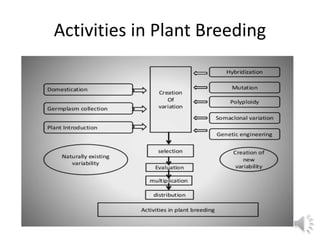
Activities in Plant Breeding
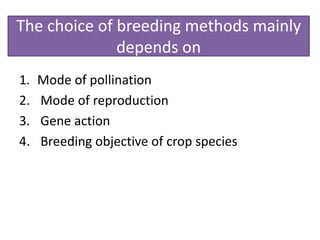
The choice of breeding methods mainly
depends on
1. Mode of pollination
2. Mode of reproduction
3. Gene action
4. Breeding objective of crop species
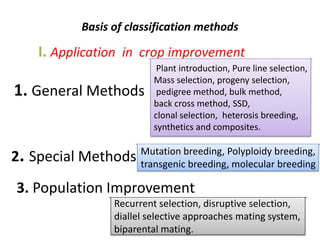
I. Application in crop improvement
4
1. General Methods
2. Special Methods
3. Population Improvement
Basis of classification methods
Plant introduction, Pure line selection,
Mass selection, progeny selection,
pedigree method, bulk method,
back cross method, SSD,
clonal selection, heterosis breeding,
synthetics and composites.
Mutation breeding, Polyploidy breeding,
transgenic breeding, molecular breeding
Recurrent selection, disruptive selection,
diallel selective approaches mating system,
biparental mating.
5
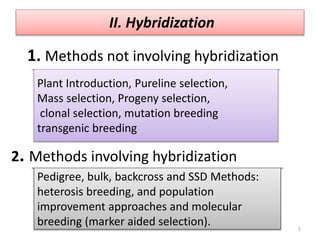
1. Methods not involving hybridization
2. Methods involving hybridization
II. Hybridization
Plant Introduction, Pureline selection,
Mass selection, Progeny selection,
clonal selection, mutation breeding
transgenic breeding
Pedigree, bulk, backcross and SSD Methods:
heterosis breeding, and population
improvement approaches and molecular
breeding (marker aided selection).
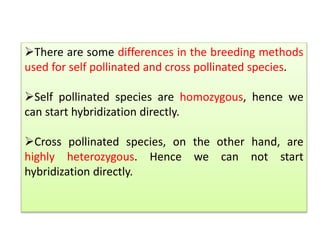
There are some differences in the breeding methods
used for self pollinated and cross pollinated species.
Self pollinated species are homozygous, hence we
can start hybridization directly.
Cross pollinated species, on the other hand, are
highly heterozygous. Hence we can not start
hybridization directly.
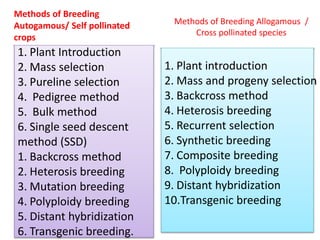
Methods of Breeding
Autogamous/ Self pollinated
crops
1. Plant Introduction
2. Mass selection
3. Pureline selection
4. Pedigree method
5. Bulk method
6. Single seed descent
method (SSD)
1. Backcross method
2. Heterosis breeding
3. Mutation breeding
4. Polyploidy breeding
5. Distant hybridization
6. Transgenic breeding.
Methods of Breeding Allogamous /
Cross pollinated species
1. Plant introduction
2. Mass and progeny selection
3. Backcross method
4. Heterosis breeding
5. Recurrent selection
6. Synthetic breeding
7. Composite breeding
8. Polyploidy breeding
9. Distant hybridization
10.Transgenic breeding
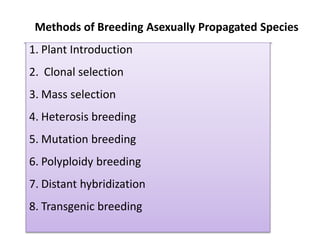
Methods of Breeding Asexually Propagated Species
1. Plant Introduction
2. Clonal selection
3. Mass selection
4. Heterosis breeding
5. Mutation breeding
6. Polyploidy breeding
7. Distant hybridization
8. Transgenic breeding
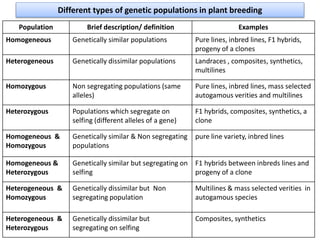
Population Brief description/ definition Examples
Homogeneous Genetically similar populations Pure lines, inbred lines, F1 hybrids,
progeny of a clones
Heterogeneous Genetically dissimilar populations Landraces , composites, synthetics,
multilines
Homozygous Non segregating populations (same
alleles)
Pure lines, inbred lines, mass selected
autogamous verities and multilines
Heterozygous Populations which segregate on
selfing (different alleles of a gene)
F1 hybrids, composites, synthetics, a
clone
Homogeneous &
Homozygous
Genetically similar & Non segregating
populations
pure line variety, inbred lines
Homogeneous &
Heterozygous
Genetically similar but segregating on
selfing
F1 hybrids between inbreds lines and
progeny of a clone
Heterogeneous &
Homozygous
Genetically dissimilar but Non
segregating population
Multilines & mass selected verities in
autogamous species
Heterogeneous &
Heterozygous
Genetically dissimilar but
segregating on selfing
Composites, synthetics
Different types of genetic populations in plant breeding
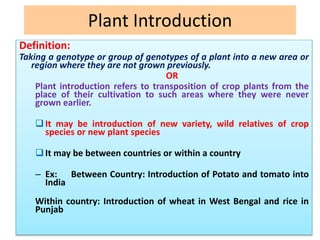
Plant Introduction
Definition:
Taking a genotype or group of genotypes of a plant into a new area or
region where they are not grown previously.
OR
Plant introduction refers to transposition of crop plants from the
place of their cultivation to such areas where they were never
grown earlier.
It may be introduction of new variety, wild relatives of crop
species or new plant species
It may be between countries or within a country
– Ex: Between Country: Introduction of Potato and tomato into
India
Within country: Introduction of wheat in West Bengal and rice in
Punjab
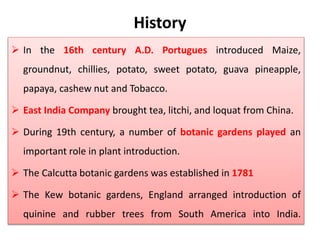
History
 In the 16th century A.D. Portugues introduced Maize,
groundnut, chillies, potato, sweet potato, guava pineapple,
papaya, cashew nut and Tobacco.
 East India Company brought tea, litchi, and loquat from China.
 During 19th century, a number of botanic gardens played an
important role in plant introduction.
 The Calcutta botanic gardens was established in 1781
 The Kew botanic gardens, England arranged introduction of
quinine and rubber trees from South America into India.
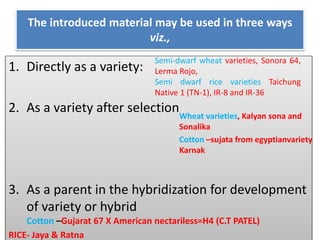
The introduced material may be used in three ways
viz.,
1. Directly as a variety:
2. As a variety after selection
3. As a parent in the hybridization for development
of variety or hybrid
Cotton –Gujarat 67 X American nectariless=H4 (C.T PATEL)
RICE- Jaya & Ratna
Semi-dwarf wheat varieties, Sonora 64,
Lerma Rojo,
Semi dwarf rice varieties Taichung
Native 1 (TN-1), IR-8 and IR-36
Wheat varieties, Kalyan sona and
Sonalika
Cotton –sujata from egyptianvariety
Karnak
Types of Plant Introduction
Primary Introduction:
Introduced genotype is directly released for commercial
cultivation without any alteration.
– Ex: Semi-dwarf wheat varieties, Sonora 64, Lerma Rojo,
– Semi dwarf rice varieties Taichung Native 1 (TN-1), IR-8 and IR-36
Secondary Introduction:
– The introduced variety is improved by selection or
hybridization with local genotypes to transfer one
or few characters from introduced variety into local
variety.
– Ex: Wheat varieties, Kalyan sona and Sonalika
Purpose of Plant Introduction
1. Entirely new crop: To bring under cultivation new crop species which
is not under cultivation Ex: Maize, Potato, Tomato in India
2. New Varieties: wheat varieties Sonora 64 and Lerma Rojo,
semidrawf rice varieties TN 1, IR-8 and IR-36
3. Utilization in crop improvement programme
4. Utilization in scientific studies: To study origin, evolution,
biosystematics of crop plants.
5. Used for Aesthetic value: Ornamental crops
6. To protect from pest and disease: Introduction of coffee from
south Africa to South America to protect from leaf rust.
7. Varieties Developed through Hybridization
International Plant Genetic Resources Institute
(IPGRI)
ROME (Italy)
Deals with introduction of plant material on
global level
INTERNATIONAL AGENCIES OF PLANT INTRODUCTION
AGENCIES OF PLANT INTRODUCTION IN INDIA
National Bureau of Plant Genetic Resources (NBPGR)
 Which has its headquarters at New Delhi,
 Substations for testing the plant materials (Shimla , Jodhpur,
Amravati, KanyaKumari , Shillong )
 NBPGR has the gene bank for long term storage and future
use
 It helps to assess the introduced plant material, coordinates
the work of other agencies and imparts training in plant
collection, introduction and maintenance in India
Forest Research Institute, Dehradun
 The plant introduction organization set up at the
institute looks after introduction, acclimatization,
conservation and testing of forest trees
Botanical Survey of India:
This body is meant for introduction of medicinal plants
and also plants for botanical importance
Different Central Research Institutes as well as
Agricultural Universities play the role for collection,
introduction and maintenance of germplasm of crop
plants.
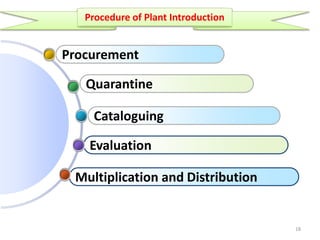
Multiplication and Distribution
Evaluation
Cataloguing
Quarantine
Procurement
18
Procedure of Plant Introduction
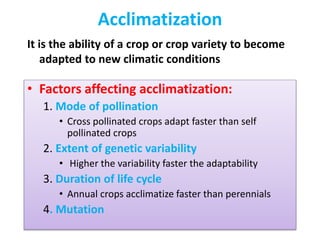
Acclimatization
• Factors affecting acclimatization:
1. Mode of pollination
• Cross pollinated crops adapt faster than self
pollinated crops
2. Extent of genetic variability
• Higher the variability faster the adaptability
3. Duration of life cycle
• Annual crops acclimatize faster than perennials
4. Mutation
It is the ability of a crop or crop variety to become
adapted to new climatic conditions
Merits of Plant introduction
1. It provides entirely new crop
2. New variety either by primary or secondary
introduction
3. To protect variability from genetic erosion
4. Quick and economical method of crop improvement
5. Crop species may be free from disease and pest in
new areas
Genetic Erosion: Gradual disappearance of various forms of a cultivated species and of
its wild relatives
Demerits
• Introduction of
1. new weeds: Argemone mexicana, Phylaris
minor etc into India
2. Diseases: Late blight of potato from Europe,
Coffee rust, bunchy top of Banana
3. Insect pest: Potato tuber moth, Woolly aphid
of apple
4. Ornamentals-turned-weeds
– Water hyacinth and Lantana camara
THANK YOU
BE SAFE STAY HOME
THANK
YOU

Breeding methods 17.05.2021

  • 1.
    Dr. NAVEENKUMAR K.L AssistantProfessor Dept. Of Genetics and Plant Breeding UAHS Shivamogga CLASSIFICATION OF BREEDING METHODS
  • 2.
  • 3.
    The choice ofbreeding methods mainly depends on 1. Mode of pollination 2. Mode of reproduction 3. Gene action 4. Breeding objective of crop species
  • 4.
    I. Application incrop improvement 4 1. General Methods 2. Special Methods 3. Population Improvement Basis of classification methods Plant introduction, Pure line selection, Mass selection, progeny selection, pedigree method, bulk method, back cross method, SSD, clonal selection, heterosis breeding, synthetics and composites. Mutation breeding, Polyploidy breeding, transgenic breeding, molecular breeding Recurrent selection, disruptive selection, diallel selective approaches mating system, biparental mating.
  • 5.
    5 1. Methods notinvolving hybridization 2. Methods involving hybridization II. Hybridization Plant Introduction, Pureline selection, Mass selection, Progeny selection, clonal selection, mutation breeding transgenic breeding Pedigree, bulk, backcross and SSD Methods: heterosis breeding, and population improvement approaches and molecular breeding (marker aided selection).
  • 6.
    There are somedifferences in the breeding methods used for self pollinated and cross pollinated species. Self pollinated species are homozygous, hence we can start hybridization directly. Cross pollinated species, on the other hand, are highly heterozygous. Hence we can not start hybridization directly.
  • 7.
    Methods of Breeding Autogamous/Self pollinated crops 1. Plant Introduction 2. Mass selection 3. Pureline selection 4. Pedigree method 5. Bulk method 6. Single seed descent method (SSD) 1. Backcross method 2. Heterosis breeding 3. Mutation breeding 4. Polyploidy breeding 5. Distant hybridization 6. Transgenic breeding. Methods of Breeding Allogamous / Cross pollinated species 1. Plant introduction 2. Mass and progeny selection 3. Backcross method 4. Heterosis breeding 5. Recurrent selection 6. Synthetic breeding 7. Composite breeding 8. Polyploidy breeding 9. Distant hybridization 10.Transgenic breeding
  • 8.
    Methods of BreedingAsexually Propagated Species 1. Plant Introduction 2. Clonal selection 3. Mass selection 4. Heterosis breeding 5. Mutation breeding 6. Polyploidy breeding 7. Distant hybridization 8. Transgenic breeding
  • 9.
    Population Brief description/definition Examples Homogeneous Genetically similar populations Pure lines, inbred lines, F1 hybrids, progeny of a clones Heterogeneous Genetically dissimilar populations Landraces , composites, synthetics, multilines Homozygous Non segregating populations (same alleles) Pure lines, inbred lines, mass selected autogamous verities and multilines Heterozygous Populations which segregate on selfing (different alleles of a gene) F1 hybrids, composites, synthetics, a clone Homogeneous & Homozygous Genetically similar & Non segregating populations pure line variety, inbred lines Homogeneous & Heterozygous Genetically similar but segregating on selfing F1 hybrids between inbreds lines and progeny of a clone Heterogeneous & Homozygous Genetically dissimilar but Non segregating population Multilines & mass selected verities in autogamous species Heterogeneous & Heterozygous Genetically dissimilar but segregating on selfing Composites, synthetics Different types of genetic populations in plant breeding
  • 10.
    Plant Introduction Definition: Taking agenotype or group of genotypes of a plant into a new area or region where they are not grown previously. OR Plant introduction refers to transposition of crop plants from the place of their cultivation to such areas where they were never grown earlier. It may be introduction of new variety, wild relatives of crop species or new plant species It may be between countries or within a country – Ex: Between Country: Introduction of Potato and tomato into India Within country: Introduction of wheat in West Bengal and rice in Punjab
  • 11.
    History  In the16th century A.D. Portugues introduced Maize, groundnut, chillies, potato, sweet potato, guava pineapple, papaya, cashew nut and Tobacco.  East India Company brought tea, litchi, and loquat from China.  During 19th century, a number of botanic gardens played an important role in plant introduction.  The Calcutta botanic gardens was established in 1781  The Kew botanic gardens, England arranged introduction of quinine and rubber trees from South America into India.
  • 12.
    The introduced materialmay be used in three ways viz., 1. Directly as a variety: 2. As a variety after selection 3. As a parent in the hybridization for development of variety or hybrid Cotton –Gujarat 67 X American nectariless=H4 (C.T PATEL) RICE- Jaya & Ratna Semi-dwarf wheat varieties, Sonora 64, Lerma Rojo, Semi dwarf rice varieties Taichung Native 1 (TN-1), IR-8 and IR-36 Wheat varieties, Kalyan sona and Sonalika Cotton –sujata from egyptianvariety Karnak
  • 13.
    Types of PlantIntroduction Primary Introduction: Introduced genotype is directly released for commercial cultivation without any alteration. – Ex: Semi-dwarf wheat varieties, Sonora 64, Lerma Rojo, – Semi dwarf rice varieties Taichung Native 1 (TN-1), IR-8 and IR-36 Secondary Introduction: – The introduced variety is improved by selection or hybridization with local genotypes to transfer one or few characters from introduced variety into local variety. – Ex: Wheat varieties, Kalyan sona and Sonalika
  • 14.
    Purpose of PlantIntroduction 1. Entirely new crop: To bring under cultivation new crop species which is not under cultivation Ex: Maize, Potato, Tomato in India 2. New Varieties: wheat varieties Sonora 64 and Lerma Rojo, semidrawf rice varieties TN 1, IR-8 and IR-36 3. Utilization in crop improvement programme 4. Utilization in scientific studies: To study origin, evolution, biosystematics of crop plants. 5. Used for Aesthetic value: Ornamental crops 6. To protect from pest and disease: Introduction of coffee from south Africa to South America to protect from leaf rust. 7. Varieties Developed through Hybridization
  • 15.
    International Plant GeneticResources Institute (IPGRI) ROME (Italy) Deals with introduction of plant material on global level INTERNATIONAL AGENCIES OF PLANT INTRODUCTION
  • 16.
    AGENCIES OF PLANTINTRODUCTION IN INDIA National Bureau of Plant Genetic Resources (NBPGR)  Which has its headquarters at New Delhi,  Substations for testing the plant materials (Shimla , Jodhpur, Amravati, KanyaKumari , Shillong )  NBPGR has the gene bank for long term storage and future use  It helps to assess the introduced plant material, coordinates the work of other agencies and imparts training in plant collection, introduction and maintenance in India
  • 17.
    Forest Research Institute,Dehradun  The plant introduction organization set up at the institute looks after introduction, acclimatization, conservation and testing of forest trees Botanical Survey of India: This body is meant for introduction of medicinal plants and also plants for botanical importance Different Central Research Institutes as well as Agricultural Universities play the role for collection, introduction and maintenance of germplasm of crop plants.
  • 18.
  • 19.
    Acclimatization • Factors affectingacclimatization: 1. Mode of pollination • Cross pollinated crops adapt faster than self pollinated crops 2. Extent of genetic variability • Higher the variability faster the adaptability 3. Duration of life cycle • Annual crops acclimatize faster than perennials 4. Mutation It is the ability of a crop or crop variety to become adapted to new climatic conditions
  • 20.
    Merits of Plantintroduction 1. It provides entirely new crop 2. New variety either by primary or secondary introduction 3. To protect variability from genetic erosion 4. Quick and economical method of crop improvement 5. Crop species may be free from disease and pest in new areas Genetic Erosion: Gradual disappearance of various forms of a cultivated species and of its wild relatives
  • 21.
    Demerits • Introduction of 1.new weeds: Argemone mexicana, Phylaris minor etc into India 2. Diseases: Late blight of potato from Europe, Coffee rust, bunchy top of Banana 3. Insect pest: Potato tuber moth, Woolly aphid of apple 4. Ornamentals-turned-weeds – Water hyacinth and Lantana camara
  • 22.
  • 23.