SECONDARY METABOLITES
INTRODUCTION
 Secondary metabolites are organic compounds that are
not directly involved in the normal growth, development
or reproduction of an organism.
 Plant secondary metabolism produces products that aid
in the growth and development of plants but are not
required for the plant to survive.
 A common role of secondary metabolites in plants is
defense mechanism i.e. used to fight from herbivores,
pests and pathogens.
 In humans plant secondary metabolites are of great
importance as they are used in many fields such as
medicine, flavouring agent, dyes etc.
 Secondary metabolites are often restricted to a narrow set
of species within a phylogenetic group.
 It is believed that production of secondary metabolites is
linked to the induction of morphological differentiation.
 Cultures are initiated by simply placing freshly cut sections
from surface sterilized plant organs on a nutrient medium
containing suitable hormones.
 Generally auxins and cytokinins are used for this purpose.
 On such a medium explant exhibit callusing which usually
starts at the cut ends and gradually extends over the entire
surface of tissue.
 There are 4 types of cultures involved:-
(i) Organized culture.
(ii) Disorganized culture.
(iii) Hairy root culture.
(iv) Immobilized cell culture.
ORGANIZED TISSUE
 This refer to taking a specific part of a plant body and
making them grow in appropriate medium to obtain
healthy hybrid.
 Roots & shoot are mainly use for this technique.
 Cells that work together to perform
a particular function are organized
into Tissues.
 Xylem Tissue, Ciliated Epithelial Tissue and
Parenchyma Tissue.
DISORGANIZED TISSUE
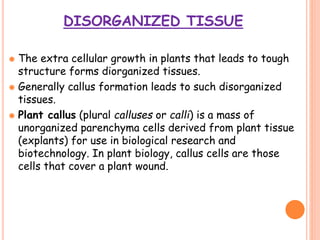
 The extra cellular growth in plants that leads to tough
structure forms diorganized tissues.
 Generally callus formation leads to such disorganized
tissues.
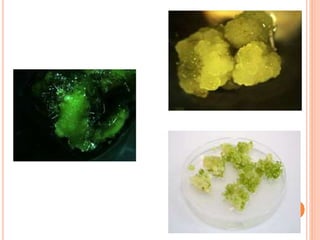
 Plant callus (plural calluses or calli) is a mass of
unorganized parenchyma cells derived from plant tissue
(explants) for use in biological research and
biotechnology. In plant biology, callus cells are those
cells that cover a plant wound.
CALLUS CULTURE
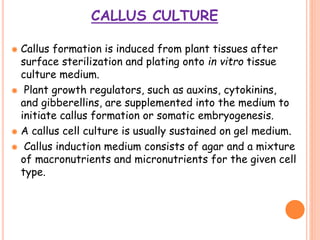
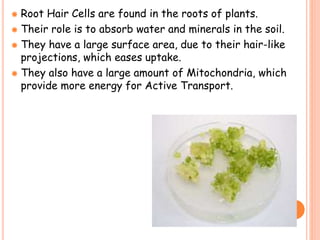
 Callus formation is induced from plant tissues after
surface sterilization and plating onto in vitro tissue
culture medium.
 Plant growth regulators, such as auxins, cytokinins,
and gibberellins, are supplemented into the medium to
initiate callus formation or somatic embryogenesis.
 A callus cell culture is usually sustained on gel medium.
 Callus induction medium consists of agar and a mixture
of macronutrients and micronutrients for the given cell
type.
 Root Hair Cells are found in the roots of plants.
 Their role is to absorb water and minerals in the soil.
 They have a large surface area, due to their hair-like
projections, which eases uptake.
 They also have a large amount of Mitochondria, which
provide more energy for Active Transport.
TECHNIQUES
1. Batch culture
 These are use for initiating single cell culture.
 Cell suspension are grown in 100-250 ml of flask, each
containing 20-75ml of culture medium.
 The cultures are continuously propagated by routinely
taking a small aliquot of suspension & transferring it to
fresh medium.
 During the incubation period the biomass of suspension
culture increases due to cell division and cell
enlargement(continues up to certain limit).
2. Continuous culture
 A number of culture vessels have been design to
grow large scale culture under steady state for long
periods by adding fresh medium and draining out the
used medium
 Continuous cultures may be closed types or opened
type.
 In the closed type, the addition of fresh medium is
balanced by outflow old medium and cells are
collected mechanically and added back to the culture.
 In contrast, in open continues culture the in flow of
medium is accompanied by a balancing harvest by
equal volume of culture.
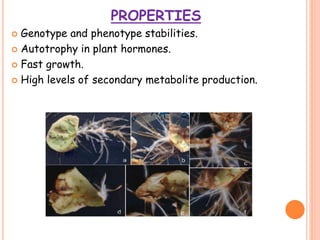
HAIRY ROOT CULTURES
 Also called transformed root culture.
 It is a type of plant tissue culture that is used to study
plant metabolic processes or to produce secondary
metabolites or recombinant proteins, often with
plant genetic engineering.
 It is the culture produced after the infection of
explants or cultures by the gram negative soil
bacterium Agrobacterium rhizogenes (contain Ri
plasmids) can infect plant roots and cause them to
produce a food source for the bacterium, opines and to
grow abnormally.
 This process take the advantage of the naturally
occurring hairy root disease in dicotlydons.
PROPERTIES
 Genotype and phenotype stabilities.
 Autotrophy in plant hormones.
 Fast growth.
 High levels of secondary metabolite production.
PRODUCTION (IN-VIVO)
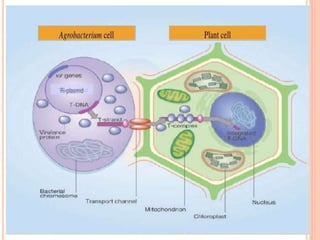
 Agrobacterium recognizes some signal molecules exuded
by wounded plant cells and become attached to it.
 The bacteria contain the root inducing plasmid(Ri-
plasmid).
 The bacteria genetically transfer the part of the Ri-
plasmid called the transfer DNA(t-DNA) to the
genome.
 Proliferate by increasing the rate of cell
division(cytokinin expression) and cell elongation(auxin
expression) to produce the hairy roots.
 Production of the opines which is the type unusual amino
acids(octopine ,mannopine etc) which is used by the
bacterium as a carbon, nitrogen and energy source.
PRODUCTION(IN-VITRO)
 Explants are wounded and then inoculated with
Agrobacterium rhizogenes.
 After 2 or 3 days, the explants can be transferred into
solid media with antibiotics such as ceftoaxime
,vancomycin etc to kill or eliminate redundant bacteria.
 The hairy roots will be induced within a short period of
time which varies from 1 week to over a month varying
on different plant species.
 The decontaminated hairy root cultures can be
subcultured on phytohormone free medium.
ADVANTAGES
 Genetically and biosynthetically stable.
 High production of secondary metabolites.
 Can be grown under phytohormone free
conditions.
 Fast growth which reduces the culture time.
 Easy to handle.
APPLICATIONS
 Functional analysis of genes.
 Expressing foreign proteins.
 Production of secondary metabolites.
 May change the composition of metabolites.
 Can be used to regenerate a whole plant.
 May produce compounds which is not found in
untransformed roots.
 Eg.(i) Quinine for malaria.
(ii)Shikonin used for anti bacterial and anti ulcer
agent.
(iii)Berberine etc.
IMMOBILIZED CELL CULTURE
 Need:-
(i)High cost due to slow growth
(ii)Low yield
(iii)Instability of selected lines
(iv)Low resistance of cells
(v)Intracellular accumulation of product
 Cells are confined within reacter system preventing
their entry into mobile phase which carries the
substrate and product.
 Firstly reported by Brodelius et. al 1979 in C. roseus
and Dacucs carota.
 Immobilization involves 2 stages-
(i) Optimized for biomass production by suspension
culture.
(ii) Optimized for product formation by immobilized cells.
ADVANTAGES
 Prolonged use of biomass.
 Cell density in bioreactor increases 2-4 times.
 Simple bioreactor can be used.
 Separate cells from medium ,thus simplifying
downstream processing.
 Uncouples growth & product formation without
affecting growth.
 Provide stable production rate of 2ndary metabolites.
 Minimizes fluid viscosity.
METHODS OF CELL IMMOBILIZATION
 Cells are entrapped in gel or behind semi permeable
membrane.
 Some polymers used to entrap cells are alginate, agar,
agarose & carrageenan.
 Alginate has been widely used as it can polymerize at RT
using Ca2+.
 Also introduction of semi permeable membrane in
between cells & recirculating media , entraps cells at
high density.
 Cell immobilization on surface of inert support(eg.
Fiberglass mat etc) has been used for 2ndary metabolite
production.
 Cells adhere to immobilizing support matrix in 2 steps.
 Surface immobilization promotes natural tendency of
cells to aggregate, improving synthesis & accumulation
of 2ndary metabolites.
 Advantage of this method is absence of physical
restriction to mass transfer between culture medium &
biomass surface.
 It is easy to monitor conditions, distribution & extent of
biomass.
 Therefore, immobilized system should maintain viable
cells over extended period and release the bulk of
product into extracellular medium in a stable form.
LIMITATIONS
 It may lead to decoupling of cell growth.
 Initial biomass must be produced in suspension culture.
 Secretion of product into the external medium is
imperative.
 Extracellular degradation of products.
 Introduction of additional diffusion barrier by gel
matrix.
SUMMARY
 Secondary metabolism produces product that’s aid in
the growth and development of plants. But are not
required for plant to survive.
 Secondary metabolism faulted the primary metabolite
in plant.
 A common role of secondary metabolite in plants is
defense mechanism.
 They also use to fight off herbivores pest and
pathogens.
BIBLIOGRAPHY
 Studies in plant science,5 by S.S. Bhojwani & M.K.
Razdan
 https://books.google.co.in/books.
 http://alevelnotes.com/cell-specialisation-and-
organism-organisation/150.
 Slideshare.net

Secondary metabolites (1)

  • 1.
  • 2.
    INTRODUCTION  Secondary metabolitesare organic compounds that are not directly involved in the normal growth, development or reproduction of an organism.  Plant secondary metabolism produces products that aid in the growth and development of plants but are not required for the plant to survive.  A common role of secondary metabolites in plants is defense mechanism i.e. used to fight from herbivores, pests and pathogens.  In humans plant secondary metabolites are of great importance as they are used in many fields such as medicine, flavouring agent, dyes etc.
  • 3.
     Secondary metabolitesare often restricted to a narrow set of species within a phylogenetic group.  It is believed that production of secondary metabolites is linked to the induction of morphological differentiation.  Cultures are initiated by simply placing freshly cut sections from surface sterilized plant organs on a nutrient medium containing suitable hormones.  Generally auxins and cytokinins are used for this purpose.  On such a medium explant exhibit callusing which usually starts at the cut ends and gradually extends over the entire surface of tissue.  There are 4 types of cultures involved:- (i) Organized culture. (ii) Disorganized culture. (iii) Hairy root culture. (iv) Immobilized cell culture.
  • 4.
    ORGANIZED TISSUE  Thisrefer to taking a specific part of a plant body and making them grow in appropriate medium to obtain healthy hybrid.  Roots & shoot are mainly use for this technique.  Cells that work together to perform a particular function are organized into Tissues.  Xylem Tissue, Ciliated Epithelial Tissue and Parenchyma Tissue.
  • 5.
    DISORGANIZED TISSUE  Theextra cellular growth in plants that leads to tough structure forms diorganized tissues.  Generally callus formation leads to such disorganized tissues.  Plant callus (plural calluses or calli) is a mass of unorganized parenchyma cells derived from plant tissue (explants) for use in biological research and biotechnology. In plant biology, callus cells are those cells that cover a plant wound.
  • 6.
    CALLUS CULTURE  Callusformation is induced from plant tissues after surface sterilization and plating onto in vitro tissue culture medium.  Plant growth regulators, such as auxins, cytokinins, and gibberellins, are supplemented into the medium to initiate callus formation or somatic embryogenesis.  A callus cell culture is usually sustained on gel medium.  Callus induction medium consists of agar and a mixture of macronutrients and micronutrients for the given cell type.
  • 8.
     Root HairCells are found in the roots of plants.  Their role is to absorb water and minerals in the soil.  They have a large surface area, due to their hair-like projections, which eases uptake.  They also have a large amount of Mitochondria, which provide more energy for Active Transport.
  • 9.
    TECHNIQUES 1. Batch culture These are use for initiating single cell culture.  Cell suspension are grown in 100-250 ml of flask, each containing 20-75ml of culture medium.  The cultures are continuously propagated by routinely taking a small aliquot of suspension & transferring it to fresh medium.  During the incubation period the biomass of suspension culture increases due to cell division and cell enlargement(continues up to certain limit).
  • 10.
    2. Continuous culture A number of culture vessels have been design to grow large scale culture under steady state for long periods by adding fresh medium and draining out the used medium  Continuous cultures may be closed types or opened type.  In the closed type, the addition of fresh medium is balanced by outflow old medium and cells are collected mechanically and added back to the culture.  In contrast, in open continues culture the in flow of medium is accompanied by a balancing harvest by equal volume of culture.
  • 11.
    HAIRY ROOT CULTURES Also called transformed root culture.  It is a type of plant tissue culture that is used to study plant metabolic processes or to produce secondary metabolites or recombinant proteins, often with plant genetic engineering.  It is the culture produced after the infection of explants or cultures by the gram negative soil bacterium Agrobacterium rhizogenes (contain Ri plasmids) can infect plant roots and cause them to produce a food source for the bacterium, opines and to grow abnormally.  This process take the advantage of the naturally occurring hairy root disease in dicotlydons.
  • 12.
    PROPERTIES  Genotype andphenotype stabilities.  Autotrophy in plant hormones.  Fast growth.  High levels of secondary metabolite production.
  • 13.
    PRODUCTION (IN-VIVO)  Agrobacteriumrecognizes some signal molecules exuded by wounded plant cells and become attached to it.  The bacteria contain the root inducing plasmid(Ri- plasmid).  The bacteria genetically transfer the part of the Ri- plasmid called the transfer DNA(t-DNA) to the genome.  Proliferate by increasing the rate of cell division(cytokinin expression) and cell elongation(auxin expression) to produce the hairy roots.  Production of the opines which is the type unusual amino acids(octopine ,mannopine etc) which is used by the bacterium as a carbon, nitrogen and energy source.
  • 15.
    PRODUCTION(IN-VITRO)  Explants arewounded and then inoculated with Agrobacterium rhizogenes.  After 2 or 3 days, the explants can be transferred into solid media with antibiotics such as ceftoaxime ,vancomycin etc to kill or eliminate redundant bacteria.  The hairy roots will be induced within a short period of time which varies from 1 week to over a month varying on different plant species.  The decontaminated hairy root cultures can be subcultured on phytohormone free medium.
  • 16.
    ADVANTAGES  Genetically andbiosynthetically stable.  High production of secondary metabolites.  Can be grown under phytohormone free conditions.  Fast growth which reduces the culture time.  Easy to handle.
  • 17.
    APPLICATIONS  Functional analysisof genes.  Expressing foreign proteins.  Production of secondary metabolites.  May change the composition of metabolites.  Can be used to regenerate a whole plant.  May produce compounds which is not found in untransformed roots.  Eg.(i) Quinine for malaria. (ii)Shikonin used for anti bacterial and anti ulcer agent. (iii)Berberine etc.
  • 18.
    IMMOBILIZED CELL CULTURE Need:- (i)High cost due to slow growth (ii)Low yield (iii)Instability of selected lines (iv)Low resistance of cells (v)Intracellular accumulation of product  Cells are confined within reacter system preventing their entry into mobile phase which carries the substrate and product.  Firstly reported by Brodelius et. al 1979 in C. roseus and Dacucs carota.  Immobilization involves 2 stages- (i) Optimized for biomass production by suspension culture. (ii) Optimized for product formation by immobilized cells.
  • 19.
    ADVANTAGES  Prolonged useof biomass.  Cell density in bioreactor increases 2-4 times.  Simple bioreactor can be used.  Separate cells from medium ,thus simplifying downstream processing.  Uncouples growth & product formation without affecting growth.  Provide stable production rate of 2ndary metabolites.  Minimizes fluid viscosity.
  • 20.
    METHODS OF CELLIMMOBILIZATION  Cells are entrapped in gel or behind semi permeable membrane.  Some polymers used to entrap cells are alginate, agar, agarose & carrageenan.  Alginate has been widely used as it can polymerize at RT using Ca2+.  Also introduction of semi permeable membrane in between cells & recirculating media , entraps cells at high density.  Cell immobilization on surface of inert support(eg. Fiberglass mat etc) has been used for 2ndary metabolite production.  Cells adhere to immobilizing support matrix in 2 steps.  Surface immobilization promotes natural tendency of cells to aggregate, improving synthesis & accumulation of 2ndary metabolites.
  • 21.
     Advantage ofthis method is absence of physical restriction to mass transfer between culture medium & biomass surface.  It is easy to monitor conditions, distribution & extent of biomass.  Therefore, immobilized system should maintain viable cells over extended period and release the bulk of product into extracellular medium in a stable form.
  • 22.
    LIMITATIONS  It maylead to decoupling of cell growth.  Initial biomass must be produced in suspension culture.  Secretion of product into the external medium is imperative.  Extracellular degradation of products.  Introduction of additional diffusion barrier by gel matrix.
  • 23.
    SUMMARY  Secondary metabolismproduces product that’s aid in the growth and development of plants. But are not required for plant to survive.  Secondary metabolism faulted the primary metabolite in plant.  A common role of secondary metabolite in plants is defense mechanism.  They also use to fight off herbivores pest and pathogens.
  • 24.
    BIBLIOGRAPHY  Studies inplant science,5 by S.S. Bhojwani & M.K. Razdan  https://books.google.co.in/books.  http://alevelnotes.com/cell-specialisation-and- organism-organisation/150.  Slideshare.net