PLANT GROWTH REGULATORS
AND RETARDANTS
PRESENTED BY: REETIKA SHARMA
DIVISION: FRUIT SCIENCE.
REGISTRATION NUMBER: J-19-M-656
PRESENTED TO: DR. GURUDEV CHAND
PLANT GROWTH REGULATORS
A hormone is a naturally produced chemical synthesized in one part of
the plant and then travels to another part where it effects growth and
development. There are five main groups:
 Auxin or Indole Acetic Acid (IAA)
 Gibberellin or Gibberellic Acid (GA)
 Cytokinin (Ck)
 Ethylene (C2H4)
 Abscisic Acid (ABA)
Hormones discovered more recently include salicylic acid, jasmonates,
brassinolides, etc.
Plant growth regulators are man-made chemicals applied to plants to
produce a desired effect (some are chemically identical to hormones).
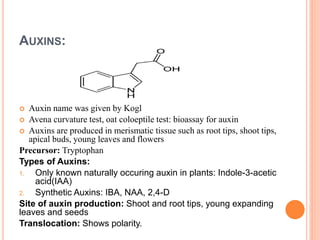
AUXINS:
 Auxin name was given by Kogl
 Avena curvature test, oat coloeptile test: bioassay for auxin
 Auxins are produced in merismatic tissue such as root tips, shoot tips,
apical buds, young leaves and flowers
Precursor: Tryptophan
Types of Auxins:
1. Only known naturally occuring auxin in plants: Indole-3-acetic
acid(IAA)
2. Synthetic Auxins: IBA, NAA, 2,4-D
Site of auxin production: Shoot and root tips, young expanding
leaves and seeds
Translocation: Shows polarity.
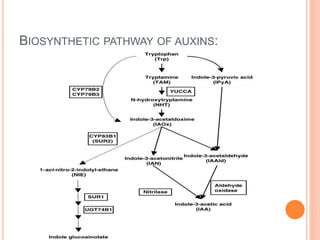
BIOSYNTHETIC PATHWAY OF AUXINS:
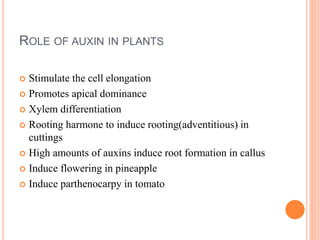
ROLE OF AUXIN IN PLANTS
 Stimulate the cell elongation
 Promotes apical dominance
 Xylem differentiation
 Rooting harmone to induce rooting(adventitious) in
cuttings
 High amounts of auxins induce root formation in callus
 Induce flowering in pineapple
 Induce parthenocarpy in tomato
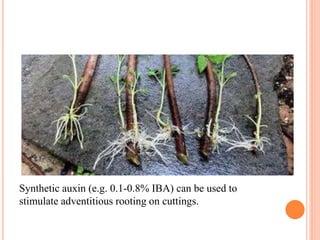
Synthetic auxin (e.g. 0.1-0.8% IBA) can be used to
stimulate adventitious rooting on cuttings.
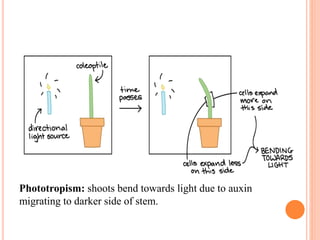
Phototropism: shoots bend towards light due to auxin
migrating to darker side of stem.
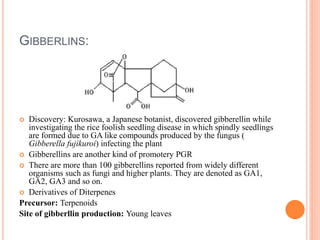
GIBBERLINS:
 Discovery: Kurosawa, a Japanese botanist, discovered gibberellin while
investigating the rice foolish seedling disease in which spindly seedlings
are formed due to GA like compounds produced by the fungus (
Gibberella fujikuroi) infecting the plant
 Gibberellins are another kind of promotery PGR
 There are more than 100 gibberellins reported from widely different
organisms such as fungi and higher plants. They are denoted as GA1,
GA2, GA3 and so on.
 Derivatives of Diterpenes
Precursor: Terpenoids
Site of gibberllin production: Young leaves
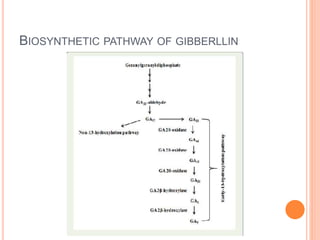
BIOSYNTHETIC PATHWAY OF GIBBERLLIN
ROLE OF GIBBERLLINS:
 Mobilize enzymes that release nutrient reserves in grass seeds
 Stem elongation requires gibberellins.
 Mutants that don’t produce gibberellins are dwarfs.When
gibberellins are added they grow normally.
 Rosette growth until an environmental cue cause them to bolt
(elongate their shoots)
 Developing seeds produce gibberellins stimulate their
growth. Seedless grapes are smaller than seeded ones.
Farmers spray them with gibberellins to get normal large
grapes.
 Delay senescence
 Improve shape of apple fruit
 Early seed production in conifers
 Increase length of stock in grapes
 Enhance barley germination and malt production (Malting) in
the liquor industry.
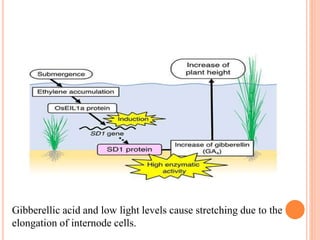
Gibberellic acid and low light levels cause stretching due to the
elongation of internode cells.
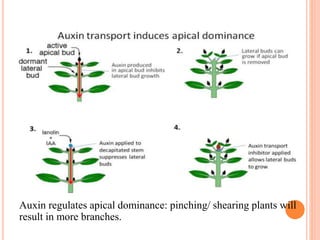
Auxin regulates apical dominance: pinching/ shearing plants will
result in more branches.
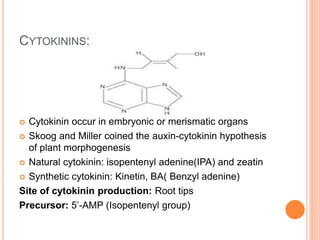
CYTOKININS:
 Cytokinin occur in embryonic or merismatic organs
 Skoog and Miller coined the auxin-cytokinin hypothesis
of plant morphogenesis
 Natural cytokinin: isopentenyl adenine(IPA) and zeatin
 Synthetic cytokinin: Kinetin, BA( Benzyl adenine)
Site of cytokinin production: Root tips
Precursor: 5’-AMP (Isopentenyl group)
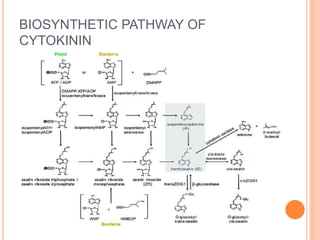
BIOSYNTHETIC PATHWAY OF
CYTOKININ
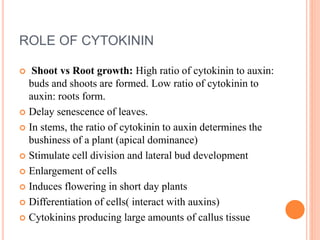
ROLE OF CYTOKININ
 Shoot vs Root growth: High ratio of cytokinin to auxin:
buds and shoots are formed. Low ratio of cytokinin to
auxin: roots form.
 Delay senescence of leaves.
 In stems, the ratio of cytokinin to auxin determines the
bushiness of a plant (apical dominance)
 Stimulate cell division and lateral bud development
 Enlargement of cells
 Induces flowering in short day plants
 Differentiation of cells( interact with auxins)
 Cytokinins producing large amounts of callus tissue
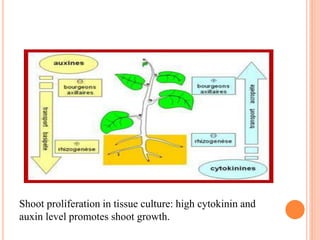
Shoot proliferation in tissue culture: high cytokinin and
auxin level promotes shoot growth.
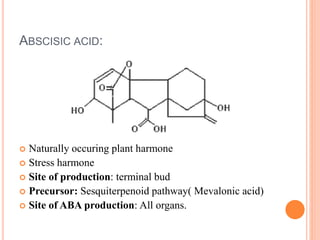
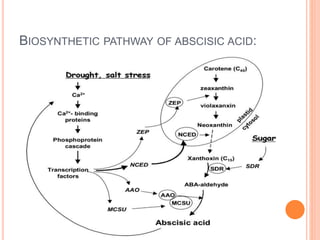
ABSCISIC ACID:
 Naturally occuring plant harmone
 Stress harmone
 Site of production: terminal bud
 Precursor: Sesquiterpenoid pathway( Mevalonic acid)
 Site of ABA production: All organs.
BIOSYNTHETIC PATHWAY OF ABSCISIC ACID:
ROLE OF ABSCISIC ACID
 Bud dormancy
 Stimulates the closure of stomata
 Induction and maintenance of dormancy
 Disease resistance
 Protecting cells from dehydration
 Act as growth inhibitor
 Reduces the rate of transpiration
 Induce abscission of flower and fruits
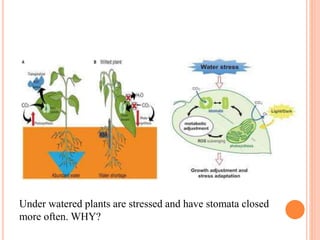
Under watered plants are stressed and have stomata closed
more often. WHY?
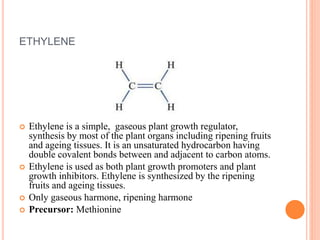
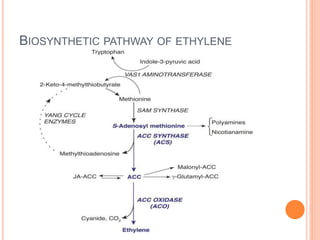
ETHYLENE
 Ethylene is a simple, gaseous plant growth regulator,
synthesis by most of the plant organs including ripening fruits
and ageing tissues. It is an unsaturated hydrocarbon having
double covalent bonds between and adjacent to carbon atoms.
 Ethylene is used as both plant growth promoters and plant
growth inhibitors. Ethylene is synthesized by the ripening
fruits and ageing tissues.
 Only gaseous harmone, ripening harmone
 Precursor: Methionine
BIOSYNTHETIC PATHWAY OF ETHYLENE
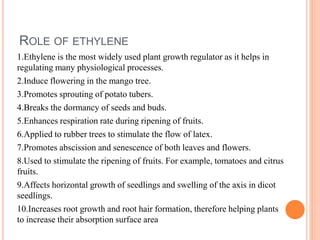
ROLE OF ETHYLENE
1.Ethylene is the most widely used plant growth regulator as it helps in
regulating many physiological processes.
2.Induce flowering in the mango tree.
3.Promotes sprouting of potato tubers.
4.Breaks the dormancy of seeds and buds.
5.Enhances respiration rate during ripening of fruits.
6.Applied to rubber trees to stimulate the flow of latex.
7.Promotes abscission and senescence of both leaves and flowers.
8.Used to stimulate the ripening of fruits. For example, tomatoes and citrus
fruits.
9.Affects horizontal growth of seedlings and swelling of the axis in dicot
seedlings.
10.Increases root growth and root hair formation, therefore helping plants
to increase their absorption surface area
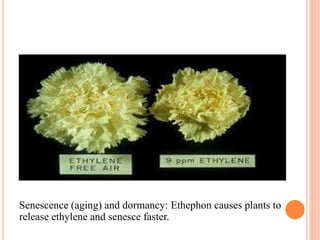
Senescence (aging) and dormancy: Ethephon causes plants to
release ethylene and senesce faster.
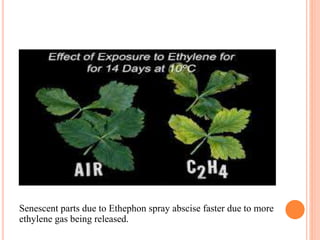
Senescent parts due to Ethephon spray abscise faster due to more
ethylene gas being released.
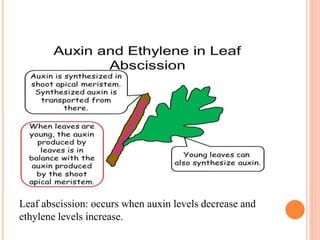
Leaf abscission: occurs when auxin levels decrease and
ethylene levels increase.
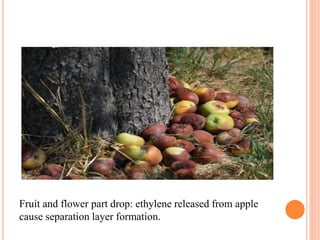
Fruit and flower part drop: ethylene released from apple
cause separation layer formation.
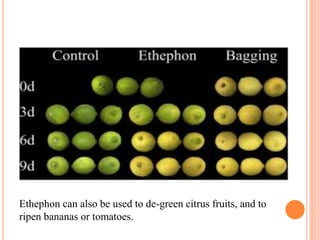
Ethephon can also be used to de-green citrus fruits, and to
ripen bananas or tomatoes.
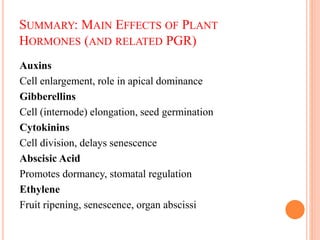
SUMMARY: MAIN EFFECTS OF PLANT
HORMONES (AND RELATED PGR)
Auxins
Cell enlargement, role in apical dominance
Gibberellins
Cell (internode) elongation, seed germination
Cytokinins
Cell division, delays senescence
Abscisic Acid
Promotes dormancy, stomatal regulation
Ethylene
Fruit ripening, senescence, organ abscissi
PLANT GROWTH RETARDANTS:

Plant growth regulators ppt

  • 1.
    PLANT GROWTH REGULATORS ANDRETARDANTS PRESENTED BY: REETIKA SHARMA DIVISION: FRUIT SCIENCE. REGISTRATION NUMBER: J-19-M-656 PRESENTED TO: DR. GURUDEV CHAND
  • 2.
    PLANT GROWTH REGULATORS Ahormone is a naturally produced chemical synthesized in one part of the plant and then travels to another part where it effects growth and development. There are five main groups:  Auxin or Indole Acetic Acid (IAA)  Gibberellin or Gibberellic Acid (GA)  Cytokinin (Ck)  Ethylene (C2H4)  Abscisic Acid (ABA) Hormones discovered more recently include salicylic acid, jasmonates, brassinolides, etc. Plant growth regulators are man-made chemicals applied to plants to produce a desired effect (some are chemically identical to hormones).
  • 3.
    AUXINS:  Auxin namewas given by Kogl  Avena curvature test, oat coloeptile test: bioassay for auxin  Auxins are produced in merismatic tissue such as root tips, shoot tips, apical buds, young leaves and flowers Precursor: Tryptophan Types of Auxins: 1. Only known naturally occuring auxin in plants: Indole-3-acetic acid(IAA) 2. Synthetic Auxins: IBA, NAA, 2,4-D Site of auxin production: Shoot and root tips, young expanding leaves and seeds Translocation: Shows polarity.
  • 4.
  • 5.
    ROLE OF AUXININ PLANTS  Stimulate the cell elongation  Promotes apical dominance  Xylem differentiation  Rooting harmone to induce rooting(adventitious) in cuttings  High amounts of auxins induce root formation in callus  Induce flowering in pineapple  Induce parthenocarpy in tomato
  • 6.
    Synthetic auxin (e.g.0.1-0.8% IBA) can be used to stimulate adventitious rooting on cuttings.
  • 7.
    Phototropism: shoots bendtowards light due to auxin migrating to darker side of stem.
  • 8.
    GIBBERLINS:  Discovery: Kurosawa,a Japanese botanist, discovered gibberellin while investigating the rice foolish seedling disease in which spindly seedlings are formed due to GA like compounds produced by the fungus ( Gibberella fujikuroi) infecting the plant  Gibberellins are another kind of promotery PGR  There are more than 100 gibberellins reported from widely different organisms such as fungi and higher plants. They are denoted as GA1, GA2, GA3 and so on.  Derivatives of Diterpenes Precursor: Terpenoids Site of gibberllin production: Young leaves
  • 9.
  • 10.
    ROLE OF GIBBERLLINS: Mobilize enzymes that release nutrient reserves in grass seeds  Stem elongation requires gibberellins.  Mutants that don’t produce gibberellins are dwarfs.When gibberellins are added they grow normally.  Rosette growth until an environmental cue cause them to bolt (elongate their shoots)  Developing seeds produce gibberellins stimulate their growth. Seedless grapes are smaller than seeded ones. Farmers spray them with gibberellins to get normal large grapes.  Delay senescence  Improve shape of apple fruit  Early seed production in conifers  Increase length of stock in grapes  Enhance barley germination and malt production (Malting) in the liquor industry.
  • 11.
    Gibberellic acid andlow light levels cause stretching due to the elongation of internode cells.
  • 12.
    Auxin regulates apicaldominance: pinching/ shearing plants will result in more branches.
  • 13.
    CYTOKININS:  Cytokinin occurin embryonic or merismatic organs  Skoog and Miller coined the auxin-cytokinin hypothesis of plant morphogenesis  Natural cytokinin: isopentenyl adenine(IPA) and zeatin  Synthetic cytokinin: Kinetin, BA( Benzyl adenine) Site of cytokinin production: Root tips Precursor: 5’-AMP (Isopentenyl group)
  • 14.
  • 15.
    ROLE OF CYTOKININ Shoot vs Root growth: High ratio of cytokinin to auxin: buds and shoots are formed. Low ratio of cytokinin to auxin: roots form.  Delay senescence of leaves.  In stems, the ratio of cytokinin to auxin determines the bushiness of a plant (apical dominance)  Stimulate cell division and lateral bud development  Enlargement of cells  Induces flowering in short day plants  Differentiation of cells( interact with auxins)  Cytokinins producing large amounts of callus tissue
  • 16.
    Shoot proliferation intissue culture: high cytokinin and auxin level promotes shoot growth.
  • 17.
    ABSCISIC ACID:  Naturallyoccuring plant harmone  Stress harmone  Site of production: terminal bud  Precursor: Sesquiterpenoid pathway( Mevalonic acid)  Site of ABA production: All organs.
  • 18.
  • 19.
    ROLE OF ABSCISICACID  Bud dormancy  Stimulates the closure of stomata  Induction and maintenance of dormancy  Disease resistance  Protecting cells from dehydration  Act as growth inhibitor  Reduces the rate of transpiration  Induce abscission of flower and fruits
  • 20.
    Under watered plantsare stressed and have stomata closed more often. WHY?
  • 21.
    ETHYLENE  Ethylene isa simple, gaseous plant growth regulator, synthesis by most of the plant organs including ripening fruits and ageing tissues. It is an unsaturated hydrocarbon having double covalent bonds between and adjacent to carbon atoms.  Ethylene is used as both plant growth promoters and plant growth inhibitors. Ethylene is synthesized by the ripening fruits and ageing tissues.  Only gaseous harmone, ripening harmone  Precursor: Methionine
  • 22.
  • 23.
    ROLE OF ETHYLENE 1.Ethyleneis the most widely used plant growth regulator as it helps in regulating many physiological processes. 2.Induce flowering in the mango tree. 3.Promotes sprouting of potato tubers. 4.Breaks the dormancy of seeds and buds. 5.Enhances respiration rate during ripening of fruits. 6.Applied to rubber trees to stimulate the flow of latex. 7.Promotes abscission and senescence of both leaves and flowers. 8.Used to stimulate the ripening of fruits. For example, tomatoes and citrus fruits. 9.Affects horizontal growth of seedlings and swelling of the axis in dicot seedlings. 10.Increases root growth and root hair formation, therefore helping plants to increase their absorption surface area
  • 24.
    Senescence (aging) anddormancy: Ethephon causes plants to release ethylene and senesce faster.
  • 25.
    Senescent parts dueto Ethephon spray abscise faster due to more ethylene gas being released.
  • 26.
    Leaf abscission: occurswhen auxin levels decrease and ethylene levels increase.
  • 27.
    Fruit and flowerpart drop: ethylene released from apple cause separation layer formation.
  • 28.
    Ethephon can alsobe used to de-green citrus fruits, and to ripen bananas or tomatoes.
  • 29.
    SUMMARY: MAIN EFFECTSOF PLANT HORMONES (AND RELATED PGR) Auxins Cell enlargement, role in apical dominance Gibberellins Cell (internode) elongation, seed germination Cytokinins Cell division, delays senescence Abscisic Acid Promotes dormancy, stomatal regulation Ethylene Fruit ripening, senescence, organ abscissi
  • 30.