
Auxins And Plant Growth
Auxins
• Auxins are a class of plant hormones (or plant growth
regulators) with some morphogen-like characteristics.
• Auxins have a cardinal role in coordination of many
growth and behavioral processes in the plant's life
cycle and are essential for plant body development.
• Auxins and their role in plant growth were first
described by the Dutch scientist Frits Warmolt Went.
Natural Auxins
• Indole-3-acetic acid (IAA), is credited to the Dutch
botanist Fritz Went who worked in the 1920s and ’30s
and was the 1st auxin to be discovered.
• IAA is produced in the growing tip of a plant shoot
and diffuses downward through the stem.
• IAA suppresses the development of axillary buds and
branching growth below the tip.
• Cutting off the main stem of a plant increases
bushiness by allowing the axillary buds below the tip
to be released from their IAA-induced dormancy to
begin growing.
Continue…
• Formula: C10H9NO2.
• Molar mass: 175.184 g/mol.
• Solubility: Insoluble in water. Soluble in ethanol.
• Melting point: 168 to 170 °
• Appearance: White solid.
Synthetic Auxins
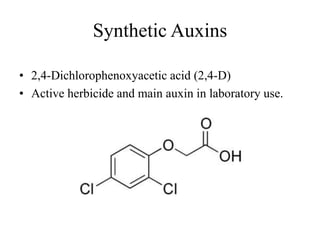
• 2,4-Dichlorophenoxyacetic acid (2,4-D)
• Active herbicide and main auxin in laboratory use.
Continue…
• α-Naphthalene acetic acid (α-NAA)
• Often part of commercial rooting powders.
Continue…
• 2-Methoxy-3,6-dichlorobenzoic acid.
• Active herbicide.
Continue…
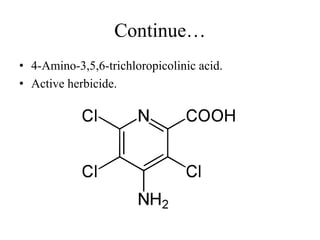
• 4-Amino-3,5,6-trichloropicolinic acid.
• Active herbicide.
Continue…
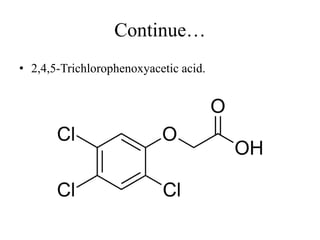
• 2,4,5-Trichlorophenoxyacetic acid.
Organization Of Plant
• Auxins govern the form and shape of plant body,
direction and strength of growth of all organs, and
their mutual interaction.
• Auxin employment begins in the embryo of the plant.
• Next, it helps to coordinate proper development of
the arising organs, such as roots, cotyledons and
leaves and mediates long distance signals between
them, contributing so to the overall architecture of the
plant.
Continue…
• An important principle of plant organization based
upon auxin distribution is apical dominance.
• Meaning that the auxin produced by the apical bud
diffuses downwards and inhibits the development of
lateral bud growth, which would otherwise compete
with the apical tip for light and nutrients.
• Removing the apical tip allows the lower dormant
lateral buds to develop, and the buds between the leaf
stalk and stem produce new shoots which compete to
become the lead growth.
Continue…
• The process is actually quite complex, because auxin
transported downwards from the lead shoot tip has to
interact with several other plant hormones along the
growth axis in plant body.
• Finally, the sum of auxin arriving from stems to roots
influences the degree of root growth
• It also follows that smaller amount of auxin arriving
to the roots results in slower growth of roots and the
nutrients are subsequently in higher degree invested
in the upper part of the plant, which hence starts to
grow faster.
Continue…
• Growth of the axillary buds is inhibited by auxin, as a
high concentration of the auxin would then directly
stimulate ethylene synthesis in axillary buds, causing
inhibition of their growth and potentiation of apical
dominance.
• When the apex of the plant is removed, the inhibitory
effect is removed and the growth of lateral buds is
enhanced.
• Auxin is sent to the part of the plant facing away
from the light, where it promotes cell elongation, thus
causing the plant to bend towards the light.
Physiological Effects
• Wound response
Auxin induces the formation and organization
of phloem and xylem. When the plant is wounded,
the auxin may induce the cell differentiation and
regeneration of the vascular tissues.
• Flowering
Auxin plays a role in the initiation of flowering and
development of reproductive organs. In low
concentrations, it can delay the senescence of
flowers.
Continue…
• Root growth and development
Auxin induces both growth of pre-existing roots and
adventitious root formation.
As more native auxin is transported down the stem to
the roots, the overall development of the roots is
stimulated.
If the source of auxin is removed, such as by
trimming the tips of stems, the roots are less
stimulated accordingly, and growth of stem is
supported instead.
NAA and IBA, are commonly applied to stimulate
root initiation
Continue…
• Fruit growth and development
Auxin is required for fruit growth and
development and delays fruit senescence.
When seeds are removed from strawberries, fruit
growth is stopped; exogenous auxin stimulates the
growth in fruits with seeds removed. For fruit
with unfertilized seeds, exogenous auxin results
in parthenocarpy ("virgin-fruit" growth).
Continue…
• Ethylene biosynthesis
In low concentrations, auxin can inhibit ethylene
formation and transport of precursor in plants;
however, high concentrations can induce the
synthesis of ethylene. Therefore, the high
concentration can induce femaleness of flowers in
some species.
Auxin inhibits abscission prior to formation of
abscission layer, and thus inhibits senescence of
leaves.
Continue…
• Respiration
Auxins stimulate respiration most probably by
increasing availability of respiratory substrate.
• Metabolism
Application of auxin has been found to enhance
metabolism due to mobilisation of plant resources.
• Solutes
Auxins increase storage of solutes inside the cells.
Continue…
• Cell Enlargement
It is the most fundamental activity of auxins. Cell
enlargement is caused by solubilisation of
carbohydrates, loosening of wall micro-fibrils,
synthesis of more wall materials, increased membrane
permeability and respiration.
• Cambial Activity
Degree of cambial activity is directly proportional to
auxin concentration. Auxin also controls xylem
differentiation.
Continue…
• Cell Division
Auxin is known to promote division in the cells of
vascular cambium.
• Tissue Culture
In tissue culture, the development of callus or mass of
undifferentiated cells is promoted by auxin.
Differentiation of callus occurs in the presence of
both auxin and cytokinin.
Continue…
• Root Formation
Auxin promotes root initiation at concentration which
is inhibitory for growth of intact root.
• Inhibition of Abscission
Auxin delays abscission of young leaves and fruits.
Its effect is through non-formation of abscission zone
below a leaf or fruit. Abscission zone cuts off
nutrients and water supply. However, auxin promotes
the abscission of mature or older leaves and fruits.
Continue…
• Tropic Movements
Differential distribution of in-dole 3-acetic acid
produces tropical plant responses like phototropism
and geotropism.
• Seedless Fruits
The carpels producing seedless or parthenocarpic
fruits have a higher internal production of auxin that
supports the development of fruits, e.g., Banana.
Thank You

023 ubaid afzal

  • 1.
  • 2.
    Auxins • Auxins area class of plant hormones (or plant growth regulators) with some morphogen-like characteristics. • Auxins have a cardinal role in coordination of many growth and behavioral processes in the plant's life cycle and are essential for plant body development. • Auxins and their role in plant growth were first described by the Dutch scientist Frits Warmolt Went.
  • 3.
    Natural Auxins • Indole-3-aceticacid (IAA), is credited to the Dutch botanist Fritz Went who worked in the 1920s and ’30s and was the 1st auxin to be discovered. • IAA is produced in the growing tip of a plant shoot and diffuses downward through the stem. • IAA suppresses the development of axillary buds and branching growth below the tip. • Cutting off the main stem of a plant increases bushiness by allowing the axillary buds below the tip to be released from their IAA-induced dormancy to begin growing.
  • 4.
    Continue… • Formula: C10H9NO2. •Molar mass: 175.184 g/mol. • Solubility: Insoluble in water. Soluble in ethanol. • Melting point: 168 to 170 ° • Appearance: White solid.
  • 5.
    Synthetic Auxins • 2,4-Dichlorophenoxyaceticacid (2,4-D) • Active herbicide and main auxin in laboratory use.
  • 6.
    Continue… • α-Naphthalene aceticacid (α-NAA) • Often part of commercial rooting powders.
  • 7.
  • 8.
  • 9.
  • 10.
    Organization Of Plant •Auxins govern the form and shape of plant body, direction and strength of growth of all organs, and their mutual interaction. • Auxin employment begins in the embryo of the plant. • Next, it helps to coordinate proper development of the arising organs, such as roots, cotyledons and leaves and mediates long distance signals between them, contributing so to the overall architecture of the plant.
  • 11.
    Continue… • An importantprinciple of plant organization based upon auxin distribution is apical dominance. • Meaning that the auxin produced by the apical bud diffuses downwards and inhibits the development of lateral bud growth, which would otherwise compete with the apical tip for light and nutrients. • Removing the apical tip allows the lower dormant lateral buds to develop, and the buds between the leaf stalk and stem produce new shoots which compete to become the lead growth.
  • 12.
    Continue… • The processis actually quite complex, because auxin transported downwards from the lead shoot tip has to interact with several other plant hormones along the growth axis in plant body. • Finally, the sum of auxin arriving from stems to roots influences the degree of root growth • It also follows that smaller amount of auxin arriving to the roots results in slower growth of roots and the nutrients are subsequently in higher degree invested in the upper part of the plant, which hence starts to grow faster.
  • 13.
    Continue… • Growth ofthe axillary buds is inhibited by auxin, as a high concentration of the auxin would then directly stimulate ethylene synthesis in axillary buds, causing inhibition of their growth and potentiation of apical dominance. • When the apex of the plant is removed, the inhibitory effect is removed and the growth of lateral buds is enhanced. • Auxin is sent to the part of the plant facing away from the light, where it promotes cell elongation, thus causing the plant to bend towards the light.
  • 14.
    Physiological Effects • Woundresponse Auxin induces the formation and organization of phloem and xylem. When the plant is wounded, the auxin may induce the cell differentiation and regeneration of the vascular tissues. • Flowering Auxin plays a role in the initiation of flowering and development of reproductive organs. In low concentrations, it can delay the senescence of flowers.
  • 15.
    Continue… • Root growthand development Auxin induces both growth of pre-existing roots and adventitious root formation. As more native auxin is transported down the stem to the roots, the overall development of the roots is stimulated. If the source of auxin is removed, such as by trimming the tips of stems, the roots are less stimulated accordingly, and growth of stem is supported instead. NAA and IBA, are commonly applied to stimulate root initiation
  • 16.
    Continue… • Fruit growthand development Auxin is required for fruit growth and development and delays fruit senescence. When seeds are removed from strawberries, fruit growth is stopped; exogenous auxin stimulates the growth in fruits with seeds removed. For fruit with unfertilized seeds, exogenous auxin results in parthenocarpy ("virgin-fruit" growth).
  • 17.
    Continue… • Ethylene biosynthesis Inlow concentrations, auxin can inhibit ethylene formation and transport of precursor in plants; however, high concentrations can induce the synthesis of ethylene. Therefore, the high concentration can induce femaleness of flowers in some species. Auxin inhibits abscission prior to formation of abscission layer, and thus inhibits senescence of leaves.
  • 18.
    Continue… • Respiration Auxins stimulaterespiration most probably by increasing availability of respiratory substrate. • Metabolism Application of auxin has been found to enhance metabolism due to mobilisation of plant resources. • Solutes Auxins increase storage of solutes inside the cells.
  • 19.
    Continue… • Cell Enlargement Itis the most fundamental activity of auxins. Cell enlargement is caused by solubilisation of carbohydrates, loosening of wall micro-fibrils, synthesis of more wall materials, increased membrane permeability and respiration. • Cambial Activity Degree of cambial activity is directly proportional to auxin concentration. Auxin also controls xylem differentiation.
  • 20.
    Continue… • Cell Division Auxinis known to promote division in the cells of vascular cambium. • Tissue Culture In tissue culture, the development of callus or mass of undifferentiated cells is promoted by auxin. Differentiation of callus occurs in the presence of both auxin and cytokinin.
  • 21.
    Continue… • Root Formation Auxinpromotes root initiation at concentration which is inhibitory for growth of intact root. • Inhibition of Abscission Auxin delays abscission of young leaves and fruits. Its effect is through non-formation of abscission zone below a leaf or fruit. Abscission zone cuts off nutrients and water supply. However, auxin promotes the abscission of mature or older leaves and fruits.
  • 22.
    Continue… • Tropic Movements Differentialdistribution of in-dole 3-acetic acid produces tropical plant responses like phototropism and geotropism. • Seedless Fruits The carpels producing seedless or parthenocarpic fruits have a higher internal production of auxin that supports the development of fruits, e.g., Banana.
  • 23.