
Plant Cell Constituents
BY
Dr. Jitendra Patel
Associate Professor
AIPS, Hyderabad, India.
Plant cells
• Plant cells are eukaryotic cells present in green
plants, photosynthetic eukaryotes of the kingdom
plantae. Their distinctive features include primary
cell walls containing cellulose, hemicelluloses and
pectin, the presence of plastids with the
capability to perform photosynthesis and store
starch, a large vacuole that regulates turgor
pressure, the absence of flagella or centrioles,
except in the gametes, and a unique method of
cell division involving the formation of a cell plate
or phragmoplast that separates the new daughter
cells.
Plant Cell Diagram
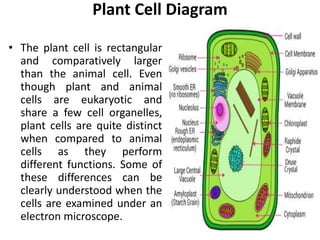
• The plant cell is rectangular
and comparatively larger
than the animal cell. Even
though plant and animal
cells are eukaryotic and
share a few cell organelles,
plant cells are quite distinct
when compared to animal
cells as they perform
different functions. Some of
these differences can be
clearly understood when the
cells are examined under an
electron microscope.
Plant Cell Structure
• Just like different organs within the body, plant cell
structure includes various components known as cell
organelles that perform different functions to sustain
itself. These organelles include:
1. Cell Wall
• It is a rigid layer which is composed of cellulose,
glycoproteins, lignin, pectin and hemicellulose. It is located
outside the cell membrane. It comprises proteins,
polysaccharides and cellulose.
• The primary function of the cell wall is to protect and
provide structural support to the cell. The plant cell wall is
also involved in protecting the cell against mechanical
stress and to provide form and structure to the cell. It also
filters the molecules passing in and out of the cell.
• The formation of the cell wall is guided by microtubules. It
consists of three layers, namely, primary, secondary and the
middle lamella. The primary cell wall is formed by cellulose
laid down by enzymes.
2. Cell membrane
• It is the semi-permeable membrane that is present within the cell
wall. It is composed of a thin layer of protein and fat.
• The cell membrane plays an important role in regulating the entry
and exit of specific substances within the cell.
• For instance, cell membrane keeps toxins from entering inside,
while nutrients and essential minerals are transported across.
3. Nucleus
• The nucleus is a membrane-bound structure that is present only in
eukaryotic cells. The vital function of a nucleus is to store DNA or
hereditary information required for cell division, metabolism and
growth.
 Nucleolus: It manufactures cell’s protein-producing structures and
ribosomes.
 Nucleopore: Nuclear membrane is perforated with holes called
nucleopore that allows proteins and nucleic acids to pass through.
4. Plastids
• They are membrane-bound organelles that have their own
DNA. They are necessary to store starch, to carry out the
process of photosynthesis. It is also used in the synthesis of
many molecules, which form the building blocks of the cell.
Some of the vital types of plastids and their functions are
stated below:
4.1 Leucoplasts
• They are found in non-photosynthetic tissues of plants.
They are used for the storage of protein, lipid and starch.
4.2 Chloroplasts
• It is an elongated organelle enclosed by phospholipid
membrane. The chloroplast is shaped like a disc and the
stroma is the fluid within the chloroplast that comprises a
circular DNA.
• Each chloroplast contains a green coloured pigment called
chlorophyll required for the process of photosynthesis. The
chlorophyll absorbs light energy from the sun and uses it to
transform carbon dioxide and water into glucose.
Chloroplasts
4.3 Chromoplasts
• They are heterogeneous, coloured plastid which is
responsible for pigment synthesis and for storage in
photosynthetic eukaryotic organisms.
• Chromoplasts have red, orange and yellow coloured
pigments which provide colour to all ripe fruits and
flowers.
5. Central Vacuole
• It occupies around 30% of the cell’s volume in a mature
plant cell. Tonoplast is a membrane that surrounds
central vacuole.
• The vital function of central vacuole apart from storage
is to sustain turgid pressure against the cell wall. The
central vacuole consists of cell sap.
• It is a mixture of salts, enzymes and other substances.
6. Golgi Apparatus
• They are found in all eukaryotic cells which are involved in
distributing synthesized macromolecules to various parts of the cell.
7. Ribosomes
• They are the smallest membrane-bound organelles which comprise
RNA and protein. They are the sites for protein synthesis, hence,
also referred to as the protein factories of the cell.
8. Mitochondria
• They are the double-membraned organelles found in the cytoplasm
of all eukaryotic cells. They provide energy by breaking down
carbohydrate and sugar molecules, hence they are also referred to
as the “Powerhouse of the cell.”
9. Lysosome
• Lysosomes are called suicidal bags as they hold digestive enzymes
in an enclosed membrane. They perform the function of cellular
waste disposal by digesting worn-out organelles, food particles and
foreign bodies in the cell.
Plant Cell Types
• Cells of a matured and higher plant become
specialized to perform certain vital functions
that are essential for their survival. Few plant
cells are involved in the transportation of
nutrients and water, while others for storing
food.
• The specialized plant cells include parenchyma
cells, sclerenchyma cells, collenchyma cells,
xylem cells and phloem cells.
• Following are some of the different types of
plant cells:
1. Collenchyma Cells
• They are hard or rigid cells, which play a primary role in providing support
to the plants when there is restraining growth in a plant due to lack of
hardening agent in primary walls.
2. Sclerenchyma Cells
• These cells are more rigid compared to collenchyma cells and this is
because of the presence of a hardening agent. These cells are usually
found in all plant roots and mainly involved in providing support to the
plants.
3. Parenchyma Cells
• Parenchyma cells play a significant role in all plants. They are the living
cells of plants, which are involved in the production of leaves. They are
also involved in the exchange of gases, production of food, storage
of organic products and cell metabolism. These cells are typically more
flexible than others because they are thinner.
4. Xylem Cells
• Xylem cells are the transport cells in vascular plants. They help in the
transport of water and minerals from the roots to the leaves and other
parts of the plants.
5. Phloem Cells
• Phloem cells are other transport cells in vascular plants. They transport
food prepared by the leaves to different parts of the plants.
Plant Cell Functions
• Plant cells are the building blocks of plants.
Photosynthesis is the major function
performed by plant cells.
• Photosynthesis occurs in the chloroplasts of
the plant cell. It is the process of preparing
food by the plants, by utilizing sunlight,
carbon dioxide and water. Energy is produced
in the form of ATP in the process.
• A few plant cells help in the transport of water
and nutrients from the roots and leaves to
different parts of the plants.
Thank You

Plant Cell constituents

  • 1.
    Plant Cell Constituents BY Dr.Jitendra Patel Associate Professor AIPS, Hyderabad, India.
  • 2.
    Plant cells • Plantcells are eukaryotic cells present in green plants, photosynthetic eukaryotes of the kingdom plantae. Their distinctive features include primary cell walls containing cellulose, hemicelluloses and pectin, the presence of plastids with the capability to perform photosynthesis and store starch, a large vacuole that regulates turgor pressure, the absence of flagella or centrioles, except in the gametes, and a unique method of cell division involving the formation of a cell plate or phragmoplast that separates the new daughter cells.
  • 3.
    Plant Cell Diagram •The plant cell is rectangular and comparatively larger than the animal cell. Even though plant and animal cells are eukaryotic and share a few cell organelles, plant cells are quite distinct when compared to animal cells as they perform different functions. Some of these differences can be clearly understood when the cells are examined under an electron microscope.
  • 4.
    Plant Cell Structure •Just like different organs within the body, plant cell structure includes various components known as cell organelles that perform different functions to sustain itself. These organelles include: 1. Cell Wall • It is a rigid layer which is composed of cellulose, glycoproteins, lignin, pectin and hemicellulose. It is located outside the cell membrane. It comprises proteins, polysaccharides and cellulose. • The primary function of the cell wall is to protect and provide structural support to the cell. The plant cell wall is also involved in protecting the cell against mechanical stress and to provide form and structure to the cell. It also filters the molecules passing in and out of the cell. • The formation of the cell wall is guided by microtubules. It consists of three layers, namely, primary, secondary and the middle lamella. The primary cell wall is formed by cellulose laid down by enzymes.
  • 5.
    2. Cell membrane •It is the semi-permeable membrane that is present within the cell wall. It is composed of a thin layer of protein and fat. • The cell membrane plays an important role in regulating the entry and exit of specific substances within the cell. • For instance, cell membrane keeps toxins from entering inside, while nutrients and essential minerals are transported across. 3. Nucleus • The nucleus is a membrane-bound structure that is present only in eukaryotic cells. The vital function of a nucleus is to store DNA or hereditary information required for cell division, metabolism and growth.  Nucleolus: It manufactures cell’s protein-producing structures and ribosomes.  Nucleopore: Nuclear membrane is perforated with holes called nucleopore that allows proteins and nucleic acids to pass through.
  • 6.
    4. Plastids • Theyare membrane-bound organelles that have their own DNA. They are necessary to store starch, to carry out the process of photosynthesis. It is also used in the synthesis of many molecules, which form the building blocks of the cell. Some of the vital types of plastids and their functions are stated below: 4.1 Leucoplasts • They are found in non-photosynthetic tissues of plants. They are used for the storage of protein, lipid and starch. 4.2 Chloroplasts • It is an elongated organelle enclosed by phospholipid membrane. The chloroplast is shaped like a disc and the stroma is the fluid within the chloroplast that comprises a circular DNA. • Each chloroplast contains a green coloured pigment called chlorophyll required for the process of photosynthesis. The chlorophyll absorbs light energy from the sun and uses it to transform carbon dioxide and water into glucose.
  • 7.
  • 8.
    4.3 Chromoplasts • Theyare heterogeneous, coloured plastid which is responsible for pigment synthesis and for storage in photosynthetic eukaryotic organisms. • Chromoplasts have red, orange and yellow coloured pigments which provide colour to all ripe fruits and flowers. 5. Central Vacuole • It occupies around 30% of the cell’s volume in a mature plant cell. Tonoplast is a membrane that surrounds central vacuole. • The vital function of central vacuole apart from storage is to sustain turgid pressure against the cell wall. The central vacuole consists of cell sap. • It is a mixture of salts, enzymes and other substances.
  • 9.
    6. Golgi Apparatus •They are found in all eukaryotic cells which are involved in distributing synthesized macromolecules to various parts of the cell. 7. Ribosomes • They are the smallest membrane-bound organelles which comprise RNA and protein. They are the sites for protein synthesis, hence, also referred to as the protein factories of the cell. 8. Mitochondria • They are the double-membraned organelles found in the cytoplasm of all eukaryotic cells. They provide energy by breaking down carbohydrate and sugar molecules, hence they are also referred to as the “Powerhouse of the cell.” 9. Lysosome • Lysosomes are called suicidal bags as they hold digestive enzymes in an enclosed membrane. They perform the function of cellular waste disposal by digesting worn-out organelles, food particles and foreign bodies in the cell.
  • 10.
    Plant Cell Types •Cells of a matured and higher plant become specialized to perform certain vital functions that are essential for their survival. Few plant cells are involved in the transportation of nutrients and water, while others for storing food. • The specialized plant cells include parenchyma cells, sclerenchyma cells, collenchyma cells, xylem cells and phloem cells. • Following are some of the different types of plant cells:
  • 11.
    1. Collenchyma Cells •They are hard or rigid cells, which play a primary role in providing support to the plants when there is restraining growth in a plant due to lack of hardening agent in primary walls. 2. Sclerenchyma Cells • These cells are more rigid compared to collenchyma cells and this is because of the presence of a hardening agent. These cells are usually found in all plant roots and mainly involved in providing support to the plants. 3. Parenchyma Cells • Parenchyma cells play a significant role in all plants. They are the living cells of plants, which are involved in the production of leaves. They are also involved in the exchange of gases, production of food, storage of organic products and cell metabolism. These cells are typically more flexible than others because they are thinner. 4. Xylem Cells • Xylem cells are the transport cells in vascular plants. They help in the transport of water and minerals from the roots to the leaves and other parts of the plants. 5. Phloem Cells • Phloem cells are other transport cells in vascular plants. They transport food prepared by the leaves to different parts of the plants.
  • 12.
    Plant Cell Functions •Plant cells are the building blocks of plants. Photosynthesis is the major function performed by plant cells. • Photosynthesis occurs in the chloroplasts of the plant cell. It is the process of preparing food by the plants, by utilizing sunlight, carbon dioxide and water. Energy is produced in the form of ATP in the process. • A few plant cells help in the transport of water and nutrients from the roots and leaves to different parts of the plants.
  • 13.