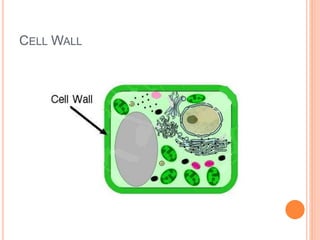
CELL WALL
Dr. Sarita Nanda
Associate Professor
Daulat Ram College
CELL WALL
HISTORY OF CELL
 Robert Hooke was the first scientist to observe the
cell under the microscope.
 He observed it in the bark of a tree.
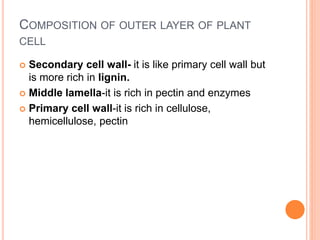
COMPOSITION OF OUTER LAYER OF PLANT
CELL
 Secondary cell wall- it is like primary cell wall but
is more rich in lignin.
 Middle lamella-it is rich in pectin and enzymes
 Primary cell wall-it is rich in cellulose,
hemicellulose, pectin
FUNCTION OF CELL WALLS
 To prevent over expansion of cell by water.
 The cell wall is seen in plants , bacteria and fungi
 The substance in cell wall differs from one species
to another
 They provide rigidity and strength
 They prevent toxic substances to enter in.
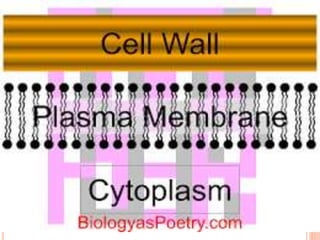
 A structure that protects and supports the cell.
 It gives shape to the cell.
PLASMADESMATA
 The cell walls are connected by plasmadesmata –
channels through the walls.
 They are connections between two adjacent cells.
 This allows cytoplasm of one cell to have
connection with the other cells.
 It is like the gap junctions of animal cells
 They allow cell to act in synctium as molecules and
ions can pass through it.
 The passage of these molecules is regulated.
 They have continued endoplasmic reticulum
between the cell which forms desmotubules.
 The primary cell wall is semipermeable and permits
passage of small molecules of 30-60kDa
 Water and CO2 can easily pass through it
 pH is an important determinant for the passage of
the molecules.
 The cell wall is a flexible structure and is not rigid
structure.
 The plant cell walls must have sufficient tensile
strength to withstand the turgor pressure.
PLASMADESMATA
PLASMADESMATA
COMPOSITION
The composition of the cell wall varies from one plant
to another. It essentially contains the following
components
 Hemicellulose- 20-35% xylan
 Cellulose
 Pectin
 Liginin
DIFFERENT KINDS OF CELL WALLS
 Plant- made of cellulose
 Bacterial – made of peptidoglycan
 Fungi- made of chitin
 Yeast-
CELL WALL STRUCTURE
CELL WALL OF FUNGI
BACTERIA
CELL WALL OF BACTERIA
GRAM POSITIVE AND GRAM NEGATIVE
DIFFERENCE BETWEEN GRAM POSITIVE AND
GRAM NEGATIVE BACTERIA
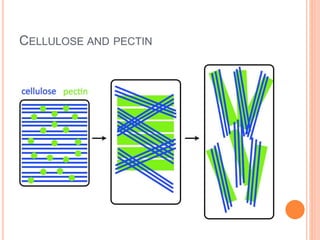
CELLULOSE AND PECTIN

Cell wall

  • 1.
    CELL WALL Dr. SaritaNanda Associate Professor Daulat Ram College
  • 2.
  • 4.
    HISTORY OF CELL Robert Hooke was the first scientist to observe the cell under the microscope.  He observed it in the bark of a tree.
  • 5.
    COMPOSITION OF OUTERLAYER OF PLANT CELL  Secondary cell wall- it is like primary cell wall but is more rich in lignin.  Middle lamella-it is rich in pectin and enzymes  Primary cell wall-it is rich in cellulose, hemicellulose, pectin
  • 6.
    FUNCTION OF CELLWALLS  To prevent over expansion of cell by water.  The cell wall is seen in plants , bacteria and fungi  The substance in cell wall differs from one species to another  They provide rigidity and strength  They prevent toxic substances to enter in.  A structure that protects and supports the cell.  It gives shape to the cell.
  • 7.
    PLASMADESMATA  The cellwalls are connected by plasmadesmata – channels through the walls.  They are connections between two adjacent cells.  This allows cytoplasm of one cell to have connection with the other cells.  It is like the gap junctions of animal cells  They allow cell to act in synctium as molecules and ions can pass through it.  The passage of these molecules is regulated.  They have continued endoplasmic reticulum between the cell which forms desmotubules.
  • 8.
     The primarycell wall is semipermeable and permits passage of small molecules of 30-60kDa  Water and CO2 can easily pass through it  pH is an important determinant for the passage of the molecules.  The cell wall is a flexible structure and is not rigid structure.  The plant cell walls must have sufficient tensile strength to withstand the turgor pressure.
  • 9.
  • 10.
  • 11.
    COMPOSITION The composition ofthe cell wall varies from one plant to another. It essentially contains the following components  Hemicellulose- 20-35% xylan  Cellulose  Pectin  Liginin
  • 12.
    DIFFERENT KINDS OFCELL WALLS  Plant- made of cellulose  Bacterial – made of peptidoglycan  Fungi- made of chitin  Yeast-
  • 13.
  • 15.
  • 16.
  • 17.
    CELL WALL OFBACTERIA
  • 18.
    GRAM POSITIVE ANDGRAM NEGATIVE
  • 19.
    DIFFERENCE BETWEEN GRAMPOSITIVE AND GRAM NEGATIVE BACTERIA
  • 20.