Parks and Playgrounds
Town Planning
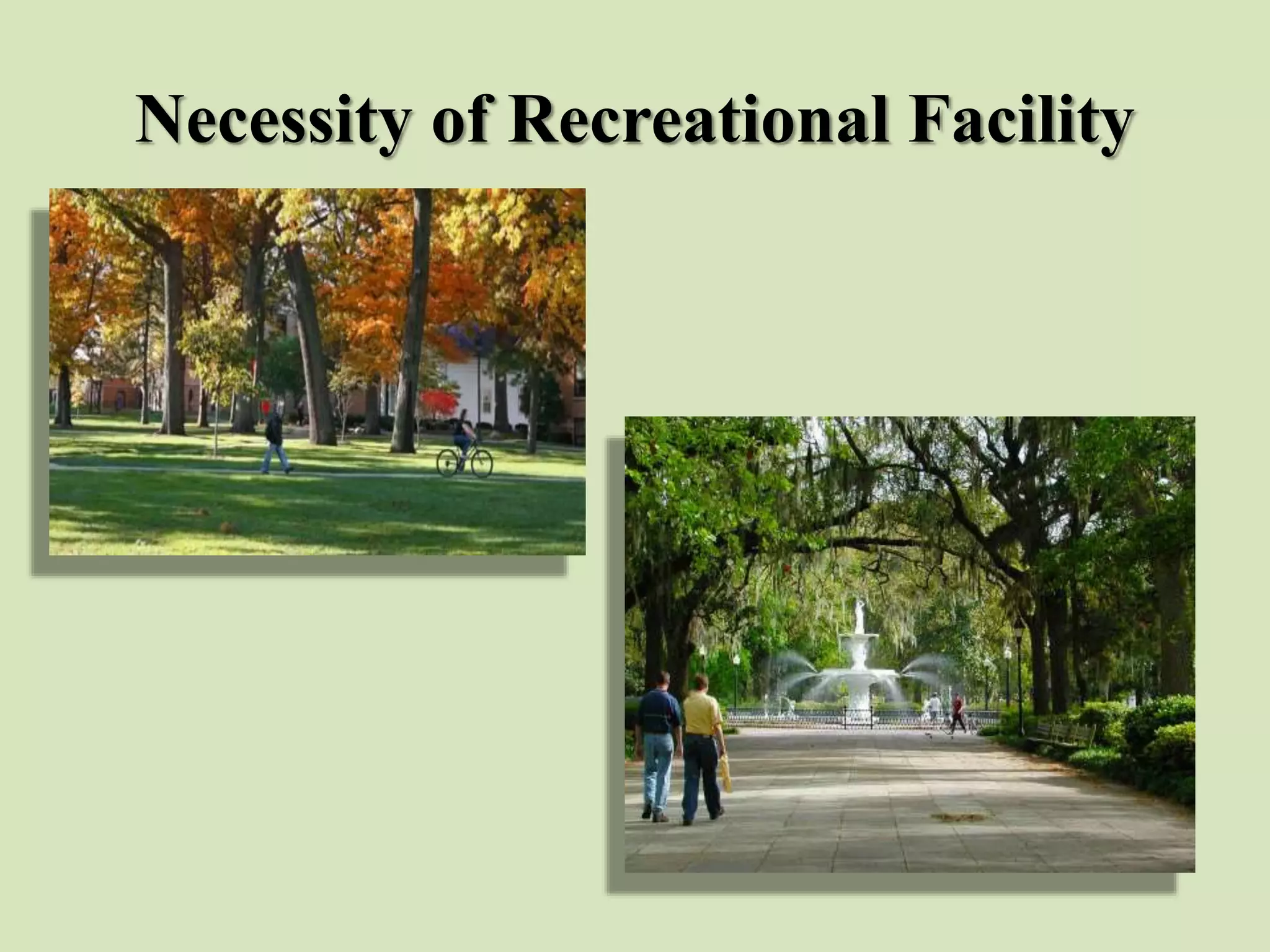
Necessity of Recreational Facility
• Recreation is one of the important part which
contribute to general health and well being of
the community.
• It brings enjoyment of living , encourages
relaxation , helps to utilize the leisurely hours of
all age groups young and old alike into the
desirable activities thus making the people to live
rich and contended life.
• Recreation facilities are scare in most of the
towns and cities and in most of the cities road
is the only open space where child can play.
Necessity of Recreational Facility
• In absence of wholesome public recreation, the
children are likely to spend time in-undesirable
activities which finally drag them towards
delinquency and juvenile crime. Hence the
town-planning authorities should make provisions
of a variety of wholesome public recreations.
• It must be remembered that no town planning
scheme is complete without provisions of parks
, playgrounds or such type of recreational
area.
Necessity of Recreational Facility
Features of Public Recreational System
• The essential features of Public Recreation
system are:
• There should be proper provision of year
round recreational activities for all age
groups for all communities.
• It should be located within easy reach of all
habitants, generally within half to one km
with easy accessibility and safety.
Features of Public Recreational System
Selection of Site for Parks and
Playground
• The points to be considered while selecting site for parks and
playground are:
• To acquire easily accessible strip of land which can cheaply
adopted, to serve as a park, playfield etc.
• To acquire such land which can be cheaply adopted , to serve as
a park , playfield.
• To acquire such lands which are not suitable for Streets and
Buildings.
• To acquire as much land as possible in advance before the cost of
land increases due to any proposed development.
• By filling the pools, ponds, and old insanitary tanks etc, in the
city.
• By clearing the slum area in the city and then the land available
may be converted into parks, gardens, playgrounds etc.
Selection of Site for Parks and
Playground
Types of Recreation Systems
• There are two types of Recreation Systems:
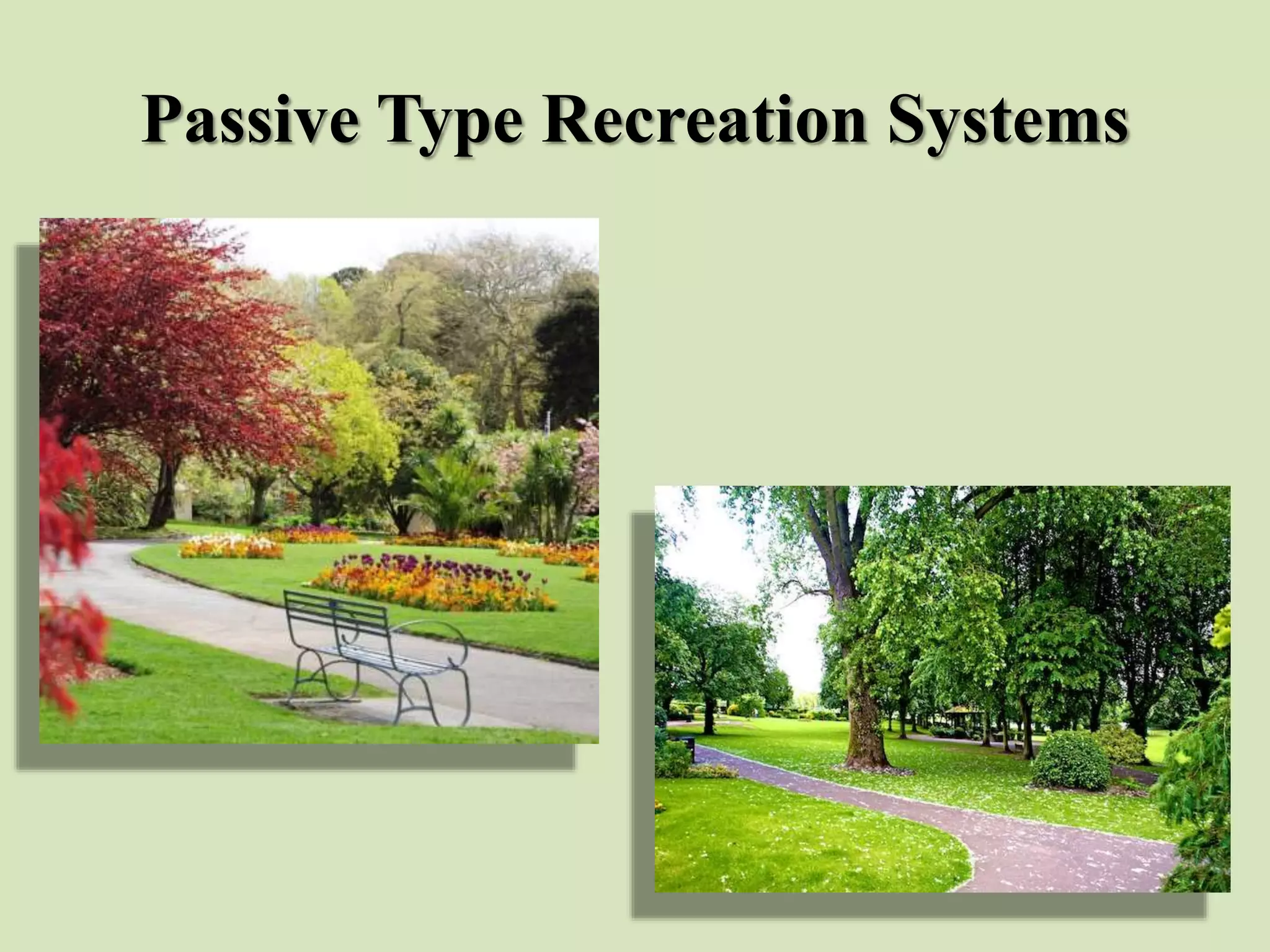
• Passive Type such as parks and gardens etc.
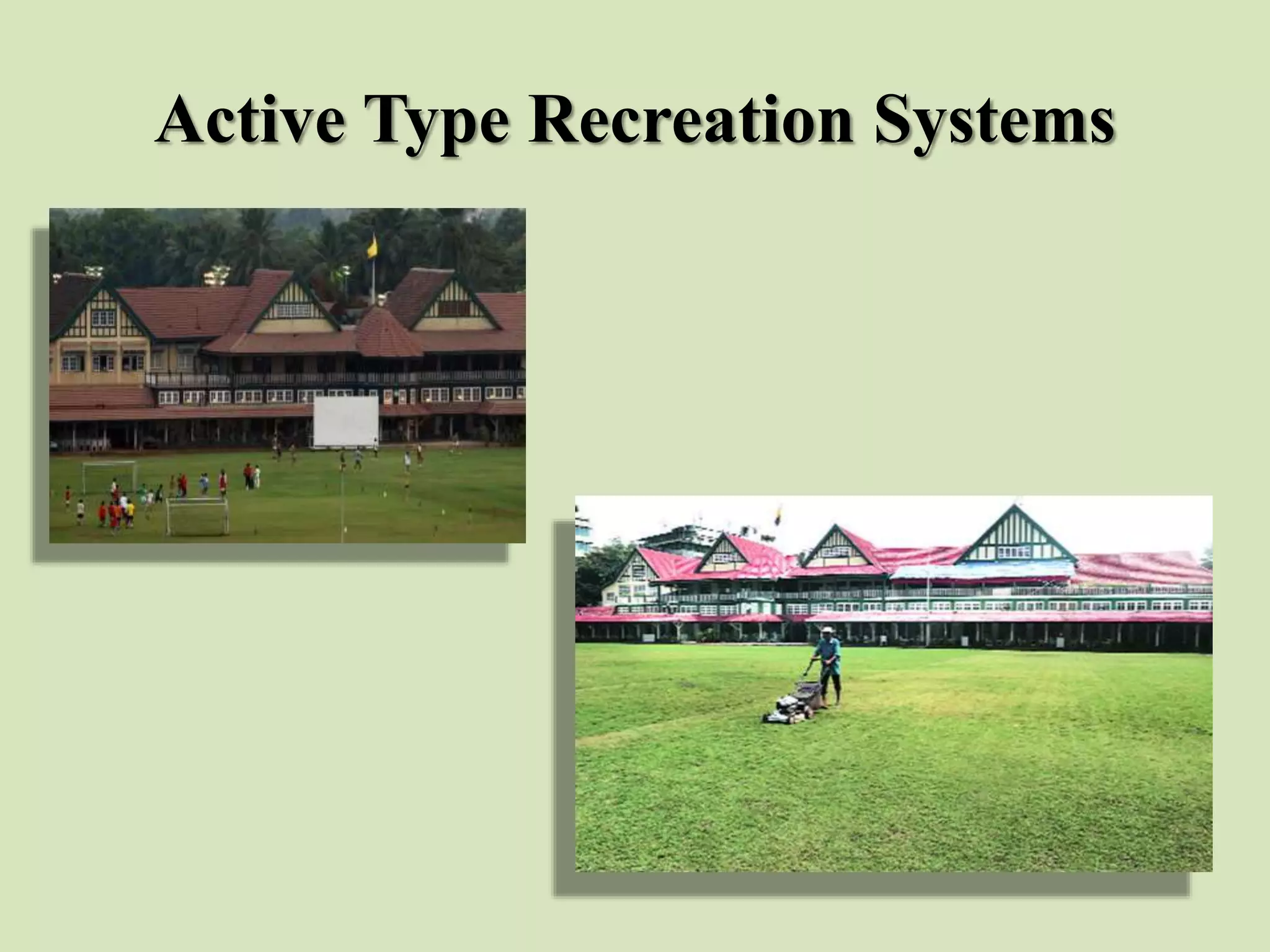
• Active Type such as playfields, Akhadas,
Gymkhanas, Stadium, Boating and swimming
clubs.
Passive Type Recreation Systems
Active Type Recreation Systems
Types of Recreation Systems
Parks:
• These are necessary to meet the needs of open spaces, to
get fresh air, evening rest and relaxation for all sections
of the society. The parks and gardens should be made more
attractive by planting all types of flowers, trees, bushes in
the pleasing layout with fountains, lawns etc. These parks ,
gardens forms passive form of recreation.
• Play field : These help to provide the physical growth of
the body and hence offer the active type of recreation.
• Both the types of recreation play an important part in social,
physical, and cultural aspects in town planning.
Parks
Play field
Location of Urban Green Space
• The urban green spaces should be located in
the town plan very carefully as they serve as a
kind of filter or protection against noise, dust,
hot sun and harmful winds. Following aspects
should be observed in connection.
Distribution
• The green spaces in a town plan should be
distributed evenly in the residential area to
insure sanitary and hygienic conditions. They
should be located near the places for rest and
recreation.
Location of Urban Green Space
Location:
• The central part of the town or large spaces in front of public
building are usually landscaped with lawns and flowerbeds. The
main streets of town should be provided with tall trees planted in
rows.
Planning :
• While planning a system of Urban green space, the climatic
feature of a locality should be taken into consideration.
• In towns having advantage of sea shores, lakes, etc. The large park
and spaces should be placed near water.
Site Selection :
• The Land required for the parks and playgrounds should be
acquired well in advance before the value of land increases due
to proposed development in the town planning scheme.
Location of Urban Green Space
Classification of Parks
• The parks can be classified into the following three
ways :
• According to Character ;
• According to purpose ;
• According to Size;
Classification of Parks
• According to Character:
• The parks according to character are classified
into two types;
• (i) Artificial Parks
• (ii) Natural Parks
Classification of Parks
Artificial Parks :
• These parks are prepared artificially with great care
by experts in the park layout. They are planted with
grass, shrubs, flower and trees. The water may be
introduced in the form of fountains and pools. The
benches with suitable design may be provided.
Natural Parks :
• In case of Natural parks, all efforts, are made to
maintain in tack the original features of the parks
and only the necessary minimum adjustments are made
to put them for public use.
Artificial Parks
Natural Parks
Classification of Parks
According to Purpose:
• The parks according to purpose are classified into
following two types and they provide green spaces for
special use:
• Botanical Parks
• Zoological Parks
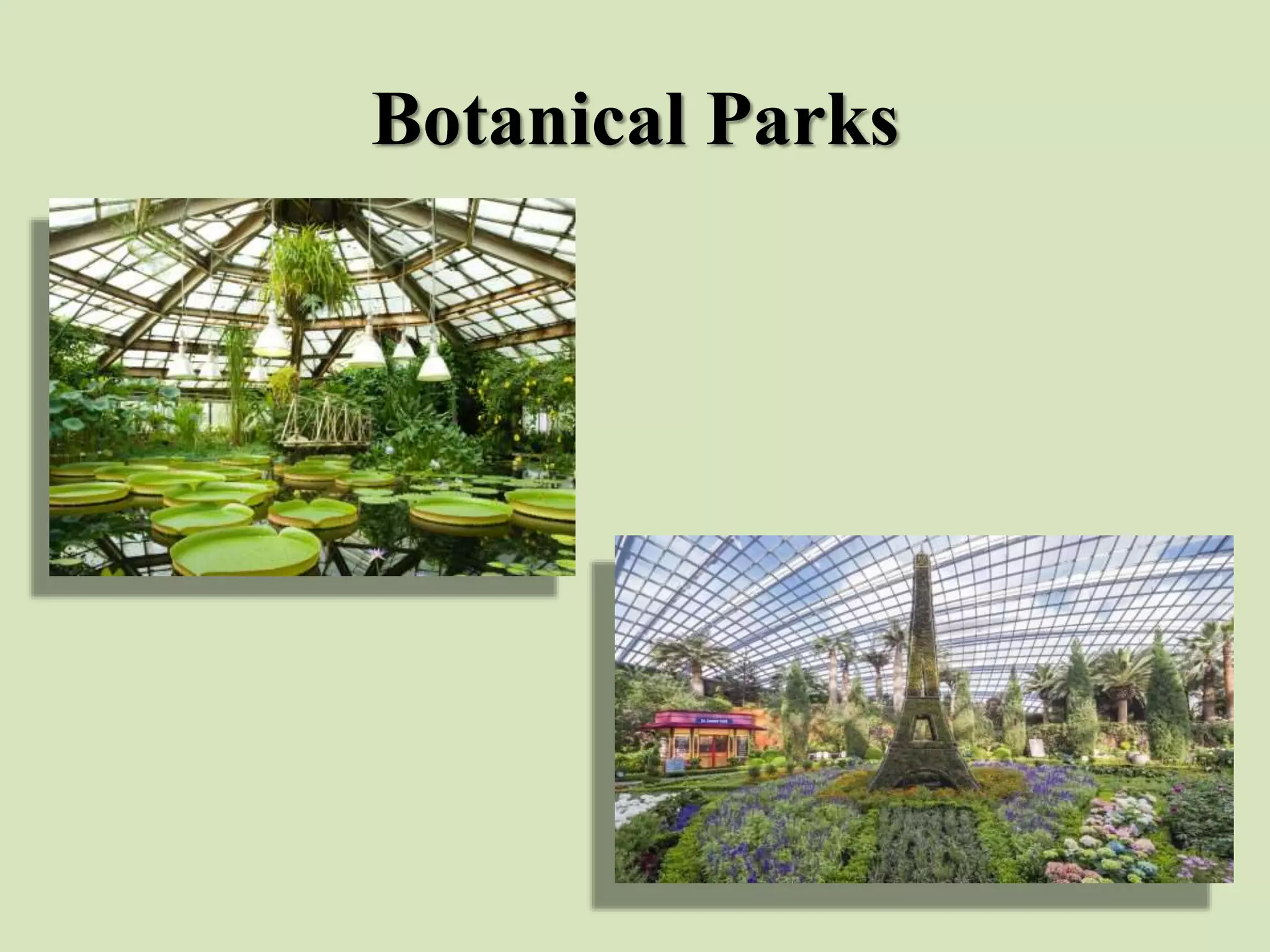
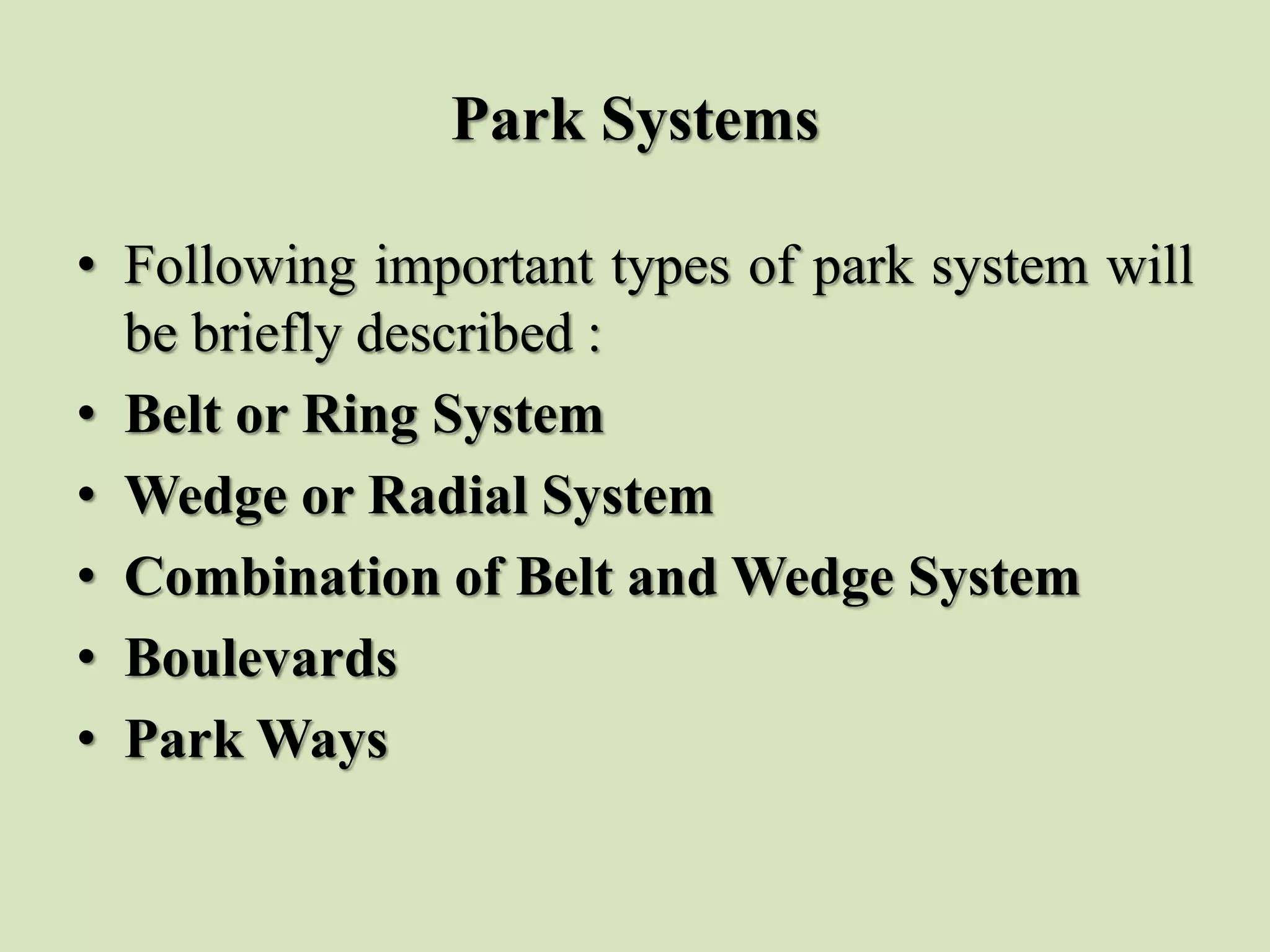
Botanical Parks:
• These parks are primarily meant for the study of
plant specimens. But their atmosphere can be made
more pleasant and appealing by the presence of
beautiful trees, flowers and lawns.
Botanical Parks
Classification of Parks
Zoological Parks
• These parks Contain zoo to be given an
attractive park like setting . It is undoubtedly
true that for the vast majority of people , a visit
to the zoological park is more or less an outing
or a picnic, usually accompanied by children.
A zoological park may contain houses and
other facilities for animals to be maintained
in the zoo.
Zoological Parks
Classification of Parks
According to the size :
• The parks according to sizes are classified as
• Small Size Parks:
• Medium Size Parks:
• Large Size Parks:
• Reservations
• National Parks
Classification of Parks
Small Size Parks :
• These parks are generally in the form of
squares enclosing a public building. They
are provided in dense business or residential
areas where land is costly. The area of these
parks varies from 1 ha to 4 ha. These parks
may also be located as settings of architectural
public buildings or monuments at junctions of
roads or in the midst of flats.
Small Size Parks
Classification of Parks
Medium Size Parks:
• Medium size parks:
• These are also known as the neighborhood
parks and they are preferred for every
residential locality in a town. Both the types
of recreation active as well as passive may be
provided in these parks The size of this parks
should not be less than 12 hectares.
Medium Size Parks
Classification of Parks
Large Size Parks :
• These parks serve the town or city as a whole
or a number of neighborhood units. They may
be provide active recreation for games like
cricket, boating, riding, swimming, etc.
and may also accommodate zoological gardens.
The large beach on the ocean front can be
included in this category of parks. The minimum
area required for this type of park is about 40
hactare.
Large Size Parks
Classification of Parks
Reservations:
• These parks are situated outside the city area and
they are mostly unexplored. They may Include within
their limits, rivers, forests, waterfalls, mountains,
wildlife, places of historical Importance, Coastal belts
etc.
• Such parks can be easily distributed throughout the
country so that whole of the population can enjoy
them. These parks should be assessable from number
of towns. Theses parks also provide facilities to the
scientists and students for the study of natural flora and
fauna.
Reservations
Park Systems
• The ideal park System in any town planning
scheme is one which functions to the best
advantage of population.
• These arrangements may be in the form of
Parkway, avenues, boulevards, or Green
belts
Park Systems
• Following important types of park system will
be briefly described :
• Belt or Ring System
• Wedge or Radial System
• Combination of Belt and Wedge System
• Boulevards
• Park Ways
Park Systems
Belt or Ring System
• In this system , the park are provided on the
periphery of the town in the form of belt or
ring. This system of open spaces exists in
some old towns and cities. The main purpose
of adopting this system in old time was to
provide an elaborate ring in the form of park as
a measure of defense of town or city.
Belt or Ring System
Park Systems
Wedge or Radial System
• In this system, the wedge shaped strips of
open spaces are provided to link up centre
of the town with the rural area. The main
advantage of this system is that it enables fresh
air from the country to reach right up to the
heart of the town In some cases the wedge
system may be developed as parkway or
Boulevards.
Wedge or Radial System
Park Systems
Combination of Belt and Wedge Systems:
• The combination of belt and wedge system
gives excellent results. In this system, it is
possible to practically link up major open
spaces of the town and people can travel from
one part of the town to the other part through
shaded parkway and boulevards.
Park Systems
Boulevards
• The word boulevard has come from Paris , France.
The ring roads of Paris was once acting as a
defensive walls but later on they were demolished,
and the roads thus formed came to be known as
boulevards.
• Now in town planning boulevards are connection
between large and medium sized parks and act as a
wide tree lined avenue in a town. They enable the
busy people who have no time to visit parks to drive in
the carriage through the park and enjoy the natural
surrounding.
Boulevards
Park Systems
Park Ways
• These have formed due to the advent and
development of automobiles and rapid growth
in traffic.
• The parkways may be defined as elongated park
through which passes a road which denies right
of access from abutting land.
• The parkways are ingeniously laid out to make
the journey as pleasant as possible. So they follow
the natural streams, valleys and sea-shore.
Park Ways
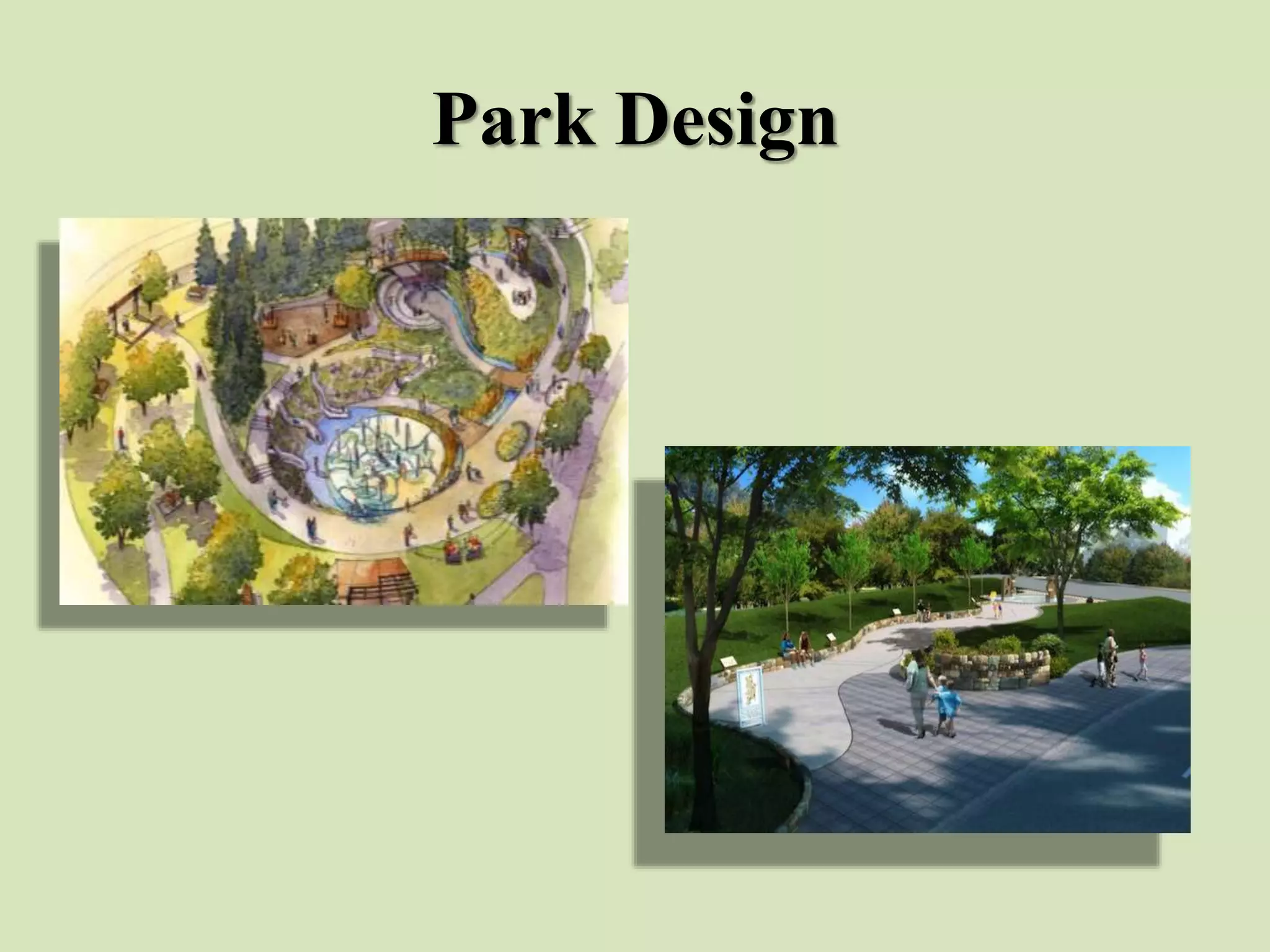
Park Design
• The design and layout of parks and
playgrounds require colloboration of
disciplines from various fields. No
satisfactory result can be obtained without
proper cohesion orderly planning and
landscaping of various elements comprising
the park system.
Park Design
Park Design
(i) Collection of Data
• It is necessary for the designer to collect
data such as characteristics of site,
population likely to visit the park, purpose
of the park facilities to be provided etc.
before the commencement of the work.
Collection of Data
Park Design
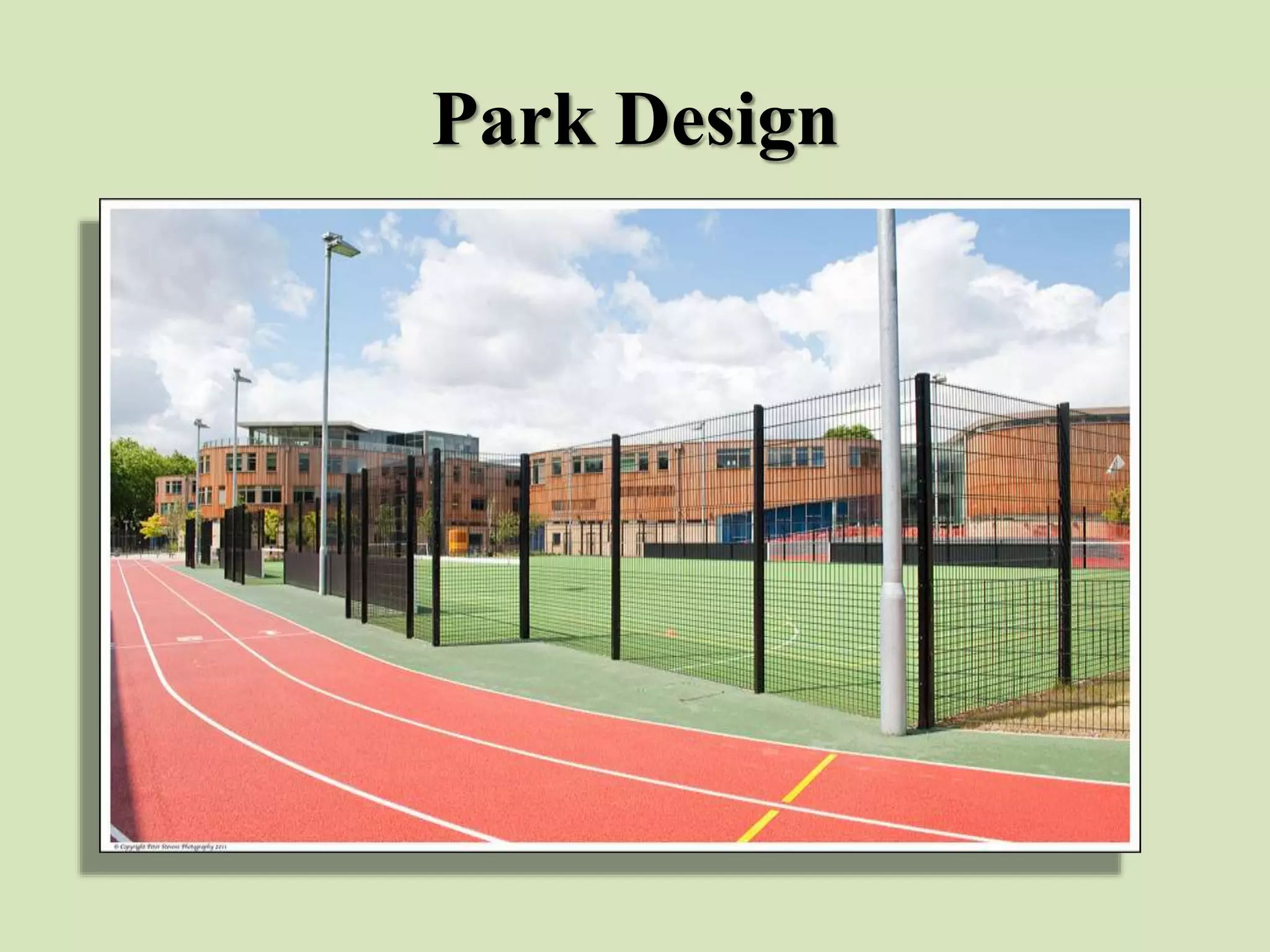
Commercial Sports
• The Ground for commercial sports such as
cricket and football should be surrounded with
walls as entry to such ground will be limited to
those who pay admission
Park Design
Park Design
Division
• The usual practice is to divide the whole area
of the park into three divisions as :
• Area of Passive Recreation
• Buffer area consisting of flower garden or
some such arrangements
• Area of active recreation or playground area
including pavilion and other building.
Park Design
Park Design
Facilities
• The park design should properly accommodate
the usual facilities such as sanitary blocks,
shelters, seats, drinking water. Fountains
etc.
Park Design
Park Design
Marine Parks
• The design of a marine park requires careful
consideration with respect to the large number of
persons to be assembled on holidays, movements
of pedestrian, and vehicular traffic , parking areas,
for private cars.
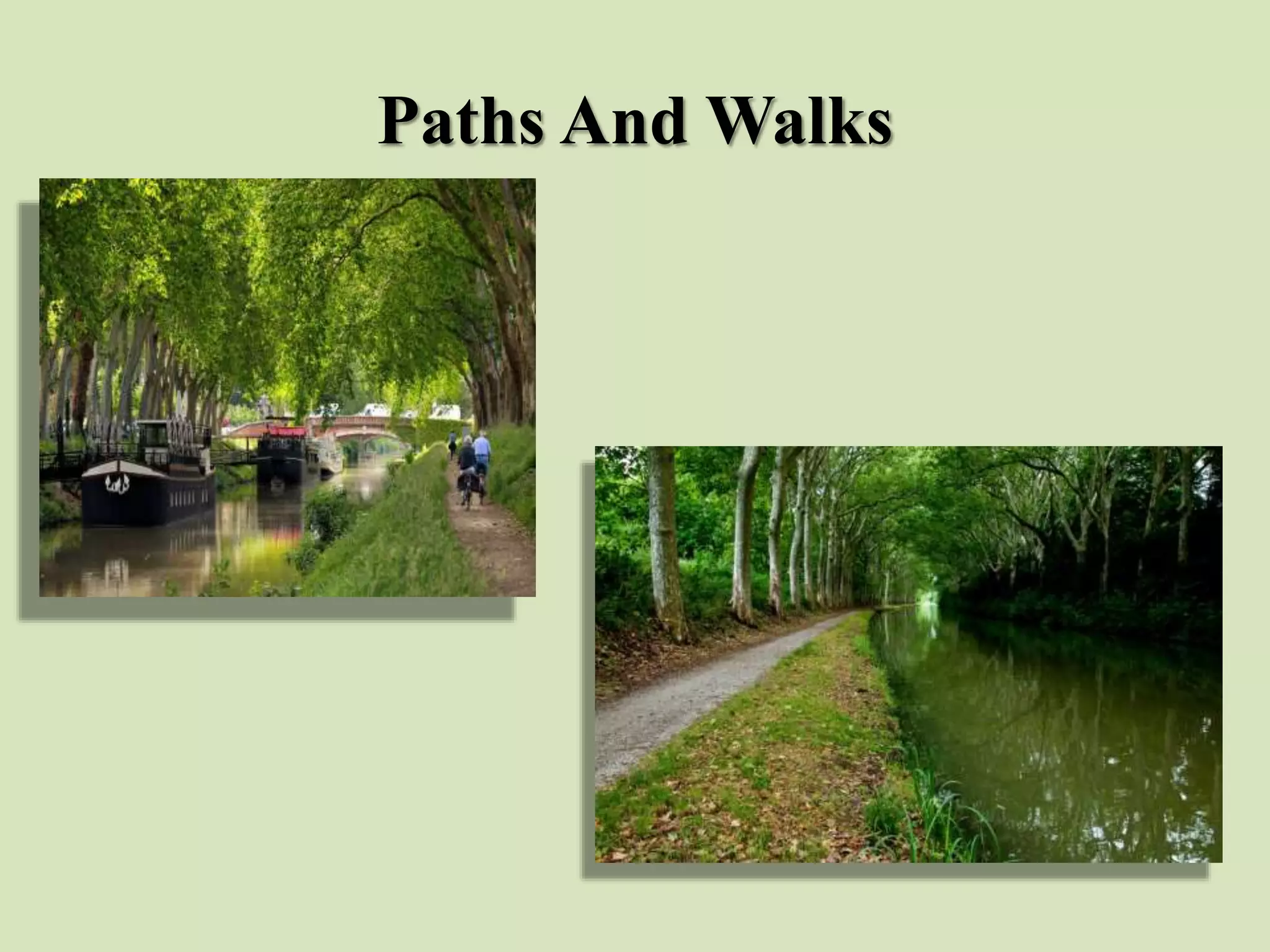
Paths And Walks
• The design of a park should provide for a
satisfactory system of paths and walks so that
there is easy circulation throughout the area.
Marine Parks
Paths And Walks
Park Design
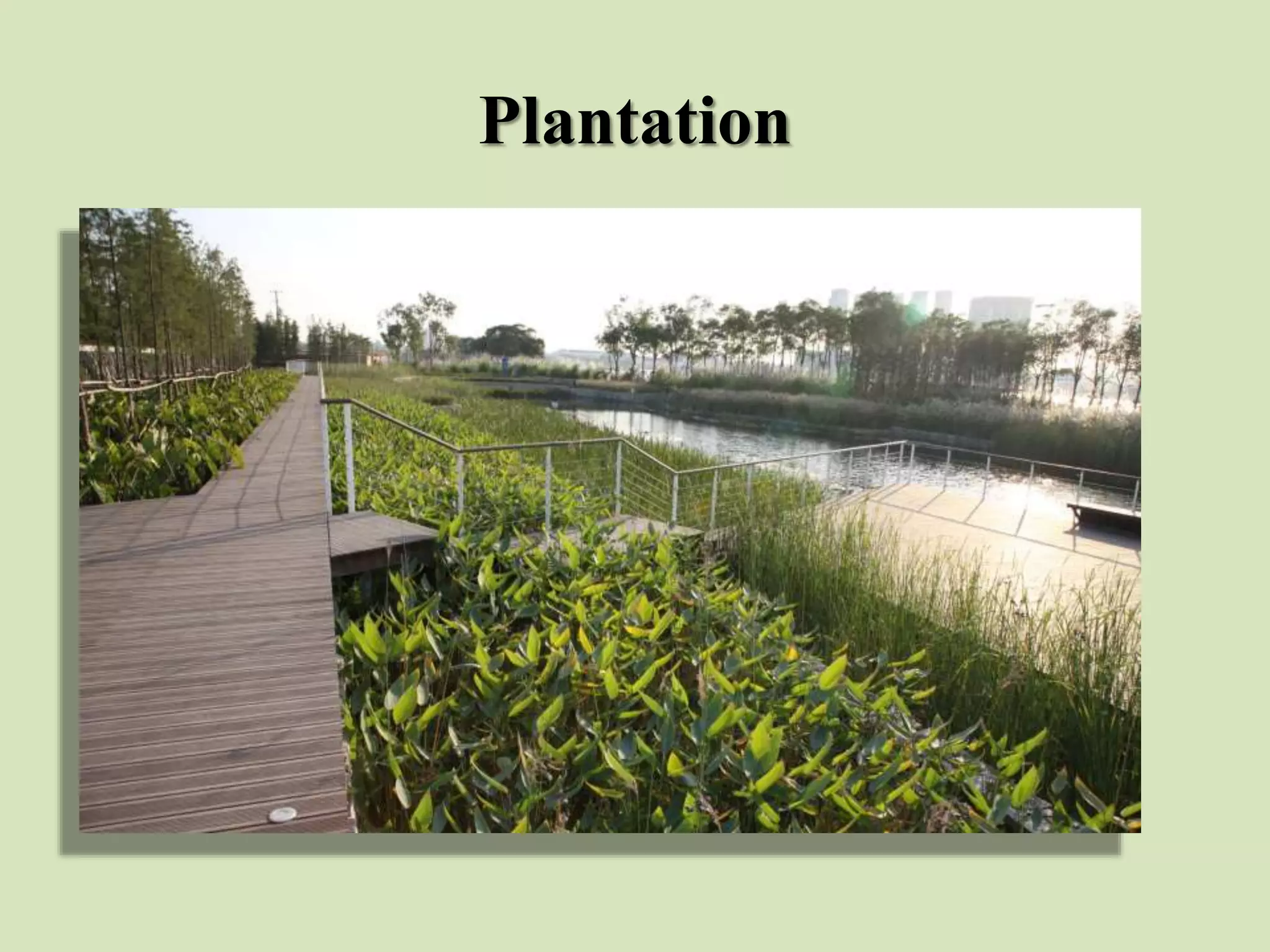
Plantation
• For providing screens between various
components of parks, the designer should
provide plants arranged in attractive shapes
and patterns.
Proportion Of Each Type Of Recreation
• An average park is usually designed for both
the types of recreation, namely passive as well
as active. The designer should workout the
proportion of site for each type of recreation.
Plantation
Park Design
Views Through Trees
• The surrounding building of the park area
should be well designed and properly grouped
so as to give excellent views through trees.
Water
• The flowing water contributes greatly to the
decorative effect of the park. From upper level,
the water may be allowed to flow by gravity in
the form of cascades and at lower levels, it may
be converted into lakes and pools.
Views Through Trees
Water
Finance For The Parks
• The finance for the parks can be obtained by any
one of the following way:
By Donation:
• The land required for parks can be received as
donation from generous persons and can be
utilized for components of parks
By Raising Loans
• The loan of required amount on long term
basis may be floated in general public by giving
complete details of the project and parks can be
collected.
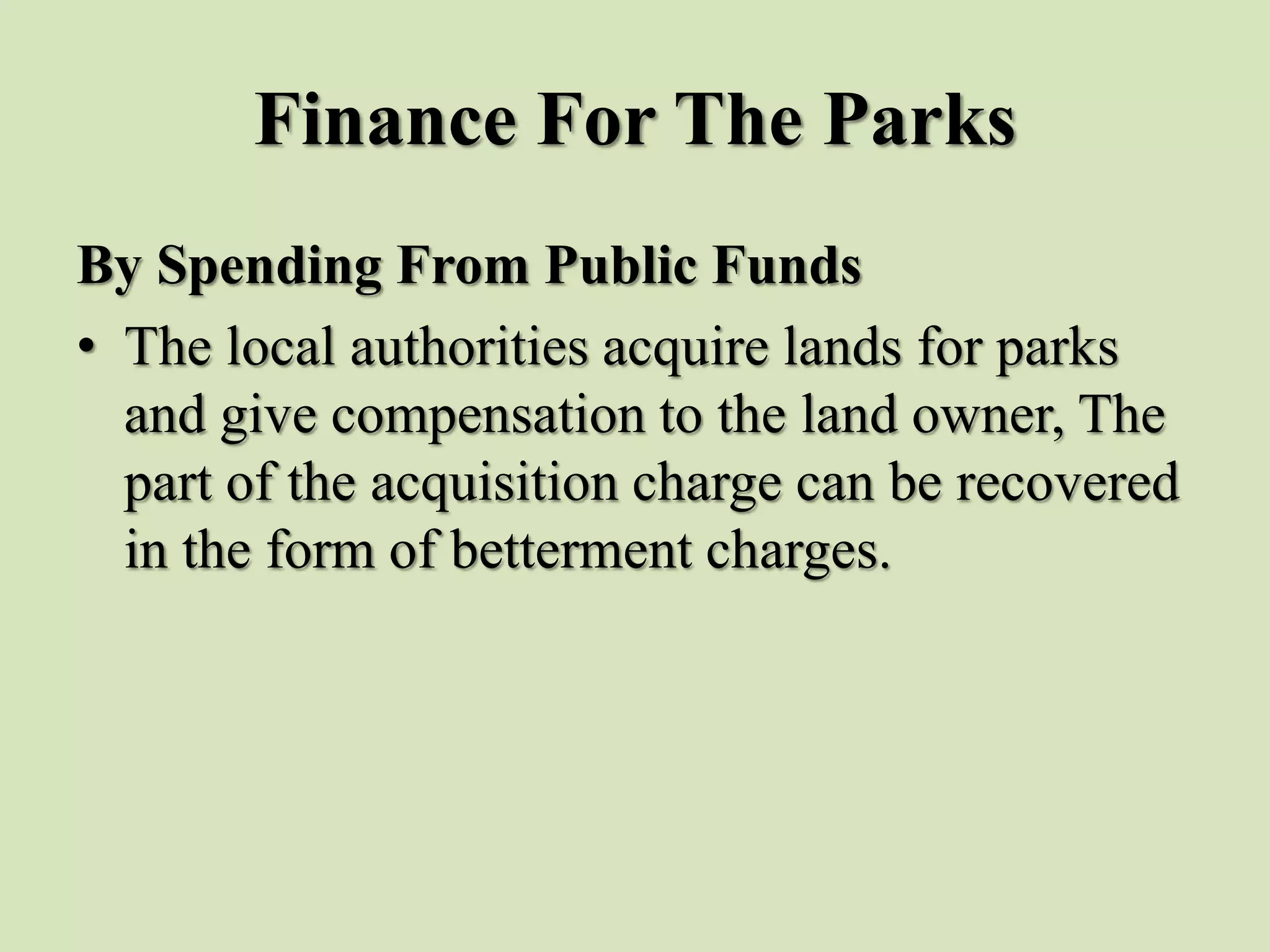
Finance For The Parks
By Spending From Public Funds
• The local authorities acquire lands for parks
and give compensation to the land owner, The
part of the acquisition charge can be recovered
in the form of betterment charges.
Finance For The Parks
References
• Fundamentals of Town Planning : G.K. Hiraskar
• Internet Websites
Thanks…
Parks and Playgrounds

Parks and Playgrounds

  • 1.
  • 2.
    Necessity of RecreationalFacility • Recreation is one of the important part which contribute to general health and well being of the community. • It brings enjoyment of living , encourages relaxation , helps to utilize the leisurely hours of all age groups young and old alike into the desirable activities thus making the people to live rich and contended life. • Recreation facilities are scare in most of the towns and cities and in most of the cities road is the only open space where child can play.
  • 3.
  • 4.
    Necessity of RecreationalFacility • In absence of wholesome public recreation, the children are likely to spend time in-undesirable activities which finally drag them towards delinquency and juvenile crime. Hence the town-planning authorities should make provisions of a variety of wholesome public recreations. • It must be remembered that no town planning scheme is complete without provisions of parks , playgrounds or such type of recreational area.
  • 5.
  • 6.
    Features of PublicRecreational System • The essential features of Public Recreation system are: • There should be proper provision of year round recreational activities for all age groups for all communities. • It should be located within easy reach of all habitants, generally within half to one km with easy accessibility and safety.
  • 7.
    Features of PublicRecreational System
  • 8.
    Selection of Sitefor Parks and Playground • The points to be considered while selecting site for parks and playground are: • To acquire easily accessible strip of land which can cheaply adopted, to serve as a park, playfield etc. • To acquire such land which can be cheaply adopted , to serve as a park , playfield. • To acquire such lands which are not suitable for Streets and Buildings. • To acquire as much land as possible in advance before the cost of land increases due to any proposed development. • By filling the pools, ponds, and old insanitary tanks etc, in the city. • By clearing the slum area in the city and then the land available may be converted into parks, gardens, playgrounds etc.
  • 9.
    Selection of Sitefor Parks and Playground
  • 10.
    Types of RecreationSystems • There are two types of Recreation Systems: • Passive Type such as parks and gardens etc. • Active Type such as playfields, Akhadas, Gymkhanas, Stadium, Boating and swimming clubs.
  • 11.
  • 12.
  • 13.
    Types of RecreationSystems Parks: • These are necessary to meet the needs of open spaces, to get fresh air, evening rest and relaxation for all sections of the society. The parks and gardens should be made more attractive by planting all types of flowers, trees, bushes in the pleasing layout with fountains, lawns etc. These parks , gardens forms passive form of recreation. • Play field : These help to provide the physical growth of the body and hence offer the active type of recreation. • Both the types of recreation play an important part in social, physical, and cultural aspects in town planning.
  • 14.
  • 15.
  • 16.
    Location of UrbanGreen Space • The urban green spaces should be located in the town plan very carefully as they serve as a kind of filter or protection against noise, dust, hot sun and harmful winds. Following aspects should be observed in connection. Distribution • The green spaces in a town plan should be distributed evenly in the residential area to insure sanitary and hygienic conditions. They should be located near the places for rest and recreation.
  • 17.
    Location of UrbanGreen Space
  • 18.
    Location of UrbanGreen Space Location: • The central part of the town or large spaces in front of public building are usually landscaped with lawns and flowerbeds. The main streets of town should be provided with tall trees planted in rows. Planning : • While planning a system of Urban green space, the climatic feature of a locality should be taken into consideration. • In towns having advantage of sea shores, lakes, etc. The large park and spaces should be placed near water. Site Selection : • The Land required for the parks and playgrounds should be acquired well in advance before the value of land increases due to proposed development in the town planning scheme.
  • 19.
    Location of UrbanGreen Space
  • 20.
    Classification of Parks •The parks can be classified into the following three ways : • According to Character ; • According to purpose ; • According to Size;
  • 21.
    Classification of Parks •According to Character: • The parks according to character are classified into two types; • (i) Artificial Parks • (ii) Natural Parks
  • 22.
    Classification of Parks ArtificialParks : • These parks are prepared artificially with great care by experts in the park layout. They are planted with grass, shrubs, flower and trees. The water may be introduced in the form of fountains and pools. The benches with suitable design may be provided. Natural Parks : • In case of Natural parks, all efforts, are made to maintain in tack the original features of the parks and only the necessary minimum adjustments are made to put them for public use.
  • 23.
  • 24.
  • 25.
    Classification of Parks Accordingto Purpose: • The parks according to purpose are classified into following two types and they provide green spaces for special use: • Botanical Parks • Zoological Parks Botanical Parks: • These parks are primarily meant for the study of plant specimens. But their atmosphere can be made more pleasant and appealing by the presence of beautiful trees, flowers and lawns.
  • 26.
  • 27.
    Classification of Parks ZoologicalParks • These parks Contain zoo to be given an attractive park like setting . It is undoubtedly true that for the vast majority of people , a visit to the zoological park is more or less an outing or a picnic, usually accompanied by children. A zoological park may contain houses and other facilities for animals to be maintained in the zoo.
  • 28.
  • 29.
    Classification of Parks Accordingto the size : • The parks according to sizes are classified as • Small Size Parks: • Medium Size Parks: • Large Size Parks: • Reservations • National Parks
  • 30.
    Classification of Parks SmallSize Parks : • These parks are generally in the form of squares enclosing a public building. They are provided in dense business or residential areas where land is costly. The area of these parks varies from 1 ha to 4 ha. These parks may also be located as settings of architectural public buildings or monuments at junctions of roads or in the midst of flats.
  • 31.
  • 32.
    Classification of Parks MediumSize Parks: • Medium size parks: • These are also known as the neighborhood parks and they are preferred for every residential locality in a town. Both the types of recreation active as well as passive may be provided in these parks The size of this parks should not be less than 12 hectares.
  • 33.
  • 34.
    Classification of Parks LargeSize Parks : • These parks serve the town or city as a whole or a number of neighborhood units. They may be provide active recreation for games like cricket, boating, riding, swimming, etc. and may also accommodate zoological gardens. The large beach on the ocean front can be included in this category of parks. The minimum area required for this type of park is about 40 hactare.
  • 35.
  • 36.
    Classification of Parks Reservations: •These parks are situated outside the city area and they are mostly unexplored. They may Include within their limits, rivers, forests, waterfalls, mountains, wildlife, places of historical Importance, Coastal belts etc. • Such parks can be easily distributed throughout the country so that whole of the population can enjoy them. These parks should be assessable from number of towns. Theses parks also provide facilities to the scientists and students for the study of natural flora and fauna.
  • 37.
  • 38.
    Park Systems • Theideal park System in any town planning scheme is one which functions to the best advantage of population. • These arrangements may be in the form of Parkway, avenues, boulevards, or Green belts
  • 39.
    Park Systems • Followingimportant types of park system will be briefly described : • Belt or Ring System • Wedge or Radial System • Combination of Belt and Wedge System • Boulevards • Park Ways
  • 40.
    Park Systems Belt orRing System • In this system , the park are provided on the periphery of the town in the form of belt or ring. This system of open spaces exists in some old towns and cities. The main purpose of adopting this system in old time was to provide an elaborate ring in the form of park as a measure of defense of town or city.
  • 41.
  • 42.
    Park Systems Wedge orRadial System • In this system, the wedge shaped strips of open spaces are provided to link up centre of the town with the rural area. The main advantage of this system is that it enables fresh air from the country to reach right up to the heart of the town In some cases the wedge system may be developed as parkway or Boulevards.
  • 43.
  • 44.
    Park Systems Combination ofBelt and Wedge Systems: • The combination of belt and wedge system gives excellent results. In this system, it is possible to practically link up major open spaces of the town and people can travel from one part of the town to the other part through shaded parkway and boulevards.
  • 45.
    Park Systems Boulevards • Theword boulevard has come from Paris , France. The ring roads of Paris was once acting as a defensive walls but later on they were demolished, and the roads thus formed came to be known as boulevards. • Now in town planning boulevards are connection between large and medium sized parks and act as a wide tree lined avenue in a town. They enable the busy people who have no time to visit parks to drive in the carriage through the park and enjoy the natural surrounding.
  • 46.
  • 47.
    Park Systems Park Ways •These have formed due to the advent and development of automobiles and rapid growth in traffic. • The parkways may be defined as elongated park through which passes a road which denies right of access from abutting land. • The parkways are ingeniously laid out to make the journey as pleasant as possible. So they follow the natural streams, valleys and sea-shore.
  • 48.
  • 49.
    Park Design • Thedesign and layout of parks and playgrounds require colloboration of disciplines from various fields. No satisfactory result can be obtained without proper cohesion orderly planning and landscaping of various elements comprising the park system.
  • 50.
  • 51.
    Park Design (i) Collectionof Data • It is necessary for the designer to collect data such as characteristics of site, population likely to visit the park, purpose of the park facilities to be provided etc. before the commencement of the work.
  • 52.
  • 53.
    Park Design Commercial Sports •The Ground for commercial sports such as cricket and football should be surrounded with walls as entry to such ground will be limited to those who pay admission
  • 54.
  • 55.
    Park Design Division • Theusual practice is to divide the whole area of the park into three divisions as : • Area of Passive Recreation • Buffer area consisting of flower garden or some such arrangements • Area of active recreation or playground area including pavilion and other building.
  • 56.
  • 57.
    Park Design Facilities • Thepark design should properly accommodate the usual facilities such as sanitary blocks, shelters, seats, drinking water. Fountains etc.
  • 58.
  • 59.
    Park Design Marine Parks •The design of a marine park requires careful consideration with respect to the large number of persons to be assembled on holidays, movements of pedestrian, and vehicular traffic , parking areas, for private cars. Paths And Walks • The design of a park should provide for a satisfactory system of paths and walks so that there is easy circulation throughout the area.
  • 60.
  • 61.
  • 62.
    Park Design Plantation • Forproviding screens between various components of parks, the designer should provide plants arranged in attractive shapes and patterns. Proportion Of Each Type Of Recreation • An average park is usually designed for both the types of recreation, namely passive as well as active. The designer should workout the proportion of site for each type of recreation.
  • 63.
  • 64.
    Park Design Views ThroughTrees • The surrounding building of the park area should be well designed and properly grouped so as to give excellent views through trees. Water • The flowing water contributes greatly to the decorative effect of the park. From upper level, the water may be allowed to flow by gravity in the form of cascades and at lower levels, it may be converted into lakes and pools.
  • 65.
  • 66.
  • 67.
    Finance For TheParks • The finance for the parks can be obtained by any one of the following way: By Donation: • The land required for parks can be received as donation from generous persons and can be utilized for components of parks By Raising Loans • The loan of required amount on long term basis may be floated in general public by giving complete details of the project and parks can be collected.
  • 68.
  • 69.
    Finance For TheParks By Spending From Public Funds • The local authorities acquire lands for parks and give compensation to the land owner, The part of the acquisition charge can be recovered in the form of betterment charges.
  • 70.
  • 71.
    References • Fundamentals ofTown Planning : G.K. Hiraskar • Internet Websites
  • 72.