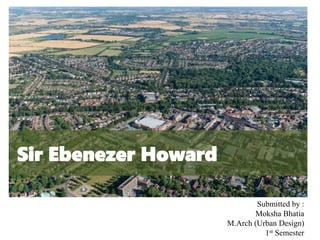
Sir Ebenezer Howard
Submitted by :
Moksha Bhatia
M.Arch (Urban Design)
1st Semester
I
N
T
R
O
D
U
C
T
I
O
N
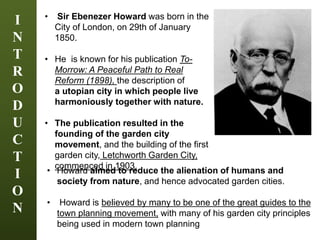
• Sir Ebenezer Howard was born in the
City of London, on 29th of January
1850.
• He is known for his publication To-
Morrow: A Peaceful Path to Real
Reform (1898), the description of
a utopian city in which people live
harmoniously together with nature.
• The publication resulted in the
founding of the garden city
movement, and the building of the first
garden city, Letchworth Garden City,
commenced in 1903.
• Howard aimed to reduce the alienation of humans and
society from nature, and hence advocated garden cities.
• Howard is believed by many to be one of the great guides to the
town planning movement, with many of his garden city principles
being used in modern town planning
What influenced Sir Ebenezer Howard to make garden
cities ?
THE CURE
• It is important to understand the context to which Howard’s work was a reaction.
• London (and other cities) in the 19th century were in the throws of
industrialization, and the cities were exerting massive forces on the labour
markets of the time.
• Massive immigration from the countryside to the cities was taking place with
London.
• This situation was unsustainable and political commentators of all parties
sought “how best to provide the proper antidote against the greatest danger of
modern existence ”To Howard the cure was simple - to reintegrate people
with the countryside.
• He disliked the way modern cities were being developed.
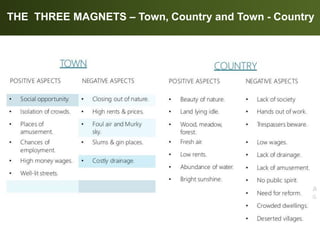
Solution – The Three Magnets
• He offered a vision of towns free of slums
and enjoying the benefits of both town
(such as opportunity, amusement and
good wages) and country (such as
beauty, fresh air and low rents).
• he believed that “Human society and
the beauty of nature are meant to be
enjoyed together” – hence giving his
solution “the two magnets must be made
one.”
• "Town and country must be united.
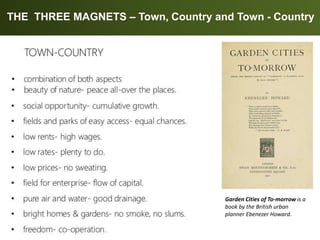
• He illustrated the idea with his
famous Three Magnets diagram
(pictured), which addressed the question
'Where will the people go?', the choices
being 'Town', 'Country' or 'Town-Country'.
THE THREE MAGNETS – Town, Country and Town - Country
Garden Cities of To-morrow is a
book by the British urban
planner Ebenezer Howard.
G
A
R
D
E
N
C
I
T
Y
• In three magnets diagram , people preferred the third magnet and it was
named as garden city.
• “A Garden City is a Town designed for healthy living and industry.
• Therefore, The garden city movement is a method of urban planning in which
self-contained communities are surrounded by "greenbelts", containing
proportionate areas of residences, industry, and agriculture.
• The idea was initiated in 1898 in the United Kingdom
• The whole of the land being in public ownership or held in trust for the
community
G
A
R
D
E
N
C
I
T
Y
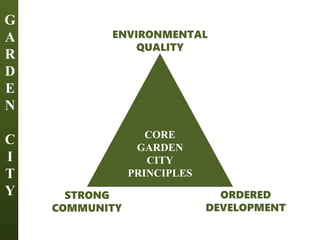
CORE
GARDEN
CITY
PRINCIPLES
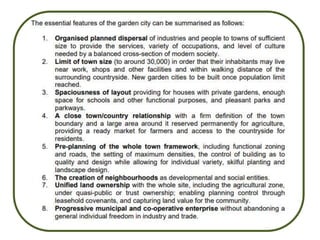
ENVIRONMENTAL
QUALITY
STRONG
COMMUNITY
ORDERED
DEVELOPMENT
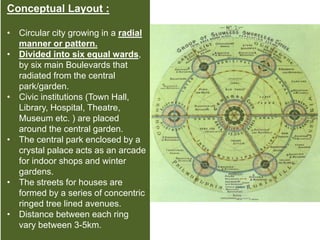
Conceptual Layout :
• Circular city growing in a radial
manner or pattern.
• Divided into six equal wards,
by six main Boulevards that
radiated from the central
park/garden.
• Civic institutions (Town Hall,
Library, Hospital, Theatre,
Museum etc. ) are placed
around the central garden.
• The central park enclosed by a
crystal palace acts as an arcade
for indoor shops and winter
gardens.
• The streets for houses are
formed by a series of concentric
ringed tree lined avenues.
• Distance between each ring
vary between 3-5km.
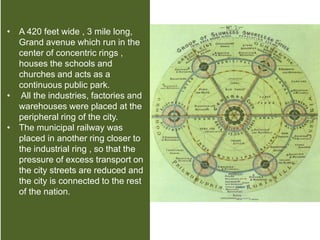
• A 420 feet wide , 3 mile long,
Grand avenue which run in the
center of concentric rings ,
houses the schools and
churches and acts as a
continuous public park.
• All the industries, factories and
warehouses were placed at the
peripheral ring of the city.
• The municipal railway was
placed in another ring closer to
the industrial ring , so that the
pressure of excess transport on
the city streets are reduced and
the city is connected to the rest
of the nation.
City Growth
• Assuming the Garden City model was implemented and found to be
successful Howard begins to describe how the City could grow and
become part of an integrated network of Garden Cities.
• The principle of “always preserving a belt of country” around cities
should always be maintained, argues Howard, so once a city has
reached capacity a new one must be founded outside the agricultural
belt (the influence of colonial-models prominent).
Therefore,
• Howard showed how workable and livable towns could be
formed.
• He concluded a central city of 58,000 people surrounded by
smaller “garden cities” of 30,000 people each.
• Permanent green space would separate the city and towns.
• Rail and roads would link the town, which would have their own
industries, the nearby farms supplying fresh foods.
• Howard’s deatiled thinking was not limited to physical design or
optimum population sizes. He also made a precise financial
analysis of what it would cost to build a garden city and how its
operating cost would meet. Therein lay the strength of his
proposal
• The idea received great acclaim and in 1902, a garden city was
Garden City principle in practice – LETCHWORTH,
UK
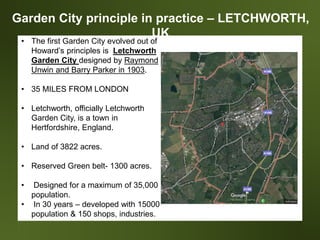
• The first Garden City evolved out of
Howard’s principles is Letchworth
Garden City designed by Raymond
Unwin and Barry Parker in 1903.
• 35 MILES FROM LONDON
• Letchworth, officially Letchworth
Garden City, is a town in
Hertfordshire, England.
• Land of 3822 acres.
• Reserved Green belt- 1300 acres.
• Designed for a maximum of 35,000
population.
• In 30 years – developed with 15000
population & 150 shops, industries.
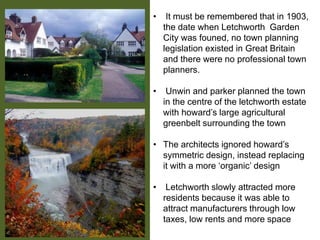
• It must be remembered that in 1903,
the date when Letchworth Garden
City was founed, no town planning
legislation existed in Great Britain
and there were no professional town
planners.
• Unwin and parker planned the town
in the centre of the letchworth estate
with howard’s large agricultural
greenbelt surrounding the town
• The architects ignored howard’s
symmetric design, instead replacing
it with a more ‘organic’ design
• Letchworth slowly attracted more
residents because it was able to
attract manufacturers through low
taxes, low rents and more space
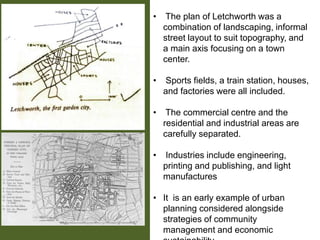
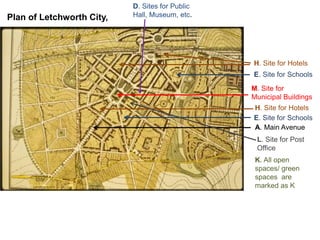
• The plan of Letchworth was a
combination of landscaping, informal
street layout to suit topography, and
a main axis focusing on a town
center.
• Sports fields, a train station, houses,
and factories were all included.
• The commercial centre and the
residential and industrial areas are
carefully separated.
• Industries include engineering,
printing and publishing, and light
manufactures
• It is an early example of urban
planning considered alongside
strategies of community
management and economic
A. Main Avenue
M. Site for
Municipal Buildings
H. Site for Hotels
H. Site for Hotels
E. Site for Schools
E. Site for Schools
L. Site for Post
Office
D. Sites for Public
Hall, Museum, etc.
K. All open
spaces/ green
spaces are
marked as K
Plan of Letchworth City,
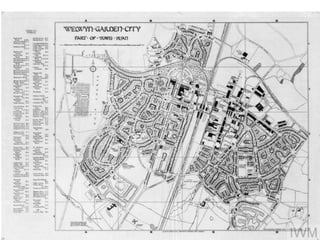
Garden City principle in practice – WELWYN
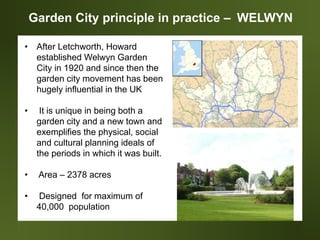
• After Letchworth, Howard
established Welwyn Garden
City in 1920 and since then the
garden city movement has been
hugely influential in the UK
• It is unique in being both a
garden city and a new town and
exemplifies the physical, social
and cultural planning ideals of
the periods in which it was built.
• Area – 2378 acres
• Designed for maximum of
40,000 population
Conclusion
• Ebenezer Howard’s Garden City concept shows us a place where genuine urban
activities are carried at human scale.
• He believed that such Garden cities were perfect blend of city and nature.
• The garden city introduced the use of greenbelts that have served many uses
including the preservation of agricultural and rural life, nature and heritage
conservation, recreation, pollution minimization, and growth management.
• Garden city tradition endowed urban planning with a social and community
dimensions.
• The garden city idea however, showed how both industrial estates and collective
retailing spaces could be used within a comprehensive planning approach to serve
public purposes.
Failure of Garden Cities
• Letchworth slowly attracted more residents because it was
able to attract manufacturers through low taxes, low rents and
more space.
• Despite Howard’s best efforts, the home prices in this garden
city could not remain affordable for workers to live in.
• Although many viewed Letchworth as a success, it did not
immediately inspire government investment into the next line
of garden cities.
• In frustration, Howard bought land at Welwyn to house the
second garden city in 1919.
• The Welwyn Garden City Corporation was formed to oversee
the construction.
• But Welwyn did not become self-sustaining because it was
only 20 miles from London.
• Even until the end of the 1930s, Letchworth and Welwyn
remained as the only existing garden citie

Ebenezer howard

  • 1.
    Sir Ebenezer Howard Submittedby : Moksha Bhatia M.Arch (Urban Design) 1st Semester
  • 2.
    I N T R O D U C T I O N • Sir EbenezerHoward was born in the City of London, on 29th of January 1850. • He is known for his publication To- Morrow: A Peaceful Path to Real Reform (1898), the description of a utopian city in which people live harmoniously together with nature. • The publication resulted in the founding of the garden city movement, and the building of the first garden city, Letchworth Garden City, commenced in 1903. • Howard aimed to reduce the alienation of humans and society from nature, and hence advocated garden cities. • Howard is believed by many to be one of the great guides to the town planning movement, with many of his garden city principles being used in modern town planning
  • 3.
    What influenced SirEbenezer Howard to make garden cities ? THE CURE • It is important to understand the context to which Howard’s work was a reaction. • London (and other cities) in the 19th century were in the throws of industrialization, and the cities were exerting massive forces on the labour markets of the time. • Massive immigration from the countryside to the cities was taking place with London. • This situation was unsustainable and political commentators of all parties sought “how best to provide the proper antidote against the greatest danger of modern existence ”To Howard the cure was simple - to reintegrate people with the countryside. • He disliked the way modern cities were being developed.
  • 4.
    Solution – TheThree Magnets • He offered a vision of towns free of slums and enjoying the benefits of both town (such as opportunity, amusement and good wages) and country (such as beauty, fresh air and low rents). • he believed that “Human society and the beauty of nature are meant to be enjoyed together” – hence giving his solution “the two magnets must be made one.” • "Town and country must be united. • He illustrated the idea with his famous Three Magnets diagram (pictured), which addressed the question 'Where will the people go?', the choices being 'Town', 'Country' or 'Town-Country'.
  • 5.
    THE THREE MAGNETS– Town, Country and Town - Country
  • 6.
    THE THREE MAGNETS– Town, Country and Town - Country Garden Cities of To-morrow is a book by the British urban planner Ebenezer Howard.
  • 7.
    G A R D E N C I T Y • In threemagnets diagram , people preferred the third magnet and it was named as garden city. • “A Garden City is a Town designed for healthy living and industry. • Therefore, The garden city movement is a method of urban planning in which self-contained communities are surrounded by "greenbelts", containing proportionate areas of residences, industry, and agriculture. • The idea was initiated in 1898 in the United Kingdom • The whole of the land being in public ownership or held in trust for the community
  • 8.
  • 9.
    Conceptual Layout : •Circular city growing in a radial manner or pattern. • Divided into six equal wards, by six main Boulevards that radiated from the central park/garden. • Civic institutions (Town Hall, Library, Hospital, Theatre, Museum etc. ) are placed around the central garden. • The central park enclosed by a crystal palace acts as an arcade for indoor shops and winter gardens. • The streets for houses are formed by a series of concentric ringed tree lined avenues. • Distance between each ring vary between 3-5km.
  • 10.
    • A 420feet wide , 3 mile long, Grand avenue which run in the center of concentric rings , houses the schools and churches and acts as a continuous public park. • All the industries, factories and warehouses were placed at the peripheral ring of the city. • The municipal railway was placed in another ring closer to the industrial ring , so that the pressure of excess transport on the city streets are reduced and the city is connected to the rest of the nation.
  • 11.
    City Growth • Assumingthe Garden City model was implemented and found to be successful Howard begins to describe how the City could grow and become part of an integrated network of Garden Cities. • The principle of “always preserving a belt of country” around cities should always be maintained, argues Howard, so once a city has reached capacity a new one must be founded outside the agricultural belt (the influence of colonial-models prominent).
  • 12.
    Therefore, • Howard showedhow workable and livable towns could be formed. • He concluded a central city of 58,000 people surrounded by smaller “garden cities” of 30,000 people each. • Permanent green space would separate the city and towns. • Rail and roads would link the town, which would have their own industries, the nearby farms supplying fresh foods. • Howard’s deatiled thinking was not limited to physical design or optimum population sizes. He also made a precise financial analysis of what it would cost to build a garden city and how its operating cost would meet. Therein lay the strength of his proposal • The idea received great acclaim and in 1902, a garden city was
  • 14.
    Garden City principlein practice – LETCHWORTH, UK • The first Garden City evolved out of Howard’s principles is Letchworth Garden City designed by Raymond Unwin and Barry Parker in 1903. • 35 MILES FROM LONDON • Letchworth, officially Letchworth Garden City, is a town in Hertfordshire, England. • Land of 3822 acres. • Reserved Green belt- 1300 acres. • Designed for a maximum of 35,000 population. • In 30 years – developed with 15000 population & 150 shops, industries.
  • 15.
    • It mustbe remembered that in 1903, the date when Letchworth Garden City was founed, no town planning legislation existed in Great Britain and there were no professional town planners. • Unwin and parker planned the town in the centre of the letchworth estate with howard’s large agricultural greenbelt surrounding the town • The architects ignored howard’s symmetric design, instead replacing it with a more ‘organic’ design • Letchworth slowly attracted more residents because it was able to attract manufacturers through low taxes, low rents and more space
  • 16.
    • The planof Letchworth was a combination of landscaping, informal street layout to suit topography, and a main axis focusing on a town center. • Sports fields, a train station, houses, and factories were all included. • The commercial centre and the residential and industrial areas are carefully separated. • Industries include engineering, printing and publishing, and light manufactures • It is an early example of urban planning considered alongside strategies of community management and economic
  • 17.
    A. Main Avenue M.Site for Municipal Buildings H. Site for Hotels H. Site for Hotels E. Site for Schools E. Site for Schools L. Site for Post Office D. Sites for Public Hall, Museum, etc. K. All open spaces/ green spaces are marked as K Plan of Letchworth City,
  • 18.
    Garden City principlein practice – WELWYN • After Letchworth, Howard established Welwyn Garden City in 1920 and since then the garden city movement has been hugely influential in the UK • It is unique in being both a garden city and a new town and exemplifies the physical, social and cultural planning ideals of the periods in which it was built. • Area – 2378 acres • Designed for maximum of 40,000 population
  • 20.
    Conclusion • Ebenezer Howard’sGarden City concept shows us a place where genuine urban activities are carried at human scale. • He believed that such Garden cities were perfect blend of city and nature. • The garden city introduced the use of greenbelts that have served many uses including the preservation of agricultural and rural life, nature and heritage conservation, recreation, pollution minimization, and growth management. • Garden city tradition endowed urban planning with a social and community dimensions. • The garden city idea however, showed how both industrial estates and collective retailing spaces could be used within a comprehensive planning approach to serve public purposes.
  • 21.
    Failure of GardenCities • Letchworth slowly attracted more residents because it was able to attract manufacturers through low taxes, low rents and more space. • Despite Howard’s best efforts, the home prices in this garden city could not remain affordable for workers to live in. • Although many viewed Letchworth as a success, it did not immediately inspire government investment into the next line of garden cities. • In frustration, Howard bought land at Welwyn to house the second garden city in 1919. • The Welwyn Garden City Corporation was formed to oversee the construction. • But Welwyn did not become self-sustaining because it was only 20 miles from London. • Even until the end of the 1930s, Letchworth and Welwyn remained as the only existing garden citie