chapter
16
Parks and
Playground
Facilities
(continued)
Parks
* Parks are prominent in communities all over
the world.
* A park can be defined as an outdoor space
made available to the public, often provided
by a public agency, for the benefit of the
citizens of a community, state, or country.
Parks (continued)
• Public parks are owned and operated by
tax-supported government agencies,
including local municipality, state, or
national systems.
• Private parks are typically owned and
operated by either corporations or private
organizations that provide opportunities for
employees or members.
Benefits of Parks
Parks offer a respite from urban areas, congestion, pavement,
and other man-made features.
Parks provide natural habitats for wildlife and plants.
Users may appreciate the ability to connect with nature in
park settings.
Users may also be able to use park areas to improve physical
fitness through running, walking, hiking, biking, and other
outdoor activities.
Parks can have economic benefits; they may be designed to
generate revenue if they have fees associated with them.
The value of property in the vicinity of parks is higher than
that of property not located near parks.
Types of Parks
• The most common public parks can be
classified as neighborhood, urban,
community or regional, linear, state, and
national parks.
• Specialty parks can be public or private,
depending on who owns them. They include
theme parks, aquatic parks, and sport parks
and are operated with the primary objective
of generating revenue.
Neighborhood Parks
Neighborhood parks serve relatively small areas of
a community, and by definition they are located in a
neighborhood, often in a densely populated area.
Generally, users or neighbors can access
neighborhood parks by walking.
These types of parks are generally 15 acres (6
hectares) or smaller in size and offer amenities
such as a playground, park benches, a picnic
shelter, and an open area for multipurpose use.
(continued)
Urban Parks
Urban parks serve the most densely developed
areas of a community.
Urban parks tend to be fairly small and are usually
bordered by a combination of residences and
businesses.
These types of parks often include hard surfaces
such as concrete or pavement due to the high
traffic expected.
Park benches, tables, and occasionally
performance stages are common in urban parks.
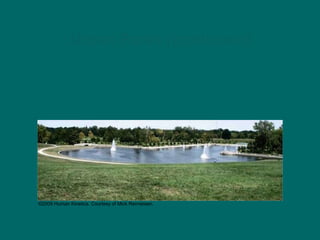
Urban Parks (continued)
©2009 Human Kinetics. Courtesy of Mick Renneisen.
Community or Regional Parks
* A community or regional park is larger than
either neighborhood or urban parks.
* Typical acreage can range from 15 acres (6
hectares) to several hundred acres.
• This type of park consists of a broader
range of amenities that attract users from a
greater geographic area.
• Users are more likely to have to drive to a
community or regional park.
Linear Parks
• The linear park is generally found along a
stream, river, or wetland area or an
abandoned railroad bed.
• By definition, linear parks are long or linear
in nature and may connect to other similar
parks.
• When two or more linear parks are
connected, they are called greenways.
• Often, a trail system is incorporated in a
linear park.
State Parks
• A state park is usually larger than a community or
regional park but may have similar amenities.
• State parks are owned and operated by a large
government unit and serve those within the
boundaries of the state and others who come to
visit from outside the state.
• In the United States, state parks are operated by the
Department of Natural Resources (DNR), a state
department.
National Parks
National parks share many characteristics with
state parks.
National parks are usually owned and operated by
the national government and serve all those within
that nation as well as visitors from around the
world.
In the United States, national parks are operated by
the National Park Service (NPS), a division of the
Department of the Interior.
These types of parks are usually created to
preserve natural areas that include unique features
of the geographic area where the park is located.
Specialty Parks
• Unlike the parks previously discussed,
specialty parks may be operated in the
public or private sector, and many are
constructed with the intent to generate
revenue.
• Specialty parks are designed with a specific
purpose in mind, including theme parks,
aquatic parks, and sport parks.
Theme Parks
Theme parks offer an entertainment experience that
attracts visitors.
Though this description could apply to other parks,
a theme park is a constructed facility that doesn’t
usually rely on natural features.
Common examples of theme parks are Walt Disney
World, Disneyland, Six Flags America, Holiday
World, and Kings Island.
These types of parks are operated by a
management system and are designed to produce a
profit.
Aquatic Parks
Aquatic parks may be designed to produce a
profit.
They may be operated by a municipal
government or a private company.
At aquatic parks, water features or aquatic
facilities are the main attraction.
Aquatic parks offer water slides, activity pools,
wave pools, serpentine waterways for rafting,
jet sprays, splash pads, lap pools, and other
amenities that allow users to interact with
water.
Sport Park
A sport park features a sport or a combination of
sports as the core product.
Sport parks may be operated by a municipal
government or a private company.
They may provide multiple sport areas for one
particular sport or for various sports.
These parks are often constructed to host
community, state, or national sporting events that
attract numerous participants and have a
significant economic impact on the community
where the park is located.
Park Design
* The design of most park areas relies on the
natural features of the area.
* Landscape designers and design architects,
the expert consultants often hired to design
parks, attempt to complement the natural
features of the area in their design.
* Every park has a unique design based on its
intended location and size, flow, amenities,
and programs.
Location and Size
The location and size of a park will influence its
design.
The topography of the area must be taken into
consideration.
Slope, valleys, soil types, and existing vegetation
can be used as part of the design or may have to be
altered in order to create the park.
Natural features, including mountains, lakes,
streams, rivers, oceans, beaches, trees, and rock,
will affect where park features can be located.
Flow
• The design of the park entrance or
reception area should consider the
maximum flow of user traffic, including
what the load will be at any single moment,
and ensure that there is adequate space to
handle user needs in entering and exiting a
facility.
* Adequate space to accommodate customer
waiting should be incorporated into the
design of any park facility.
Amenities
• Most park users have expectations for basic
furnishings, including benches, tables,
trash receptacles, signage, dog waste
stations, water fountains, and cooking
grills.
• These products are called amenities.
♦Because they enhance the core product,
they are core product extensions.
Programs
* Park areas are generally designed for
unstructured leisure experiences.
• However, park areas may be used for
programmed activities.
* Programs that take place in a park can
include nature programs, sport programs,
camp activities, special events, youth
programs, and senior activities.
Park Areas
* Parks contain a variety of areas that
enhance the core product and are important
to users.
• These areas can include a welcome center,
shelter buildings, food service, restrooms,
equipment rental or checkout, retail outlets,
trails, and playgrounds.
Equipment Rental
* Park operating agencies should analyze the
potential equipment needs of visitors.
♦ Equipment rental or checkout should be
considered where possible to provide a
service and generate revenue.
• Each park area should analyze the rental
opportunities available based on the core
product.
Retail Outlets
* Some park areas offer retail outlets, pro
shops, or gift shops that serve as core
product extensions.
* Depending on the type and size of the park,
the retail outlet may be as simple as counter
space within the welcome center, or it may
be a separate area located close to the
welcome center or the core product area.
(continued)
Retail Outlets (continued)
Trails
* A common element in a park is a trail.
• Trails are paths or tracks in a natural
outdoor area that are designed to be used
by park users for a variety of activities, such
as walking, jogging, hiking, horseback
riding, cross-country skiing, or biking.
• An important consideration in trail design is
to make sure the trail is properly sloped for
water drainage.
Park Operations
* Operating a park requires that a
management system be in place to
coordinate basic park functions.
• Park operations functions include access
control, fee collection, maintenance, safety,
and security.
• The implementation of these considerations
varies depending on the type, location, and
size of the park.
Access Control
* The process of managing customer or
visitor entry into a park area is called
access control.
* Access control can vary based on the type
of facility.
* Various access control systems may be
used: gates, turnstiles, counter areas, and
ticket booths.
Fee Collection
• Some park facilities collect a fee before permitting
access and use of the area or product.
• Access control or reception areas can incorporate
this function by using a staff person and
equipment, including a cash register, credit card
machine, or computer, to assist with fee collection.
• Park facilities may collect an admission fee each
time a user accesses a facility, or they may collect
fees in one lump sum, such as memberships or
season passes.
Maintenance of Park Facilities
• Restrooms
• Concession or food service areas
• Shelter buildings
• Parking facilities
• Roads
• Paths
• Trails
Safety
* Park users have a basic expectation that
their visit to a park will be a safe one.
• Management must limit the risks associated
with delivery of a service in a park area.
• Common safety practices include signage
that warns users of potential risks,
brochures that educate users of risks, and
barriers that limit access to areas that may
pose risks.
Security
• The sheer size of some park areas makes
security a challenging aspect of recreation
facility management.
• It is common for parks to have staff on site
to provide assistance to users or to enforce
park rules and regulations.
* These employees may be patrol personnel,
park police, or other security personnel.
Playgrounds
* On the surface, playgrounds appear to be a
fun attraction for children to play on.
• However, there is much more to a well-
designed playground than just an area to
play.
* All playgrounds should be designed to
foster the physical and social development
of children.
Playground Equipment
• Playground equipment varies in the type of
physical challenge provided.
• The equipment selected for a playground should
reflect the age of the users.
• Typically, playground equipment is designed to
meet the needs of two age groups: preschool and
school-age children.
• Guidelines established by the CPSC are typically
adopted by state departments and dictate safety
recommendations for playground equipment for
these age groups.
Playground Safety
* Safety should be the top priority of
recreation facility managers when designing
a playground and selecting playground
equipment.
• The CPSC tests and evaluates playground
equipment, and agencies should strongly
consider choosing equipment that has been
certified by the CPSC.
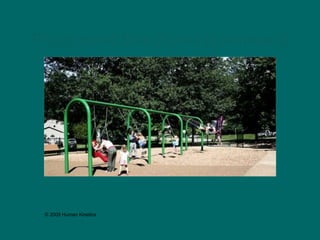
Playground Use Zones
* A use zone is the space below and around a
piece of equipment that should have some
type of fall-absorbent surface and be free of
other equipment.
* The use zone, which is also called the
safety zone, provides adequate space to
prevent injury should a child fall from the
equipment.
(continued)
Playground Use Zones (continued)
© 2009 Human Kinetics
Size of the Use Zone
The size of the use zone is typically dictated by the
height of the equipment, the ground, the type of
play or movement taking place on the equipment,
and whether the equipment is stationary.
For equipment that is stationary, the standard use
zone is 6 feet (2 meters) beyond the perimeter of
the structure.
Equipment that is not stationary will require a
larger use zone, and in most instances, the use
zone is specific to the equipment.
Surfaces and Accessibility
of Use Zones
• The most important factor for selecting a
safe surface is fall protection.
• Fall protection refers to how absorbent a
surface is, or how much give there is in a
surface.
• Each surface provides a unique degree of
fall protection.
* Two basic categories of surfaces may be
used on a playground: loose-fill surfaces
and unitary surfaces.
Playground Supervision
• Playgrounds are primarily supervised by
adults visiting the area with children.
• Most playgrounds are not equipped with
staff to supervise use; however, recreation
facility managers must design the play area
in such a way that adults can easily
supervise it.
(continued)
Playground Supervision (continued)
• Several factors in the planning phase can
make supervision easier:
- Locations that minimize potential hazards
- Sight lines
- Signage
- Support amenities, such as permanent benches in
predetermined areas, that informally direct adults to
those areas where they will be better able to
supervise
- Other amenities such as trash receptacles, water
fountains, or restrooms
Playground Maintenance
* Playgrounds must be maintained in order to
ensure a safe user experience.
• Maintenance crews should examine
surfaces in fall-protection areas on a regular
basis.
* It is good policy for maintenance crews to
establish a schedule for checking
equipment and surfaces to ensure the safe
experience of playground users.

Recreation facilities Recreation facilities

  • 1.
  • 2.
    (continued) Parks * Parks areprominent in communities all over the world. * A park can be defined as an outdoor space made available to the public, often provided by a public agency, for the benefit of the citizens of a community, state, or country.
  • 3.
    Parks (continued) • Publicparks are owned and operated by tax-supported government agencies, including local municipality, state, or national systems. • Private parks are typically owned and operated by either corporations or private organizations that provide opportunities for employees or members.
  • 4.
    Benefits of Parks Parksoffer a respite from urban areas, congestion, pavement, and other man-made features. Parks provide natural habitats for wildlife and plants. Users may appreciate the ability to connect with nature in park settings. Users may also be able to use park areas to improve physical fitness through running, walking, hiking, biking, and other outdoor activities. Parks can have economic benefits; they may be designed to generate revenue if they have fees associated with them. The value of property in the vicinity of parks is higher than that of property not located near parks.
  • 5.
    Types of Parks •The most common public parks can be classified as neighborhood, urban, community or regional, linear, state, and national parks. • Specialty parks can be public or private, depending on who owns them. They include theme parks, aquatic parks, and sport parks and are operated with the primary objective of generating revenue.
  • 6.
    Neighborhood Parks Neighborhood parksserve relatively small areas of a community, and by definition they are located in a neighborhood, often in a densely populated area. Generally, users or neighbors can access neighborhood parks by walking. These types of parks are generally 15 acres (6 hectares) or smaller in size and offer amenities such as a playground, park benches, a picnic shelter, and an open area for multipurpose use.
  • 7.
    (continued) Urban Parks Urban parksserve the most densely developed areas of a community. Urban parks tend to be fairly small and are usually bordered by a combination of residences and businesses. These types of parks often include hard surfaces such as concrete or pavement due to the high traffic expected. Park benches, tables, and occasionally performance stages are common in urban parks.
  • 8.
    Urban Parks (continued) ©2009Human Kinetics. Courtesy of Mick Renneisen.
  • 9.
    Community or RegionalParks * A community or regional park is larger than either neighborhood or urban parks. * Typical acreage can range from 15 acres (6 hectares) to several hundred acres. • This type of park consists of a broader range of amenities that attract users from a greater geographic area. • Users are more likely to have to drive to a community or regional park.
  • 10.
    Linear Parks • Thelinear park is generally found along a stream, river, or wetland area or an abandoned railroad bed. • By definition, linear parks are long or linear in nature and may connect to other similar parks. • When two or more linear parks are connected, they are called greenways. • Often, a trail system is incorporated in a linear park.
  • 11.
    State Parks • Astate park is usually larger than a community or regional park but may have similar amenities. • State parks are owned and operated by a large government unit and serve those within the boundaries of the state and others who come to visit from outside the state. • In the United States, state parks are operated by the Department of Natural Resources (DNR), a state department.
  • 12.
    National Parks National parksshare many characteristics with state parks. National parks are usually owned and operated by the national government and serve all those within that nation as well as visitors from around the world. In the United States, national parks are operated by the National Park Service (NPS), a division of the Department of the Interior. These types of parks are usually created to preserve natural areas that include unique features of the geographic area where the park is located.
  • 13.
    Specialty Parks • Unlikethe parks previously discussed, specialty parks may be operated in the public or private sector, and many are constructed with the intent to generate revenue. • Specialty parks are designed with a specific purpose in mind, including theme parks, aquatic parks, and sport parks.
  • 14.
    Theme Parks Theme parksoffer an entertainment experience that attracts visitors. Though this description could apply to other parks, a theme park is a constructed facility that doesn’t usually rely on natural features. Common examples of theme parks are Walt Disney World, Disneyland, Six Flags America, Holiday World, and Kings Island. These types of parks are operated by a management system and are designed to produce a profit.
  • 15.
    Aquatic Parks Aquatic parksmay be designed to produce a profit. They may be operated by a municipal government or a private company. At aquatic parks, water features or aquatic facilities are the main attraction. Aquatic parks offer water slides, activity pools, wave pools, serpentine waterways for rafting, jet sprays, splash pads, lap pools, and other amenities that allow users to interact with water.
  • 16.
    Sport Park A sportpark features a sport or a combination of sports as the core product. Sport parks may be operated by a municipal government or a private company. They may provide multiple sport areas for one particular sport or for various sports. These parks are often constructed to host community, state, or national sporting events that attract numerous participants and have a significant economic impact on the community where the park is located.
  • 17.
    Park Design * Thedesign of most park areas relies on the natural features of the area. * Landscape designers and design architects, the expert consultants often hired to design parks, attempt to complement the natural features of the area in their design. * Every park has a unique design based on its intended location and size, flow, amenities, and programs.
  • 18.
    Location and Size Thelocation and size of a park will influence its design. The topography of the area must be taken into consideration. Slope, valleys, soil types, and existing vegetation can be used as part of the design or may have to be altered in order to create the park. Natural features, including mountains, lakes, streams, rivers, oceans, beaches, trees, and rock, will affect where park features can be located.
  • 19.
    Flow • The designof the park entrance or reception area should consider the maximum flow of user traffic, including what the load will be at any single moment, and ensure that there is adequate space to handle user needs in entering and exiting a facility. * Adequate space to accommodate customer waiting should be incorporated into the design of any park facility.
  • 20.
    Amenities • Most parkusers have expectations for basic furnishings, including benches, tables, trash receptacles, signage, dog waste stations, water fountains, and cooking grills. • These products are called amenities. ♦Because they enhance the core product, they are core product extensions.
  • 21.
    Programs * Park areasare generally designed for unstructured leisure experiences. • However, park areas may be used for programmed activities. * Programs that take place in a park can include nature programs, sport programs, camp activities, special events, youth programs, and senior activities.
  • 22.
    Park Areas * Parkscontain a variety of areas that enhance the core product and are important to users. • These areas can include a welcome center, shelter buildings, food service, restrooms, equipment rental or checkout, retail outlets, trails, and playgrounds.
  • 23.
    Equipment Rental * Parkoperating agencies should analyze the potential equipment needs of visitors. ♦ Equipment rental or checkout should be considered where possible to provide a service and generate revenue. • Each park area should analyze the rental opportunities available based on the core product.
  • 24.
    Retail Outlets * Somepark areas offer retail outlets, pro shops, or gift shops that serve as core product extensions. * Depending on the type and size of the park, the retail outlet may be as simple as counter space within the welcome center, or it may be a separate area located close to the welcome center or the core product area. (continued)
  • 25.
  • 26.
    Trails * A commonelement in a park is a trail. • Trails are paths or tracks in a natural outdoor area that are designed to be used by park users for a variety of activities, such as walking, jogging, hiking, horseback riding, cross-country skiing, or biking. • An important consideration in trail design is to make sure the trail is properly sloped for water drainage.
  • 27.
    Park Operations * Operatinga park requires that a management system be in place to coordinate basic park functions. • Park operations functions include access control, fee collection, maintenance, safety, and security. • The implementation of these considerations varies depending on the type, location, and size of the park.
  • 28.
    Access Control * Theprocess of managing customer or visitor entry into a park area is called access control. * Access control can vary based on the type of facility. * Various access control systems may be used: gates, turnstiles, counter areas, and ticket booths.
  • 29.
    Fee Collection • Somepark facilities collect a fee before permitting access and use of the area or product. • Access control or reception areas can incorporate this function by using a staff person and equipment, including a cash register, credit card machine, or computer, to assist with fee collection. • Park facilities may collect an admission fee each time a user accesses a facility, or they may collect fees in one lump sum, such as memberships or season passes.
  • 30.
    Maintenance of ParkFacilities • Restrooms • Concession or food service areas • Shelter buildings • Parking facilities • Roads • Paths • Trails
  • 31.
    Safety * Park usershave a basic expectation that their visit to a park will be a safe one. • Management must limit the risks associated with delivery of a service in a park area. • Common safety practices include signage that warns users of potential risks, brochures that educate users of risks, and barriers that limit access to areas that may pose risks.
  • 32.
    Security • The sheersize of some park areas makes security a challenging aspect of recreation facility management. • It is common for parks to have staff on site to provide assistance to users or to enforce park rules and regulations. * These employees may be patrol personnel, park police, or other security personnel.
  • 33.
    Playgrounds * On thesurface, playgrounds appear to be a fun attraction for children to play on. • However, there is much more to a well- designed playground than just an area to play. * All playgrounds should be designed to foster the physical and social development of children.
  • 34.
    Playground Equipment • Playgroundequipment varies in the type of physical challenge provided. • The equipment selected for a playground should reflect the age of the users. • Typically, playground equipment is designed to meet the needs of two age groups: preschool and school-age children. • Guidelines established by the CPSC are typically adopted by state departments and dictate safety recommendations for playground equipment for these age groups.
  • 35.
    Playground Safety * Safetyshould be the top priority of recreation facility managers when designing a playground and selecting playground equipment. • The CPSC tests and evaluates playground equipment, and agencies should strongly consider choosing equipment that has been certified by the CPSC.
  • 36.
    Playground Use Zones *A use zone is the space below and around a piece of equipment that should have some type of fall-absorbent surface and be free of other equipment. * The use zone, which is also called the safety zone, provides adequate space to prevent injury should a child fall from the equipment. (continued)
  • 37.
    Playground Use Zones(continued) © 2009 Human Kinetics
  • 38.
    Size of theUse Zone The size of the use zone is typically dictated by the height of the equipment, the ground, the type of play or movement taking place on the equipment, and whether the equipment is stationary. For equipment that is stationary, the standard use zone is 6 feet (2 meters) beyond the perimeter of the structure. Equipment that is not stationary will require a larger use zone, and in most instances, the use zone is specific to the equipment.
  • 39.
    Surfaces and Accessibility ofUse Zones • The most important factor for selecting a safe surface is fall protection. • Fall protection refers to how absorbent a surface is, or how much give there is in a surface. • Each surface provides a unique degree of fall protection. * Two basic categories of surfaces may be used on a playground: loose-fill surfaces and unitary surfaces.
  • 40.
    Playground Supervision • Playgroundsare primarily supervised by adults visiting the area with children. • Most playgrounds are not equipped with staff to supervise use; however, recreation facility managers must design the play area in such a way that adults can easily supervise it. (continued)
  • 41.
    Playground Supervision (continued) •Several factors in the planning phase can make supervision easier: - Locations that minimize potential hazards - Sight lines - Signage - Support amenities, such as permanent benches in predetermined areas, that informally direct adults to those areas where they will be better able to supervise - Other amenities such as trash receptacles, water fountains, or restrooms
  • 42.
    Playground Maintenance * Playgroundsmust be maintained in order to ensure a safe user experience. • Maintenance crews should examine surfaces in fall-protection areas on a regular basis. * It is good policy for maintenance crews to establish a schedule for checking equipment and surfaces to ensure the safe experience of playground users.