CE5601:
Urban Transportation Planning
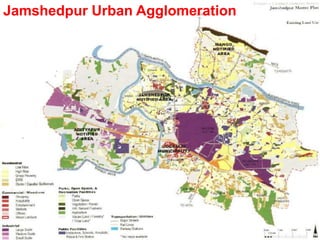
Jamshedpur Urban Agglomeration
Planning
• Planning may be defined as the activity or
process that examines the potential of
future actions to guide a situation or a
system towards a desired direction, for
example, toward the attainment of
positive goals, the avoidance of problems
or both.
• It is oriented toward the future
Travel Demand Modelling
• Trends, Overall Planning process,
• Long term - Short term planning,
• Demand Function, Independent Variables,
Travel Attributes,
• Assumptions in Demand Estimation,
• Sequential, and Simultaneous Approaches,
• Aggregate and Disaggregate Techniques,
• Tour based models, and Activity based
models.
Data Collection and Inventories
• Collection of data – Organisation of surveys and
Analysis
• Study Area - Zoning
• Types and Sources of Data, Road Side Interviews,
Home Interview Surveys, Commercial Vehicle
Surveys
• Sampling Techniques, Expansion Factors,
Accuracy Checks
• Use of Secondary Sources, Economic data –
Income – Population – Employment – Vehicle
Owner Ship.
TRIP GENERATION MODELS
• UTPS Approach,
• Trip Generation Analysis:
–Zonal Models
–Category Analysis
–Household Models
–Trip Attraction models
–Commercial Trip Rates
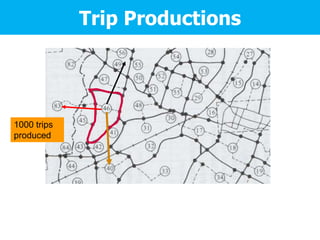
Trip Productions
1000 trips
produced
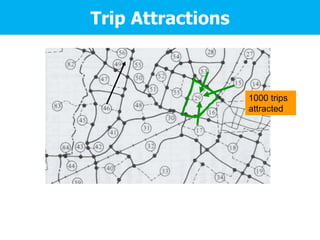
Trip Attractions
1000 trips
attracted
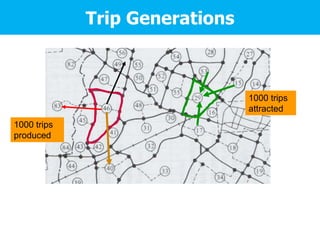
Trip Generations
1000 trips
produced
1000 trips
attracted
TRIP DISTRIBUTION MODELS
• Growth Factor Methods
• Gravity Models
• Opportunity Models
• Time Function Iteration Models
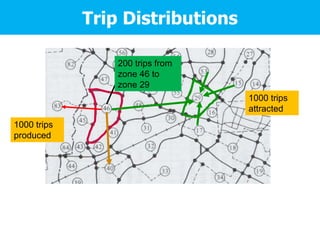
Trip Distributions
1000 trips
produced
1000 trips
attracted
200 trips from
zone 46 to
zone 29
MODE SPLIT ANALYSIS
• Mode Choice Behavior
• Competing Modes
• Mode Split Curves
• Mode Choice Models and Probabilistic
Approaches – Logit Model
Modal Split Analysis
1000 trips
produced
1000 trips
attracted
200 trips
from zone 46
to zone 29
Private total: 190 (95%) Public transit: 10 (5%)
TRAFFIC ASSIGNMENT
TECHNIQUES
• Diversion Curves
• Basic Elements of Transport Networks,
Coding, Route Properties
• Path Building Criteria, Skimming Tree
• All-or-Nothing Assignment
• Capacity Restraint Techniques,
Reallocation of Assigned Volumes
• Equilibrium Assignment
• Multipath Assignment Technique
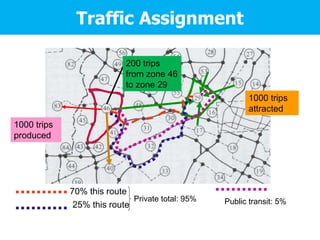
Traffic Assignment
1000 trips
produced
1000 trips
attracted
200 trips
from zone 46
to zone 29
Private total: 95% Public transit: 5%
70% this route
25% this route
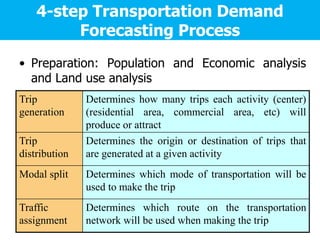
4-step Transportation Demand
Forecasting Process
• Preparation: Population and Economic analysis
and Land use analysis
Trip
generation
Determines how many trips each activity (center)
(residential area, commercial area, etc) will
produce or attract
Trip
distribution
Determines the origin or destination of trips that
are generated at a given activity
Modal split Determines which mode of transportation will be
used to make the trip
Traffic
assignment
Determines which route on the transportation
network will be used when making the trip

urban transportation planning introduction.ppt

  • 1.
  • 2.
  • 4.
    Planning • Planning maybe defined as the activity or process that examines the potential of future actions to guide a situation or a system towards a desired direction, for example, toward the attainment of positive goals, the avoidance of problems or both. • It is oriented toward the future
  • 6.
    Travel Demand Modelling •Trends, Overall Planning process, • Long term - Short term planning, • Demand Function, Independent Variables, Travel Attributes, • Assumptions in Demand Estimation, • Sequential, and Simultaneous Approaches, • Aggregate and Disaggregate Techniques, • Tour based models, and Activity based models.
  • 8.
    Data Collection andInventories • Collection of data – Organisation of surveys and Analysis • Study Area - Zoning • Types and Sources of Data, Road Side Interviews, Home Interview Surveys, Commercial Vehicle Surveys • Sampling Techniques, Expansion Factors, Accuracy Checks • Use of Secondary Sources, Economic data – Income – Population – Employment – Vehicle Owner Ship.
  • 10.
    TRIP GENERATION MODELS •UTPS Approach, • Trip Generation Analysis: –Zonal Models –Category Analysis –Household Models –Trip Attraction models –Commercial Trip Rates
  • 11.
  • 12.
  • 13.
  • 14.
    TRIP DISTRIBUTION MODELS •Growth Factor Methods • Gravity Models • Opportunity Models • Time Function Iteration Models
  • 15.
    Trip Distributions 1000 trips produced 1000trips attracted 200 trips from zone 46 to zone 29
  • 16.
    MODE SPLIT ANALYSIS •Mode Choice Behavior • Competing Modes • Mode Split Curves • Mode Choice Models and Probabilistic Approaches – Logit Model
  • 17.
    Modal Split Analysis 1000trips produced 1000 trips attracted 200 trips from zone 46 to zone 29 Private total: 190 (95%) Public transit: 10 (5%)
  • 18.
    TRAFFIC ASSIGNMENT TECHNIQUES • DiversionCurves • Basic Elements of Transport Networks, Coding, Route Properties • Path Building Criteria, Skimming Tree • All-or-Nothing Assignment • Capacity Restraint Techniques, Reallocation of Assigned Volumes • Equilibrium Assignment • Multipath Assignment Technique
  • 19.
    Traffic Assignment 1000 trips produced 1000trips attracted 200 trips from zone 46 to zone 29 Private total: 95% Public transit: 5% 70% this route 25% this route
  • 20.
    4-step Transportation Demand ForecastingProcess • Preparation: Population and Economic analysis and Land use analysis Trip generation Determines how many trips each activity (center) (residential area, commercial area, etc) will produce or attract Trip distribution Determines the origin or destination of trips that are generated at a given activity Modal split Determines which mode of transportation will be used to make the trip Traffic assignment Determines which route on the transportation network will be used when making the trip