NORTH CORRIDOR
LAND USE
CHARRETTES
NOVEMBER 4 & 8, 2017
WHY ARE WE DOING THIS
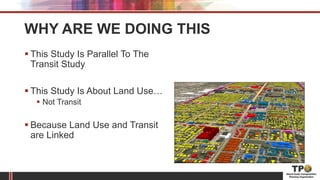
 This Study Is Parallel To The
Transit Study
 This Study Is About Land Use…
 Not Transit
 Because Land Use and Transit
are Linked
WHAT IS LAND USE
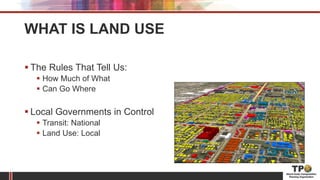
 The Rules That Tell Us:
 How Much of What
 Can Go Where
 Local Governments in Control
 Transit: National
 Land Use: Local
TIMES and LOCATIONS – PHASE I
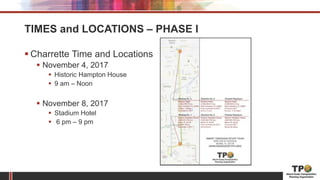
 Charrette Time and Locations
 November 4, 2017
 Historic Hampton House
 9 am – Noon
 November 8, 2017
 Stadium Hotel
 6 pm – 9 pm
CHARRETTE PROCESS
 Ample opportunity to provide input/feedback
 Two phases
 1: November,2017
 2: March,2018
 Two meetings in each phase
 North
 South
 Phase 1: Lifestyle
 What do you want the corridor to look like?
 Phase 2: Location and urban design
 What should the station areas look like?
 Station Area Massing/Scale
 Parcel Accessibility
QUESTIONS TO CONSIDER
 Think about where you live
 What does your neighborhood look like?
 What do you want it to look like?
 What Would Make It Better?
 Jobs?
 What Kind?
 Where?
 Schools?
TRANSPORTATION AND LAND USE
 Both Very Connected
 How Much Of Each Do We Need
 Why
 Naturally Happens
 Federal Transit Administration Scores it That Way
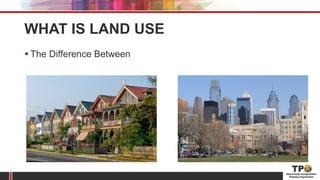
WHAT IS LAND USE
 The Difference Between
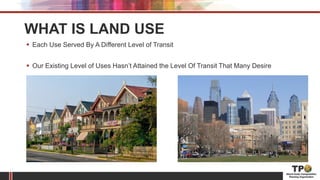
WHAT IS LAND USE
 Each Use Served By A Different Level of Transit
 Our Existing Level of Uses Hasn’t Attained the Level Of Transit That Many Desire
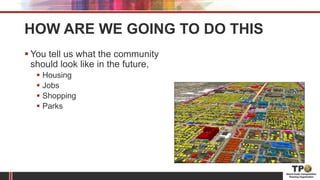
HOW ARE WE GOING TO DO THIS
 You tell us what the community
should look like in the future,
 Housing
 Jobs
 Shopping
 Parks
WHAT WE WILL ACHIEVE
 Determine the level of transit that can be supported today and
tomorrow under the existing codes
 Analyze alternative development scenarios and the degree of support
for various transit modes.
Begin with the community’s vision gained through charrettes
 Define the steps and processes achieve the final vision
 Comprehensive Plan Policies
 Zoning Code Changes
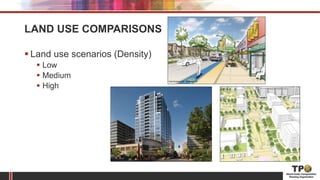
LAND USE COMPARISONS
 Land use scenarios (Density)
 Low
 Medium
 High
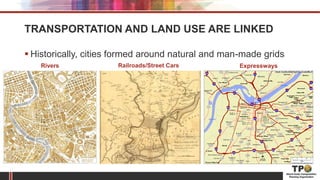
TRANSPORTATION AND LAND USE ARE LINKED
 Historically, cities formed around natural and man-made grids
Rivers Railroads/Street Cars Expressways
IT’S ABOUT THE MONEY
 FTA Funding
 Transit funding is highly competitive
 Federal Transit Administration evaluates based on (each rated on 5
point scale)
 Land use
 Mobility
 Environment
 Congestion relief
 Economic development
 Affordable housing
 Cost Effectiveness
WANTS vs NEEDS
 Federal Transit Administration (FTA) Perspectives…….
 What is wanted must be needed or the project fails to attain
financial assistance
 Totally locally-funded projects are not constrained by FTA rules
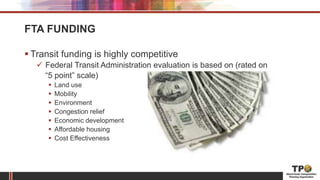
FTA FUNDING
 Transit funding is highly competitive
 Federal Transit Administration evaluation is based on (rated on
“5 point” scale)
 Land use
 Mobility
 Environment
 Congestion relief
 Economic development
 Affordable housing
 Cost Effectiveness
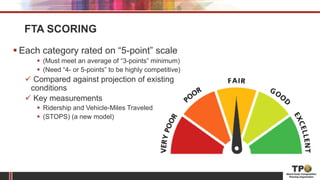
FTA SCORING
 Each category rated on “5-point” scale
 (Must meet an average of “3-points” minimum)
 (Need “4- or 5-points” to be highly competitive)
 Compared against projection of existing
conditions
 Key measurements
 Ridership and Vehicle-Miles Traveled
 (STOPS) (a new model)
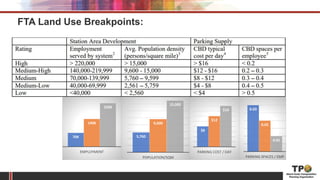
FTA Land Use Breakpoints:
70K
140K
220K
EMPLOYMENT
5,760
9,600
15,000
POPULATION/SQM
$8
$12
$16
PARKING COST / DAY
0.03
0.02
0.01
PARKING SPACES / EMP
The North Corridor
THE DETAILS
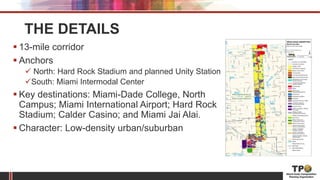
 13-mile corridor
 Anchors
 North: Hard Rock Stadium and planned Unity Station
South: Miami Intermodal Center
 Key destinations: Miami-Dade College, North
Campus; Miami International Airport; Hard Rock
Stadium; Calder Casino; and Miami Jai Alai.
 Character: Low-density urban/suburban
DEMOGRAPHICS
 120,000 residents (9,000 people per square mile)
 36,000 households.
 24,000 jobs (primarily filled by employees living outside the corridor)
 Fewer than 1,000 workers who live in the corridor also work in the corridor
 Generates approximately 100,000 employment trips regionally.
 Workers within the corridor primarily originate from Hialeah, City of Miami,
Sweetwater, or the Fontainebleau area
 Resident workers primarily work in Downtown Miami, Aventura, Miami Beach, and
Doral’s industrial/warehouse districts.
 Linked Jobs (+/- 49,000)
WHO WORKS HERE
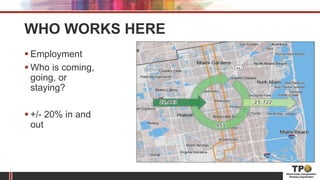
 Employment
 Who is coming,
going, or
staying?
 +/- 20% in and
out
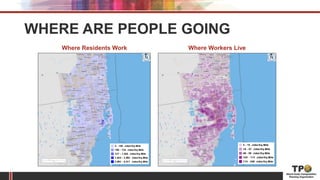
WHERE ARE PEOPLE GOING
Where Residents Work Where Workers Live
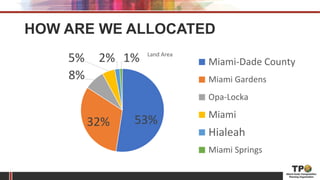
HOW ARE WE ALLOCATED
53%32%
8%
5% 2% 1% Land Area
Miami-Dade County
Miami Gardens
Opa-Locka
Miami
Hialeah
Miami Springs
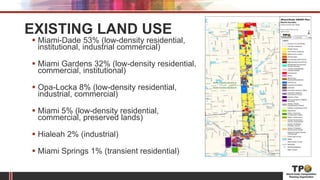
EXISTING LAND USE
 Miami-Dade 53% (low-density residential,
institutional, industrial commercial)
 Miami Gardens 32% (low-density residential,
commercial, institutional)
 Opa-Locka 8% (low-density residential,
industrial, commercial)
 Miami 5% (low-density residential,
commercial, preserved lands)
 Hialeah 2% (industrial)
 Miami Springs 1% (transient residential)
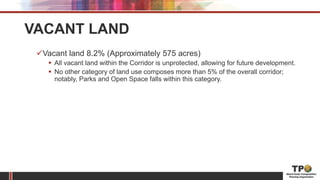
VACANT LAND
Vacant land 8.2% (Approximately 575 acres)
 All vacant land within the Corridor is unprotected, allowing for future development.
 No other category of land use composes more than 5% of the overall corridor;
notably, Parks and Open Space falls within this category.
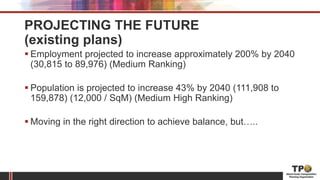
PROJECTING THE FUTURE
(existing plans)
 Employment projected to increase approximately 200% by 2040
(30,815 to 89,976) (Medium Ranking)
 Population is projected to increase 43% by 2040 (111,908 to
159,878) (12,000 / SqM) (Medium High Ranking)
 Moving in the right direction to achieve balance, but…..
WHAT DO YOU LIKE
 So, before we begin - Everyone have a clicker?
 When asked--Press any button.
 When answering, point to computer at the front of the room.
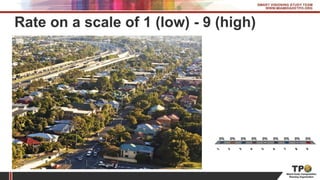
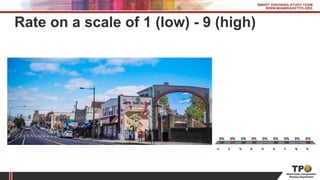
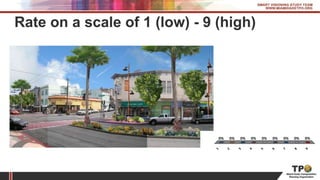
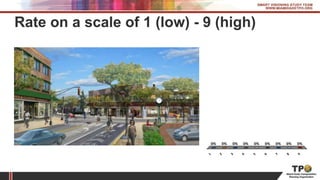
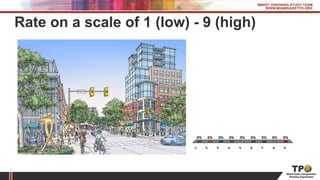
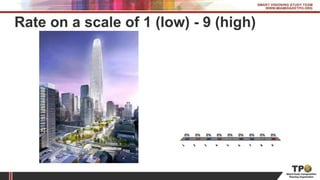
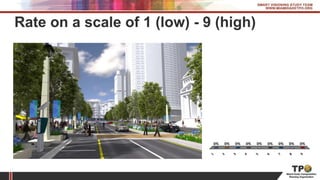
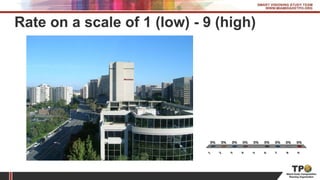
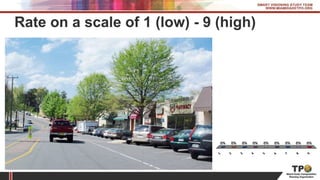
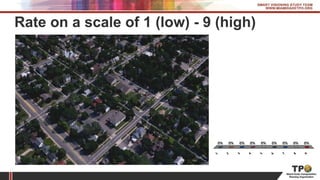
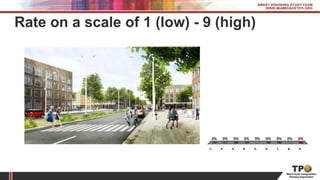
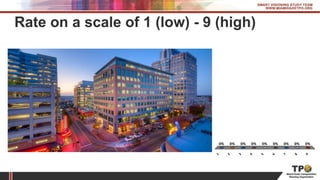
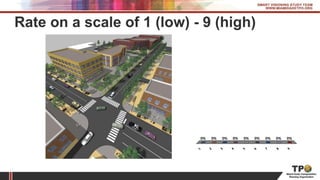
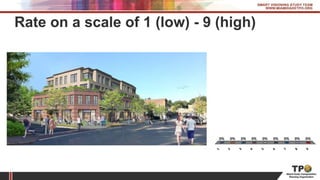
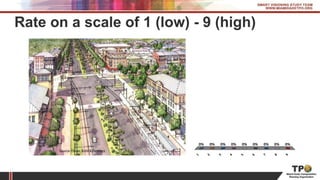
 Look at the following slides. Each represents a level of intensity.
 Tell us: How much do you like what you see?
WHAT DO YOU LIKE
 Look at these pictures
 Use the Key Pad to vote on how much you like each
How did you hear about this meeting?
A. Flyer
B. Postcard
C. Radio
D. Newspaper
E. Email
F. Facebook
G. Word of Mouth
H. Other
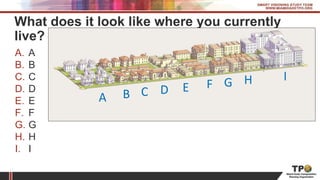
What does it look like where you currently
live?
A. A
B. B
C. C
D. D
E. E
F. F
G. G
H. H
I. I
A B DC E F HG I
Rate on a scale of 1 (low) - 9 (high)
1
2
3
4
5
6
7
8
9
0% 0% 0% 0% 0%0%0%0%0%
Rate on a scale of 1 (low) - 9 (high)
1
2
3
4
5
6
7
8
9
0% 0% 0% 0% 0%0%0%0%0%
Rate on a scale of 1 (low) - 9 (high)
1
2
3
4
5
6
7
8
9
0% 0% 0% 0% 0%0%0%0%0%
Rate on a scale of 1 (low) - 9 (high)
1
2
3
4
5
6
7
8
9
0% 0% 0% 0% 0%0%0%0%0%
Rate on a scale of 1 (low) - 9 (high)
1
2
3
4
5
6
7
8
9
0% 0% 0% 0% 0%0%0%0%0%
Rate on a scale of 1 (low) - 9 (high)
1
2
3
4
5
6
7
8
9
0% 0% 0% 0% 0%0%0%0%0%
Rate on a scale of 1 (low) - 9 (high)
1
2
3
4
5
6
7
8
9
0% 0% 0% 0% 0%0%0%0%0%
Rate on a scale of 1 (low) - 9 (high)
1
2
3
4
5
6
7
8
9
0% 0% 0% 0% 0%0%0%0%0%
Rate on a scale of 1 (low) - 9 (high)
1
2
3
4
5
6
7
8
9
0% 0% 0% 0% 0%0%0%0%0%
Rate on a scale of 1 (low) - 9 (high)
1
2
3
4
5
6
7
8
9
0% 0% 0% 0% 0%0%0%0%0%
Rate on a scale of 1 (low) - 9 (high)
1
2
3
4
5
6
7
8
9
0% 0% 0% 0% 0%0%0%0%0%
Rate on a scale of 1 (low) - 9 (high)
1
2
3
4
5
6
7
8
9
0% 0% 0% 0% 0%0%0%0%0%
Rate on a scale of 1 (low) - 9 (high)
1
2
3
4
5
6
7
8
9
0% 0% 0% 0% 0%0%0%0%0%
Rate on a scale of 1 (low) - 9 (high)
1
2
3
4
5
6
7
8
9
0% 0% 0% 0% 0%0%0%0%0%
Rate on a scale of 1 (low) - 9 (high)
1
2
3
4
5
6
7
8
9
0% 0% 0% 0% 0%0%0%0%0%
BREAK OUT SESSION
 Discuss Questions
 Report Back
15-Minute BREAK
QUESTIONS TO CONSIDER
 Think about where you live
 What does your neighborhood look like?
 What do you want it to look like?
 What Would Make It Better?
 Jobs?
 What Kind?
 Where?
 Schools?
15-Minute BREAK
Individual Group Presentations
NEXT STEPS
 We Refine The Information
 Use the ESRI Tool
 Next Charrettes – March or April
 Conversation about Station Areas
ESRI 3D Model
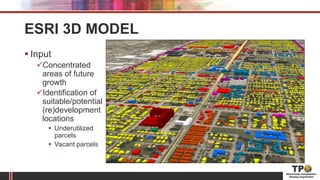
ESRI 3D MODEL
 Input
Concentrated
areas of future
growth
Identification of
suitable/potential
(re)development
locations
 Underutilized
parcels
 Vacant parcels
ESRI 3D MODEL
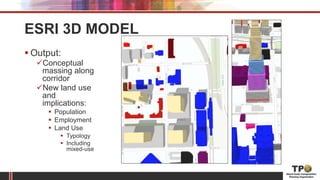
 Output:
Conceptual
massing along
corridor
New land use
and
implications:
 Population
 Employment
 Land Use
 Typology
 Including
mixed-use
Thank you !!!
We’ll keep in touch.

SMART Implementation Plan Charrette - North Corridor Presentation

  • 1.
  • 2.
    WHY ARE WEDOING THIS  This Study Is Parallel To The Transit Study  This Study Is About Land Use…  Not Transit  Because Land Use and Transit are Linked
  • 3.
    WHAT IS LANDUSE  The Rules That Tell Us:  How Much of What  Can Go Where  Local Governments in Control  Transit: National  Land Use: Local
  • 4.
    TIMES and LOCATIONS– PHASE I  Charrette Time and Locations  November 4, 2017  Historic Hampton House  9 am – Noon  November 8, 2017  Stadium Hotel  6 pm – 9 pm
  • 5.
    CHARRETTE PROCESS  Ampleopportunity to provide input/feedback  Two phases  1: November,2017  2: March,2018  Two meetings in each phase  North  South  Phase 1: Lifestyle  What do you want the corridor to look like?  Phase 2: Location and urban design  What should the station areas look like?  Station Area Massing/Scale  Parcel Accessibility
  • 6.
    QUESTIONS TO CONSIDER Think about where you live  What does your neighborhood look like?  What do you want it to look like?  What Would Make It Better?  Jobs?  What Kind?  Where?  Schools?
  • 7.
    TRANSPORTATION AND LANDUSE  Both Very Connected  How Much Of Each Do We Need  Why  Naturally Happens  Federal Transit Administration Scores it That Way
  • 8.
    WHAT IS LANDUSE  The Difference Between
  • 9.
    WHAT IS LANDUSE  Each Use Served By A Different Level of Transit  Our Existing Level of Uses Hasn’t Attained the Level Of Transit That Many Desire
  • 10.
    HOW ARE WEGOING TO DO THIS  You tell us what the community should look like in the future,  Housing  Jobs  Shopping  Parks
  • 11.
    WHAT WE WILLACHIEVE  Determine the level of transit that can be supported today and tomorrow under the existing codes  Analyze alternative development scenarios and the degree of support for various transit modes. Begin with the community’s vision gained through charrettes  Define the steps and processes achieve the final vision  Comprehensive Plan Policies  Zoning Code Changes
  • 12.
    LAND USE COMPARISONS Land use scenarios (Density)  Low  Medium  High
  • 13.
    TRANSPORTATION AND LANDUSE ARE LINKED  Historically, cities formed around natural and man-made grids Rivers Railroads/Street Cars Expressways
  • 14.
    IT’S ABOUT THEMONEY  FTA Funding  Transit funding is highly competitive  Federal Transit Administration evaluates based on (each rated on 5 point scale)  Land use  Mobility  Environment  Congestion relief  Economic development  Affordable housing  Cost Effectiveness
  • 15.
    WANTS vs NEEDS Federal Transit Administration (FTA) Perspectives…….  What is wanted must be needed or the project fails to attain financial assistance  Totally locally-funded projects are not constrained by FTA rules
  • 16.
    FTA FUNDING  Transitfunding is highly competitive  Federal Transit Administration evaluation is based on (rated on “5 point” scale)  Land use  Mobility  Environment  Congestion relief  Economic development  Affordable housing  Cost Effectiveness
  • 17.
    FTA SCORING  Eachcategory rated on “5-point” scale  (Must meet an average of “3-points” minimum)  (Need “4- or 5-points” to be highly competitive)  Compared against projection of existing conditions  Key measurements  Ridership and Vehicle-Miles Traveled  (STOPS) (a new model)
  • 18.
    FTA Land UseBreakpoints: 70K 140K 220K EMPLOYMENT 5,760 9,600 15,000 POPULATION/SQM $8 $12 $16 PARKING COST / DAY 0.03 0.02 0.01 PARKING SPACES / EMP
  • 19.
  • 20.
    THE DETAILS  13-milecorridor  Anchors  North: Hard Rock Stadium and planned Unity Station South: Miami Intermodal Center  Key destinations: Miami-Dade College, North Campus; Miami International Airport; Hard Rock Stadium; Calder Casino; and Miami Jai Alai.  Character: Low-density urban/suburban
  • 21.
    DEMOGRAPHICS  120,000 residents(9,000 people per square mile)  36,000 households.  24,000 jobs (primarily filled by employees living outside the corridor)  Fewer than 1,000 workers who live in the corridor also work in the corridor  Generates approximately 100,000 employment trips regionally.  Workers within the corridor primarily originate from Hialeah, City of Miami, Sweetwater, or the Fontainebleau area  Resident workers primarily work in Downtown Miami, Aventura, Miami Beach, and Doral’s industrial/warehouse districts.  Linked Jobs (+/- 49,000)
  • 22.
    WHO WORKS HERE Employment  Who is coming, going, or staying?  +/- 20% in and out
  • 23.
    WHERE ARE PEOPLEGOING Where Residents Work Where Workers Live
  • 24.
    HOW ARE WEALLOCATED 53%32% 8% 5% 2% 1% Land Area Miami-Dade County Miami Gardens Opa-Locka Miami Hialeah Miami Springs
  • 25.
    EXISTING LAND USE Miami-Dade 53% (low-density residential, institutional, industrial commercial)  Miami Gardens 32% (low-density residential, commercial, institutional)  Opa-Locka 8% (low-density residential, industrial, commercial)  Miami 5% (low-density residential, commercial, preserved lands)  Hialeah 2% (industrial)  Miami Springs 1% (transient residential)
  • 26.
    VACANT LAND Vacant land8.2% (Approximately 575 acres)  All vacant land within the Corridor is unprotected, allowing for future development.  No other category of land use composes more than 5% of the overall corridor; notably, Parks and Open Space falls within this category.
  • 27.
    PROJECTING THE FUTURE (existingplans)  Employment projected to increase approximately 200% by 2040 (30,815 to 89,976) (Medium Ranking)  Population is projected to increase 43% by 2040 (111,908 to 159,878) (12,000 / SqM) (Medium High Ranking)  Moving in the right direction to achieve balance, but…..
  • 28.
    WHAT DO YOULIKE  So, before we begin - Everyone have a clicker?  When asked--Press any button.  When answering, point to computer at the front of the room.  Look at the following slides. Each represents a level of intensity.  Tell us: How much do you like what you see?
  • 29.
    WHAT DO YOULIKE  Look at these pictures  Use the Key Pad to vote on how much you like each
  • 30.
    How did youhear about this meeting? A. Flyer B. Postcard C. Radio D. Newspaper E. Email F. Facebook G. Word of Mouth H. Other
  • 31.
    What does itlook like where you currently live? A. A B. B C. C D. D E. E F. F G. G H. H I. I A B DC E F HG I
  • 32.
    Rate on ascale of 1 (low) - 9 (high) 1 2 3 4 5 6 7 8 9 0% 0% 0% 0% 0%0%0%0%0%
  • 33.
    Rate on ascale of 1 (low) - 9 (high) 1 2 3 4 5 6 7 8 9 0% 0% 0% 0% 0%0%0%0%0%
  • 34.
    Rate on ascale of 1 (low) - 9 (high) 1 2 3 4 5 6 7 8 9 0% 0% 0% 0% 0%0%0%0%0%
  • 35.
    Rate on ascale of 1 (low) - 9 (high) 1 2 3 4 5 6 7 8 9 0% 0% 0% 0% 0%0%0%0%0%
  • 36.
    Rate on ascale of 1 (low) - 9 (high) 1 2 3 4 5 6 7 8 9 0% 0% 0% 0% 0%0%0%0%0%
  • 37.
    Rate on ascale of 1 (low) - 9 (high) 1 2 3 4 5 6 7 8 9 0% 0% 0% 0% 0%0%0%0%0%
  • 38.
    Rate on ascale of 1 (low) - 9 (high) 1 2 3 4 5 6 7 8 9 0% 0% 0% 0% 0%0%0%0%0%
  • 39.
    Rate on ascale of 1 (low) - 9 (high) 1 2 3 4 5 6 7 8 9 0% 0% 0% 0% 0%0%0%0%0%
  • 40.
    Rate on ascale of 1 (low) - 9 (high) 1 2 3 4 5 6 7 8 9 0% 0% 0% 0% 0%0%0%0%0%
  • 41.
    Rate on ascale of 1 (low) - 9 (high) 1 2 3 4 5 6 7 8 9 0% 0% 0% 0% 0%0%0%0%0%
  • 42.
    Rate on ascale of 1 (low) - 9 (high) 1 2 3 4 5 6 7 8 9 0% 0% 0% 0% 0%0%0%0%0%
  • 43.
    Rate on ascale of 1 (low) - 9 (high) 1 2 3 4 5 6 7 8 9 0% 0% 0% 0% 0%0%0%0%0%
  • 44.
    Rate on ascale of 1 (low) - 9 (high) 1 2 3 4 5 6 7 8 9 0% 0% 0% 0% 0%0%0%0%0%
  • 45.
    Rate on ascale of 1 (low) - 9 (high) 1 2 3 4 5 6 7 8 9 0% 0% 0% 0% 0%0%0%0%0%
  • 46.
    Rate on ascale of 1 (low) - 9 (high) 1 2 3 4 5 6 7 8 9 0% 0% 0% 0% 0%0%0%0%0%
  • 47.
    BREAK OUT SESSION Discuss Questions  Report Back
  • 48.
  • 49.
    QUESTIONS TO CONSIDER Think about where you live  What does your neighborhood look like?  What do you want it to look like?  What Would Make It Better?  Jobs?  What Kind?  Where?  Schools?
  • 50.
  • 51.
  • 52.
    NEXT STEPS  WeRefine The Information  Use the ESRI Tool  Next Charrettes – March or April  Conversation about Station Areas
  • 53.
  • 54.
    ESRI 3D MODEL Input Concentrated areas of future growth Identification of suitable/potential (re)development locations  Underutilized parcels  Vacant parcels
  • 55.
    ESRI 3D MODEL Output: Conceptual massing along corridor New land use and implications:  Population  Employment  Land Use  Typology  Including mixed-use
  • 56.
    Thank you !!! We’llkeep in touch.