Planets & Other Objects in our Solar System
ProtoplanetHypothesis
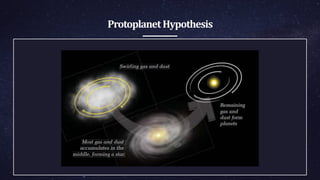
Protoplanet hypothesis - is a model used to explain the birth of solar
systems.
There are 3 steps:
1) a cloud of dust and gas begins swirling
2) most of the material (more than 90%) accumulates in the center,
forming the Sun
3) the remaining material forms smaller clumps circling the center.
These are the planets.
ProtoplanetHypothesis
TheSun
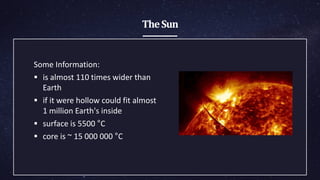
Some Information:
 is almost 110 times ​wider than
Earth
 if it were hollow could ​fit almost
1 million ​Earth's inside
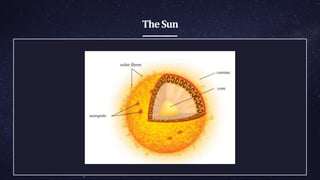
 surface is 5500 °C
 core is ~ 15 000 000 °C
TheSun
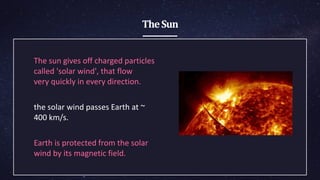
The sun gives off charged ​particles
called 'solar ​wind', that flow
very ​quickly in every ​direction.
the solar wind ​passes Earth at ~
400 ​km/s.
Earth is protected ​from the solar
wind by ​its magnetic field.
TheSun
ThePlanets
ThePlanets
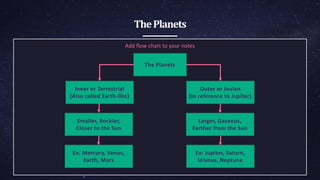
The Planets
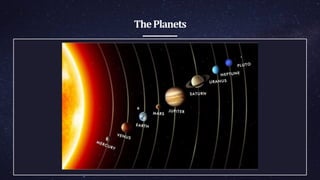
Inner or Terrestrial
(Also called Earth-like)
Outer or Jovian
(In reference to Jupiter)
Smaller, Rockier,
Closer to the Sun
Larger, Gaseous,
Farther from the Sun
Ex: Mercury, Venus,
Earth, Mars
Ex: Jupiter, Saturn,
Uranus, Neptune
Add flow chart to your notes
OtherBodiesintheSolarSystem
Asteroids: rocky or metallic bodies travelling in space with predictable
orbits.
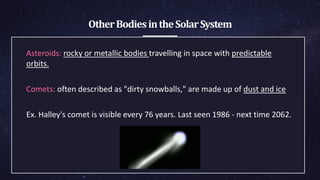
Comets: often described as "dirty snowballs," are made up of dust and ice
Ex. Halley's comet is visible every 76 years. Last seen 1986 - next ​time 2062.
OtherBodiesintheSolarSystem
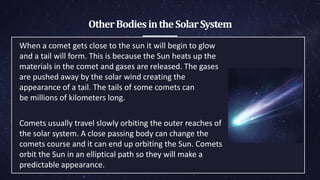
When a comet gets close to the sun it will begin to glow
and a tail will ​form. This is because the Sun heats up the
materials in the comet and ​gases are released. The gases
are pushed away by the solar wind ​creating the
appearance of a tail. The tails of some comets can
be ​millions of kilometers long.
Comets usually travel slowly orbiting the outer reaches of
the solar ​system. A close passing body can change the
comets course and it can ​end up orbiting the Sun. Comets
orbit the Sun in an elliptical path so ​they will make a
predictable appearance.
OtherBodiesintheSolarSystem
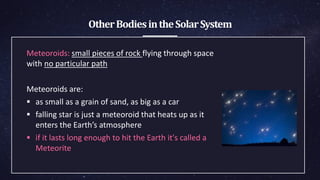
Meteoroids: small pieces of rock flying through space
with no particular path
Meteoroids are:
 as small as a grain of sand, as big as a car
 falling star is just a meteoroid that heats up as it
enters the Earth’s atmosphere
 if it lasts long enough to hit the Earth it's called a
Meteorite
OtherBodiesintheSolarSystem
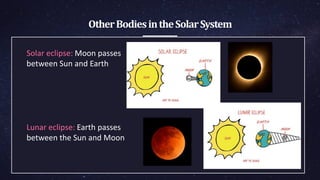
Solar eclipse: Moon passes
between Sun and Earth
Lunar eclipse: Earth passes
between the Sun and Moon
OtherBodiesintheSolarSystem
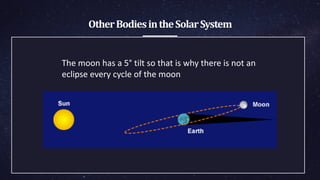
The moon has a 5° tilt so that is why there is not an
eclipse every cycle of the moon

Planets & other objects in solar system

  • 1.
    Planets & OtherObjects in our Solar System
  • 2.
    ProtoplanetHypothesis Protoplanet hypothesis -is a model used to explain the birth of solar systems. There are 3 steps: 1) a cloud of dust and gas begins swirling 2) most of the material (more than 90%) accumulates in the center, forming the Sun 3) the remaining material forms smaller clumps circling the center. These are the planets.
  • 3.
  • 4.
    TheSun Some Information:  isalmost 110 times ​wider than Earth  if it were hollow could ​fit almost 1 million ​Earth's inside  surface is 5500 °C  core is ~ 15 000 000 °C
  • 5.
    TheSun The sun givesoff charged ​particles called 'solar ​wind', that flow very ​quickly in every ​direction. the solar wind ​passes Earth at ~ 400 ​km/s. Earth is protected ​from the solar wind by ​its magnetic field.
  • 6.
  • 7.
  • 8.
    ThePlanets The Planets Inner orTerrestrial (Also called Earth-like) Outer or Jovian (In reference to Jupiter) Smaller, Rockier, Closer to the Sun Larger, Gaseous, Farther from the Sun Ex: Mercury, Venus, Earth, Mars Ex: Jupiter, Saturn, Uranus, Neptune Add flow chart to your notes
  • 9.
    OtherBodiesintheSolarSystem Asteroids: rocky ormetallic bodies travelling in space with predictable orbits. Comets: often described as "dirty snowballs," are made up of dust and ice Ex. Halley's comet is visible every 76 years. Last seen 1986 - next ​time 2062.
  • 10.
  • 11.
    OtherBodiesintheSolarSystem When a cometgets close to the sun it will begin to glow and a tail will ​form. This is because the Sun heats up the materials in the comet and ​gases are released. The gases are pushed away by the solar wind ​creating the appearance of a tail. The tails of some comets can be ​millions of kilometers long. Comets usually travel slowly orbiting the outer reaches of the solar ​system. A close passing body can change the comets course and it can ​end up orbiting the Sun. Comets orbit the Sun in an elliptical path so ​they will make a predictable appearance.
  • 12.
    OtherBodiesintheSolarSystem Meteoroids: small piecesof rock flying through space with no particular path Meteoroids are:  as small as a grain of sand, as big as a car  falling star is just a meteoroid that heats up as it enters the Earth’s atmosphere  if it lasts long enough to hit the Earth it's called a Meteorite
  • 13.
    OtherBodiesintheSolarSystem Solar eclipse: Moonpasses between Sun and Earth Lunar eclipse: Earth passes between the Sun and Moon
  • 14.
    OtherBodiesintheSolarSystem The moon hasa 5° tilt so that is why there is not an eclipse every cycle of the moon