Other
Members
of the Solar
System
▪By: SIRTHON AZUELA
▪ SABANG NATIONAL HIGH SCHOOL
▪ Sabang, Calabanga, Camarines Sur,
Region V – Bicol , Philippines
▪ 09122738106
ASTERIOIDS
▪ Large gap between Mars and Jupiter is populated by
thousands of small rocky bodies
▪ Irregular in shape, like boulders and the larger ones are
spherical.
▪ CERES – the largest asteroids has a diameter of 750
kilometers
▪ Thought to have failed to become a planet during the
formation of the solar system
▪ Many asteroids circle the sun, others do not.
▪ VESTA- is the only asteroid which can be seen by the
naked eyes.
▪ Asteroids which are smaller than a few hundred kilometers
are called meteoroids
NASA
▪ The National Aeronautics and Space
Administration (NASA /ˈnæsə/)
▪ is an independent agency of the executive branch
of the United States federal government
responsible for the civilian space program, as well
as aeronautics and aerospace research.
▪ It is a streaking light which lasts for a few seconds.
▪ We see it as shooting star
▪ A meteoroid (/ˈmiːtiərɔɪd/) is a small rocky or metallic
body in outer space.
▪ Meteoroids are significantly smaller than asteroids, and
range in size from small grains to one-meter-wide
objects.[2] Objects smaller than this are classified as
micrometeoroids or space dust. Most are fragments
from comets or asteroids, whereas others are collision
impact debris ejected from bodies such as the Moon or
Mars.
▪ When a meteoroid, comet, or asteroid enters Earth's
atmosphere at a speed typically in excess of 20 km/s
(72,000 km/h; 45,000 mph), aerodynamic heating of that
object produces a streak of light, both from the glowing
object and the trail of glowing particles that it leaves in
its wake. This phenomenon is called a meteor or
"shooting star". A series of many meteors appearing
seconds or minutes apart and appearing to originate
from the same fixed point in the sky is called a meteor
shower. If that object withstands ablation from its
passage through the atmosphere as a meteor and
impacts with the ground, it is then called a meteorite.
METEORITES
METEORITES
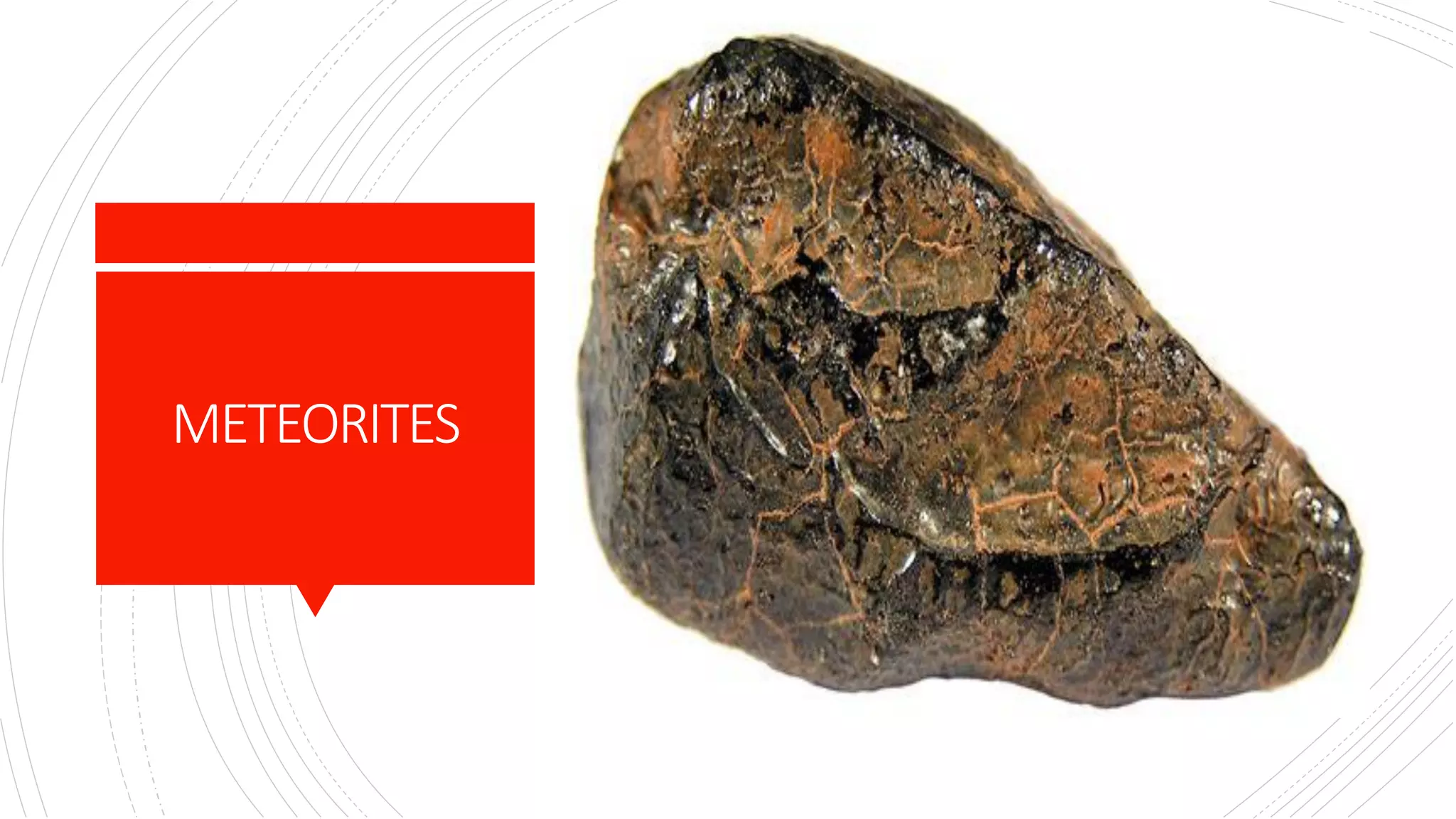
▪ Meteorites are the solid pieces of debris from an
object, such as a comet, asteroid, or meteoroid, that
originates in outer space and survives its passage
through the atmosphere to reach the surface of a planet
or moon.
▪ When the object enters the atmosphere, various factors
like friction, pressure, and chemical interactions with
the atmospheric gases cause it to heat up and radiate
that energy. It then becomes a meteor and forms a
fireball, also known as a shooting star or falling star;
astronomers call the brightest examples "bolides.“
▪ Meteorites vary greatly in size. For geologists, a bolide
is a meteorite large enough to create a crater.
Collisionwith
Earth's
atmosphere
▪ When meteoroids intersect with Earth's atmosphere at
night, they are likely to become visible as meteors.
▪ If meteoroids survive the entry through the atmosphere
and reach Earth's surface, they are called meteorites.
Meteorites are transformed in structure and chemistry by
the heat of entry and force of impact.
▪ A noted 4-meter asteroid, 2008 TC3, was observed in space
on a collision course with Earth on 6 October 2008 and
entered Earth's atmosphere the next day, striking a remote
area of northern Sudan.
▪ It was the first time that a meteoroid had been observed in
space and tracked prior to impacting Earth. NASA has
produced a map showing the most notable asteroid
collisions with Earth and its atmosphere from 1994 to 2013
from data gathered by U.S. government sensors .
METEORS
Meteors
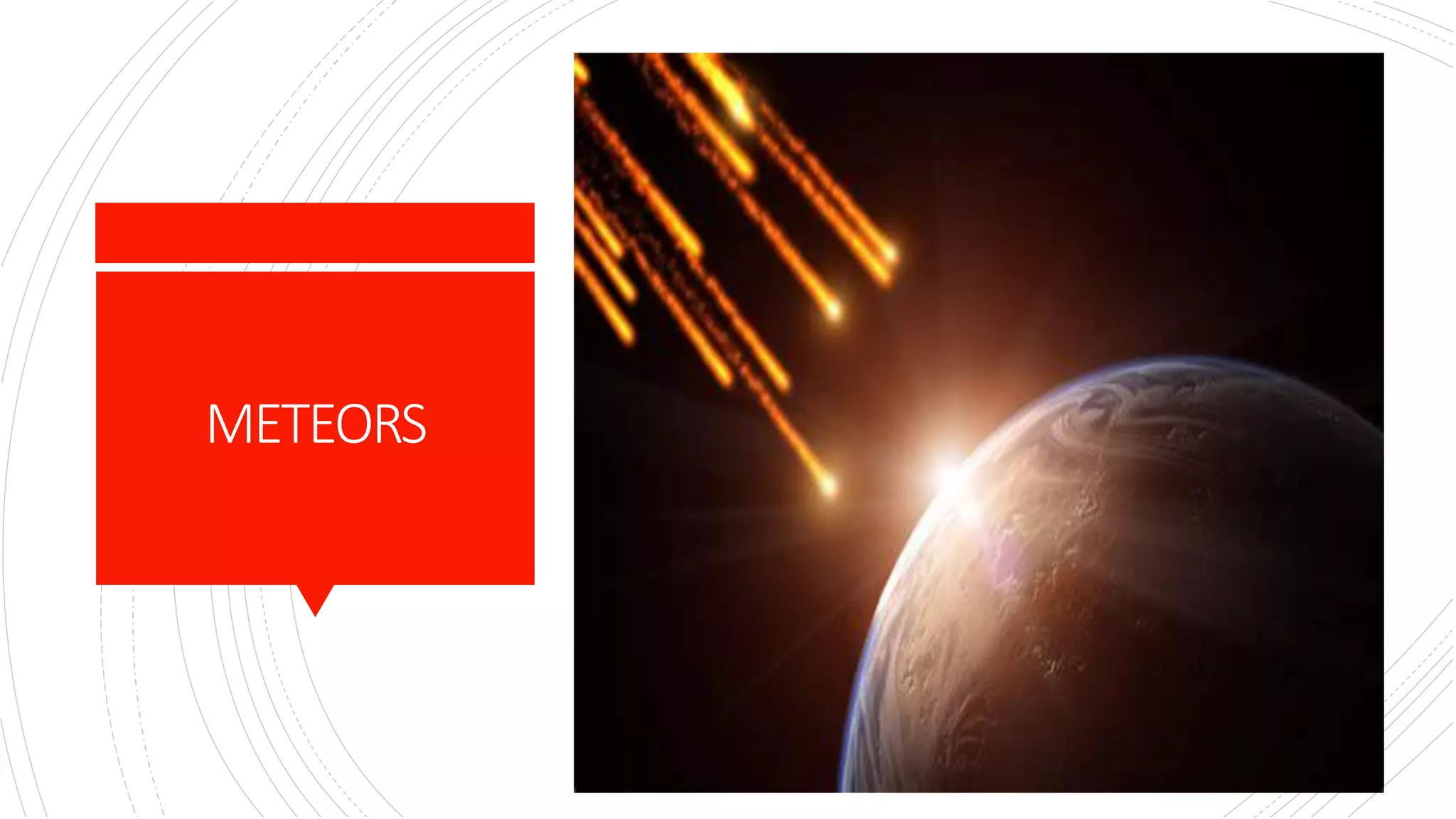
▪ A meteor, known colloquially as a "shooting star" or
"falling star", is the visible passage of a glowing
meteoroid, micrometeoroid, comet or asteroid through
Earth's atmosphere, after being heated to
incandescence by collisions with air molecules in the
upper atmosphere, creating a streak of light via its rapid
motion and sometimes also by shedding glowing
material in its wake.
▪ Although a meteor may seem to be a few thousand feet
from the Earth, meteors typically occur in the
mesosphere at altitudes from 76 to 100 km (47 to 62 mi).
The root word meteor comes from the Greek meteōros,
meaning "high in the air".
COMETS
COMETS
▪ The term comet was derived from the Greek word
meaning “Long haired”.
▪ It is small body of rock, iron, ice, and gases that orbit the
sun elliptical orbits.
▪ It is composed of nucleus which looks like a dirty
snowbell called coma and long tail of vaporized
gases(water,ammonia, methane, and carbon dioxide)
▪ The most spectacular bodies in the solar system.
▪ Visible only when they are within the orbits of saturn
COMETS
▪ A comet is an icy small Solar System body that, when
passing close to the Sun, warms and begins to release
gases, a process called outgassing.
▪ This produces a visible atmosphere or coma, and
sometimes also a tail. These phenomena are due to the
effects of solar radiation and the solar wind acting upon the
nucleus of the comet.
▪ Comet nuclei range from a few hundred metres to tens of
kilometres across and are composed of loose collections of
ice, dust, and small rocky particles.
▪ The coma may be up to 15 times the Earth's diameter, while
the tail may stretch one astronomical unit. If sufficiently
bright, a comet may be seen from the Earth without the aid
of a telescope and may subtend an arc of 30° (60 Moons)
across the sky.
▪ Comets have been observed and recorded since ancient
times by many cultures.
▪ A comet revolves around the sun in either the kulper
belt or Oort cloud.
▪ Kulper belt is an area outside the orbit of Pluto
▪ Oort cloud is a sphere beyond the orbit of
Uranus.Because comets follow a path, we can see them
from time to time.
▪ Halley’s comet include Halebopp, Schwassmann, and
Wachmann, Kopff and Oterma, Linear and Shoemaker
Levy 9 which hit the planet Jupiter.
The SUN
▪ Our solar system is composed of the
Sun and all things which orbit around
it: the Earth, the other eight planets,
asteroids, and comets.
▪ The Sun is 150 million kilometer s (93
million miles) away from the Earth
(this distance varies slightly
throughout the year, because the
Earth’s orbit is an ellipse and not a
perfect circle).
The Sun
▪ The Sun is an average star – there are other stars which are much
hotter or much cooler, and intrinsically much brighter or fainter.
▪ However, since it is by far the closest star to the Earth, it looks
bigger and brighter in our sky than any other star. With a diameter
of about 1.4 million kilometer s (860,000 miles) it would take 110
Earths strung together to be as long as the diameter of the Sun.The
Sun is mostly made up of hydrogen (about 92.1% of the number of
atoms, 75% of the mass). Helium can also be found in the Sun (7.8%
of the number of atoms and 25% of the mass). The other 0.1% is
made up of heavier elements, mainly carbon, nitrogen, oxygen,
neon, magnesium, silicon and iron. The Sun is neither a solid nor a
gas but is actually plasma . This plasma is tenuous and gaseous
near the surface, but gets denser down towards the Sun’s fusion
core .
▪ Stars like the Sun shine for nine to ten billion years. The Sun is about
4.5 billion years old, judging by the age of moon rocks. Based on
this information, current astrophysical theory predicts that the Sun
will become a red giant in about five billion (5,000,000,000) years.
FACTS
ABOUT THE
SUN
▪ The sun is the largest object in the solar system
▪ The sun contains more than 99.8% of the total mass of
the Solar System (Jupiter contains most of the rest).
▪ The sun is the closest star to Earth
▪ The sun is an average star, its size, age, and temperature
fall in about the middle of the ranges of these
properties for all stars.
▪ Some in our galaxy are nearly as old as the universe,
about 15 billion years,our sun is a 2nd-generation star,
only 4.6 billion years old.
FACTS
ABOUT THE
SUN
▪ Some of the sun’s material came from former
stars.
▪ We’ve always known the sun, unlike many other
objects in our solar system, the sun has been
known to humans since the dawn of time. There is
no discovery date or discoverer.
▪ Since its creation, the sun has used up about half
of the hydrogen in its core
▪ The solar “surface,” known as the photosphere, is
just the visible 500-km-thick layer from which
most of the Sun’s radiation and light finally escape,
and it is the place where sunspots are found.
SUN FACTS
▪ Above the sun’s photosphere lies the chromosphere
(“sphere of color”) that may be seen briefly during
total solar eclipses as a reddish rim, caused by hot
hydrogen atoms, around the Sun.
▪ The corona (“crown”) is above the chromosphere,
extending outward from the Sun in the form of the “solar
wind” to the edge of the solar system.
▪ One unsolved mystery of the sun involves the corona
(“crown”), why is extremely hot – millions of degrees
kelvin.
▪ It is physically impossible to transfer thermal energy
from the cooler surface of the Sun to the much hotter
corona, the source of coronal heating has been a
scientific mystery for more than 60 years.
SUN FACTS
▪ The Greeks named the sun Helios, the
Romans used the name Sol, which is still
in use today.
▪ Ulysses was the first spacecraft to study
our Sun’s poles.
▪ The sun’s strong gravitational pull holds
Earth and the other planets in place.
▪ The sun is made up of distinctive areas In
addition to the energy-producing solar
core, the interior has two distinct regions:
a radiative zone and a convective zone.
SOLAR
STRUCTURE
SOLAR
STRUCTURE
1. The CORE
▪ CORE
This is the inner most part of the Sun. Here gravity has
squeezed the Sun so much that hydrogen compresses
together to form helium and release energy through
nuclear fusion. All the energy that comes away from the
Sun and all the reaches the Earth started in the core. The
core is around 150 times as dense as water and has a
blazing temperature of around 15 million degrees Celsius
or 28 million degrees Fahrenheit.
2.RadiativeZone
▪ Radiative Zone
This is the layer of the Sun above the super
dense core. The density slowly decreases
moving away from the core. Light produced
by nuclear fusion in the core travels out in
the shell called the radiative zone. This
layer is not as dense as the core but it is still
so dense that light from the core bounces
around taking about 100,000 years to move
through the radiative zone.
3.Convection
Zone
▪ Convection Zone
This is the layer of the Sun above the
radiative zone. When the density of the
radiative zone becomes low enough energy
from the core in the form of light is
converted into heat. Much like the bubbles
in a pot of boiling, the heat from the edge of
the radiative zone rises until it cools
enough that it sinks back down. This
pattern of heated material rising then
cooling happens in big bubbles called
convection cells.
4.Solar
Atmosphere
Solar Atmosphere
▪ A. PHOTOSPHERE
The material that reaches the top of the convection
zone cools by giving of light. This region of the Sun
is the first part of the Sun that is visible to us and we
call it the photosphere. This is where the light we
see from the Sun originates. If we could look at the
Sun directly (never stare at the Sun without the
proper equipment) we would see the photosphere.
Even though the layer is not solid we call this part of
the Sun the surface and it is also where the solar
atmosphere starts. Its temperature is around 5,800
Celsius or 10,000 degrees Fahrenheit.
4.Solar
Atmosphere
B. Chromosphere
▪ Above the photosphere is a layer of the
atmosphere about 2,000 km thick called
the chromosphere. The temperature
increases as you move higher to about
20,000 degrees Celsius at the top of the
chromosphere. The chromosphere is no
longer white light like the photosphere
but is mostly red in visible light. It can be
seen as red flashes during a total solar
eclipse.
4. SOLAR
STRUCTURE
▪ C. Corona
▪ The highest part of the solar atmosphere is called
the corona. The corona starts around 10,000 km
above the solar photosphere. Unlike the
atmosphere of the Earth the atmosphere of the
Sun continues to get hotter as you move away from
the solar surface. The answer of why exactly this
happens is one of the biggest questions of
astronomy and solar physics of the 20th and 21st
centuries. At 20,000-25,000 km away from the
solar surface the corona has an average
temperature of 1,000,000 to 2,000,000 million
degrees Celsius. But the density is very low, about
1 billion times less dense than water.
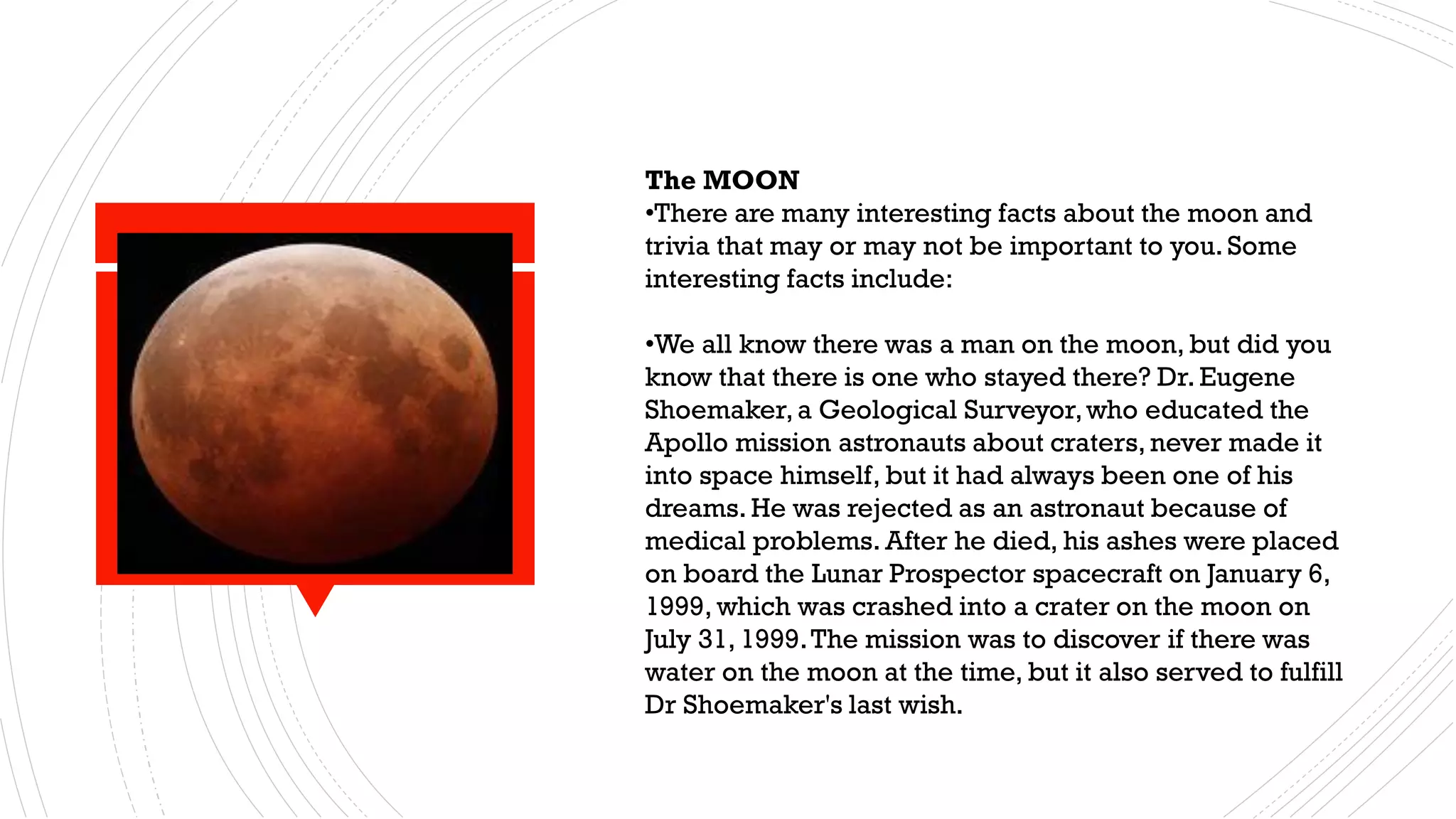
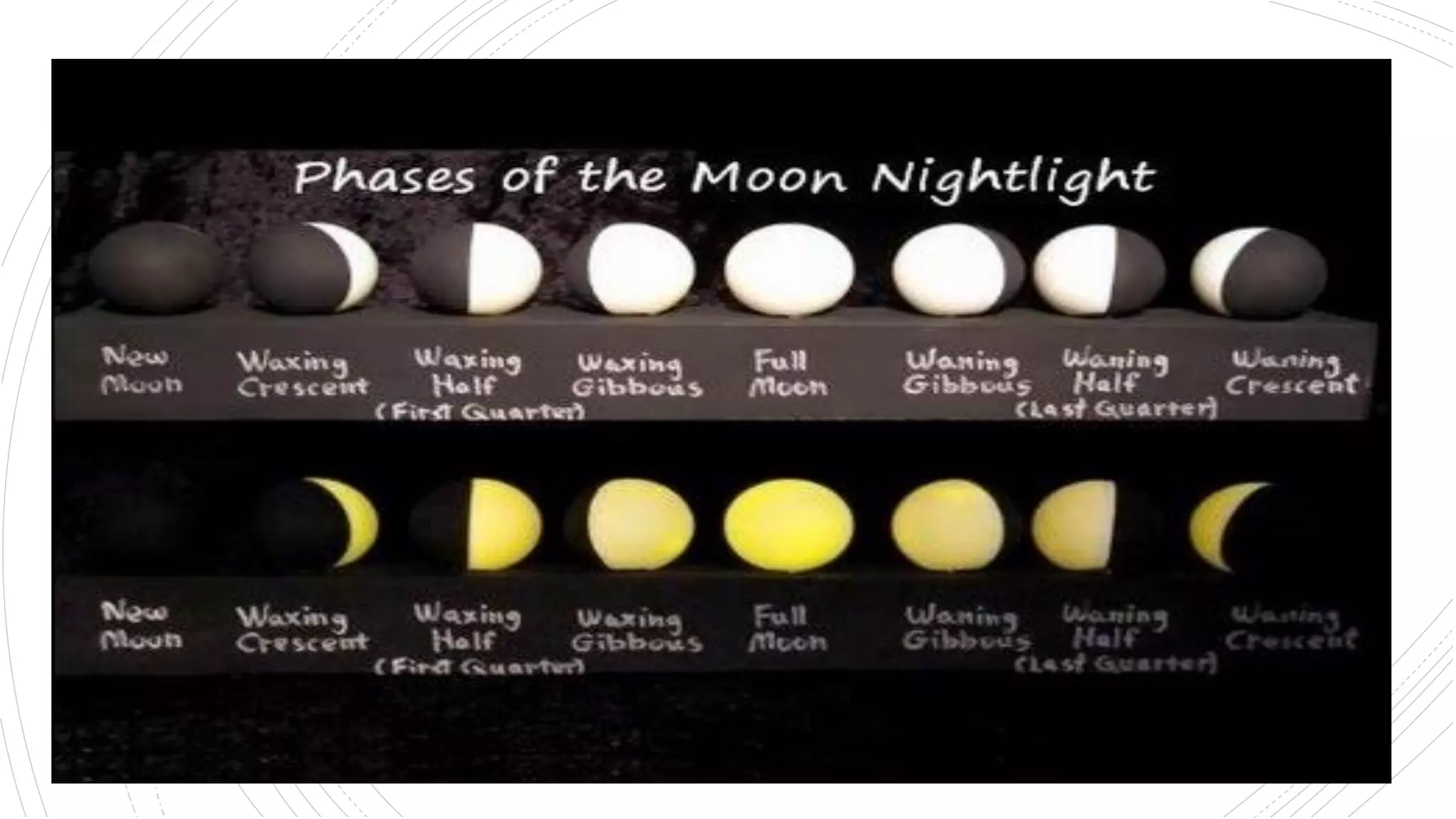
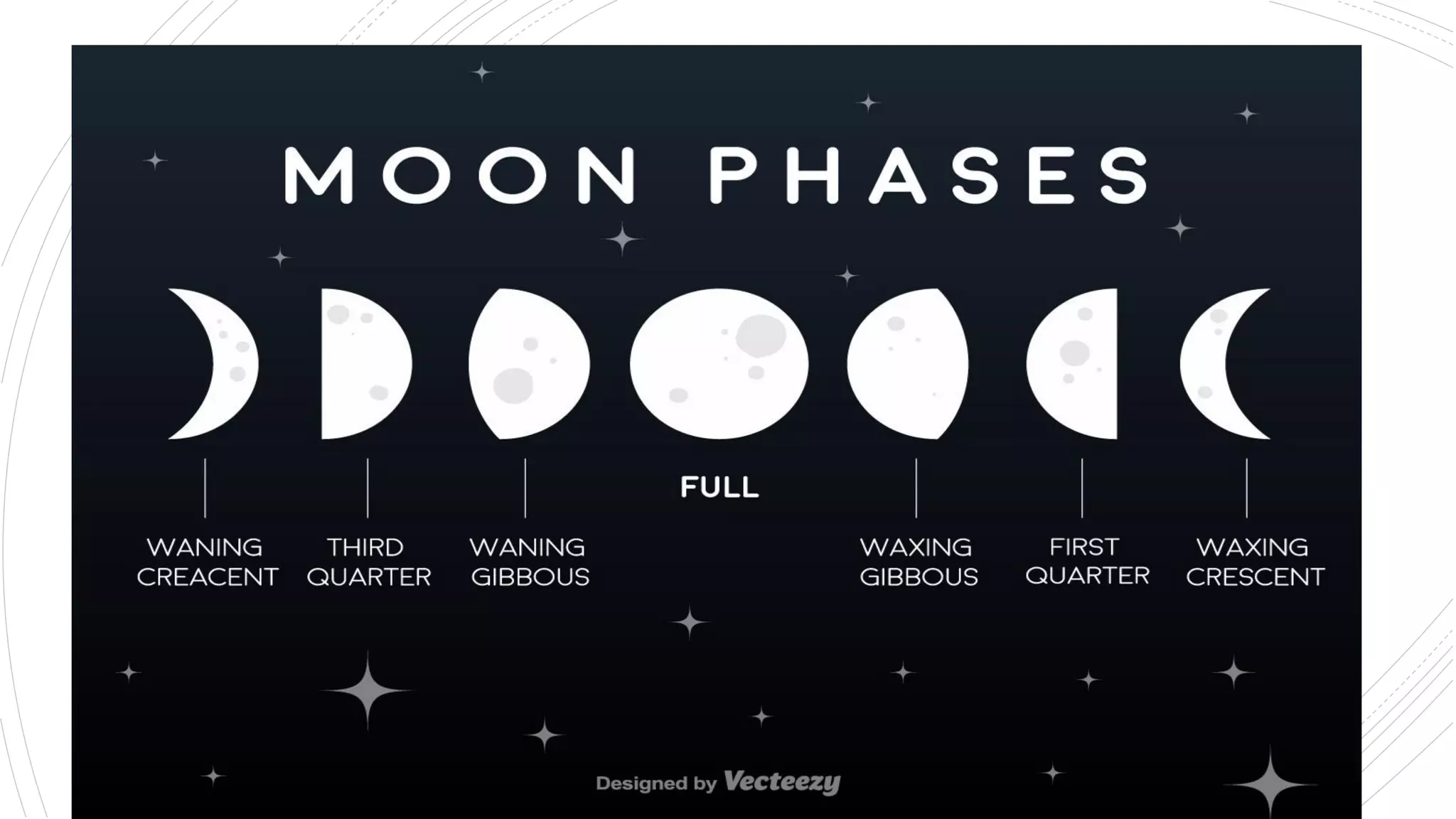
MOON
The MOON
•There are many interesting facts about the moon and
trivia that may or may not be important to you. Some
interesting facts include:
•We all know there was a man on the moon, but did you
know that there is one who stayed there? Dr. Eugene
Shoemaker,a Geological Surveyor,who educated the
Apollo mission astronauts about craters, never made it
into space himself, but it had always been one of his
dreams. He was rejected as an astronaut because of
medical problems. After he died, his ashes were placed
on board the Lunar Prospector spacecraft on January 6,
1999, which was crashed into a crater on the moon on
July 31, 1999.The mission was to discover if there was
water on the moon at the time, but it also served to fulfill
Dr Shoemaker's last wish.
Definition of an
Eclipse
▪An eclipse is the total or partial
obscuring of one celestial body by
another. It may occur when one
celestial body passes in front of
another therefore cutting off some
or all of its light. It may also occur
when a celestial body passes
through all or part off the shadow of
another celestial body.
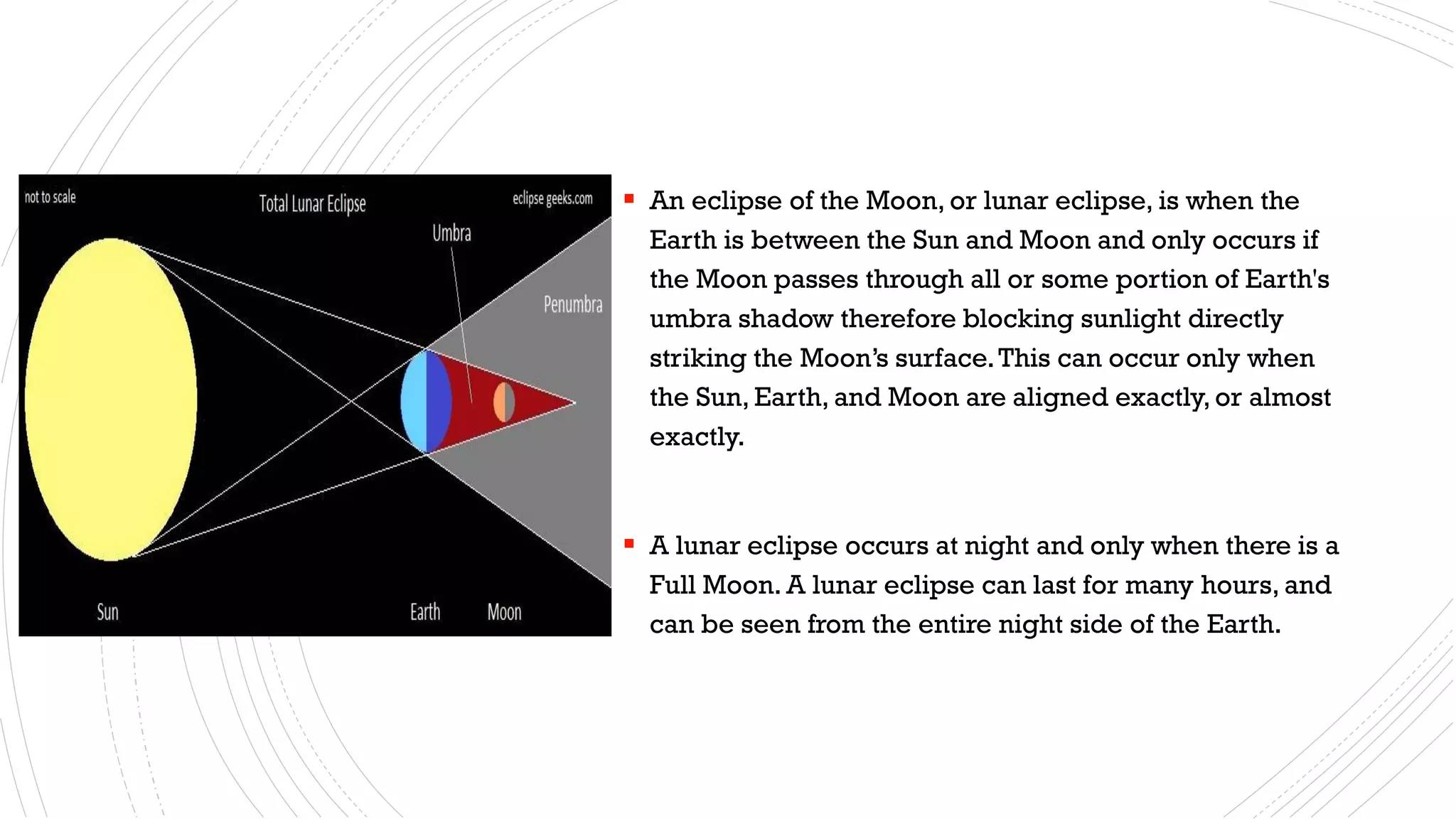
▪ An eclipse of the Moon, or lunar eclipse, is when the
Earth is between the Sun and Moon and only occurs if
the Moon passes through all or some portion of Earth's
umbra shadow therefore blocking sunlight directly
striking the Moon’s surface.This can occur only when
the Sun, Earth, and Moon are aligned exactly, or almost
exactly.
▪ A lunar eclipse occurs at night and only when there is a
Full Moon. A lunar eclipse can last for many hours, and
can be seen from the entire night side of the Earth.
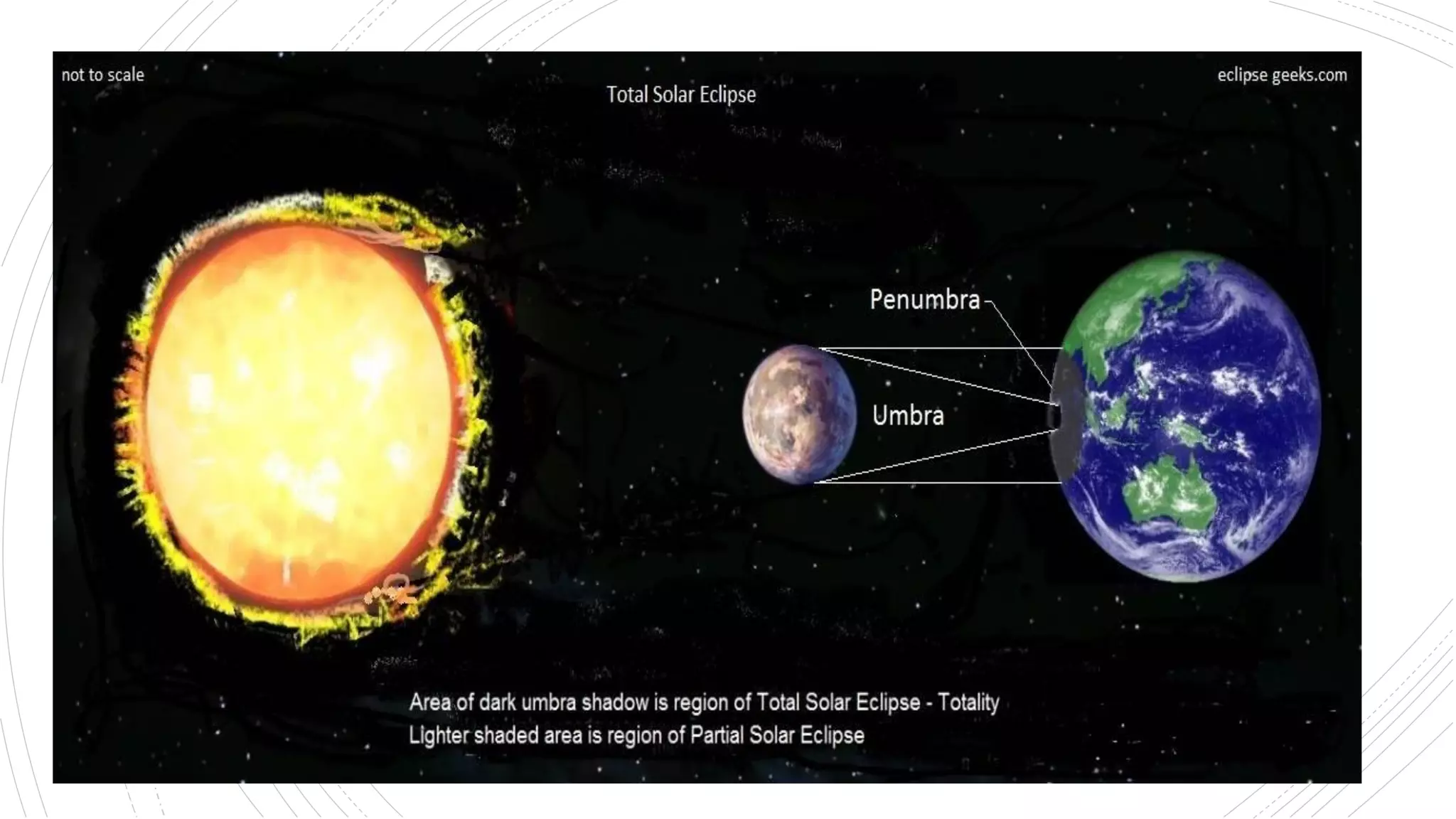
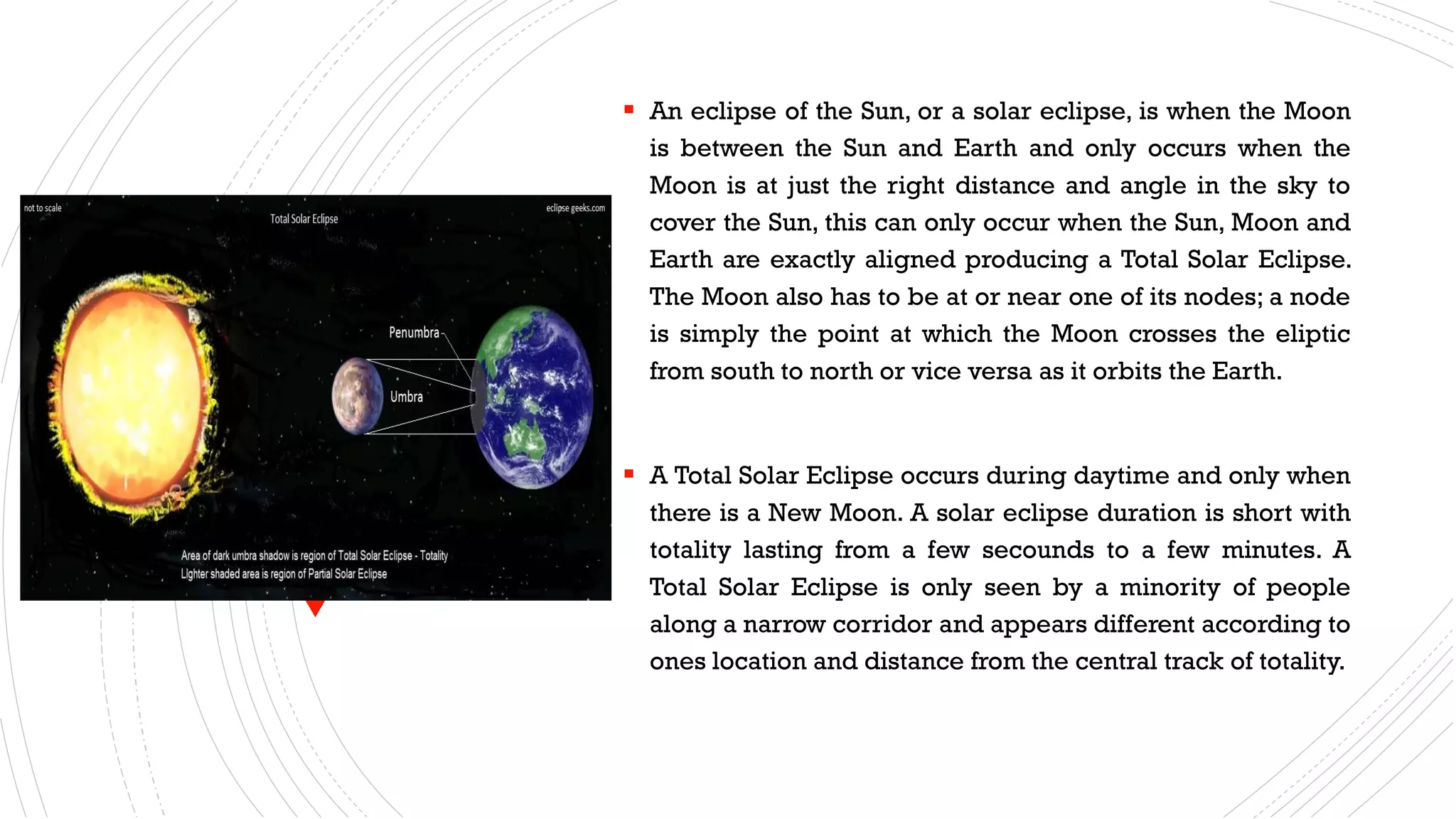
▪ An eclipse of the Sun, or a solar eclipse, is when the Moon
is between the Sun and Earth and only occurs when the
Moon is at just the right distance and angle in the sky to
cover the Sun, this can only occur when the Sun, Moon and
Earth are exactly aligned producing a Total Solar Eclipse.
The Moon also has to be at or near one of its nodes; a node
is simply the point at which the Moon crosses the eliptic
from south to north or vice versa as it orbits the Earth.
▪ A Total Solar Eclipse occurs during daytime and only when
there is a New Moon. A solar eclipse duration is short with
totality lasting from a few secounds to a few minutes. A
Total Solar Eclipse is only seen by a minority of people
along a narrow corridor and appears different according to
ones location and distance from the central track of totality.
Diameter of the Sun; 1,392,684km / 865,374 miles
Diameter of the Moon; 3,476km / 2,159 miles
Although the Sun is much bigger than the Moon they
both have the same apparent size in the sky both
having approximately the same degree of 0.5 arc in
angular measurement.
The MOON
▪ When Neil Armstrong took that first historical step and
said "That's one small step for man, one giant leap for
mankind" it would not have occurred to anyone that the
step he took in the dust of the moon was there to stay. It
will be there for millions of years because there is no
wind on the moon. That is, assuming the downdraft from
the Command Module upon takeoff back into space
didn't destroy the print. Buzz Aldrin reportedly saw the
American flag, much further away, blow over during
launch. Nevertheless, any footprints made by the
famous astronauts undisturbed by takeoff are, in fact,
there to stay.
The Moon
▪ When Alan Sheppard was on the moon, he hit a golf ball
and drove it 2,400 feet, nearly one half a mile.
▪ In a survey conducted in 1988, 13% of those surveyed
believed that the moon is made of cheese.
▪ The multi layer space suits worn by the astronauts to the
moon weighed 180 pounds on earth, but thirty pounds
on the moon due to the lower gravity.
▪ How close can you get without completely running out
of gas? Apollo 11 had only 20 seconds of fuel left when
they landed on the moon.
▪ Apollo 15 was the first mission to use a lunar rover.The
top speed that was ever recorded in this 4-wheeled
land vehicle was 10.56 miles per hour.
MOON FACTS
▪ It is possible to have a month without a full moon.This
occurs in February,but either January or March will
have two moons.
▪ It is possible to have a month without a full moon.This
occurs in February,but either January or March will
have two moons.
▪ The Apollo missions brought back 2196 rock samples
weighing 382 kg in total
FactsAboutthe
Moon
▪ The moon is not a planet, but a satellite of the Earth.
▪ The surface area of the moon is 14,658,000 square miles
or 9.4 billion acres
▪ Only 59% of the moon's surface is visible from earth.
▪ The moon rotates at 10 miles per hour compared to the
earth's rotation of 1000 miles per hour.
▪ When a month has two full moons, the second full moon
is called a blue moon. Another definition of a blue moon
is the third full moon in any season (quarter of year)
containing 4 total full moons.
FactsAboutthe
Moon
▪ From Earth, we always see the same side of the moon;
the other side is always hidden.
▪ The dark spots we see on the moon that create the
image of the man in the moon are actually craters filled
with basalt, which is a very dense material.
▪ The moon is the only extraterrestrial body that has ever
been visited by humans.
▪ The first space craft to send back pictures from the
moon was Luna 3 (built by the Soviet Union) in October
1959.
▪ The moon has no global magnetic field
▪ The moon's diameter is about 1/4 the diameter of the
Earth. About 49 moons would fit inside the Earth.
•.
The STARS
STAR
▪ A star is a luminous ball of gas, mostly hydrogen and
helium, held together by its own gravity. Nuclear fusion
reactions in its core support the star against gravity and
produce photons and heat, as well as small amounts of
heavier elements.The Sun is the closest star to Earth.
▪ THE BIRTH OF STARS
▪ Stars are formed in nebulae, interstellar
clouds of dust and gas (mostly hydrogen).
These stellar nurseries are abundant in
the arms of spiral galaxies.
▪ In these stellar nurseries, dense parts of
these clouds undergo gravitational
collapse and compress to form a rotating
gas globule.
THEBIRTHOF
STARS
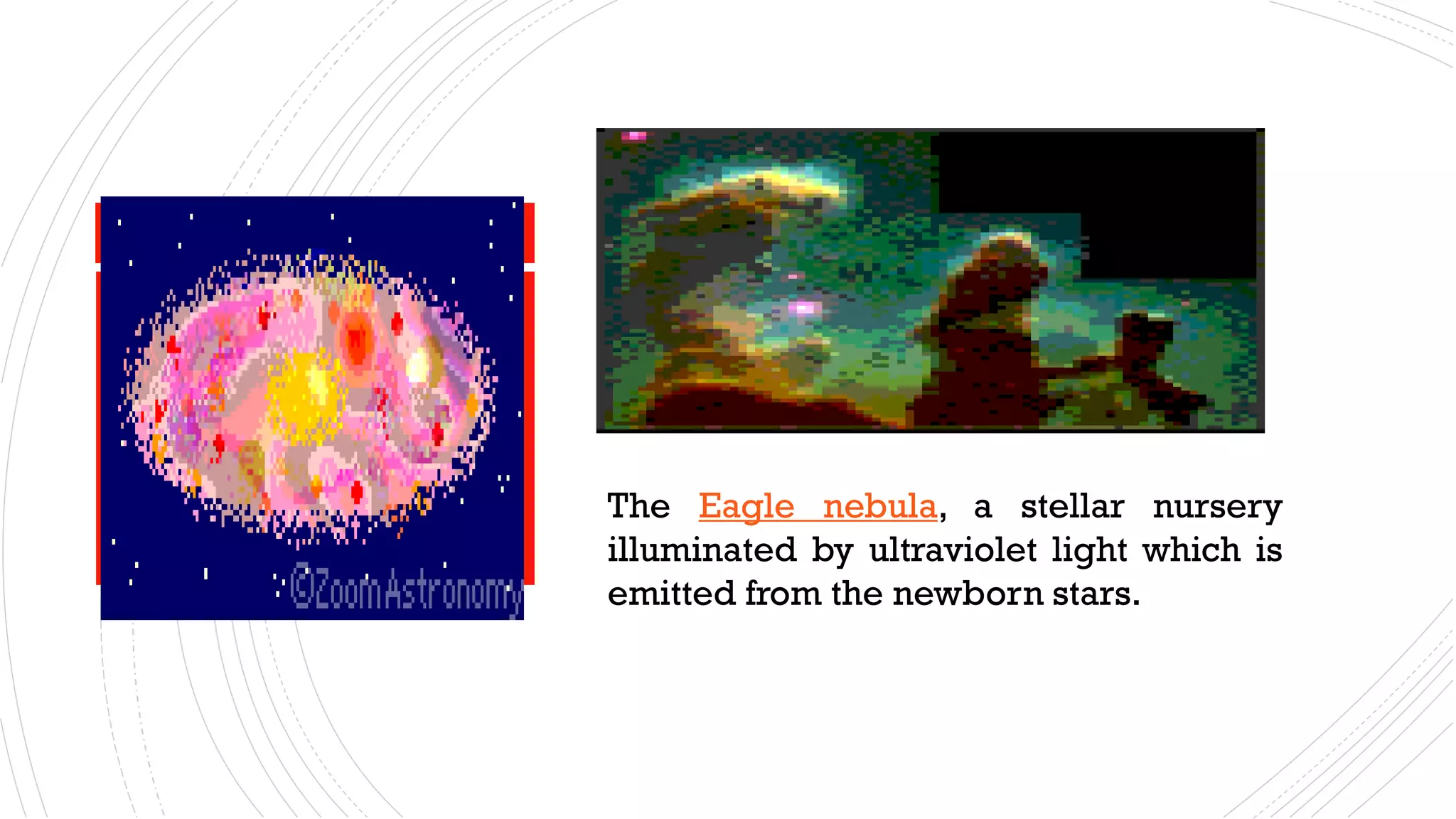
The Eagle nebula, a stellar nursery
illuminated by ultraviolet light which is
emitted from the newborn stars.
When a temperature of about
27,000,000°F is reached, nuclear
fusion begins. This is the nuclear
reaction in which hydrogen atoms
are converted to helium atoms plus
energy. This energy (radiation)
production prevents further
contraction of the star.
A
Newborn
Star:
▪ Young stars emit jets of intense radiation that
heat the surrounding matter to the point at
which it glows brightly. These narrowly-
focused jets can be trillions of miles long and
can travel at 500,000 miles per hour. These
jets may be focused by the star's magnetic
field.
▪ The protostar is now a stable main sequence
star which will remain in this state for about
10 billion years. After that, the hydrogen fuel
is depleted and the star begins to die.
The protostar is now a
stable main sequence
star which will remain in
this state for about 10
billion years.After that,
the hydrogen fuel is
depleted and the star
begins to die.
Lifespanof
the star
▪
The most massive stars have the
shortest lives. Stars that are 25 to 50
times that of the Sun live for only a
few million years. Stars like our Sun
live for about 10 billion years. Stars
less massive than the Sun have even
longer life spans.
COLOR OFTHE
STAR
▪
▪ The Color of Stars
▪ Astronomy is full of color references;
white dwarfs, black holes and red giants for example.
▪ If you look up into the night sky you may be able to see a
few thousand stars from a dark site. As the stars are all so
distant they appear as points in the sky.
▪ Most appear white but a few stars such as Antares and
Betelgeuse have an orange or reddish hue to them.
▪ Others such as Rigel suggest a bluer color. The colors of
stars, however, are not obvious in most stars for several
reasons discussed below.
▪ Color is nonetheless an important and useful property of
stars. In this page we will look at how it is defined,
measured and used in astronomy.
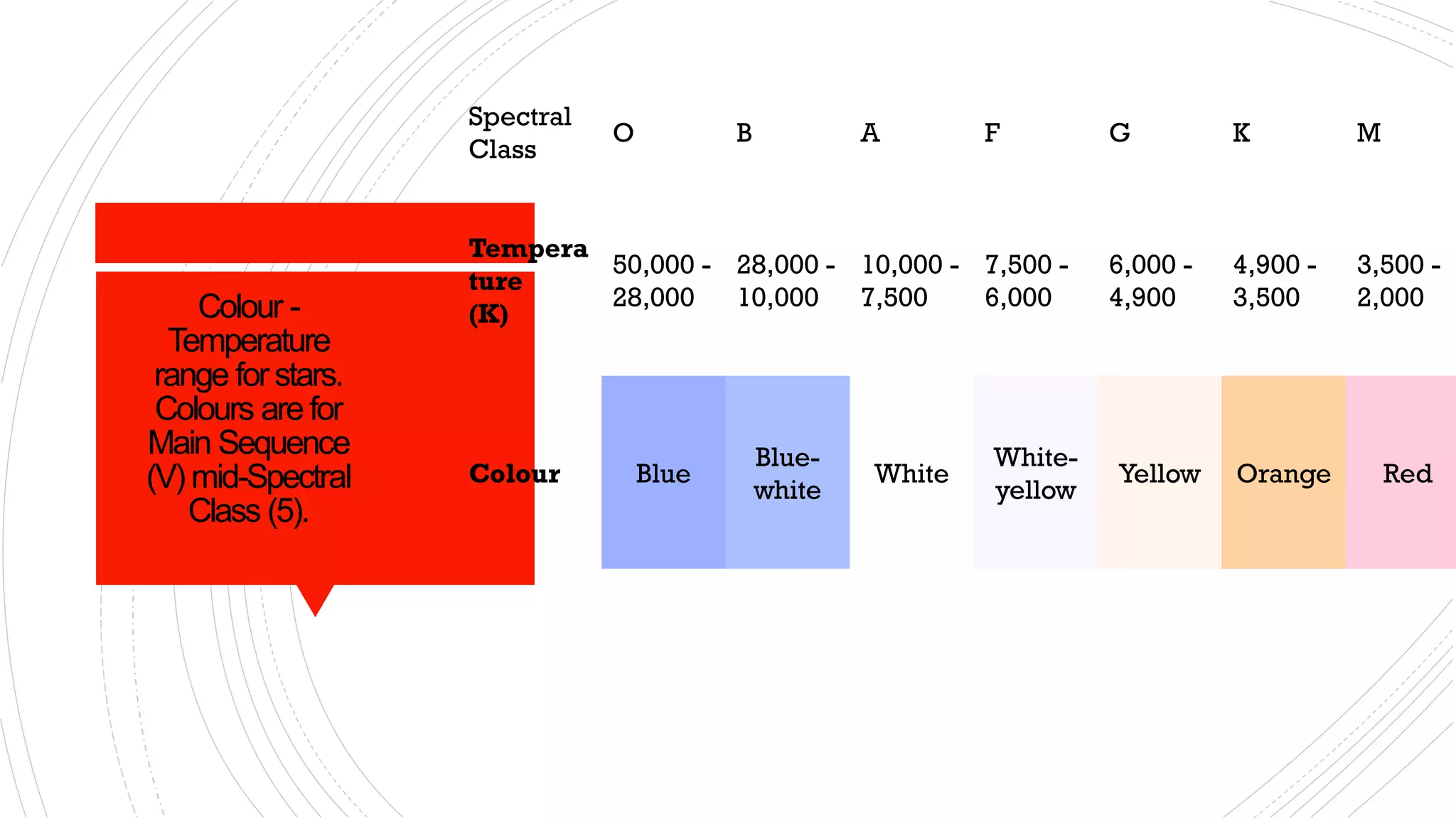
Colour -
Temperature
range forstars.
Colours are for
Main Sequence
(V) mid-Spectral
Class (5).
Spectral
Class
O B A F G K M
Tempera
ture
(K)
50,000 -
28,000
28,000 -
10,000
10,000 -
7,500
7,500 -
6,000
6,000 -
4,900
4,900 -
3,500
3,500 -
2,000
Colour Blue
Blue-
white
White
White-
yellow
Yellow Orange Red
Thespectral code
classification
system isusedto
organize stars into
groups.
DIVISION OF
stars into seven
main types
▪ Scientists classify stars by temperature and the
elements they absorb, which are called their spectra.
They have divided stars into seven main types.
▪ There are seven main types of stars: O, B, A, F, G, K and
M.The O stars are the bright, hot, blue stars and the M
stars are the dimmer, cooler, red stars. A common
mnemonic for remembering the order of the
classifications is: 'Oh Be A Fine Girl, Kiss Me.' But I like
this mnemonic better: 'Oh Boy, An F Grade Kills Me.'
According tothe
modern spectral
classification
system:
▪ O stars are blue
▪ B stars are blue-white
▪ A stars are white
▪ F stars are yellow-white
▪ G stars are yellow
▪ K stars are orange
▪ M stars are red
▪ These categories of stars can also be broken down into
tenths by giving them a number of 0-9. So an A5 star is
five tenths (5/10) between an A star and an F star.
Whatdoyousee
whenyoulookat
thenight sky?
▪ Depending on where you live, you see mostly stars. If
you look at the sky without a telescope, you see white
stars, maybe some faintly blue or even sometimes some
yellow or orange ones.The color depends on the star's
surface temperature.
▪ For example, our sun's surface temperature is about
6,000 Kelvin. Although it looks yellow from Earth, the
light of the sun would actually look very white if we
were in space.This white light coming off of the sun is
because its temperature is 6,000 Kelvin. If the sun were
cooler, it would give off light more in the red range, and
if the sun were hotter, it would look more blue.
The star color you see is dependent on its
temperature.
The coolest stars in the universe are the red dwarf stars.These
are very tiny stars, some of the tiniest, so they don't burn as hot
and their surface temperature is only 3,500 Kelvin.The light
they give off looks mostly red to us.
Red is also the color you see with red giant stars, huge stars that
ran out of hydrogen fuel and bloated up many times their
original size.The luminosity of the star is spread out over the
much larger surface area of the red giant, making this star
cooler than other large stars.
On the opposite end of the color spectrum are the blue stars.
These stars are giants and hypergiants - much, much bigger
than the sun, and also much, much hotter (between 10,000 and
40,000 K). For us on Earth, though, most stars in the sky, except
for the brightest ones, appear white or bluish white because
they don't emit enough light for our eyes to see color.
Wheredostars
comefrom?
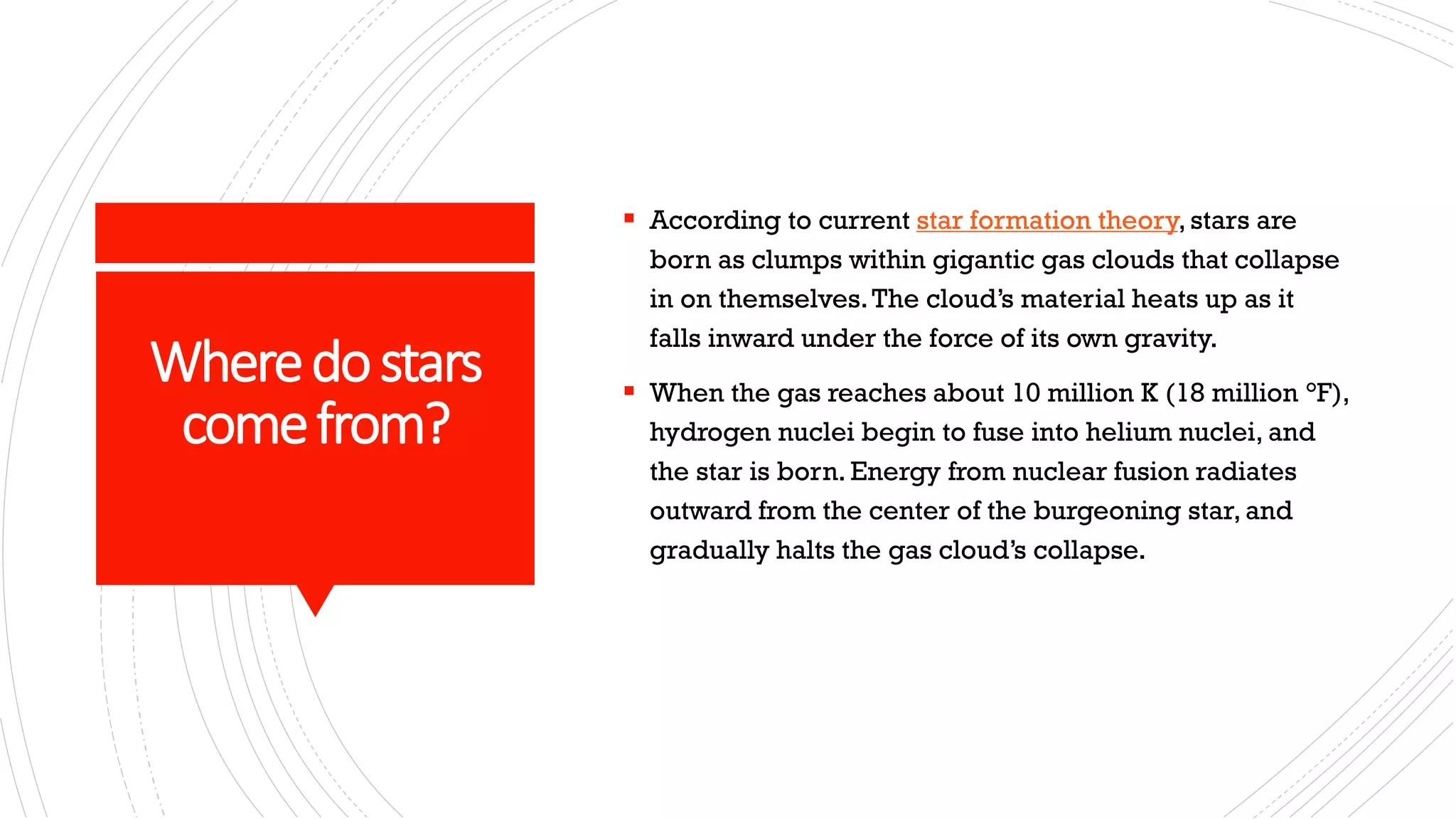
▪ According to current star formation theory, stars are
born as clumps within gigantic gas clouds that collapse
in on themselves.The cloud’s material heats up as it
falls inward under the force of its own gravity.
▪ When the gas reaches about 10 million K (18 million °F),
hydrogen nuclei begin to fuse into helium nuclei, and
the star is born. Energy from nuclear fusion radiates
outward from the center of the burgeoning star, and
gradually halts the gas cloud’s collapse.
TypesofStars
▪ A star’s color relies on its temperature: hotter stars emit
bluer light and cooler stars emit redder light.
Temperature is also correlated to mass. Red dwarf stars
have as little as 0.075 solar masses and a visible surface
temperature less than 4,000 K. The most massive star
known is R136a1, a Wolf-Rayet star 265 times the Sun’s
mass — its visible surface temperature hovers at a
searing 50,000 K.
▪ The most massive (and hottest) stars exhaust their
energy supply within a few million years, while tiny and
cool red dwarf stars can keep on burning for many
billions of years.
Star Image
byNASA
1.Arewe
stardust?
Absolutely – if it weren’t for generations of stars, the universe
would contain nothing more than the light elements that
formed in the Big Bang. Everything else, from the calcium in
our bones to the carbon in our DNA, ultimately comes from
stars.
Deep in their cores, nuclear fusion forces the nuclei of
lightweight atoms together to form heavier ones, and the
heavier the star, the further this process goes.
Stars like the Sun create elements such as carbon, nitrogen
and oxygen through their lives, and then scatter them across
space when they die. Heavier stars release iron, gold and
uranium when they go supernova.
AmazingFacts
AboutStars
2.Whatcolor
canstarsbe?
▪The color of any star is a mix of
different wavelengths of light,
ranging from high-energy, short-
wavelength blue and violet light
emitted by the hottest materials, to
lower-energy, longer-wavelength
red and orange emitted by cooler
gases. White stars represent an
even balance between the two.
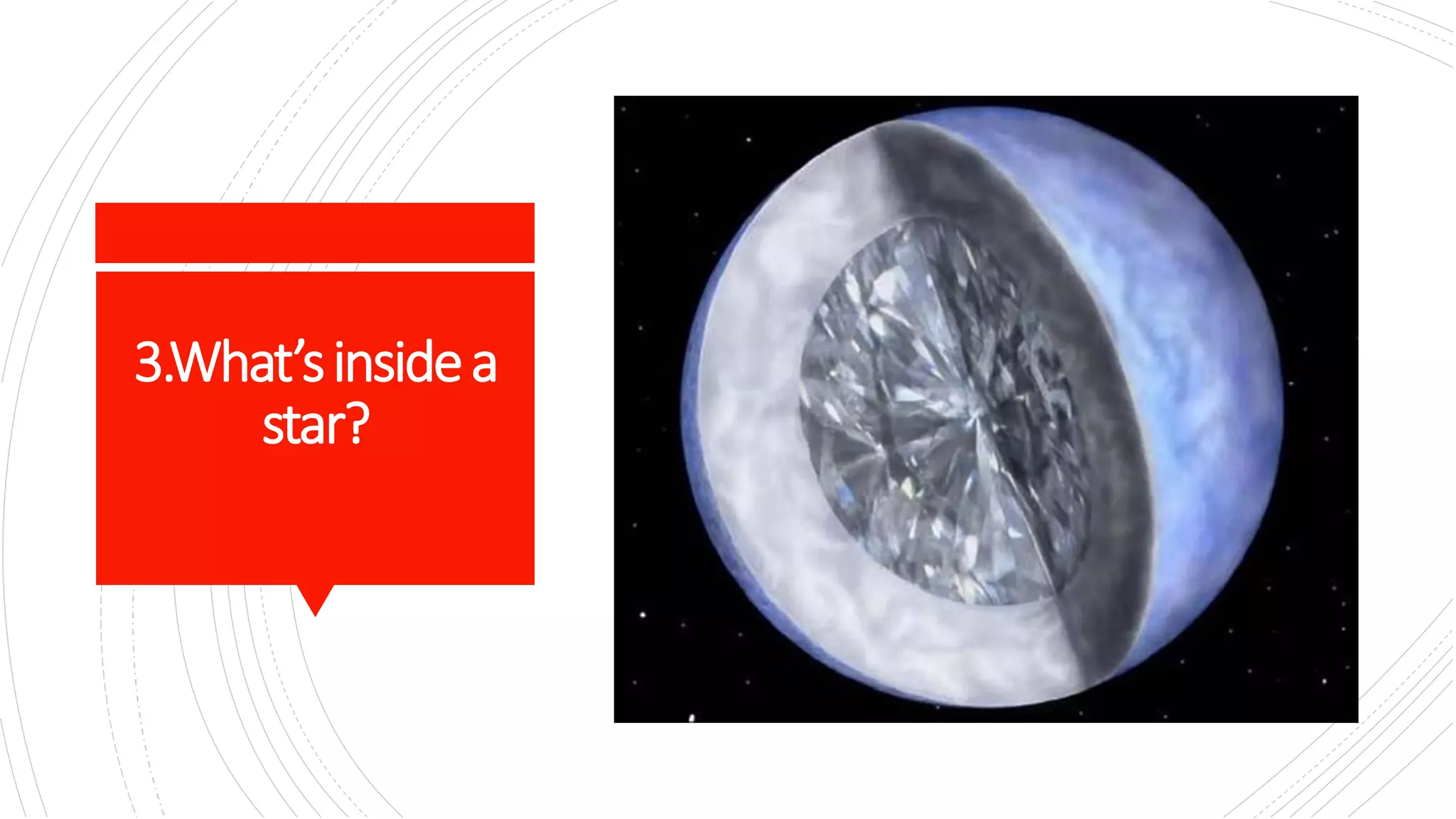
3.What’sinsidea
star?
What’sinsidea
star?
▪ Convection zone – In this opaque region, energy is
absorbed from below and carried up by moving
masses of gas. At the photosphere, the gas releases its
energy, cools and sinks back down.
▪ Photosphere – The visible surface of the star, where it
becomes transparent and light escapes.The
temperature of the photosphere determines the colour.
▪ Radiation zone – High-energy photons bounce around
in this dense interior region, gradually losing their
energy as they push their way outwards over many
millennia.
What’sinsidea
star?
▪ Core – Temperatures in this super-dense region reach
millions of degrees, triggering nuclear fusion processes
that release high-energy radiation -ie gamma and X-
rays.
▪ Sunspots – Magnetic fields pushing out through the
photosphere create cooler areas that appear dark
compared to the rest of the star’s surface.
▪ Corona – Above the photosphere is a vast outer
atmosphere which is superhot but sparse. Denser
structures within this layer include prominences and
flares.
4.Whydostars
twinkle?
▪ They don’t. Their light gets distorted by
churning gases in Earth’s atmosphere –
hence why telescopes are built on
mountains, above the bulk of the air. We
only notice the twinkling as stars are tiny
points of light; planets don’t twinkle as
they’re close enough to appear as tiny
discs.
5.Whichisthe
fartheststarthat
wecansee?
▪ Ignoring occasional flare-ups such as supernovas,
the farthest star we can reliably see with the
naked eye is the obscure V762 Cassiopeiae, which
is just visible under dark skies and is around
16,300 light years away. The most distant well-
known star, meanwhile, is Deneb, the brightest
star in the constellation of Cygnus, the Swan. It lies
a still impressive 2,600 light years away and is the
19th brightest star in the sky, suggesting it is
around 200,000 times more luminous than the Sun.
6.Whatisa
neutronstar?
▪ Neutron stars are extreme stellar remnants formed
after a giant star goes supernova. When the star
runs out of fuel, it collapses under its own weight,
creating a huge Shockwave that compresses the
core from the size of our Sun to roughly the size of
London. Atomic nuclei in the core are torn into
their subatomic components and protons are
transmuted into yet more neutrons that can reach
crazy densities: a pinhead of neutron star material
can weigh as much as a fully laden supertanker!
7.Howarestars
named?
▪ The brightest stars have proper names
that often originated with Ancient Greek
or Arabic astronomers – for instance,
Sirius, the brightest star in the night sky,
has a name derived from the Greek for
“scorcher”. The bright stars in each
constellation are also named with Greek
letters in alphabetical order – so Sirius is
also Alpha Canis Majoris.
8.Canwetellif
thestarswesee
havedied?
▪ Stars take millions or billions of years to move through
their life cycles, but the light from stars in our galaxy
usually spends a few thousand years at most travelling
to Earth. On the law of averages, then, it’s pretty unlikely
that a star will have died in the intervening time, but
there are some exceptions, eg Eta Carinae might have
already exploded.
9.Howcanastar
burnwithno
oxygeninspace?
▪ Blame astronomers for the misleading
word ‘burn’ -stars aren’t going through
the same kind of combustion we see on
Earth. Instead, stars feed off their
hydrogen fuel by forcing individual nuclei
together until they transmute into helium
and eventually other elements in a
process known as nuclear fusion.
10.Whatexactlyis
awhitedwarf?
▪ White dwarfs are the superhot, burnt-out
cores of stars like the Sun, exposed when
a dying red giant star sheds its outer
layers. With no nuclear fusion left to
support it, the core collapses under its
own weight until it is about the size of
Earth, but typically still contains roughly
half a Sun’s mass of material.
11.Whatare
main-sequence
stars?
▪ Most stars spend the majority of their
lives in what astronomers call the ‘main
sequence’. This phase marks the period
when they generate energy by nuclear
fusion of hydrogen into helium. A star’s
position on the main sequence is
governed by its mass – the lightest main-
sequence stars are small, red and faint,
while the heaviest are big, blue and
brilliant.
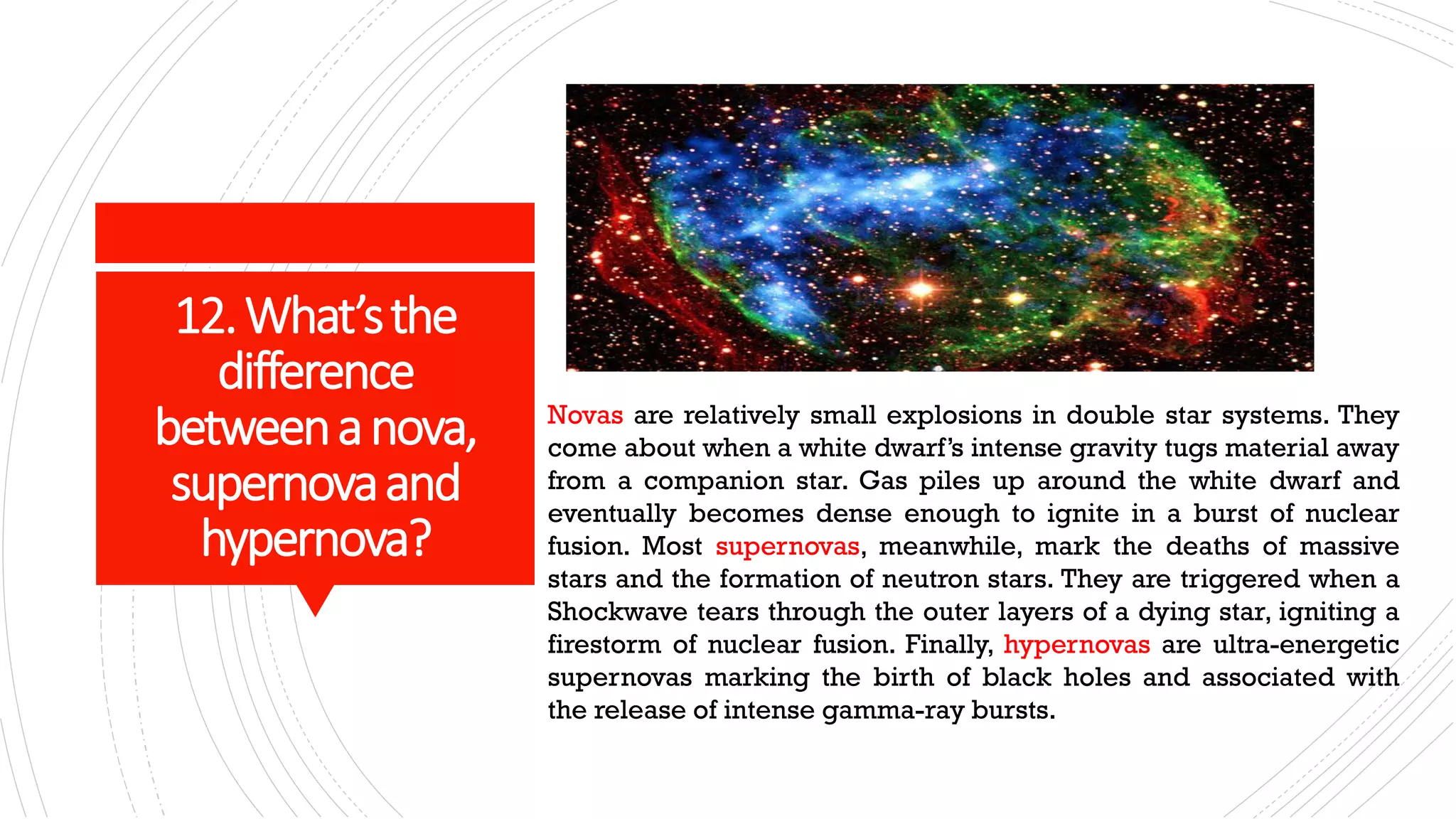
12.What’sthe
difference
betweenanova,
supernovaand
hypernova?
Novas are relatively small explosions in double star systems. They
come about when a white dwarf’s intense gravity tugs material away
from a companion star. Gas piles up around the white dwarf and
eventually becomes dense enough to ignite in a burst of nuclear
fusion. Most supernovas, meanwhile, mark the deaths of massive
stars and the formation of neutron stars. They are triggered when a
Shockwave tears through the outer layers of a dying star, igniting a
firestorm of nuclear fusion. Finally, hypernovas are ultra-energetic
supernovas marking the birth of black holes and associated with
the release of intense gamma-ray bursts.
13.Whichstars
arethebiggest
andsmallest?
▪ The biggest known star is an unstable red
hypergiant called NML Cygni, about
5,500 lightyears from Earth – its diameter
of around 1,600 Suns makes it close to
twice the size of Betelgeuse. The smallest
star is 0GLE-TR-i22b, a tiny red dwarf only
slightly larger than Jupiter and with just a
tenth the mass of the Sun. Anything
smaller is a brown dwarf.
14.Whereis
Betelgeuse?
▪ With a diameter large enough to swallow up
Jupiter’s orbit around the Sun, Betelgeuse is the
closest supergiant star to Earth 640 light years
away in the Orion constellation. Nearing the end
of its life, it has developed a series of internal
shells creating energy from the fusion of various
elements, increasing its energy output to the
equivalent of 120,000 Suns. The pressure of
radiation pouring out from the star’s interior has
caused its outer layers to balloon to a vast size and
cool to a deep red.
15.Howare
starsmade?
▪ The birth and death of a star depend on its mass.
Average stars like the Sun may live for billions of
years and end their lives as white dwarfs, while
heavyweights live fast and die young. Ultimately,
all stars scatter material across space to produce
the next generation.
Howarestars
made?
▪ Nebula collapse – Star formation begins when a cloud of
interstellar gas and dust begins to collapse, perhaps
triggered by a supernova Shockwave, or by gentler tides
from passing stars.
▪ Stellar globules – The nebula gradually separates into
dense knots of matter, each a seed for a potential new star
or multi-star system.Within these dark clouds, matter
continues to coalesce.
▪ Outflow – Over time the nebula flattens into a disc with a
protostar at the centre, flinging off material along its axis of
rotation.
▪ Ignition – Eventually, the protostar becomes hot and dense
enough to trigger nuclear fusion within its core – a new star
is born.
▪ Planets – The material in the surrounding disc is either
pulled into the star, or blown outward.The rest may
coalesce to form planets.
16.Whatisthe
hotteststar?
▪Eta Carinae – The brighter
component of unstable double
star Eta Carinae is a blue
hypergiant – perhaps the
hottest star known with a
temperature of 37,000°C
(67,000°F).
17.Howmany
starsaretherein
theuniverse? Brace yourself for some big numbers.
Astronomers believe there are probably
somewhere between 10 sextillion (21 zeros) and 1
septillion (24 zeros) stars in total. That’s based on
recent discoveries that there are a lot more tiny,
faint stars lurking in large galaxies than previously
thought, and some educated guesswork on the
total number of galaxies themselves.
18.Ifwepouredagiant
bucketofwaterona
star,couldwe
extinguishit?
▪ Funnily enough, it would probably have
the opposite effect. The ferocity of
nuclear fusion in a star depends on the
temperature and pressure in its core, so if
we added a huge amount of extra mass to
the star in the form of all that hydrogen
and oxygen, we’d increase the star’s mass
and central pressure, in turn making it
shine brighter.
19.Howdo
peopleusethe
starstonavigate?
▪ Because objects in the sky stay fixed,
even as Earth rotates beneath them, they
form a perfect reference point for
navigators. If you have an almanac and an
accurate clock, you can calculate your
latitude by measuring the height of a star
passing across the meridian (north-south
line across the sky). Similarly, you can
work out latitude by comparing ‘local
noon’, when the Sun crosses a particular
meridian, with the time at a fixed location
such as the Greenwich Meridian.
20.Howisthe
distancetoastar
calculated?
▪ The only way to measure a star’s distance
directly uses parallax – measuring the tiny
difference in a star’s apparent position in the
sky when we look at it from different points of
view (on opposite sides of Earth’s orbit
around the Sun). This only works for nearby
stars, but, using parallax, astronomers can
discover patterns in stellar behavior from
which they can work out the brightness of
stars independently. They can then use this to
extrapolate the distance of more remote stars.
BLACK HOLES
▪ A very massive star that undergoes gravitational
collapse leaves a back holes.The collapsed star is
black because the gravitational force is so enormous
that light cannot escape.
▪ Along with an increase in gravitational field, the
increases.If our sun were to collapse to a radius of 3
kilometers, the escapr speed from its surface would
exceed the speed of light, and so nothing- not even
light could escape.The sun would be invisible. It would
be a black hole.
Three
Properties of
Black Holes
▪ The black holes have three properties:
1.Mass
2. Charge
3. Angular Momentum
Contrary to the story of black holes, they are non-
agreessive and don’t reach out and swallow innocent
people and other objects at a distance.The gravitational
field is so strong that nothing not even light can escape.
▪ASSIGNMENT :
▪Do the ChallengeYourself no.3
▪Study your lesson and prepare for
a long test.
Goodluck !
- ZYRTHON

Other members of the solar system

  • 1.
    Other Members of the Solar System ▪By:SIRTHON AZUELA ▪ SABANG NATIONAL HIGH SCHOOL ▪ Sabang, Calabanga, Camarines Sur, Region V – Bicol , Philippines ▪ 09122738106
  • 2.
    ASTERIOIDS ▪ Large gapbetween Mars and Jupiter is populated by thousands of small rocky bodies ▪ Irregular in shape, like boulders and the larger ones are spherical. ▪ CERES – the largest asteroids has a diameter of 750 kilometers ▪ Thought to have failed to become a planet during the formation of the solar system ▪ Many asteroids circle the sun, others do not. ▪ VESTA- is the only asteroid which can be seen by the naked eyes. ▪ Asteroids which are smaller than a few hundred kilometers are called meteoroids
  • 3.
    NASA ▪ The NationalAeronautics and Space Administration (NASA /ˈnæsə/) ▪ is an independent agency of the executive branch of the United States federal government responsible for the civilian space program, as well as aeronautics and aerospace research.
  • 4.
    ▪ It isa streaking light which lasts for a few seconds. ▪ We see it as shooting star ▪ A meteoroid (/ˈmiːtiərɔɪd/) is a small rocky or metallic body in outer space. ▪ Meteoroids are significantly smaller than asteroids, and range in size from small grains to one-meter-wide objects.[2] Objects smaller than this are classified as micrometeoroids or space dust. Most are fragments from comets or asteroids, whereas others are collision impact debris ejected from bodies such as the Moon or Mars.
  • 5.
    ▪ When ameteoroid, comet, or asteroid enters Earth's atmosphere at a speed typically in excess of 20 km/s (72,000 km/h; 45,000 mph), aerodynamic heating of that object produces a streak of light, both from the glowing object and the trail of glowing particles that it leaves in its wake. This phenomenon is called a meteor or "shooting star". A series of many meteors appearing seconds or minutes apart and appearing to originate from the same fixed point in the sky is called a meteor shower. If that object withstands ablation from its passage through the atmosphere as a meteor and impacts with the ground, it is then called a meteorite.
  • 6.
  • 7.
    METEORITES ▪ Meteorites arethe solid pieces of debris from an object, such as a comet, asteroid, or meteoroid, that originates in outer space and survives its passage through the atmosphere to reach the surface of a planet or moon. ▪ When the object enters the atmosphere, various factors like friction, pressure, and chemical interactions with the atmospheric gases cause it to heat up and radiate that energy. It then becomes a meteor and forms a fireball, also known as a shooting star or falling star; astronomers call the brightest examples "bolides.“ ▪ Meteorites vary greatly in size. For geologists, a bolide is a meteorite large enough to create a crater.
  • 8.
    Collisionwith Earth's atmosphere ▪ When meteoroidsintersect with Earth's atmosphere at night, they are likely to become visible as meteors. ▪ If meteoroids survive the entry through the atmosphere and reach Earth's surface, they are called meteorites. Meteorites are transformed in structure and chemistry by the heat of entry and force of impact. ▪ A noted 4-meter asteroid, 2008 TC3, was observed in space on a collision course with Earth on 6 October 2008 and entered Earth's atmosphere the next day, striking a remote area of northern Sudan. ▪ It was the first time that a meteoroid had been observed in space and tracked prior to impacting Earth. NASA has produced a map showing the most notable asteroid collisions with Earth and its atmosphere from 1994 to 2013 from data gathered by U.S. government sensors .
  • 9.
  • 10.
    Meteors ▪ A meteor,known colloquially as a "shooting star" or "falling star", is the visible passage of a glowing meteoroid, micrometeoroid, comet or asteroid through Earth's atmosphere, after being heated to incandescence by collisions with air molecules in the upper atmosphere, creating a streak of light via its rapid motion and sometimes also by shedding glowing material in its wake. ▪ Although a meteor may seem to be a few thousand feet from the Earth, meteors typically occur in the mesosphere at altitudes from 76 to 100 km (47 to 62 mi). The root word meteor comes from the Greek meteōros, meaning "high in the air".
  • 11.
  • 12.
    COMETS ▪ The termcomet was derived from the Greek word meaning “Long haired”. ▪ It is small body of rock, iron, ice, and gases that orbit the sun elliptical orbits. ▪ It is composed of nucleus which looks like a dirty snowbell called coma and long tail of vaporized gases(water,ammonia, methane, and carbon dioxide) ▪ The most spectacular bodies in the solar system. ▪ Visible only when they are within the orbits of saturn
  • 13.
    COMETS ▪ A cometis an icy small Solar System body that, when passing close to the Sun, warms and begins to release gases, a process called outgassing. ▪ This produces a visible atmosphere or coma, and sometimes also a tail. These phenomena are due to the effects of solar radiation and the solar wind acting upon the nucleus of the comet. ▪ Comet nuclei range from a few hundred metres to tens of kilometres across and are composed of loose collections of ice, dust, and small rocky particles. ▪ The coma may be up to 15 times the Earth's diameter, while the tail may stretch one astronomical unit. If sufficiently bright, a comet may be seen from the Earth without the aid of a telescope and may subtend an arc of 30° (60 Moons) across the sky. ▪ Comets have been observed and recorded since ancient times by many cultures.
  • 14.
    ▪ A cometrevolves around the sun in either the kulper belt or Oort cloud. ▪ Kulper belt is an area outside the orbit of Pluto ▪ Oort cloud is a sphere beyond the orbit of Uranus.Because comets follow a path, we can see them from time to time. ▪ Halley’s comet include Halebopp, Schwassmann, and Wachmann, Kopff and Oterma, Linear and Shoemaker Levy 9 which hit the planet Jupiter.
  • 15.
  • 16.
    ▪ Our solarsystem is composed of the Sun and all things which orbit around it: the Earth, the other eight planets, asteroids, and comets. ▪ The Sun is 150 million kilometer s (93 million miles) away from the Earth (this distance varies slightly throughout the year, because the Earth’s orbit is an ellipse and not a perfect circle).
  • 17.
    The Sun ▪ TheSun is an average star – there are other stars which are much hotter or much cooler, and intrinsically much brighter or fainter. ▪ However, since it is by far the closest star to the Earth, it looks bigger and brighter in our sky than any other star. With a diameter of about 1.4 million kilometer s (860,000 miles) it would take 110 Earths strung together to be as long as the diameter of the Sun.The Sun is mostly made up of hydrogen (about 92.1% of the number of atoms, 75% of the mass). Helium can also be found in the Sun (7.8% of the number of atoms and 25% of the mass). The other 0.1% is made up of heavier elements, mainly carbon, nitrogen, oxygen, neon, magnesium, silicon and iron. The Sun is neither a solid nor a gas but is actually plasma . This plasma is tenuous and gaseous near the surface, but gets denser down towards the Sun’s fusion core . ▪ Stars like the Sun shine for nine to ten billion years. The Sun is about 4.5 billion years old, judging by the age of moon rocks. Based on this information, current astrophysical theory predicts that the Sun will become a red giant in about five billion (5,000,000,000) years.
  • 18.
    FACTS ABOUT THE SUN ▪ Thesun is the largest object in the solar system ▪ The sun contains more than 99.8% of the total mass of the Solar System (Jupiter contains most of the rest). ▪ The sun is the closest star to Earth ▪ The sun is an average star, its size, age, and temperature fall in about the middle of the ranges of these properties for all stars. ▪ Some in our galaxy are nearly as old as the universe, about 15 billion years,our sun is a 2nd-generation star, only 4.6 billion years old.
  • 19.
    FACTS ABOUT THE SUN ▪ Someof the sun’s material came from former stars. ▪ We’ve always known the sun, unlike many other objects in our solar system, the sun has been known to humans since the dawn of time. There is no discovery date or discoverer. ▪ Since its creation, the sun has used up about half of the hydrogen in its core ▪ The solar “surface,” known as the photosphere, is just the visible 500-km-thick layer from which most of the Sun’s radiation and light finally escape, and it is the place where sunspots are found.
  • 20.
    SUN FACTS ▪ Abovethe sun’s photosphere lies the chromosphere (“sphere of color”) that may be seen briefly during total solar eclipses as a reddish rim, caused by hot hydrogen atoms, around the Sun. ▪ The corona (“crown”) is above the chromosphere, extending outward from the Sun in the form of the “solar wind” to the edge of the solar system. ▪ One unsolved mystery of the sun involves the corona (“crown”), why is extremely hot – millions of degrees kelvin. ▪ It is physically impossible to transfer thermal energy from the cooler surface of the Sun to the much hotter corona, the source of coronal heating has been a scientific mystery for more than 60 years.
  • 21.
    SUN FACTS ▪ TheGreeks named the sun Helios, the Romans used the name Sol, which is still in use today. ▪ Ulysses was the first spacecraft to study our Sun’s poles. ▪ The sun’s strong gravitational pull holds Earth and the other planets in place. ▪ The sun is made up of distinctive areas In addition to the energy-producing solar core, the interior has two distinct regions: a radiative zone and a convective zone.
  • 22.
  • 23.
    SOLAR STRUCTURE 1. The CORE ▪CORE This is the inner most part of the Sun. Here gravity has squeezed the Sun so much that hydrogen compresses together to form helium and release energy through nuclear fusion. All the energy that comes away from the Sun and all the reaches the Earth started in the core. The core is around 150 times as dense as water and has a blazing temperature of around 15 million degrees Celsius or 28 million degrees Fahrenheit.
  • 24.
    2.RadiativeZone ▪ Radiative Zone Thisis the layer of the Sun above the super dense core. The density slowly decreases moving away from the core. Light produced by nuclear fusion in the core travels out in the shell called the radiative zone. This layer is not as dense as the core but it is still so dense that light from the core bounces around taking about 100,000 years to move through the radiative zone.
  • 25.
    3.Convection Zone ▪ Convection Zone Thisis the layer of the Sun above the radiative zone. When the density of the radiative zone becomes low enough energy from the core in the form of light is converted into heat. Much like the bubbles in a pot of boiling, the heat from the edge of the radiative zone rises until it cools enough that it sinks back down. This pattern of heated material rising then cooling happens in big bubbles called convection cells.
  • 26.
    4.Solar Atmosphere Solar Atmosphere ▪ A.PHOTOSPHERE The material that reaches the top of the convection zone cools by giving of light. This region of the Sun is the first part of the Sun that is visible to us and we call it the photosphere. This is where the light we see from the Sun originates. If we could look at the Sun directly (never stare at the Sun without the proper equipment) we would see the photosphere. Even though the layer is not solid we call this part of the Sun the surface and it is also where the solar atmosphere starts. Its temperature is around 5,800 Celsius or 10,000 degrees Fahrenheit.
  • 27.
    4.Solar Atmosphere B. Chromosphere ▪ Abovethe photosphere is a layer of the atmosphere about 2,000 km thick called the chromosphere. The temperature increases as you move higher to about 20,000 degrees Celsius at the top of the chromosphere. The chromosphere is no longer white light like the photosphere but is mostly red in visible light. It can be seen as red flashes during a total solar eclipse.
  • 28.
    4. SOLAR STRUCTURE ▪ C.Corona ▪ The highest part of the solar atmosphere is called the corona. The corona starts around 10,000 km above the solar photosphere. Unlike the atmosphere of the Earth the atmosphere of the Sun continues to get hotter as you move away from the solar surface. The answer of why exactly this happens is one of the biggest questions of astronomy and solar physics of the 20th and 21st centuries. At 20,000-25,000 km away from the solar surface the corona has an average temperature of 1,000,000 to 2,000,000 million degrees Celsius. But the density is very low, about 1 billion times less dense than water.
  • 29.
    MOON The MOON •There aremany interesting facts about the moon and trivia that may or may not be important to you. Some interesting facts include: •We all know there was a man on the moon, but did you know that there is one who stayed there? Dr. Eugene Shoemaker,a Geological Surveyor,who educated the Apollo mission astronauts about craters, never made it into space himself, but it had always been one of his dreams. He was rejected as an astronaut because of medical problems. After he died, his ashes were placed on board the Lunar Prospector spacecraft on January 6, 1999, which was crashed into a crater on the moon on July 31, 1999.The mission was to discover if there was water on the moon at the time, but it also served to fulfill Dr Shoemaker's last wish.
  • 34.
    Definition of an Eclipse ▪Aneclipse is the total or partial obscuring of one celestial body by another. It may occur when one celestial body passes in front of another therefore cutting off some or all of its light. It may also occur when a celestial body passes through all or part off the shadow of another celestial body.
  • 36.
    ▪ An eclipseof the Moon, or lunar eclipse, is when the Earth is between the Sun and Moon and only occurs if the Moon passes through all or some portion of Earth's umbra shadow therefore blocking sunlight directly striking the Moon’s surface.This can occur only when the Sun, Earth, and Moon are aligned exactly, or almost exactly. ▪ A lunar eclipse occurs at night and only when there is a Full Moon. A lunar eclipse can last for many hours, and can be seen from the entire night side of the Earth.
  • 38.
    ▪ An eclipseof the Sun, or a solar eclipse, is when the Moon is between the Sun and Earth and only occurs when the Moon is at just the right distance and angle in the sky to cover the Sun, this can only occur when the Sun, Moon and Earth are exactly aligned producing a Total Solar Eclipse. The Moon also has to be at or near one of its nodes; a node is simply the point at which the Moon crosses the eliptic from south to north or vice versa as it orbits the Earth. ▪ A Total Solar Eclipse occurs during daytime and only when there is a New Moon. A solar eclipse duration is short with totality lasting from a few secounds to a few minutes. A Total Solar Eclipse is only seen by a minority of people along a narrow corridor and appears different according to ones location and distance from the central track of totality.
  • 39.
    Diameter of theSun; 1,392,684km / 865,374 miles Diameter of the Moon; 3,476km / 2,159 miles Although the Sun is much bigger than the Moon they both have the same apparent size in the sky both having approximately the same degree of 0.5 arc in angular measurement.
  • 40.
    The MOON ▪ WhenNeil Armstrong took that first historical step and said "That's one small step for man, one giant leap for mankind" it would not have occurred to anyone that the step he took in the dust of the moon was there to stay. It will be there for millions of years because there is no wind on the moon. That is, assuming the downdraft from the Command Module upon takeoff back into space didn't destroy the print. Buzz Aldrin reportedly saw the American flag, much further away, blow over during launch. Nevertheless, any footprints made by the famous astronauts undisturbed by takeoff are, in fact, there to stay.
  • 41.
    The Moon ▪ WhenAlan Sheppard was on the moon, he hit a golf ball and drove it 2,400 feet, nearly one half a mile. ▪ In a survey conducted in 1988, 13% of those surveyed believed that the moon is made of cheese. ▪ The multi layer space suits worn by the astronauts to the moon weighed 180 pounds on earth, but thirty pounds on the moon due to the lower gravity. ▪ How close can you get without completely running out of gas? Apollo 11 had only 20 seconds of fuel left when they landed on the moon. ▪ Apollo 15 was the first mission to use a lunar rover.The top speed that was ever recorded in this 4-wheeled land vehicle was 10.56 miles per hour.
  • 42.
    MOON FACTS ▪ Itis possible to have a month without a full moon.This occurs in February,but either January or March will have two moons. ▪ It is possible to have a month without a full moon.This occurs in February,but either January or March will have two moons. ▪ The Apollo missions brought back 2196 rock samples weighing 382 kg in total
  • 43.
    FactsAboutthe Moon ▪ The moonis not a planet, but a satellite of the Earth. ▪ The surface area of the moon is 14,658,000 square miles or 9.4 billion acres ▪ Only 59% of the moon's surface is visible from earth. ▪ The moon rotates at 10 miles per hour compared to the earth's rotation of 1000 miles per hour. ▪ When a month has two full moons, the second full moon is called a blue moon. Another definition of a blue moon is the third full moon in any season (quarter of year) containing 4 total full moons.
  • 44.
    FactsAboutthe Moon ▪ From Earth,we always see the same side of the moon; the other side is always hidden. ▪ The dark spots we see on the moon that create the image of the man in the moon are actually craters filled with basalt, which is a very dense material. ▪ The moon is the only extraterrestrial body that has ever been visited by humans. ▪ The first space craft to send back pictures from the moon was Luna 3 (built by the Soviet Union) in October 1959. ▪ The moon has no global magnetic field ▪ The moon's diameter is about 1/4 the diameter of the Earth. About 49 moons would fit inside the Earth. •.
  • 45.
  • 46.
    STAR ▪ A staris a luminous ball of gas, mostly hydrogen and helium, held together by its own gravity. Nuclear fusion reactions in its core support the star against gravity and produce photons and heat, as well as small amounts of heavier elements.The Sun is the closest star to Earth.
  • 47.
    ▪ THE BIRTHOF STARS ▪ Stars are formed in nebulae, interstellar clouds of dust and gas (mostly hydrogen). These stellar nurseries are abundant in the arms of spiral galaxies. ▪ In these stellar nurseries, dense parts of these clouds undergo gravitational collapse and compress to form a rotating gas globule. THEBIRTHOF STARS
  • 48.
    The Eagle nebula,a stellar nursery illuminated by ultraviolet light which is emitted from the newborn stars.
  • 49.
    When a temperatureof about 27,000,000°F is reached, nuclear fusion begins. This is the nuclear reaction in which hydrogen atoms are converted to helium atoms plus energy. This energy (radiation) production prevents further contraction of the star. A Newborn Star:
  • 50.
    ▪ Young starsemit jets of intense radiation that heat the surrounding matter to the point at which it glows brightly. These narrowly- focused jets can be trillions of miles long and can travel at 500,000 miles per hour. These jets may be focused by the star's magnetic field. ▪ The protostar is now a stable main sequence star which will remain in this state for about 10 billion years. After that, the hydrogen fuel is depleted and the star begins to die. The protostar is now a stable main sequence star which will remain in this state for about 10 billion years.After that, the hydrogen fuel is depleted and the star begins to die.
  • 51.
    Lifespanof the star ▪ The mostmassive stars have the shortest lives. Stars that are 25 to 50 times that of the Sun live for only a few million years. Stars like our Sun live for about 10 billion years. Stars less massive than the Sun have even longer life spans.
  • 52.
    COLOR OFTHE STAR ▪ ▪ TheColor of Stars ▪ Astronomy is full of color references; white dwarfs, black holes and red giants for example. ▪ If you look up into the night sky you may be able to see a few thousand stars from a dark site. As the stars are all so distant they appear as points in the sky. ▪ Most appear white but a few stars such as Antares and Betelgeuse have an orange or reddish hue to them. ▪ Others such as Rigel suggest a bluer color. The colors of stars, however, are not obvious in most stars for several reasons discussed below. ▪ Color is nonetheless an important and useful property of stars. In this page we will look at how it is defined, measured and used in astronomy.
  • 53.
    Colour - Temperature range forstars. Coloursare for Main Sequence (V) mid-Spectral Class (5). Spectral Class O B A F G K M Tempera ture (K) 50,000 - 28,000 28,000 - 10,000 10,000 - 7,500 7,500 - 6,000 6,000 - 4,900 4,900 - 3,500 3,500 - 2,000 Colour Blue Blue- white White White- yellow Yellow Orange Red
  • 54.
  • 55.
    DIVISION OF stars intoseven main types ▪ Scientists classify stars by temperature and the elements they absorb, which are called their spectra. They have divided stars into seven main types. ▪ There are seven main types of stars: O, B, A, F, G, K and M.The O stars are the bright, hot, blue stars and the M stars are the dimmer, cooler, red stars. A common mnemonic for remembering the order of the classifications is: 'Oh Be A Fine Girl, Kiss Me.' But I like this mnemonic better: 'Oh Boy, An F Grade Kills Me.'
  • 56.
    According tothe modern spectral classification system: ▪O stars are blue ▪ B stars are blue-white ▪ A stars are white ▪ F stars are yellow-white ▪ G stars are yellow ▪ K stars are orange ▪ M stars are red ▪ These categories of stars can also be broken down into tenths by giving them a number of 0-9. So an A5 star is five tenths (5/10) between an A star and an F star.
  • 57.
    Whatdoyousee whenyoulookat thenight sky? ▪ Dependingon where you live, you see mostly stars. If you look at the sky without a telescope, you see white stars, maybe some faintly blue or even sometimes some yellow or orange ones.The color depends on the star's surface temperature. ▪ For example, our sun's surface temperature is about 6,000 Kelvin. Although it looks yellow from Earth, the light of the sun would actually look very white if we were in space.This white light coming off of the sun is because its temperature is 6,000 Kelvin. If the sun were cooler, it would give off light more in the red range, and if the sun were hotter, it would look more blue.
  • 58.
    The star coloryou see is dependent on its temperature. The coolest stars in the universe are the red dwarf stars.These are very tiny stars, some of the tiniest, so they don't burn as hot and their surface temperature is only 3,500 Kelvin.The light they give off looks mostly red to us. Red is also the color you see with red giant stars, huge stars that ran out of hydrogen fuel and bloated up many times their original size.The luminosity of the star is spread out over the much larger surface area of the red giant, making this star cooler than other large stars. On the opposite end of the color spectrum are the blue stars. These stars are giants and hypergiants - much, much bigger than the sun, and also much, much hotter (between 10,000 and 40,000 K). For us on Earth, though, most stars in the sky, except for the brightest ones, appear white or bluish white because they don't emit enough light for our eyes to see color.
  • 59.
    Wheredostars comefrom? ▪ According tocurrent star formation theory, stars are born as clumps within gigantic gas clouds that collapse in on themselves.The cloud’s material heats up as it falls inward under the force of its own gravity. ▪ When the gas reaches about 10 million K (18 million °F), hydrogen nuclei begin to fuse into helium nuclei, and the star is born. Energy from nuclear fusion radiates outward from the center of the burgeoning star, and gradually halts the gas cloud’s collapse.
  • 60.
    TypesofStars ▪ A star’scolor relies on its temperature: hotter stars emit bluer light and cooler stars emit redder light. Temperature is also correlated to mass. Red dwarf stars have as little as 0.075 solar masses and a visible surface temperature less than 4,000 K. The most massive star known is R136a1, a Wolf-Rayet star 265 times the Sun’s mass — its visible surface temperature hovers at a searing 50,000 K. ▪ The most massive (and hottest) stars exhaust their energy supply within a few million years, while tiny and cool red dwarf stars can keep on burning for many billions of years.
  • 61.
  • 62.
    1.Arewe stardust? Absolutely – ifit weren’t for generations of stars, the universe would contain nothing more than the light elements that formed in the Big Bang. Everything else, from the calcium in our bones to the carbon in our DNA, ultimately comes from stars. Deep in their cores, nuclear fusion forces the nuclei of lightweight atoms together to form heavier ones, and the heavier the star, the further this process goes. Stars like the Sun create elements such as carbon, nitrogen and oxygen through their lives, and then scatter them across space when they die. Heavier stars release iron, gold and uranium when they go supernova.
  • 63.
  • 64.
    2.Whatcolor canstarsbe? ▪The color ofany star is a mix of different wavelengths of light, ranging from high-energy, short- wavelength blue and violet light emitted by the hottest materials, to lower-energy, longer-wavelength red and orange emitted by cooler gases. White stars represent an even balance between the two.
  • 65.
  • 66.
    What’sinsidea star? ▪ Convection zone– In this opaque region, energy is absorbed from below and carried up by moving masses of gas. At the photosphere, the gas releases its energy, cools and sinks back down. ▪ Photosphere – The visible surface of the star, where it becomes transparent and light escapes.The temperature of the photosphere determines the colour. ▪ Radiation zone – High-energy photons bounce around in this dense interior region, gradually losing their energy as they push their way outwards over many millennia.
  • 67.
    What’sinsidea star? ▪ Core –Temperatures in this super-dense region reach millions of degrees, triggering nuclear fusion processes that release high-energy radiation -ie gamma and X- rays. ▪ Sunspots – Magnetic fields pushing out through the photosphere create cooler areas that appear dark compared to the rest of the star’s surface. ▪ Corona – Above the photosphere is a vast outer atmosphere which is superhot but sparse. Denser structures within this layer include prominences and flares.
  • 68.
    4.Whydostars twinkle? ▪ They don’t.Their light gets distorted by churning gases in Earth’s atmosphere – hence why telescopes are built on mountains, above the bulk of the air. We only notice the twinkling as stars are tiny points of light; planets don’t twinkle as they’re close enough to appear as tiny discs.
  • 69.
    5.Whichisthe fartheststarthat wecansee? ▪ Ignoring occasionalflare-ups such as supernovas, the farthest star we can reliably see with the naked eye is the obscure V762 Cassiopeiae, which is just visible under dark skies and is around 16,300 light years away. The most distant well- known star, meanwhile, is Deneb, the brightest star in the constellation of Cygnus, the Swan. It lies a still impressive 2,600 light years away and is the 19th brightest star in the sky, suggesting it is around 200,000 times more luminous than the Sun.
  • 70.
    6.Whatisa neutronstar? ▪ Neutron starsare extreme stellar remnants formed after a giant star goes supernova. When the star runs out of fuel, it collapses under its own weight, creating a huge Shockwave that compresses the core from the size of our Sun to roughly the size of London. Atomic nuclei in the core are torn into their subatomic components and protons are transmuted into yet more neutrons that can reach crazy densities: a pinhead of neutron star material can weigh as much as a fully laden supertanker!
  • 71.
    7.Howarestars named? ▪ The brighteststars have proper names that often originated with Ancient Greek or Arabic astronomers – for instance, Sirius, the brightest star in the night sky, has a name derived from the Greek for “scorcher”. The bright stars in each constellation are also named with Greek letters in alphabetical order – so Sirius is also Alpha Canis Majoris.
  • 72.
    8.Canwetellif thestarswesee havedied? ▪ Stars takemillions or billions of years to move through their life cycles, but the light from stars in our galaxy usually spends a few thousand years at most travelling to Earth. On the law of averages, then, it’s pretty unlikely that a star will have died in the intervening time, but there are some exceptions, eg Eta Carinae might have already exploded.
  • 73.
    9.Howcanastar burnwithno oxygeninspace? ▪ Blame astronomersfor the misleading word ‘burn’ -stars aren’t going through the same kind of combustion we see on Earth. Instead, stars feed off their hydrogen fuel by forcing individual nuclei together until they transmute into helium and eventually other elements in a process known as nuclear fusion.
  • 74.
    10.Whatexactlyis awhitedwarf? ▪ White dwarfsare the superhot, burnt-out cores of stars like the Sun, exposed when a dying red giant star sheds its outer layers. With no nuclear fusion left to support it, the core collapses under its own weight until it is about the size of Earth, but typically still contains roughly half a Sun’s mass of material.
  • 75.
    11.Whatare main-sequence stars? ▪ Most starsspend the majority of their lives in what astronomers call the ‘main sequence’. This phase marks the period when they generate energy by nuclear fusion of hydrogen into helium. A star’s position on the main sequence is governed by its mass – the lightest main- sequence stars are small, red and faint, while the heaviest are big, blue and brilliant.
  • 76.
    12.What’sthe difference betweenanova, supernovaand hypernova? Novas are relativelysmall explosions in double star systems. They come about when a white dwarf’s intense gravity tugs material away from a companion star. Gas piles up around the white dwarf and eventually becomes dense enough to ignite in a burst of nuclear fusion. Most supernovas, meanwhile, mark the deaths of massive stars and the formation of neutron stars. They are triggered when a Shockwave tears through the outer layers of a dying star, igniting a firestorm of nuclear fusion. Finally, hypernovas are ultra-energetic supernovas marking the birth of black holes and associated with the release of intense gamma-ray bursts.
  • 77.
    13.Whichstars arethebiggest andsmallest? ▪ The biggestknown star is an unstable red hypergiant called NML Cygni, about 5,500 lightyears from Earth – its diameter of around 1,600 Suns makes it close to twice the size of Betelgeuse. The smallest star is 0GLE-TR-i22b, a tiny red dwarf only slightly larger than Jupiter and with just a tenth the mass of the Sun. Anything smaller is a brown dwarf.
  • 78.
    14.Whereis Betelgeuse? ▪ With adiameter large enough to swallow up Jupiter’s orbit around the Sun, Betelgeuse is the closest supergiant star to Earth 640 light years away in the Orion constellation. Nearing the end of its life, it has developed a series of internal shells creating energy from the fusion of various elements, increasing its energy output to the equivalent of 120,000 Suns. The pressure of radiation pouring out from the star’s interior has caused its outer layers to balloon to a vast size and cool to a deep red.
  • 79.
    15.Howare starsmade? ▪ The birthand death of a star depend on its mass. Average stars like the Sun may live for billions of years and end their lives as white dwarfs, while heavyweights live fast and die young. Ultimately, all stars scatter material across space to produce the next generation.
  • 80.
    Howarestars made? ▪ Nebula collapse– Star formation begins when a cloud of interstellar gas and dust begins to collapse, perhaps triggered by a supernova Shockwave, or by gentler tides from passing stars. ▪ Stellar globules – The nebula gradually separates into dense knots of matter, each a seed for a potential new star or multi-star system.Within these dark clouds, matter continues to coalesce. ▪ Outflow – Over time the nebula flattens into a disc with a protostar at the centre, flinging off material along its axis of rotation. ▪ Ignition – Eventually, the protostar becomes hot and dense enough to trigger nuclear fusion within its core – a new star is born. ▪ Planets – The material in the surrounding disc is either pulled into the star, or blown outward.The rest may coalesce to form planets.
  • 81.
    16.Whatisthe hotteststar? ▪Eta Carinae –The brighter component of unstable double star Eta Carinae is a blue hypergiant – perhaps the hottest star known with a temperature of 37,000°C (67,000°F).
  • 82.
    17.Howmany starsaretherein theuniverse? Brace yourselffor some big numbers. Astronomers believe there are probably somewhere between 10 sextillion (21 zeros) and 1 septillion (24 zeros) stars in total. That’s based on recent discoveries that there are a lot more tiny, faint stars lurking in large galaxies than previously thought, and some educated guesswork on the total number of galaxies themselves.
  • 83.
    18.Ifwepouredagiant bucketofwaterona star,couldwe extinguishit? ▪ Funnily enough,it would probably have the opposite effect. The ferocity of nuclear fusion in a star depends on the temperature and pressure in its core, so if we added a huge amount of extra mass to the star in the form of all that hydrogen and oxygen, we’d increase the star’s mass and central pressure, in turn making it shine brighter.
  • 84.
    19.Howdo peopleusethe starstonavigate? ▪ Because objectsin the sky stay fixed, even as Earth rotates beneath them, they form a perfect reference point for navigators. If you have an almanac and an accurate clock, you can calculate your latitude by measuring the height of a star passing across the meridian (north-south line across the sky). Similarly, you can work out latitude by comparing ‘local noon’, when the Sun crosses a particular meridian, with the time at a fixed location such as the Greenwich Meridian.
  • 85.
    20.Howisthe distancetoastar calculated? ▪ The onlyway to measure a star’s distance directly uses parallax – measuring the tiny difference in a star’s apparent position in the sky when we look at it from different points of view (on opposite sides of Earth’s orbit around the Sun). This only works for nearby stars, but, using parallax, astronomers can discover patterns in stellar behavior from which they can work out the brightness of stars independently. They can then use this to extrapolate the distance of more remote stars.
  • 86.
    BLACK HOLES ▪ Avery massive star that undergoes gravitational collapse leaves a back holes.The collapsed star is black because the gravitational force is so enormous that light cannot escape. ▪ Along with an increase in gravitational field, the increases.If our sun were to collapse to a radius of 3 kilometers, the escapr speed from its surface would exceed the speed of light, and so nothing- not even light could escape.The sun would be invisible. It would be a black hole.
  • 87.
    Three Properties of Black Holes ▪The black holes have three properties: 1.Mass 2. Charge 3. Angular Momentum Contrary to the story of black holes, they are non- agreessive and don’t reach out and swallow innocent people and other objects at a distance.The gravitational field is so strong that nothing not even light can escape.
  • 88.
    ▪ASSIGNMENT : ▪Do theChallengeYourself no.3 ▪Study your lesson and prepare for a long test. Goodluck ! - ZYRTHON