OTHER MEMBERS OF
THE SOLAR SYSTEM
COMETS
 Dirty Snowballs
 Water, dust, carbon dioxide,
ice, ammonia, methane and
more
COMETS
 Orbit the sun
 Can lead to meteor showers on
Earth
 Usually visible only at sunrise or
sunset
COMETS
 We can see a number of comets with the
naked eye when they pass close to the sun
because their comas and tails reflect sunlight
or even glow because of energy they absorb
from the sun.
 However, most comets are too small or too
faint to be seen without a telescope.
HEAD AND COMA
 Nucleus
 As a comet gets closer to the sun,
the ice on the surface of the nucleus
begins turning into gas, forming a
cloud known as the coma.
WHY DOES THE COMA APPEARS
BRIGHT?
 Reflection of the sunlight
 Emission of electromagnetic
radiation
THE TAIL
 Can be 150 million
kilometers in length
 Emitted from the nucleus
 Gas and dust
THE TAIL
 Gas tail
 Composed of ion blown out away from the sun
 Bluer, narrow and straight
 Solar wind
 Dust tail
 Dust particles
 Whiter, diffuse and curved
 Liberated from the nucleus
THE TAIL
 Radiation from the sun pushes dust
particles away from the coma, forming a
dust tail
 Charged particles from the sun convert
some of the comet's gases into ions,
forming an ion tail
 Comet tails always point away from the
sun
SHORT PERIOD COMET AND
LONG PERIOD COMET
CLASSIFICATION OF
COMETS
SHORT PERIOD COMET
 Mildly elliptical orbits
 Cannot be seen by the
naked eye
LONG PERIOD COMET
 Can be seen by the naked eye
 Orbits are more elongated
 Extended beyond Jupiter’s orbit
ASTEROID
 Minor planets
 Asteroid belt
 Ceres
BEGINNING OF ASTEROIDS
They might have formed
from the breakup of the
planet that once occupied an
orbit.
BEGINNING OF ASTEROIDS
Several larger bodies once
coexisted in close proximity
and their collisions produced
numerous smaller ones.
METEOROIDS
 Rocky metallic objects less than 100
‐
meters
 Smaller bodies in between the planets
 Several hundred tons of meteoroids
enter the Earth’s atmosphere each day
METEOROIDS
 While heated to incandescence by
atmospheric friction during their passage
through the atmosphere, they are
termed meteors.
 A fragment that survives to hit the ground
is known as a meteorite.
CLASSES OF METEORITES
 Chondrite
 Iron meteorite
 Carbonaceous chondrite
CLASSES OF METEORITES
 Chondrite
 Stony
meteorites
CLASSES OF METEORITES
 Iron
Meteorites
 Iron and
nickel
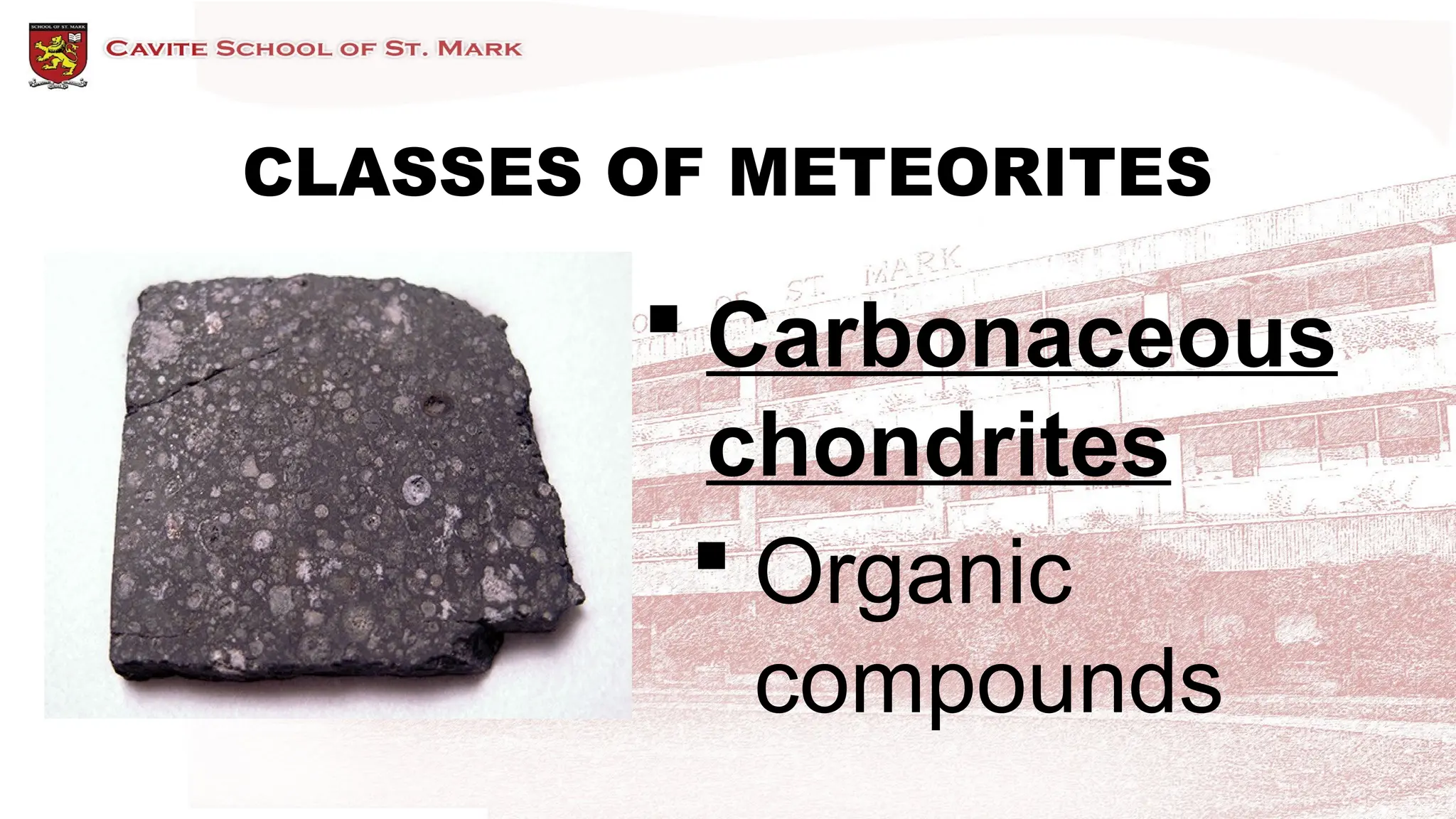
CLASSES OF METEORITES
 Carbonaceous
chondrites
 Organic
compounds
ANTARCTIC METEORITES
 Finds- discovered by
accident
 Falls- seen falling from the
sky
TWO TYPES OF METEORS
Sporadic
 orbital paths intersect that of Earth in
random directions
Meteor Shower
 the remains of old comets that have left lots
of small particles and dust in a common
orbit
METEORS
Meteor craters
 Barringer Meteor Crater in Northern
Arizona
 25, 000 years old
 4, 200 feet in diameter
 Depth of 6,000 feet
Barringer Meteor Crater in
Northern Arizona

COMET, METEOR AND ASTEROID GRADE 8 SCIENCE.pptx

  • 1.
  • 2.
    COMETS  Dirty Snowballs Water, dust, carbon dioxide, ice, ammonia, methane and more
  • 3.
    COMETS  Orbit thesun  Can lead to meteor showers on Earth  Usually visible only at sunrise or sunset
  • 4.
    COMETS  We cansee a number of comets with the naked eye when they pass close to the sun because their comas and tails reflect sunlight or even glow because of energy they absorb from the sun.  However, most comets are too small or too faint to be seen without a telescope.
  • 6.
    HEAD AND COMA Nucleus  As a comet gets closer to the sun, the ice on the surface of the nucleus begins turning into gas, forming a cloud known as the coma.
  • 7.
    WHY DOES THECOMA APPEARS BRIGHT?  Reflection of the sunlight  Emission of electromagnetic radiation
  • 8.
    THE TAIL  Canbe 150 million kilometers in length  Emitted from the nucleus  Gas and dust
  • 9.
    THE TAIL  Gastail  Composed of ion blown out away from the sun  Bluer, narrow and straight  Solar wind  Dust tail  Dust particles  Whiter, diffuse and curved  Liberated from the nucleus
  • 10.
    THE TAIL  Radiationfrom the sun pushes dust particles away from the coma, forming a dust tail  Charged particles from the sun convert some of the comet's gases into ions, forming an ion tail  Comet tails always point away from the sun
  • 11.
    SHORT PERIOD COMETAND LONG PERIOD COMET CLASSIFICATION OF COMETS
  • 12.
    SHORT PERIOD COMET Mildly elliptical orbits  Cannot be seen by the naked eye
  • 13.
    LONG PERIOD COMET Can be seen by the naked eye  Orbits are more elongated  Extended beyond Jupiter’s orbit
  • 16.
    ASTEROID  Minor planets Asteroid belt  Ceres
  • 17.
    BEGINNING OF ASTEROIDS Theymight have formed from the breakup of the planet that once occupied an orbit.
  • 18.
    BEGINNING OF ASTEROIDS Severallarger bodies once coexisted in close proximity and their collisions produced numerous smaller ones.
  • 23.
    METEOROIDS  Rocky metallicobjects less than 100 ‐ meters  Smaller bodies in between the planets  Several hundred tons of meteoroids enter the Earth’s atmosphere each day
  • 25.
    METEOROIDS  While heatedto incandescence by atmospheric friction during their passage through the atmosphere, they are termed meteors.  A fragment that survives to hit the ground is known as a meteorite.
  • 28.
    CLASSES OF METEORITES Chondrite  Iron meteorite  Carbonaceous chondrite
  • 29.
    CLASSES OF METEORITES Chondrite  Stony meteorites
  • 30.
    CLASSES OF METEORITES Iron Meteorites  Iron and nickel
  • 31.
    CLASSES OF METEORITES Carbonaceous chondrites  Organic compounds
  • 32.
    ANTARCTIC METEORITES  Finds-discovered by accident  Falls- seen falling from the sky
  • 33.
    TWO TYPES OFMETEORS Sporadic  orbital paths intersect that of Earth in random directions Meteor Shower  the remains of old comets that have left lots of small particles and dust in a common orbit
  • 34.
    METEORS Meteor craters  BarringerMeteor Crater in Northern Arizona  25, 000 years old  4, 200 feet in diameter  Depth of 6,000 feet
  • 35.
    Barringer Meteor Craterin Northern Arizona