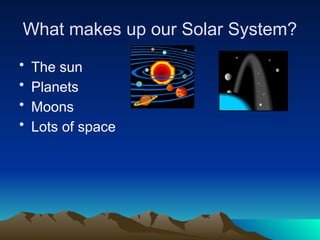
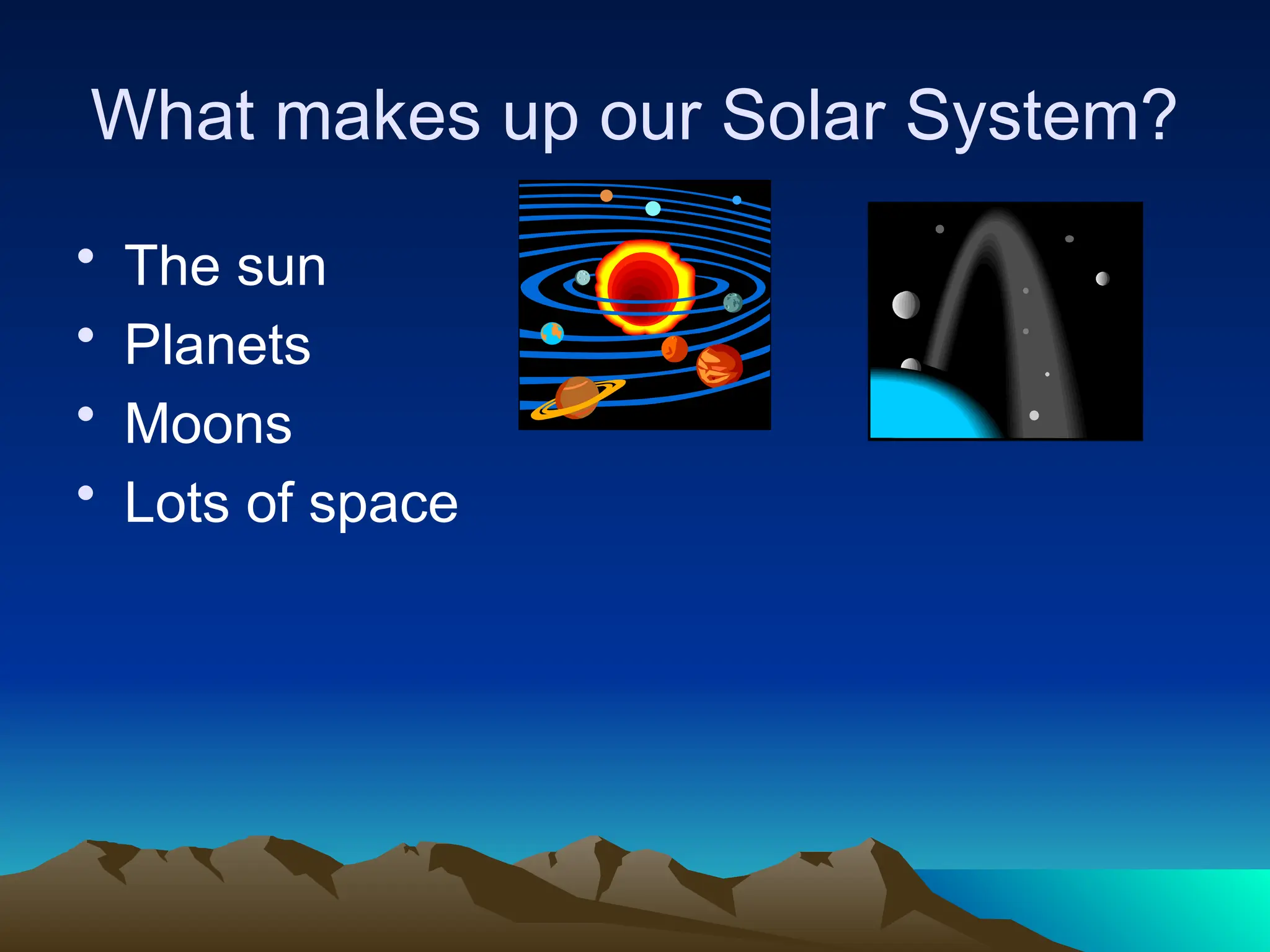
What makes up our Solar System?
• The sun
• Planets
• Moons
• Lots of space
Other than the sun,
planets, and moon, what
other objects are found in
the Solar System?
A R S
T
P
S
W E
E I
M K
E
M E
T 0
N
O
R
C R S
T
P
S
W E
A I
M K
E
T O
R I
D
O
D
S
A
O F X
T
M
S
D N
E U
R T
O E
M T
C
O
C
G
A
COMETS,
METEORS, &
ASTEROIDS
In this lesson, we are
going to:
1. describe comet, meteor
and asteroid
2. compare and contrast
comets, meteors, and
asteroids which are found
in the Solar System.
Essential Question:
What is the difference between
a comet, meteor,
and asteroid?
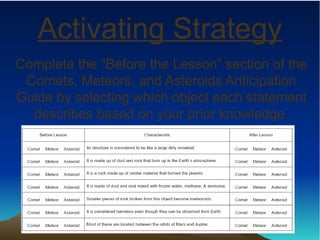
Activating Strategy
Complete the “Before the Lesson” section of the
Comets, Meteors, and Asteroids Anticipation
Guide by selecting which object each statement
describes based on your prior knowledge.
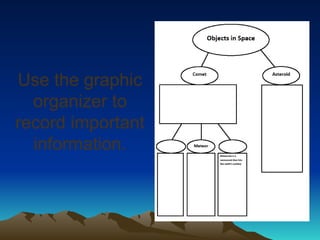
Use the graphic
organizer to
record important
information.
Comets
Comets
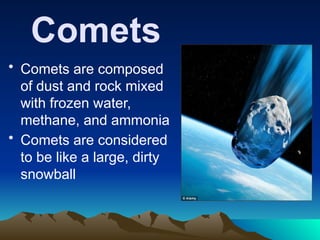
• Comets are composed
of dust and rock mixed
with frozen water,
methane, and ammonia
• Comets are considered
to be like a large, dirty
snowball
Comets
Comets travel around the
sun in elliptical orbits
Comets
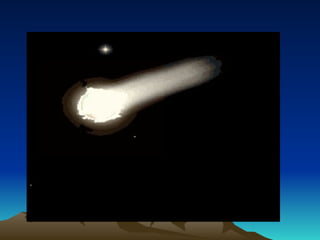
• When a comet nears the sun, some of it
melts and forms a long tail (gases in the
comet are vaporized by the sun)
• When a comet moves farther away from
the sun, the tail disappears
After a comet has passed close to
the Sun many times, it breaks
apart. The small pieces from the
comet spread out.
These pieces of dust and rock,
along with those coming from other
sources, are called Meteoroids.
You may have noticed that in the
last slide we used the term
Meteoroids to describe objects in
the sky, but your essential question
and the standard say Meteor.
What’s the difference?
Meteoroid, Meteor,
Meteorite?
The difference is just based on
where the rock is located when
you are describing it.
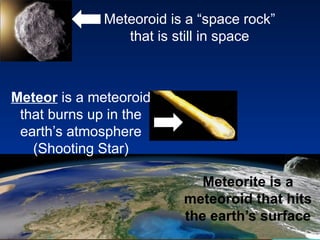
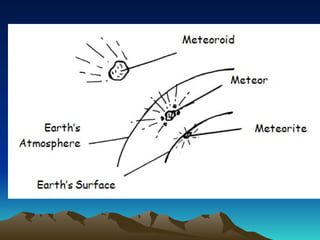
Meteoroid is a “space rock”
that is still in space
Meteor is a meteoroid
that burns up in the
earth’s atmosphere
(Shooting Star)
Meteorite is a
meteoroid that hits
the earth’s surface
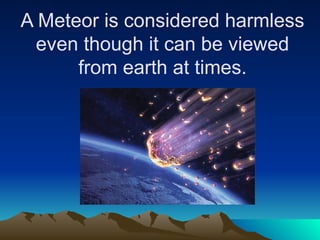
A Meteor is considered harmless
even though it can be viewed
from earth at times.
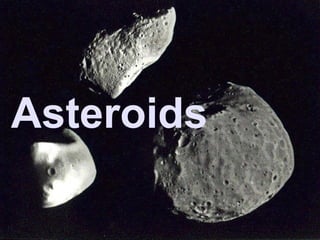
Asteroids
Asteroid
• A piece of rock similar to the
material formed into planets.
• An Asteroid is smaller than a
planet but larger than a
meteoroid
Asteroid
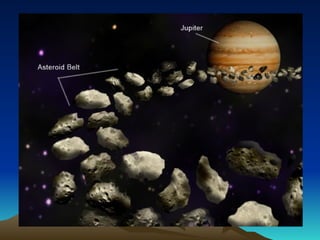
• Most asteroids are located in an
area between the orbits of Mars and
Jupiter called the Asteroid Belt.
• Why are they located there?
• The gravity of Jupiter might have
kept a planet from forming in the
area
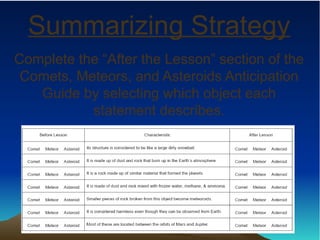
Summarizing Strategy
Complete the “After the Lesson” section of the
Comets, Meteors, and Asteroids Anticipation
Guide by selecting which object each
statement describes.
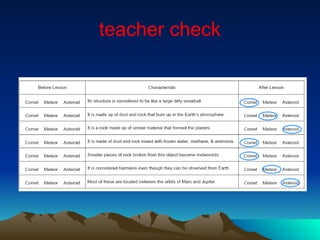
teacher check
Comet
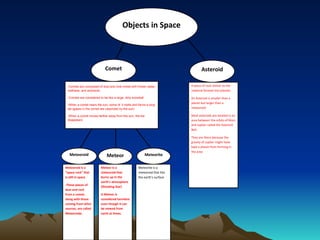
Objects in Space
Asteroid
A piece of rock similar to the
material formed into planets.
An Asteroid is smaller than a
planet but larger than a
meteoroid
Most asteroids are located in an
area between the orbits of Mars
and Jupiter called the Asteroid
Belt.
They are there because the
gravity of Jupiter might have
kept a planet from forming in
the area
-Comets are composed of dust and rock mixed with frozen water,
methane, and ammonia
-Comets are considered to be like a large, dirty snowball
-When a comet nears the sun, some of it melts and forms a long
tail (gases in the comet are vaporized by the sun)
-When a comet moves farther away from the sun, the tail
disappears
Meteoroid Meteor Meteorite
Meteoroid is a
“space rock” that
is still in space
-These pieces of
dust and rock
from a comet,
along with those
coming from other
sources, are called
Meteoroids.
Meteor is a
meteoroid that
burns up in the
earth’s atmosphere
(Shooting Star)
A Meteor is
considered harmless
even though it can
be viewed from
earth at times.
Meteorite is a
meteoroid that hits
the earth’s surface

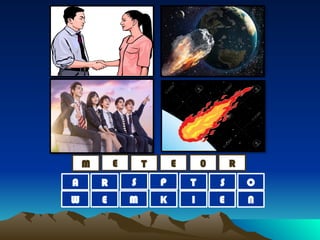
4 pic 1 word meteor.pptx

  • 1.
    What makes upour Solar System? • The sun • Planets • Moons • Lots of space
  • 2.
    Other than thesun, planets, and moon, what other objects are found in the Solar System?
  • 4.
    A R S T P S WE E I M K E M E T 0 N O R
  • 5.
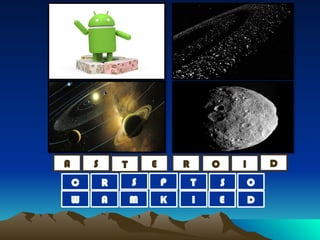
    C R S T P S WE A I M K E T O R I D O D S A
  • 6.
    O F X T M S DN E U R T O E M T C O C G A
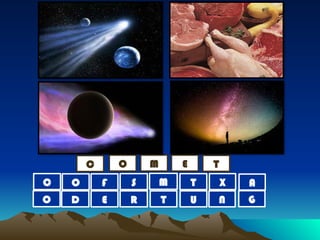
  • 7.
  • 8.
    In this lesson,we are going to: 1. describe comet, meteor and asteroid 2. compare and contrast comets, meteors, and asteroids which are found in the Solar System.
  • 9.
    Essential Question: What isthe difference between a comet, meteor, and asteroid?
  • 10.
    Activating Strategy Complete the“Before the Lesson” section of the Comets, Meteors, and Asteroids Anticipation Guide by selecting which object each statement describes based on your prior knowledge.
  • 11.
    Use the graphic organizerto record important information.
  • 12.
  • 14.
    Comets • Comets arecomposed of dust and rock mixed with frozen water, methane, and ammonia • Comets are considered to be like a large, dirty snowball
  • 15.
    Comets Comets travel aroundthe sun in elliptical orbits
  • 16.
    Comets • When acomet nears the sun, some of it melts and forms a long tail (gases in the comet are vaporized by the sun) • When a comet moves farther away from the sun, the tail disappears
  • 17.
    After a comethas passed close to the Sun many times, it breaks apart. The small pieces from the comet spread out. These pieces of dust and rock, along with those coming from other sources, are called Meteoroids.
  • 18.
    You may havenoticed that in the last slide we used the term Meteoroids to describe objects in the sky, but your essential question and the standard say Meteor. What’s the difference?
  • 19.
    Meteoroid, Meteor, Meteorite? The differenceis just based on where the rock is located when you are describing it.
  • 20.
    Meteoroid is a“space rock” that is still in space Meteor is a meteoroid that burns up in the earth’s atmosphere (Shooting Star) Meteorite is a meteoroid that hits the earth’s surface
  • 22.
    A Meteor isconsidered harmless even though it can be viewed from earth at times.
  • 23.
  • 24.
    Asteroid • A pieceof rock similar to the material formed into planets. • An Asteroid is smaller than a planet but larger than a meteoroid
  • 25.
    Asteroid • Most asteroidsare located in an area between the orbits of Mars and Jupiter called the Asteroid Belt. • Why are they located there? • The gravity of Jupiter might have kept a planet from forming in the area
  • 28.
    Summarizing Strategy Complete the“After the Lesson” section of the Comets, Meteors, and Asteroids Anticipation Guide by selecting which object each statement describes.
  • 29.
  • 30.
    Comet Objects in Space Asteroid Apiece of rock similar to the material formed into planets. An Asteroid is smaller than a planet but larger than a meteoroid Most asteroids are located in an area between the orbits of Mars and Jupiter called the Asteroid Belt. They are there because the gravity of Jupiter might have kept a planet from forming in the area -Comets are composed of dust and rock mixed with frozen water, methane, and ammonia -Comets are considered to be like a large, dirty snowball -When a comet nears the sun, some of it melts and forms a long tail (gases in the comet are vaporized by the sun) -When a comet moves farther away from the sun, the tail disappears Meteoroid Meteor Meteorite Meteoroid is a “space rock” that is still in space -These pieces of dust and rock from a comet, along with those coming from other sources, are called Meteoroids. Meteor is a meteoroid that burns up in the earth’s atmosphere (Shooting Star) A Meteor is considered harmless even though it can be viewed from earth at times. Meteorite is a meteoroid that hits the earth’s surface

Editor's Notes

  • #2 Instructional Approach(s): The teacher should ask the students the question on the ppt slide. Give students 1 minute or less to provide examples of other objects in the solar system.
  • #8 Instructional Approach(s): The teacher should read the slide to the class.
  • #9 Instructional Approach(s): The teacher should introduce the essential question and the standard that aligns to the essential question.
  • #10 Instructional Approach(s): The teacher should give each student a Comet, Meteor, and Asteroid Anticipation Guide. The students should individually read each statement and mark whether it describes a comet, meteor, or asteroid. Remind students that it is an activating strategy; therefore, students are not expected to know the information yet. You are activating any prior knowledge they have about comets, meteors, and asteroids. The teacher may want to allow students to compare their responses; however, stress to the students that they should not change their answer based on another student’s response. See the Comets, Meteors and Asteroids Anticipation Guide linked on the resource page.
  • #11 Instructional Approach(s): The teacher should give each student a copy of the graphic organizer to record important information during the lesson.
  • #14 Instructional Approach(s): The teacher should present the characteristics of a comet while the students record the important information on their notes.
  • #15 Instructional Approach(s): The teacher should present the characteristic of a comet while the students record the information on their notes. The teacher should show the animation of a comet traveling in the solar system to reinforce the concepts.
  • #16 Instructional Approach(s): The teacher should present the characteristics of a comet while the students record the information on their notes. The teacher should show the animations of a comet traveling in the solar system to reinforce the concepts.
  • #17 Instructional Approach(s): The teacher should present the information on the slide.
  • #18 Instructional Approach(s): The teacher should present the information on the slide and ask students if they can identify the difference in a meteoroid and a meteor.
  • #19 Instructional Approach(s): The teacher should present the information on the slide.
  • #20 Instructional Approach(s): The teacher should present the information on the slide while the students record the important information on their notes. Possibly do the Meteor Burnout demonstration linked on the resource page.
  • #21 Instructional Approach(s): The teacher should use the image on the slide to reinforce the difference between a meteoroid, meteor, and meteorite.
  • #22 Instructional Approach(s): The teacher should present the information on the slide while the students record any important information on their notes.
  • #23 Instructional Approach(s): Introduce Asteroids
  • #24 Instructional Approach(s): The teacher should present the characteristics of an asteroid while the students record important information on their notes.
  • #25 Instructional Approach(s): The teacher should present the characteristics of an asteroid while the students record important information on their notes.
  • #26 Instructional Approach(s): The teacher should use the image to reinforce the location of asteroids.
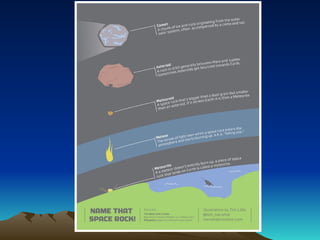
  • #27 Instructional Approach(s): The teacher should use the image to reinforce the characteristics of a comet, asteroid, and a meteor.
  • #29 Instructional Approach(s): The teacher should use the slide to go over the information ONLY AFTER the teacher has viewed student responses to determine student mastery of the concepts.
  • #30 Instructional Approach(s): The teacher should use the slide to allow students to make sure they have the correct information in their graphic organizer.