(SOLAR SYSTEM)
The Solar System was formed approximately 4.6 billion years ago and consists of the Sun,
planets, dwarf planets and other astronomical objects bound in its orbit.The formation was
cause by the collapse of a giant molecular cloud, the mass at the centre collecting to form the
Sun and a flat disk of dust around it which the planets and other bodies would eventually be
formed from.
99.86% of the system’s mass is found in the Sun and the majority of the remaining 0.14%
is contained within the solar system’s eight planets.
The four smaller inner planets, also known as the “terrestrial planets” (Mercury,Venus, Earth
and Mars), are primarily composed of rock and metal.The four outer planets, also known as the
“gas giants” (Jupiter, Saturn, Uranus and Neptune), are substantially larger and more massive
than the inner planets.
The two innermost gas giants, Jupiter and Saturn, are the larger of the four and are composed
mainly of hydrogen and helium.The two outermost gas giants, Uranus and Neptune, are
composed largely of ices, (water, ammonia and methane) and are sometimes also referred to
as the “ice giants“.
Other objects of note in the Solar System are the dwarf planets (Ceres, Pluto, Haumea,
Makemake & Eris),moons, asteroids, the asteroid belt, comets and the Kuiper belt.
Facts AboutThe Solar System
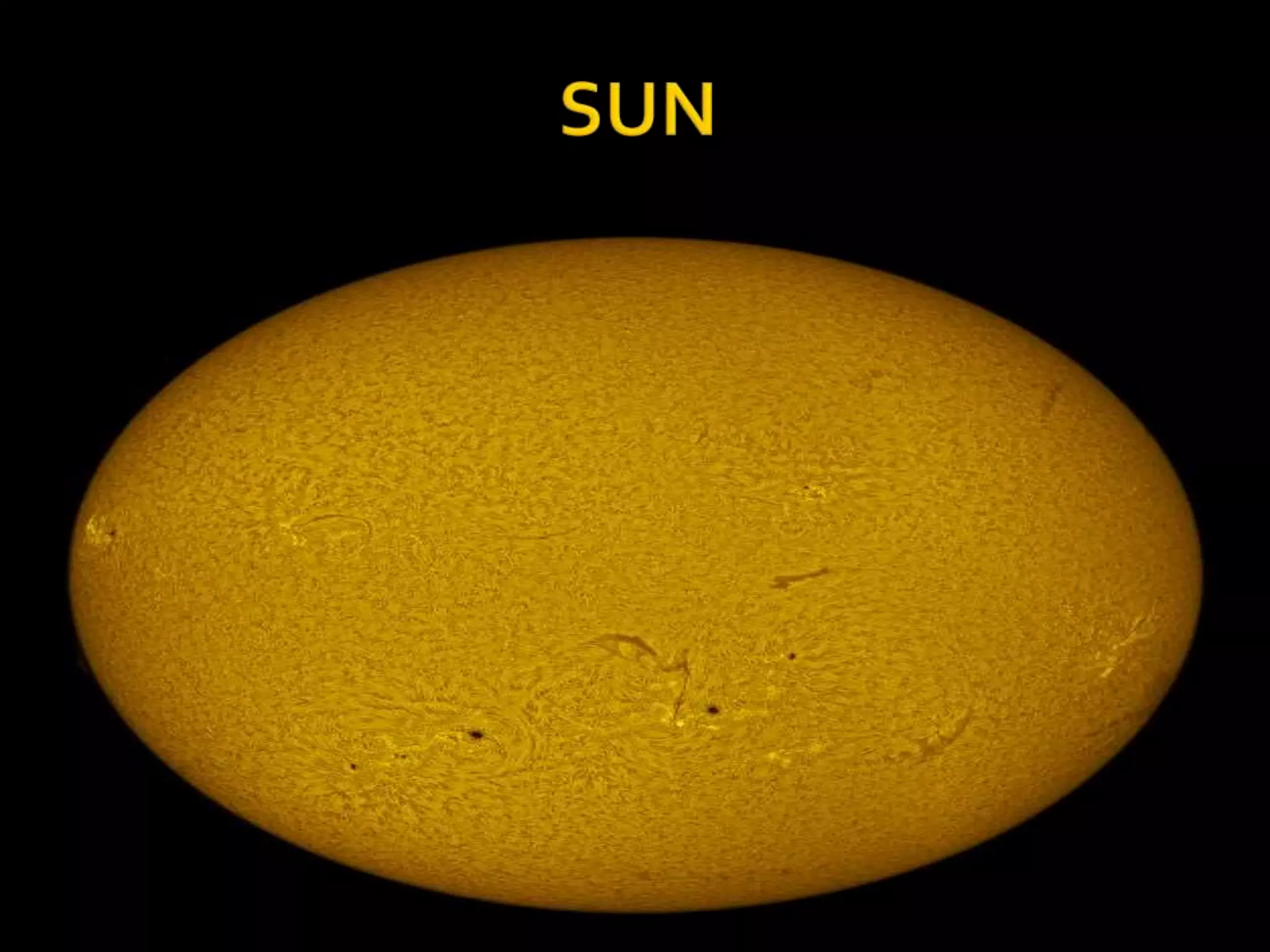
The Sun or Sol, is the star at the
centre of our solar system and is
responsible for the Earth’s climate
and weather.The Sun is an almost
perfect sphere with a difference of
just 10km in diameter between the
poles and the equator.The average
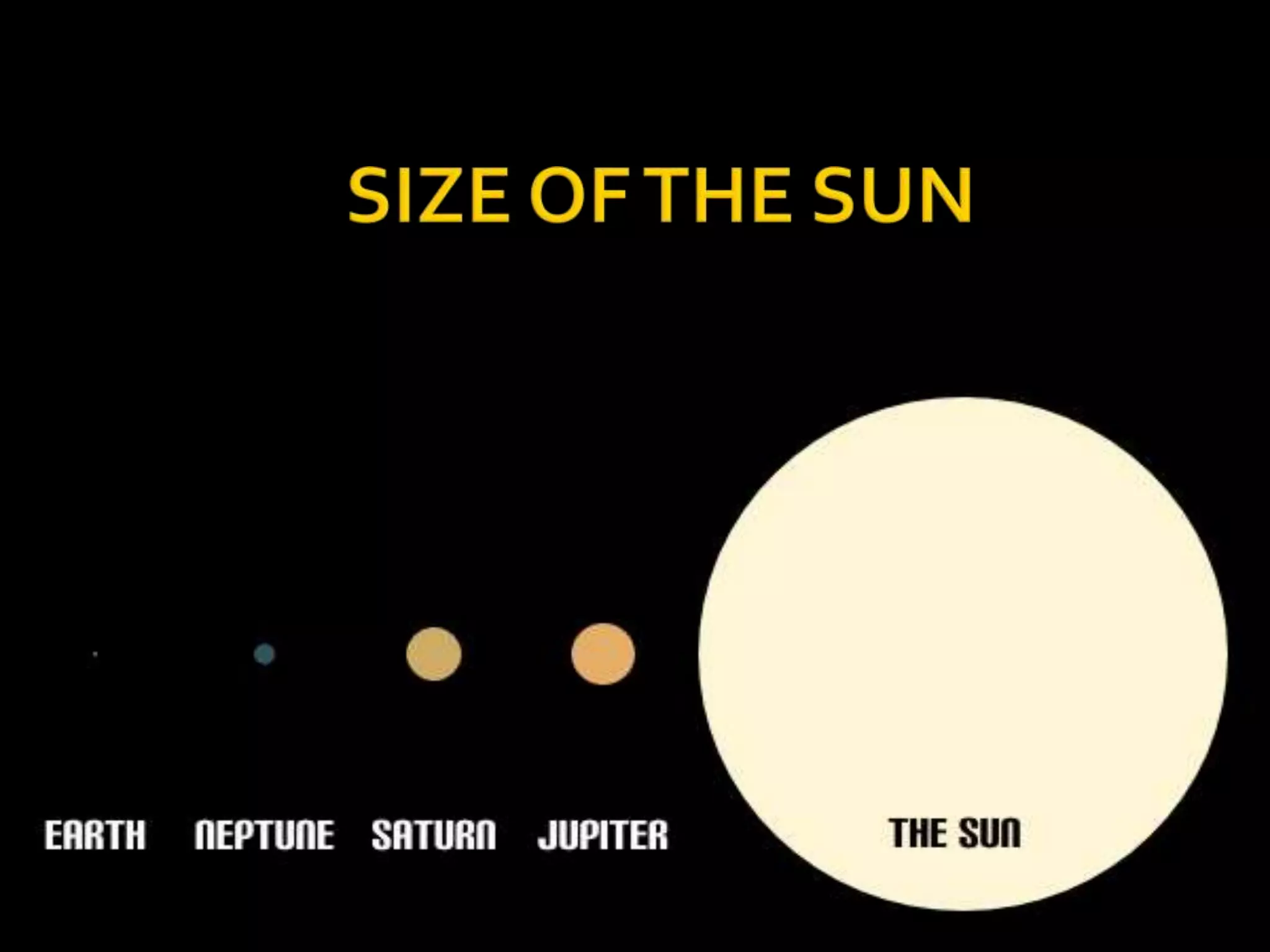
radius of the Sun is 695,508 km
(109.2 x that of the Earth) of which
20–25% is the core.
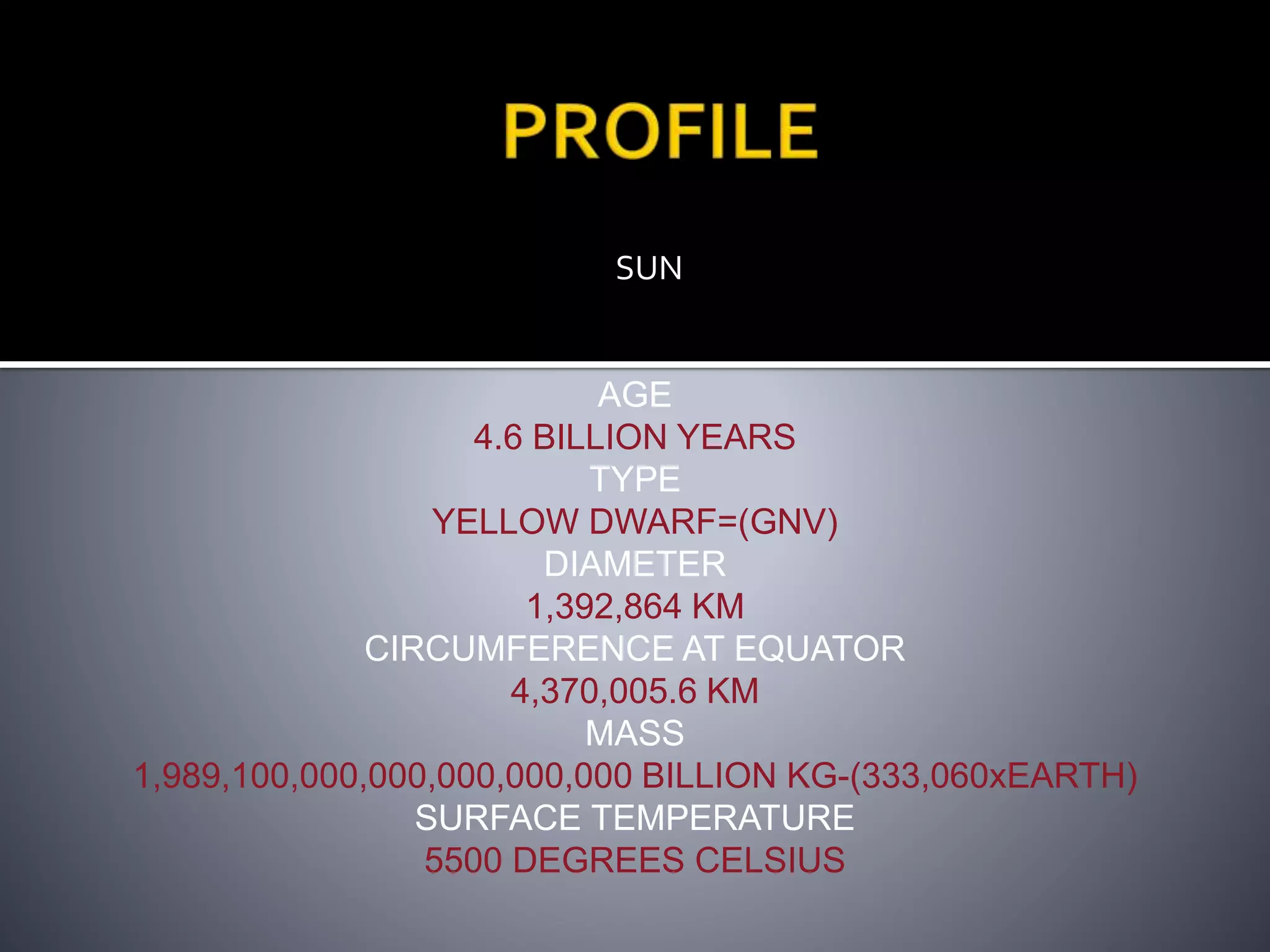
SUN
AGE
4.6 BILLION YEARS
TYPE
YELLOW DWARF=(GNV)
DIAMETER
1,392,864 KM
CIRCUMFERENCE AT EQUATOR
4,370,005.6 KM
MASS
1,989,100,000,000,000,000,000 BILLION KG-(333,060xEARTH)
SURFACE TEMPERATURE
5500 DEGREES CELSIUS
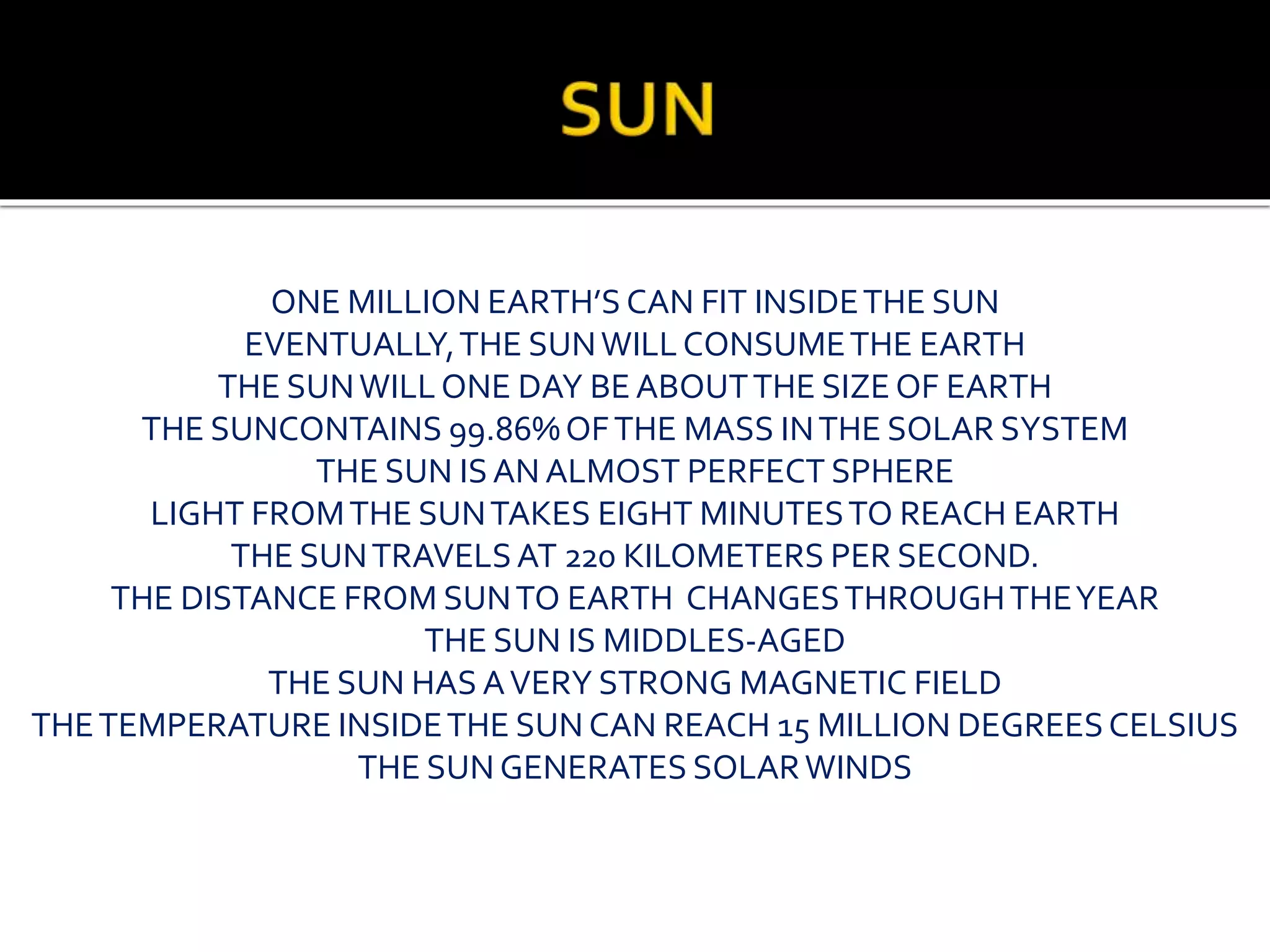
ONE MILLION EARTH’S CAN FIT INSIDETHE SUN
EVENTUALLY,THE SUNWILLCONSUMETHE EARTH
THE SUNWILLONE DAY BE ABOUTTHE SIZE OF EARTH
THE SUNCONTAINS 99.86%OFTHE MASS INTHE SOLAR SYSTEM
THE SUN ISAN ALMOST PERFECT SPHERE
LIGHT FROMTHE SUNTAKES EIGHT MINUTESTO REACH EARTH
THE SUNTRAVELSAT 220 KILOMETERS PER SECOND.
THE DISTANCE FROM SUNTO EARTH CHANGESTHROUGHTHEYEAR
THE SUN IS MIDDLES-AGED
THE SUN HAS AVERY STRONG MAGNETIC FIELD
THETEMPERATURE INSIDETHE SUN CAN REACH 15 MILLION DEGREESCELSIUS
THE SUN GENERATES SOLARWINDS
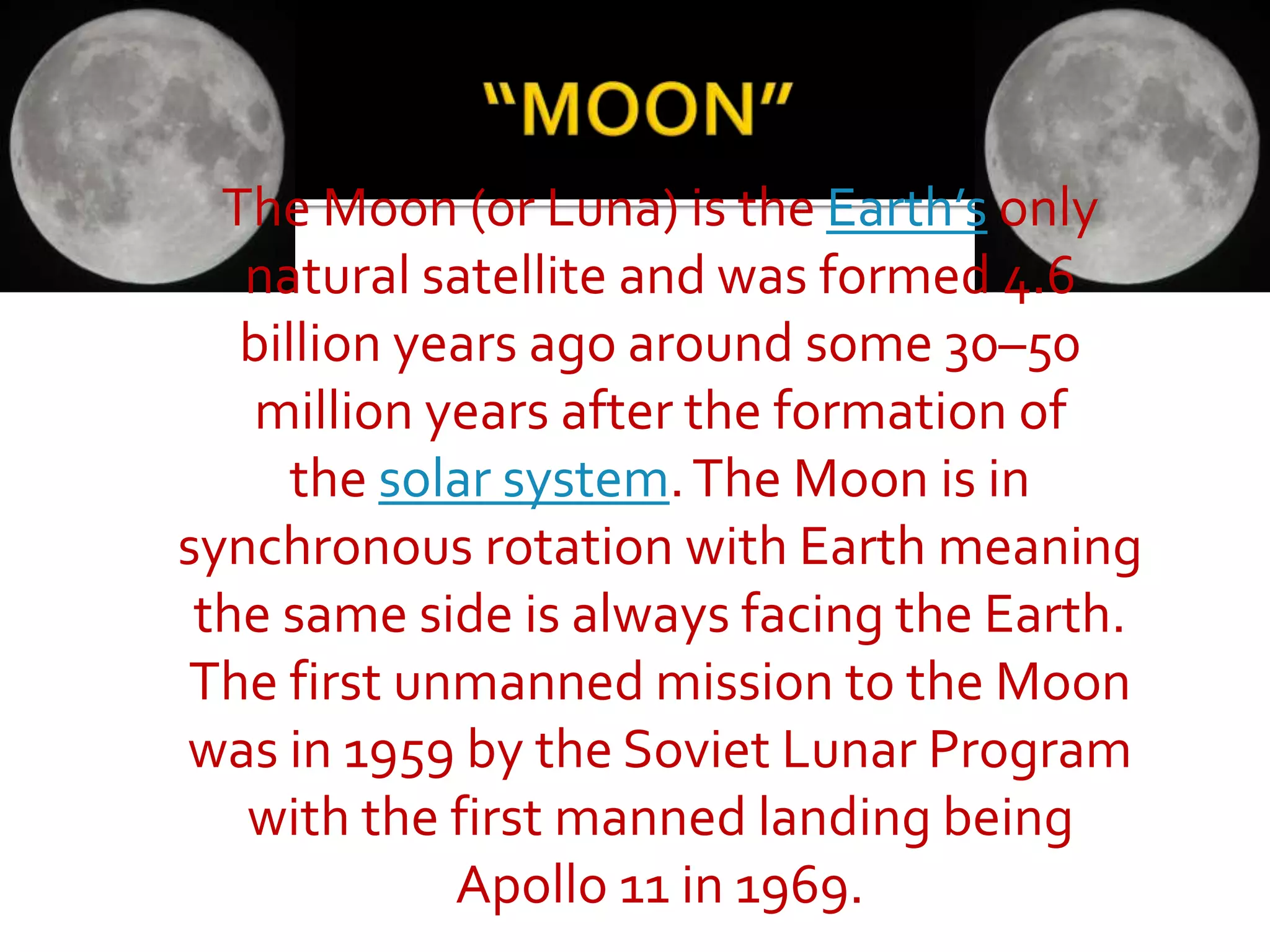
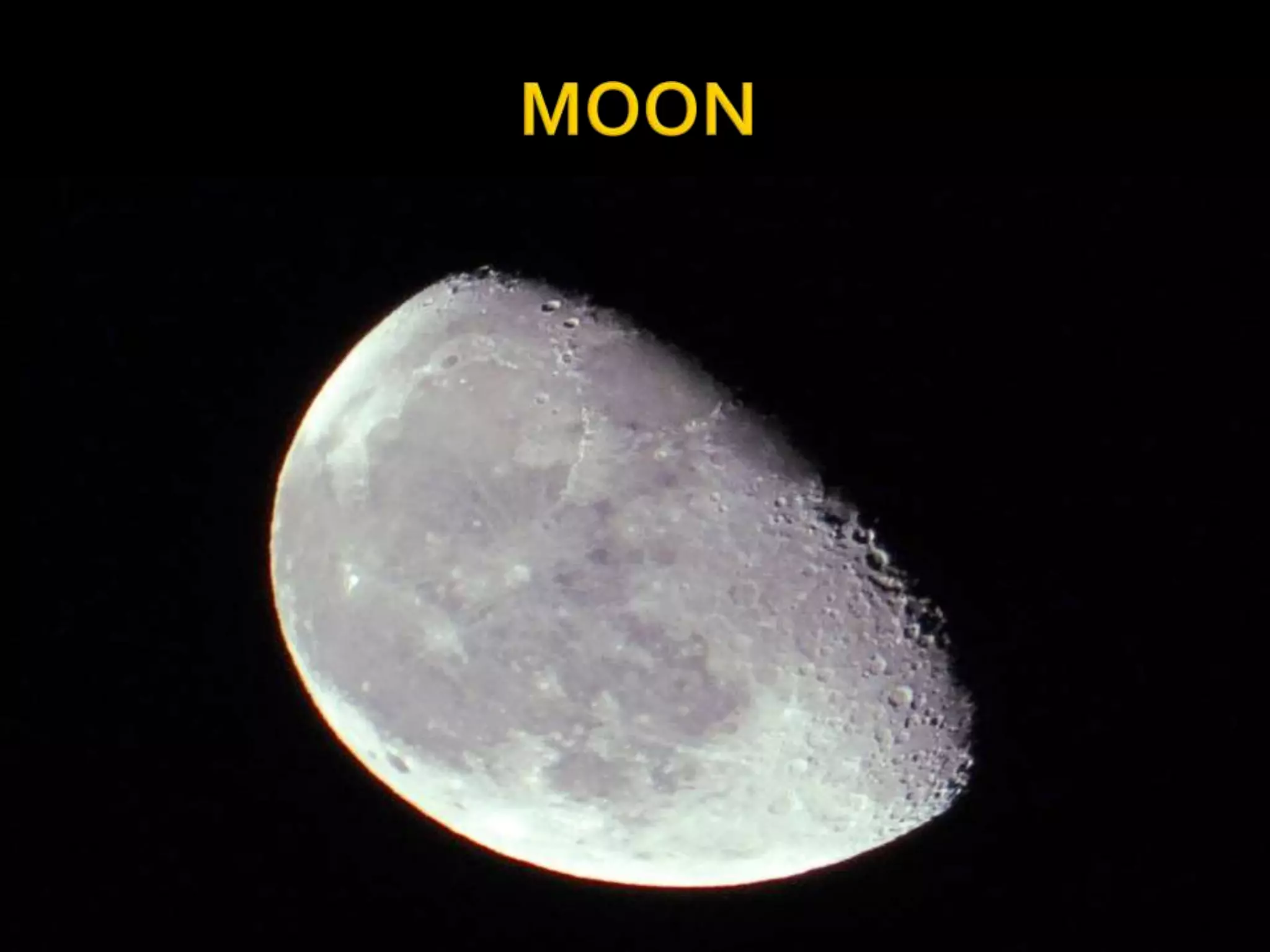
The Moon (or Luna) is the Earth’s only
natural satellite and was formed 4.6
billion years ago around some 30–50
million years after the formation of
the solar system.The Moon is in
synchronous rotation with Earth meaning
the same side is always facing the Earth.
The first unmanned mission to the Moon
was in 1959 by the Soviet Lunar Program
with the first manned landing being
Apollo 11 in 1969.
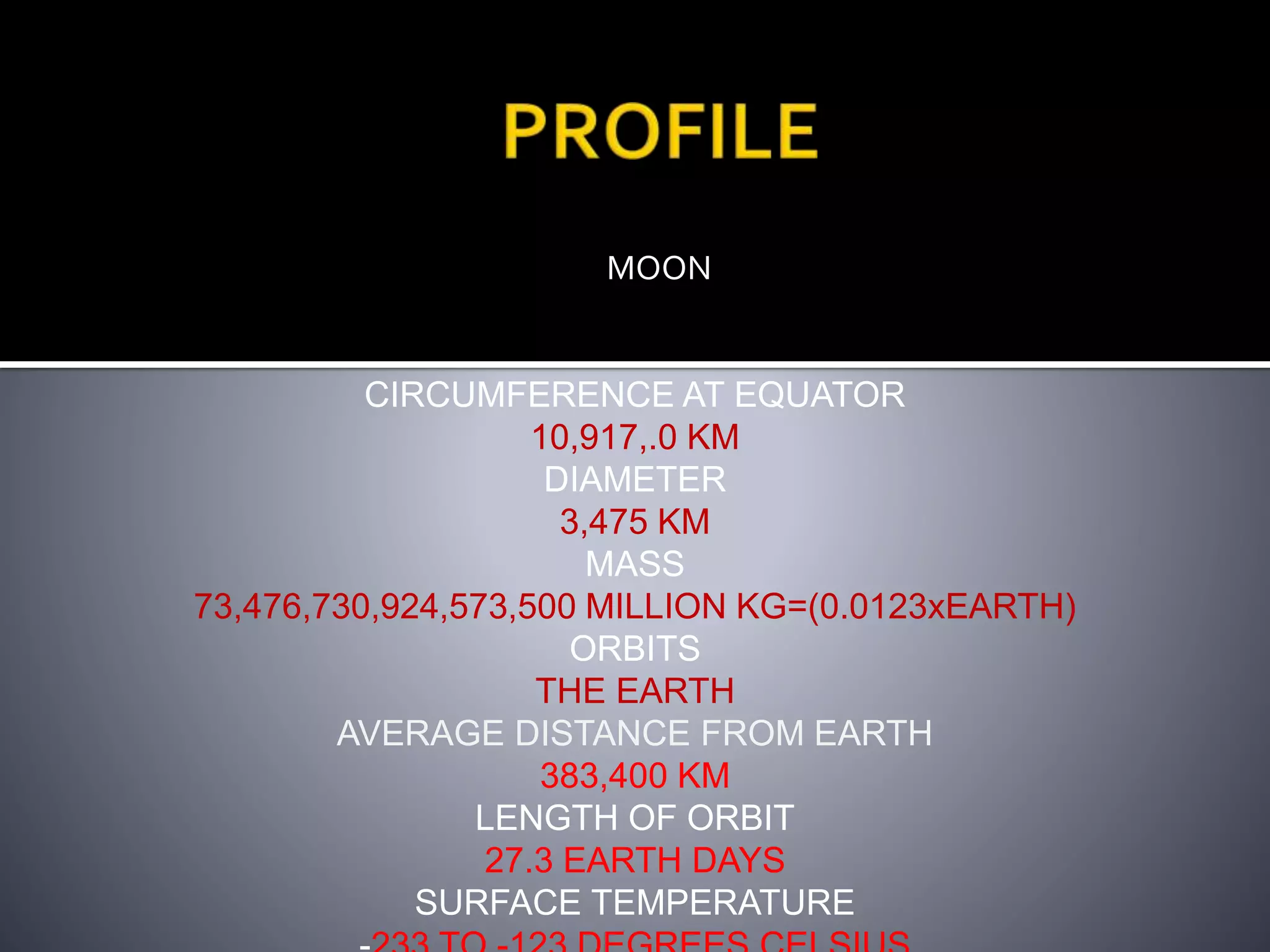
MOON
CIRCUMFERENCE AT EQUATOR
10,917,.0 KM
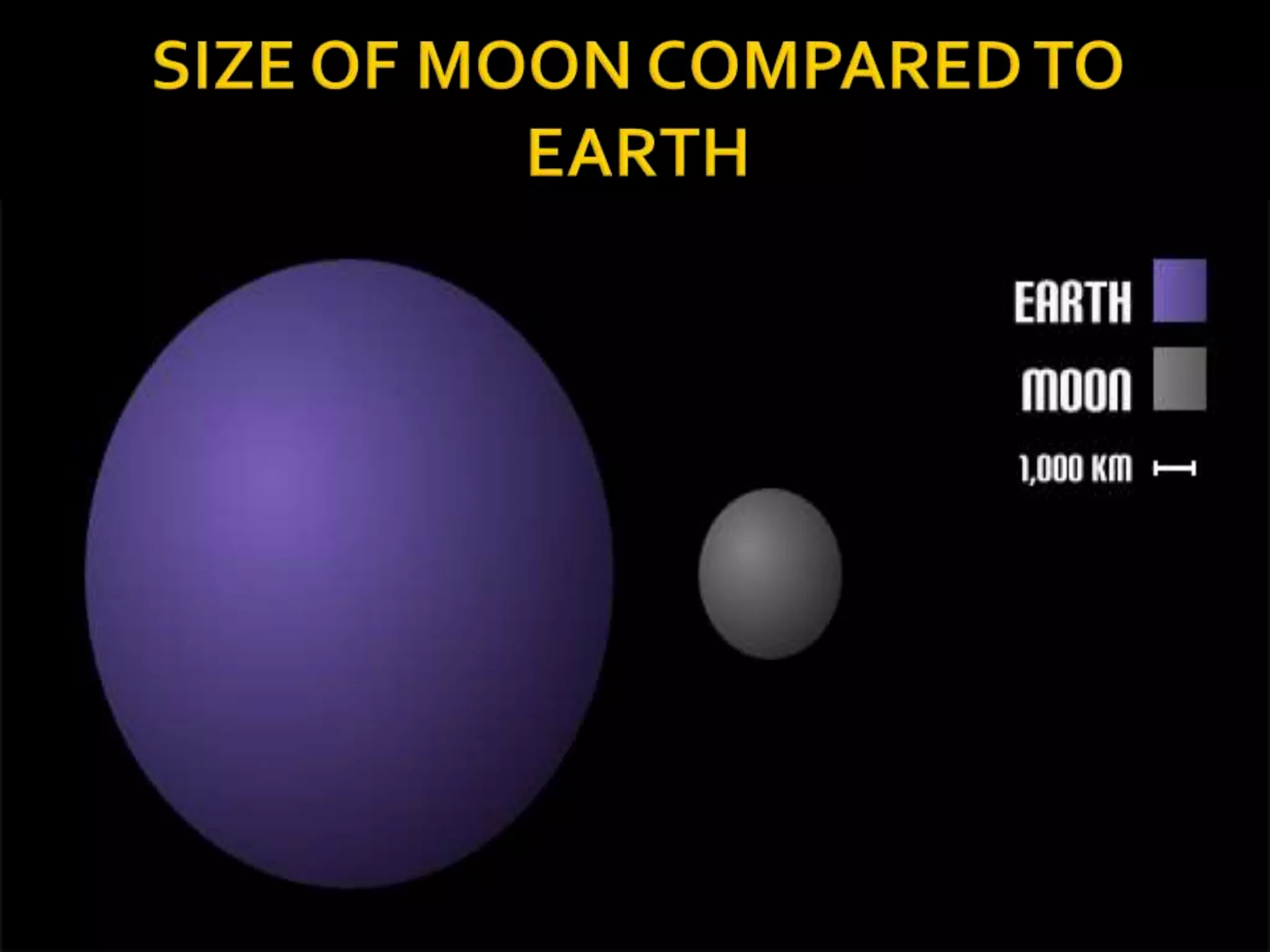
DIAMETER
3,475 KM
MASS
73,476,730,924,573,500 MILLION KG=(0.0123xEARTH)
ORBITS
THE EARTH
AVERAGE DISTANCE FROM EARTH
383,400 KM
LENGTH OF ORBIT
27.3 EARTH DAYS
SURFACE TEMPERATURE
THE DARK SIDEOFTHE MOON ISTHE MYTH
THE RISEAND FALL OFTHETIDESON EARTH IS CAUSED BYTHE MOON
THE MOON IS DRIFTINGAWAY FROM EARTH
A PERSONWOULDWEIGH MUCH LESSONTHE MOON
THE MOON HAS ONLY BEENWALKED ON BY 12 PEOPLE
THE MOON HAS NO ATMOSPHERE
THE MOON HAS QUAKES
THE FIRST SPACECRAFTTO REACHTHE MOONWAS LUNA 1 IN 1959
THE MOON ISTHE FIFTH LARGEST SATELLITE INTHE SOLAR SYSTEM
THE MOONWILL BEVISITED BY MAN INTHE NEAR FUTURE
DURINGTHE 1950’STHE USA CONSIDERED DENOTINGA NUCLEAR BOMB ONTHE
MOON
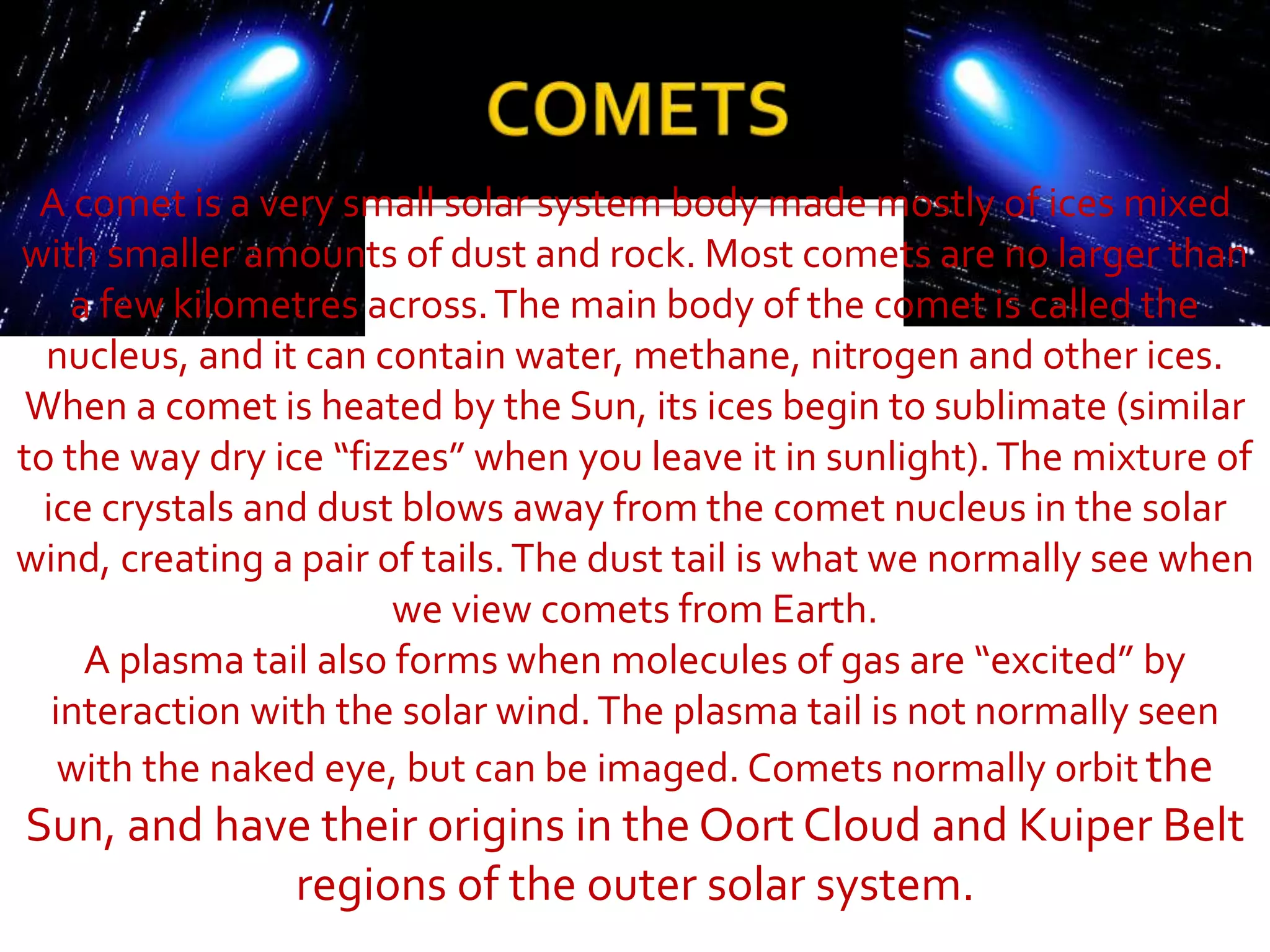
A comet is a very small solar system body made mostly of ices mixed
with smaller amounts of dust and rock. Most comets are no larger than
a few kilometres across.The main body of the comet is called the
nucleus, and it can contain water, methane, nitrogen and other ices.
When a comet is heated by the Sun, its ices begin to sublimate (similar
to the way dry ice “fizzes” when you leave it in sunlight).The mixture of
ice crystals and dust blows away from the comet nucleus in the solar
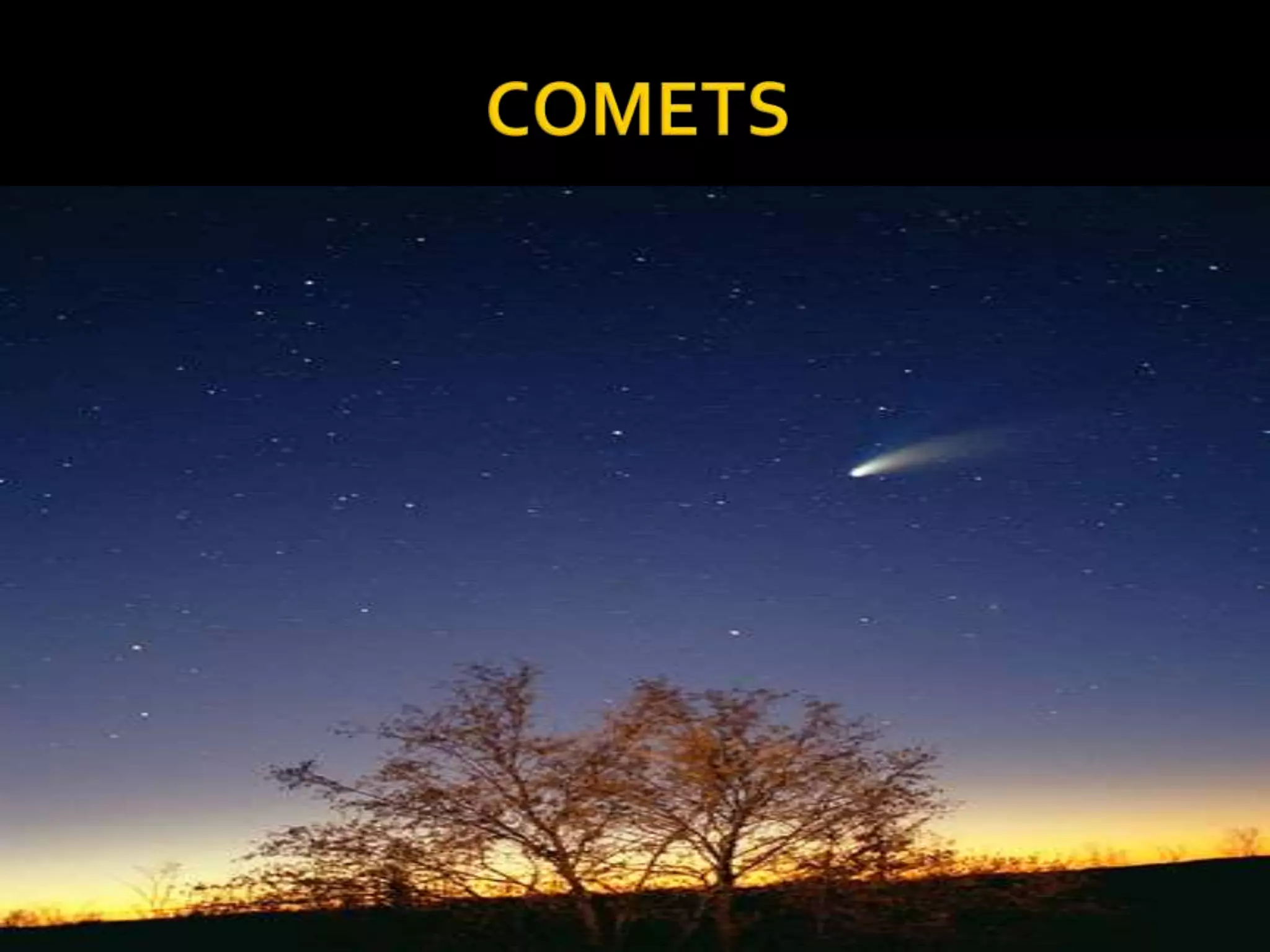
wind, creating a pair of tails.The dust tail is what we normally see when
we view comets from Earth.
A plasma tail also forms when molecules of gas are “excited” by
interaction with the solar wind.The plasma tail is not normally seen
with the naked eye, but can be imaged. Comets normally orbit the
Sun, and have their origins in the Oort Cloud and Kuiper Belt
regions of the outer solar system.
A comet is a relatively small solar system body that orbits the Sun.When close
enough to the Sun they display a visible coma (a fuzzy outline or atmosphere due to
solar radiation) and sometimes a tail.
The coma is created as the comet gets closer to the Sun, causing water, carbon
dioxide and other compounds to sublime (quickly changing from solid to gas) from its
surface.
Comets are made of ice, dust and small rocky particles.
The name comet comes from the Greek word meaning ‘hair of the head’, it came
from the Greek philosopherAristotle who observed comets as ‘stars with hair’.
Short term comets (also known as periodic comets) have orbital periods of less than
200 years while long term comets have orbital periods of over 200 years.
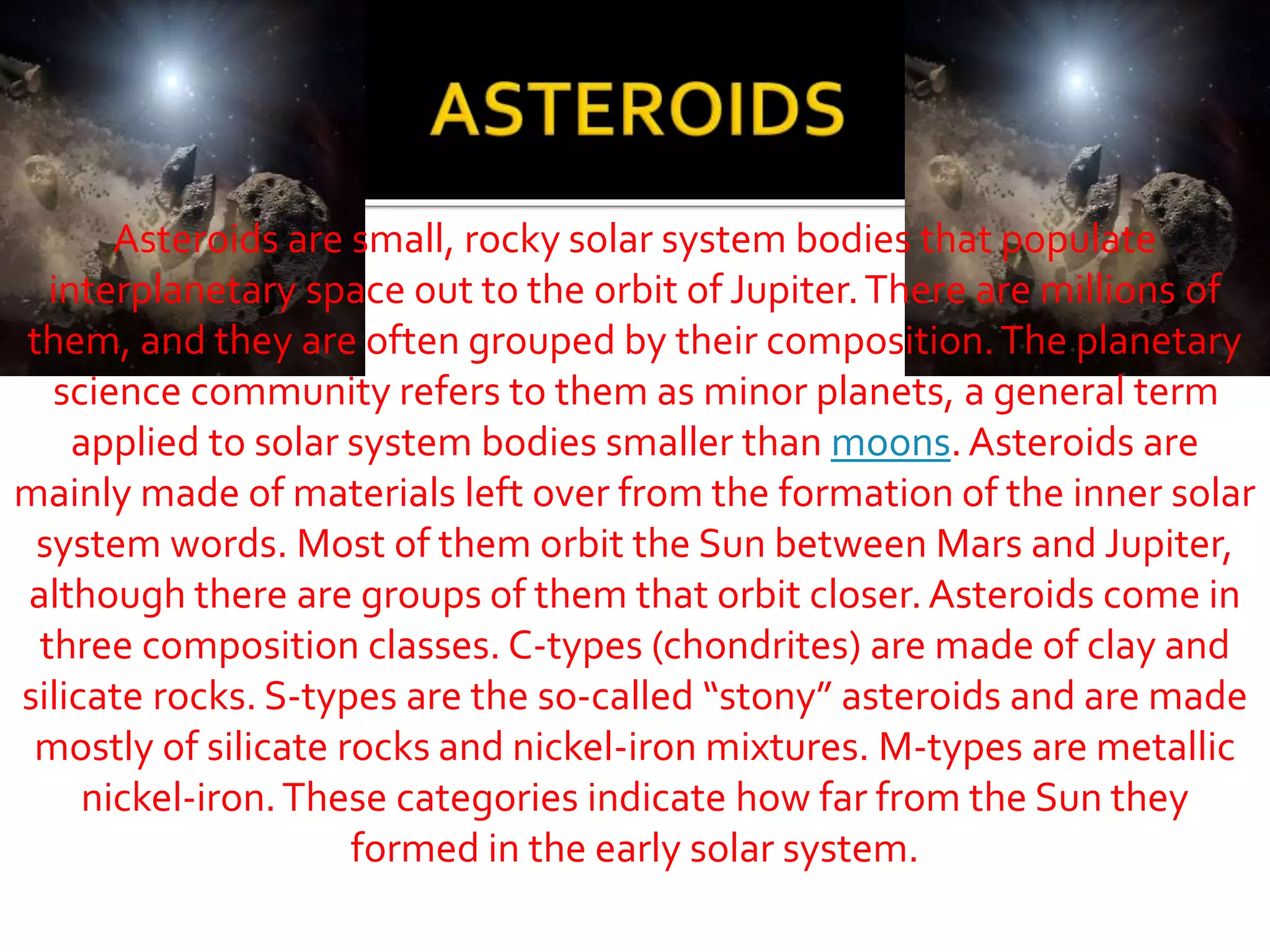
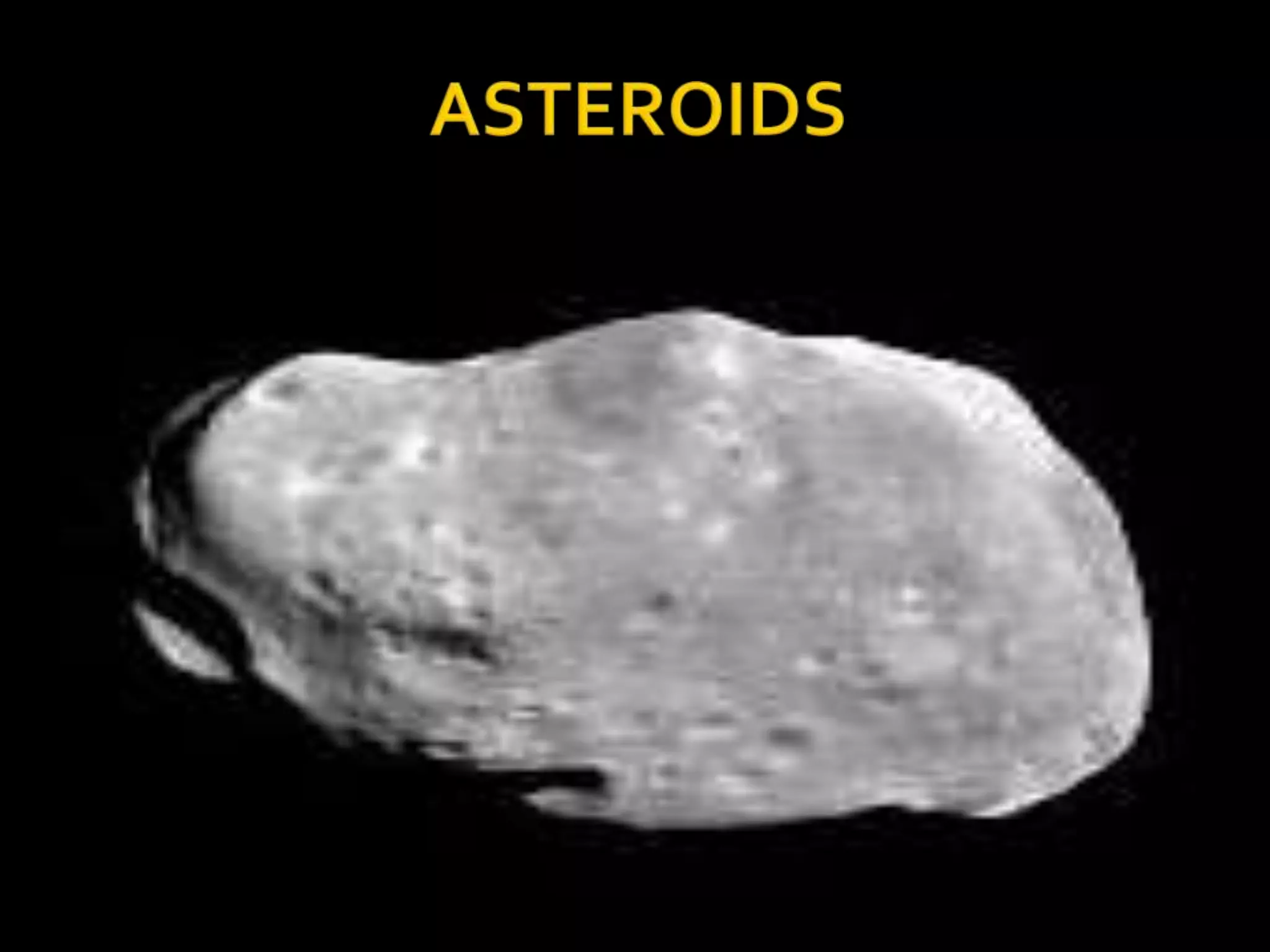
Asteroids are small, rocky solar system bodies that populate
interplanetary space out to the orbit of Jupiter.There are millions of
them, and they are often grouped by their composition.The planetary
science community refers to them as minor planets, a general term
applied to solar system bodies smaller than moons.Asteroids are
mainly made of materials left over from the formation of the inner solar
system words. Most of them orbit the Sun between Mars and Jupiter,
although there are groups of them that orbit closer. Asteroids come in
three composition classes. C-types (chondrites) are made of clay and
silicate rocks. S-types are the so-called “stony” asteroids and are made
mostly of silicate rocks and nickel-iron mixtures. M-types are metallic
nickel-iron.These categories indicate how far from the Sun they
formed in the early solar system.
Asteroids aren’t the only things that hit Earth. Each day, more than 100 tons of
material from asteroids and comets falls toward Earth. Most of it is destroyed by
friction as it passes through our atmosphere. If something DOES hit the ground, it is
known as a meteorite.
While asteroid impacts were more common in the past, they aren’t as frequent today.
An asteroid impact some 65 million years ago contributed to the extinction of the
dinosaurs. (It was one of several factors that affected all life on Earth at that time.)
Earth suffers an impact from an object the size of a football field about once every
2,000 years.
A car-sized meteoroid (a piece of asteroid) falls into Earth’s atmosphere about once a
year.The result is a beautiful fireball, but the meteoroid usually burns up before
reaching the ground.
Asteroids are rich in precious metals and other metals, as well as water.
Some asteroids have moons of their own!
Most asteroids orbit the Sun in the Asteroid Belt, which lies between Mars and Jupiter.
Earth is bombarded with millions of tons of space material each day. Most of the
objects vaporize in our atmosphere, but some of the larger pieces (from pebbles to
boulder-sized rocks) actually fall to the ground. Most of the objects come from
asteroids, which are objects made of various types of rock and have existed since the
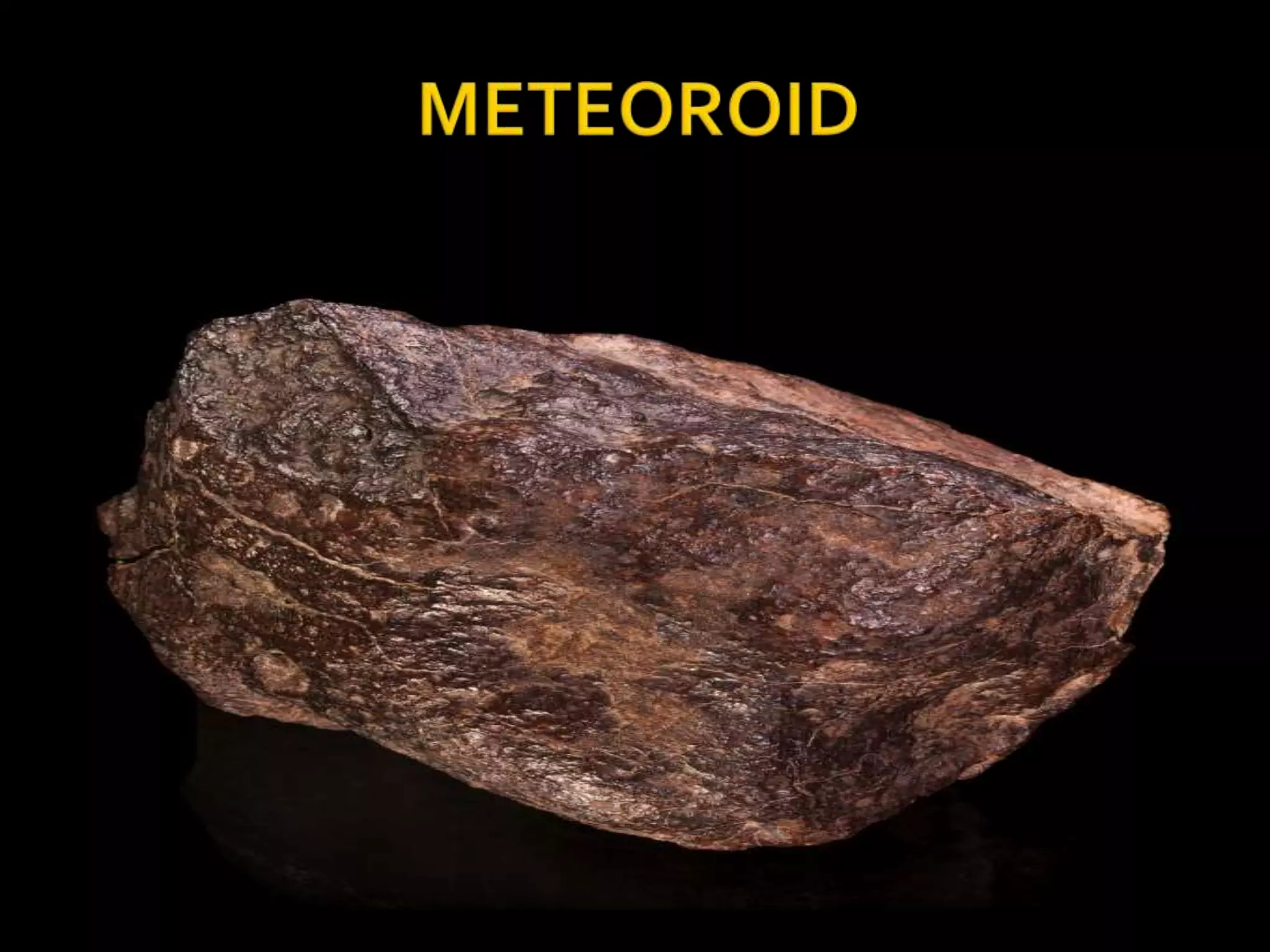
origin of the solar system. A small rocky or metallic chunk of material that travels
through space is called a meteoroid.Very small meteoroids (the size of dust) are often
referred to as micrometeoroids or space dust.These fragments may also be leftover
comet debris, or were ejected in collisions between other solar system bodies such as
the Moon or Mars.
As a meteoroid travels through our atmosphere, it is heated by friction.That causes it
to glow, and if this happens at night, we see a long streak of light known as a meteor.
If the object survives the trip and falls to Earth’s surface, it is known as a meteorite.
Many of these fall into the ocean (since about 71% of Earth’s surface is covered by
water).The rest fall on land, where they await discovery by meteorite hunters.
Millions of meteoroids travel through Earth’s atmosphere each day.
When a meteor encounters our atmosphere and is vaporized, it leaves
behind a trail.That “burning” meteoroid is called a meteor.
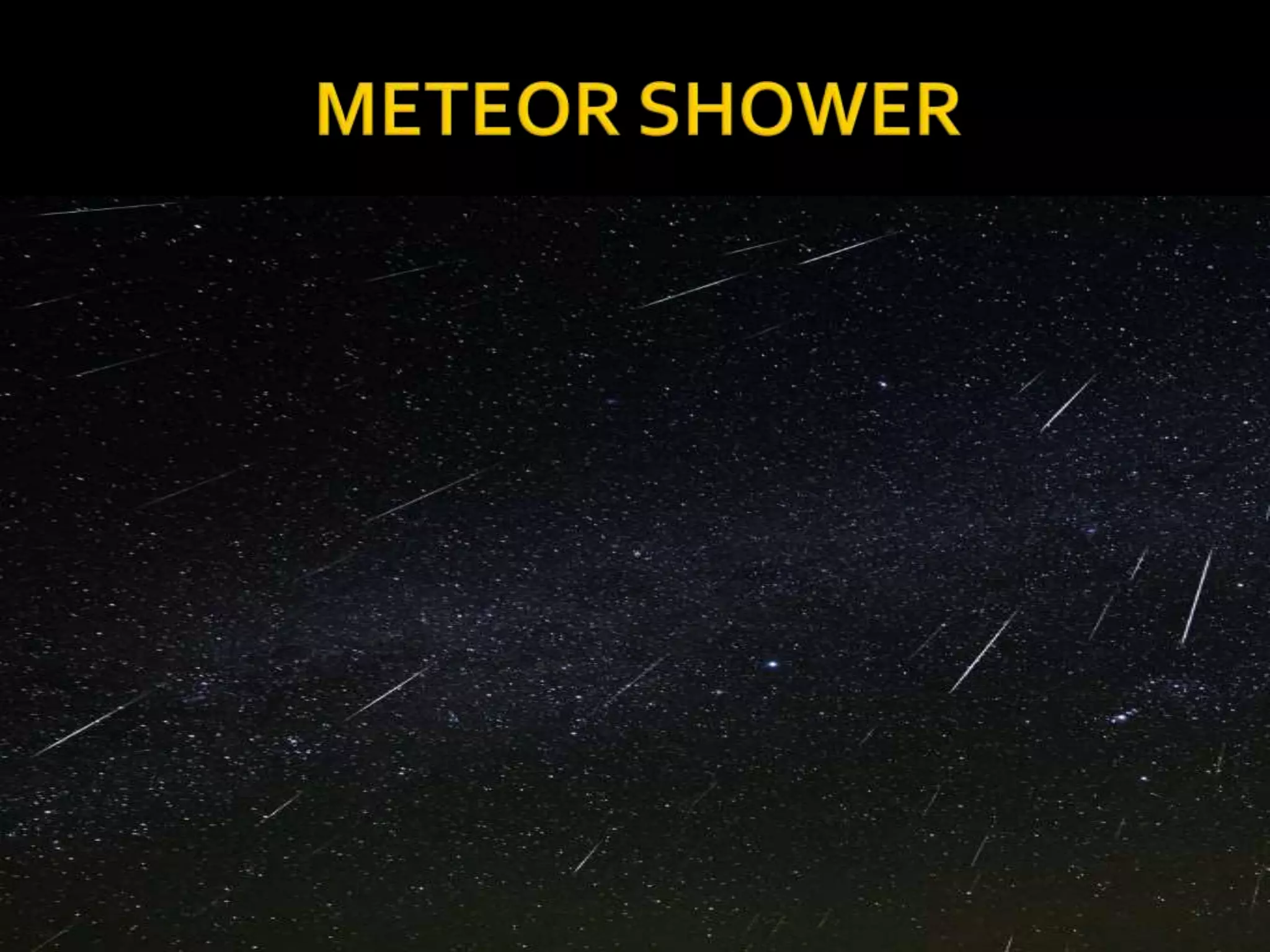
The appearance of a number of meteors occurring in the same part of
the sky over a period of time is called “meteor shower”.
Many meteor showers are associated with comets, which leave behind
debris as they orbit through the solar system. Showers occur when
Earth’s orbit crosses the path of a comet’s orbit.
Most meteorites are one of three types: stony, stony-iron, or iron.
These compositions tell us where the meteoroid existed in its parent
body. An iron or stony iron was close to the core of an asteroid, while a
stony object was closer to the surface.
A meteor shower occurs when a number of
meteors flash seem to radiate (or shoot out
from) the same point in the sky. They are
usually named for the constellation in which
their radiant appears. The meteoroids in a
shower usually come from the trail of debris
left behind by a comet. In the case of the
Geminids and Quadrantids, those meteor
showers come from the debris scatted by
orbiting asteroids. When Earth’s orbit
intersects the dust trail, we see more
meteors flaring as the cometary debris
encounters our planet’s atmosphere.
Most meteor showers are caused by debris from comets. When Earth moves through
those debris trails, we see increased numbers of comets.
Two meteor showers are caused by debris shed by asteroids.The Quadrantids are
very likely caused by debris from the minor planet 2003 EH1.The Geminid meteor
shower comes from debris shed by asteroid 3200 Phaethon.
The Orionid Meteor shower (which occurs in late October each year) is created by
dust and debris left behind by the passage of Comet 1P/Halley.
Meteors fall to Earth during the day, although we can’t see them.
It is very rare that a meteorite will strike a human being. It’s more likely that it will fall
into the ocean.
The best time to view a meteor shower is in the early morning hours, preferably on a
dark, moonless night.
The earliest record of the Perseids meteor shower is found in Chinese annals from 36
AD.

Solar System Facts Powerpoint

  • 1.
  • 2.
    The Solar Systemwas formed approximately 4.6 billion years ago and consists of the Sun, planets, dwarf planets and other astronomical objects bound in its orbit.The formation was cause by the collapse of a giant molecular cloud, the mass at the centre collecting to form the Sun and a flat disk of dust around it which the planets and other bodies would eventually be formed from. 99.86% of the system’s mass is found in the Sun and the majority of the remaining 0.14% is contained within the solar system’s eight planets. The four smaller inner planets, also known as the “terrestrial planets” (Mercury,Venus, Earth and Mars), are primarily composed of rock and metal.The four outer planets, also known as the “gas giants” (Jupiter, Saturn, Uranus and Neptune), are substantially larger and more massive than the inner planets. The two innermost gas giants, Jupiter and Saturn, are the larger of the four and are composed mainly of hydrogen and helium.The two outermost gas giants, Uranus and Neptune, are composed largely of ices, (water, ammonia and methane) and are sometimes also referred to as the “ice giants“. Other objects of note in the Solar System are the dwarf planets (Ceres, Pluto, Haumea, Makemake & Eris),moons, asteroids, the asteroid belt, comets and the Kuiper belt. Facts AboutThe Solar System
  • 3.
    The Sun orSol, is the star at the centre of our solar system and is responsible for the Earth’s climate and weather.The Sun is an almost perfect sphere with a difference of just 10km in diameter between the poles and the equator.The average radius of the Sun is 695,508 km (109.2 x that of the Earth) of which 20–25% is the core.
  • 5.
    SUN AGE 4.6 BILLION YEARS TYPE YELLOWDWARF=(GNV) DIAMETER 1,392,864 KM CIRCUMFERENCE AT EQUATOR 4,370,005.6 KM MASS 1,989,100,000,000,000,000,000 BILLION KG-(333,060xEARTH) SURFACE TEMPERATURE 5500 DEGREES CELSIUS
  • 7.
    ONE MILLION EARTH’SCAN FIT INSIDETHE SUN EVENTUALLY,THE SUNWILLCONSUMETHE EARTH THE SUNWILLONE DAY BE ABOUTTHE SIZE OF EARTH THE SUNCONTAINS 99.86%OFTHE MASS INTHE SOLAR SYSTEM THE SUN ISAN ALMOST PERFECT SPHERE LIGHT FROMTHE SUNTAKES EIGHT MINUTESTO REACH EARTH THE SUNTRAVELSAT 220 KILOMETERS PER SECOND. THE DISTANCE FROM SUNTO EARTH CHANGESTHROUGHTHEYEAR THE SUN IS MIDDLES-AGED THE SUN HAS AVERY STRONG MAGNETIC FIELD THETEMPERATURE INSIDETHE SUN CAN REACH 15 MILLION DEGREESCELSIUS THE SUN GENERATES SOLARWINDS
  • 8.
    The Moon (orLuna) is the Earth’s only natural satellite and was formed 4.6 billion years ago around some 30–50 million years after the formation of the solar system.The Moon is in synchronous rotation with Earth meaning the same side is always facing the Earth. The first unmanned mission to the Moon was in 1959 by the Soviet Lunar Program with the first manned landing being Apollo 11 in 1969.
  • 10.
    MOON CIRCUMFERENCE AT EQUATOR 10,917,.0KM DIAMETER 3,475 KM MASS 73,476,730,924,573,500 MILLION KG=(0.0123xEARTH) ORBITS THE EARTH AVERAGE DISTANCE FROM EARTH 383,400 KM LENGTH OF ORBIT 27.3 EARTH DAYS SURFACE TEMPERATURE
  • 12.
    THE DARK SIDEOFTHEMOON ISTHE MYTH THE RISEAND FALL OFTHETIDESON EARTH IS CAUSED BYTHE MOON THE MOON IS DRIFTINGAWAY FROM EARTH A PERSONWOULDWEIGH MUCH LESSONTHE MOON THE MOON HAS ONLY BEENWALKED ON BY 12 PEOPLE THE MOON HAS NO ATMOSPHERE THE MOON HAS QUAKES THE FIRST SPACECRAFTTO REACHTHE MOONWAS LUNA 1 IN 1959 THE MOON ISTHE FIFTH LARGEST SATELLITE INTHE SOLAR SYSTEM THE MOONWILL BEVISITED BY MAN INTHE NEAR FUTURE DURINGTHE 1950’STHE USA CONSIDERED DENOTINGA NUCLEAR BOMB ONTHE MOON
  • 13.
    A comet isa very small solar system body made mostly of ices mixed with smaller amounts of dust and rock. Most comets are no larger than a few kilometres across.The main body of the comet is called the nucleus, and it can contain water, methane, nitrogen and other ices. When a comet is heated by the Sun, its ices begin to sublimate (similar to the way dry ice “fizzes” when you leave it in sunlight).The mixture of ice crystals and dust blows away from the comet nucleus in the solar wind, creating a pair of tails.The dust tail is what we normally see when we view comets from Earth. A plasma tail also forms when molecules of gas are “excited” by interaction with the solar wind.The plasma tail is not normally seen with the naked eye, but can be imaged. Comets normally orbit the Sun, and have their origins in the Oort Cloud and Kuiper Belt regions of the outer solar system.
  • 15.
    A comet isa relatively small solar system body that orbits the Sun.When close enough to the Sun they display a visible coma (a fuzzy outline or atmosphere due to solar radiation) and sometimes a tail. The coma is created as the comet gets closer to the Sun, causing water, carbon dioxide and other compounds to sublime (quickly changing from solid to gas) from its surface. Comets are made of ice, dust and small rocky particles. The name comet comes from the Greek word meaning ‘hair of the head’, it came from the Greek philosopherAristotle who observed comets as ‘stars with hair’. Short term comets (also known as periodic comets) have orbital periods of less than 200 years while long term comets have orbital periods of over 200 years.
  • 16.
    Asteroids are small,rocky solar system bodies that populate interplanetary space out to the orbit of Jupiter.There are millions of them, and they are often grouped by their composition.The planetary science community refers to them as minor planets, a general term applied to solar system bodies smaller than moons.Asteroids are mainly made of materials left over from the formation of the inner solar system words. Most of them orbit the Sun between Mars and Jupiter, although there are groups of them that orbit closer. Asteroids come in three composition classes. C-types (chondrites) are made of clay and silicate rocks. S-types are the so-called “stony” asteroids and are made mostly of silicate rocks and nickel-iron mixtures. M-types are metallic nickel-iron.These categories indicate how far from the Sun they formed in the early solar system.
  • 18.
    Asteroids aren’t theonly things that hit Earth. Each day, more than 100 tons of material from asteroids and comets falls toward Earth. Most of it is destroyed by friction as it passes through our atmosphere. If something DOES hit the ground, it is known as a meteorite. While asteroid impacts were more common in the past, they aren’t as frequent today. An asteroid impact some 65 million years ago contributed to the extinction of the dinosaurs. (It was one of several factors that affected all life on Earth at that time.) Earth suffers an impact from an object the size of a football field about once every 2,000 years. A car-sized meteoroid (a piece of asteroid) falls into Earth’s atmosphere about once a year.The result is a beautiful fireball, but the meteoroid usually burns up before reaching the ground. Asteroids are rich in precious metals and other metals, as well as water. Some asteroids have moons of their own! Most asteroids orbit the Sun in the Asteroid Belt, which lies between Mars and Jupiter.
  • 19.
    Earth is bombardedwith millions of tons of space material each day. Most of the objects vaporize in our atmosphere, but some of the larger pieces (from pebbles to boulder-sized rocks) actually fall to the ground. Most of the objects come from asteroids, which are objects made of various types of rock and have existed since the origin of the solar system. A small rocky or metallic chunk of material that travels through space is called a meteoroid.Very small meteoroids (the size of dust) are often referred to as micrometeoroids or space dust.These fragments may also be leftover comet debris, or were ejected in collisions between other solar system bodies such as the Moon or Mars. As a meteoroid travels through our atmosphere, it is heated by friction.That causes it to glow, and if this happens at night, we see a long streak of light known as a meteor. If the object survives the trip and falls to Earth’s surface, it is known as a meteorite. Many of these fall into the ocean (since about 71% of Earth’s surface is covered by water).The rest fall on land, where they await discovery by meteorite hunters.
  • 21.
    Millions of meteoroidstravel through Earth’s atmosphere each day. When a meteor encounters our atmosphere and is vaporized, it leaves behind a trail.That “burning” meteoroid is called a meteor. The appearance of a number of meteors occurring in the same part of the sky over a period of time is called “meteor shower”. Many meteor showers are associated with comets, which leave behind debris as they orbit through the solar system. Showers occur when Earth’s orbit crosses the path of a comet’s orbit. Most meteorites are one of three types: stony, stony-iron, or iron. These compositions tell us where the meteoroid existed in its parent body. An iron or stony iron was close to the core of an asteroid, while a stony object was closer to the surface.
  • 22.
    A meteor showeroccurs when a number of meteors flash seem to radiate (or shoot out from) the same point in the sky. They are usually named for the constellation in which their radiant appears. The meteoroids in a shower usually come from the trail of debris left behind by a comet. In the case of the Geminids and Quadrantids, those meteor showers come from the debris scatted by orbiting asteroids. When Earth’s orbit intersects the dust trail, we see more meteors flaring as the cometary debris encounters our planet’s atmosphere.
  • 24.
    Most meteor showersare caused by debris from comets. When Earth moves through those debris trails, we see increased numbers of comets. Two meteor showers are caused by debris shed by asteroids.The Quadrantids are very likely caused by debris from the minor planet 2003 EH1.The Geminid meteor shower comes from debris shed by asteroid 3200 Phaethon. The Orionid Meteor shower (which occurs in late October each year) is created by dust and debris left behind by the passage of Comet 1P/Halley. Meteors fall to Earth during the day, although we can’t see them. It is very rare that a meteorite will strike a human being. It’s more likely that it will fall into the ocean. The best time to view a meteor shower is in the early morning hours, preferably on a dark, moonless night. The earliest record of the Perseids meteor shower is found in Chinese annals from 36 AD.