PLACENTA
Ms. Simranpal Kaur
Assistant Professor
>The placenta is a temporary organ.
>This is a fetomaternal organ.
>It has two components:
-Fetal part – develops from the chorionic sac
-Maternal part – derived from the endometrium(functional
layer)
>The placenta and the umbilical cord are transport system for
substances between the mother and the fetus.(vessels in umbilical
cord)
>Shape: Discoid
>Diameter: 15-20 cm.
>Weight: 500 gm
>Thickness: 2.5 cm at its center and gradually tapers towards the
periphery.
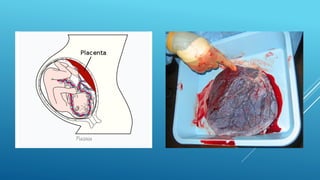
>Position: in the upper uterine segment (99.5%),either in the
posterior surface (2/3) or the anterior surface(1/3)
FUNCTION OF THE PLACENTA
RESPIRATORY FUNCTION
>O2 and CO2 pass across the placenta by simple diffusion.
The foetal hemoglobin has more affinity and carrying capacity
than adult hemoglobin. The rate of diffusion depends upon:
-maternal gases gradient
-maternal and foetal placental blood flow
-placental permeability
-placental surface area
NUTRITIVE FUNCTION
The transfer of nutrients from the mother to the foetus is
achieved by:
➢ Simple diffusion: e.g. water and electrolytes.
➢ Facilitated diffusion: e.g. glucose.
➢ Active diffusion: e.g. amino acids
➢ Pinocytosis: e.g. large protein molecules and cells
EXCRETORY FUNCTION
➢ Waste products of the foetus as urea are passed to maternal
blood by simple diffusion through placenta.
➢ Production of enzymes E.g. oxytocinase, monoamino oxidase,
insulinase, histaminase and heat stable alkaline phosphatase.
➢ Production of pregnancy associated plasma proteins(PAPP)
E.g. PAPP-A, PAPP-B, PAPP-C, PAPP-D and PP5.The exact
function of these proteins are not defined.
BARRIER FUNCTION
❑ The foetal blood in the chronic villi is separated from the maternal
blood, in the intervillous spaces, by the placental barrier which is
composed of:
- endothelium of the foetal blood vessels,
- the villious stroma,
- the cytotrophoblast and syncytiotrophoblast.
❑ However, it is an incomplete barrier. It allows the passage of
antibodies(IgG only), hormone, antibiotics, sedatives, some viruses
as rubella and smallpox and some organisms as treponema
pallida. Substances of large molecular size as heparine and insulin
cannot pass the placental barrier.
ABNORMALITIES OF PLACENTA
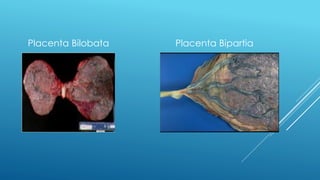
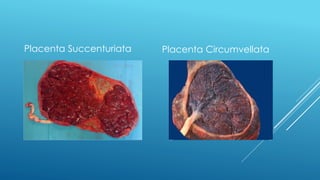
❑ Abnormal Shape:
1.Placenta Bilobata
2.Placenta Bipartia
3.Placenta Succenturiata
4.Placenta Circumvallata
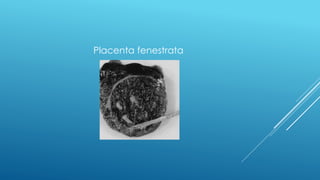
5.Placenta Fenestrata
Placenta Bilobata Placenta Bipartia
Placenta Succenturiata Placenta Circumvellata
Placenta fenestrata
❑ Abnormal Diameter:
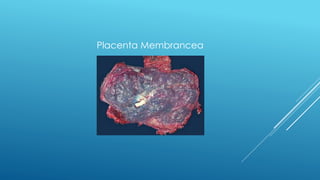
-Placenta membrancea: A great part of the
chorion develops into placental tissue. The placenta
is large, thin and may measure 30-40 cm in diameter.
It may encroach on lower uterine segment i.e.
placenta praevia.
Placenta Membrancea
❑ Abnormal Weight
-The placenta increase in size and weight as in
congenital syphilis, hydrops foetalis and diabetes
mellitus.
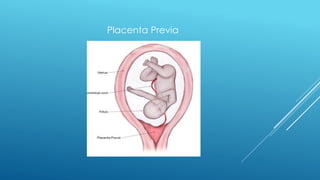
❑ Abnormal Position:
- Placenta Praevia: The placenta is partly
or completely attached to the lower uterine
segment
Placenta Previa
❑ Abnormal Adhesion:
- Placenta Accreta: The chorionic villi penetrate deeply
into the uterine wall to reach the myometrium, due to
deficient decidua basalis. When the villi penetrate
deeply into the myometrium, it is called “placenta
increta” and when they reach the peritoneal coat it is
called “placenta percreta”.
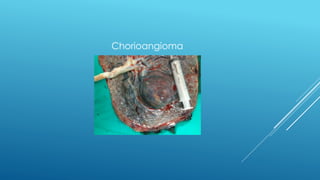
❑ Placental Tumor:
- Chorioangioma is rare benign tumor of the
placental blood vessels which may be
associated with hydraaminos.
Chorioangioma
THANK YOU

powerpoint presentation on placenta-2.pdf

  • 1.
  • 2.
    >The placenta isa temporary organ. >This is a fetomaternal organ. >It has two components: -Fetal part – develops from the chorionic sac -Maternal part – derived from the endometrium(functional layer) >The placenta and the umbilical cord are transport system for substances between the mother and the fetus.(vessels in umbilical cord)
  • 3.
    >Shape: Discoid >Diameter: 15-20cm. >Weight: 500 gm >Thickness: 2.5 cm at its center and gradually tapers towards the periphery. >Position: in the upper uterine segment (99.5%),either in the posterior surface (2/3) or the anterior surface(1/3)
  • 5.
  • 6.
    RESPIRATORY FUNCTION >O2 andCO2 pass across the placenta by simple diffusion. The foetal hemoglobin has more affinity and carrying capacity than adult hemoglobin. The rate of diffusion depends upon: -maternal gases gradient -maternal and foetal placental blood flow -placental permeability -placental surface area
  • 7.
    NUTRITIVE FUNCTION The transferof nutrients from the mother to the foetus is achieved by: ➢ Simple diffusion: e.g. water and electrolytes. ➢ Facilitated diffusion: e.g. glucose. ➢ Active diffusion: e.g. amino acids ➢ Pinocytosis: e.g. large protein molecules and cells
  • 8.
    EXCRETORY FUNCTION ➢ Wasteproducts of the foetus as urea are passed to maternal blood by simple diffusion through placenta.
  • 9.
    ➢ Production ofenzymes E.g. oxytocinase, monoamino oxidase, insulinase, histaminase and heat stable alkaline phosphatase. ➢ Production of pregnancy associated plasma proteins(PAPP) E.g. PAPP-A, PAPP-B, PAPP-C, PAPP-D and PP5.The exact function of these proteins are not defined.
  • 10.
    BARRIER FUNCTION ❑ Thefoetal blood in the chronic villi is separated from the maternal blood, in the intervillous spaces, by the placental barrier which is composed of: - endothelium of the foetal blood vessels, - the villious stroma, - the cytotrophoblast and syncytiotrophoblast. ❑ However, it is an incomplete barrier. It allows the passage of antibodies(IgG only), hormone, antibiotics, sedatives, some viruses as rubella and smallpox and some organisms as treponema pallida. Substances of large molecular size as heparine and insulin cannot pass the placental barrier.
  • 11.
  • 12.
    ❑ Abnormal Shape: 1.PlacentaBilobata 2.Placenta Bipartia 3.Placenta Succenturiata 4.Placenta Circumvallata 5.Placenta Fenestrata
  • 13.
  • 14.
  • 15.
  • 16.
    ❑ Abnormal Diameter: -Placentamembrancea: A great part of the chorion develops into placental tissue. The placenta is large, thin and may measure 30-40 cm in diameter. It may encroach on lower uterine segment i.e. placenta praevia.
  • 17.
  • 18.
    ❑ Abnormal Weight -Theplacenta increase in size and weight as in congenital syphilis, hydrops foetalis and diabetes mellitus.
  • 19.
    ❑ Abnormal Position: -Placenta Praevia: The placenta is partly or completely attached to the lower uterine segment
  • 20.
  • 21.
    ❑ Abnormal Adhesion: -Placenta Accreta: The chorionic villi penetrate deeply into the uterine wall to reach the myometrium, due to deficient decidua basalis. When the villi penetrate deeply into the myometrium, it is called “placenta increta” and when they reach the peritoneal coat it is called “placenta percreta”.
  • 22.
    ❑ Placental Tumor: -Chorioangioma is rare benign tumor of the placental blood vessels which may be associated with hydraaminos.
  • 23.
  • 24.