Downloaded 43 times
![Certificates
♦ Introduced in 1978
[Kohnfelder’s Bachelor’s thesis]
♦ X.509 – “the standard standard” today
– v.1 (1988) – not extendable
– v.2 – not much better
– v.3 (1997) is much better – optional extensions
Today, X.509=v.3
– Many other standards extend X.509
♦ Others
– PGP, SPKI, etc.](https://image.slidesharecdn.com/pkigeneitkis-140303204314-phpapp01/85/PKI-by-Gene-Itkis-8-320.jpg)
![X.509 Certificate Format
♦ See [AL] pg.76](https://image.slidesharecdn.com/pkigeneitkis-140303204314-phpapp01/85/PKI-by-Gene-Itkis-10-320.jpg)
![SET – Secure Electronic Transaction
♦ Credit card payment protocol
♦ Adopts and extends X.509
– See [AL] pg.84](https://image.slidesharecdn.com/pkigeneitkis-140303204314-phpapp01/85/PKI-by-Gene-Itkis-15-320.jpg)
![Certificate Policies
♦ Distinguished by OIDs (Object ID)
– “form letters”
♦ Equivalences
– Policy Mapping ext. declare policies equivalent
♦ Established & registered by
Policy [Management] Authorities
– Internal – e.g. corporate
– External – community](https://image.slidesharecdn.com/pkigeneitkis-140303204314-phpapp01/85/PKI-by-Gene-Itkis-19-320.jpg)
![Key & Certificate Management
Key/Certificate Life Cycle Management
– Identity ≠ Key. Focus on Key!
Stages
♦ Initialization
♦ Issued (active)
♦ Cancellation
• Generation
• Issuance
• [Usage]
• Cancellation](https://image.slidesharecdn.com/pkigeneitkis-140303204314-phpapp01/85/PKI-by-Gene-Itkis-23-320.jpg)
![Initialization
♦ Registration
– Via RA
– Identity verification
• According to CP/CPS docs
– If on-line, should be protected+authenticated (?)
– Secret shared by user and CA
• New or pre-existing relationship
♦ Key pair generation
♦ Certificate creation & delivery
♦ [Key backup]](https://image.slidesharecdn.com/pkigeneitkis-140303204314-phpapp01/85/PKI-by-Gene-Itkis-24-320.jpg)
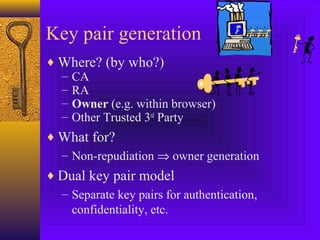
![Issued Phase
♦ Certificate retrieval
– To encrypt msg or verify signature
♦ Certificate validation
– Verify certificate integrity+validity
♦ Key recovery
– Key backup – automate as much as possible
♦ Key update
– When keys expire: new certificate [+new keys]](https://image.slidesharecdn.com/pkigeneitkis-140303204314-phpapp01/85/PKI-by-Gene-Itkis-30-320.jpg)
![CRL versions
♦ Version 1 (from x509 v1)
– Flaws:
• Scalability
• Not extendable
• Can replace one CRL with another
♦ Version 2 (similar to x509 v3)
– Extensions
• critical and non-critical
• Per-CRL and per-entry
– Format: see [AL] pg.112](https://image.slidesharecdn.com/pkigeneitkis-140303204314-phpapp01/85/PKI-by-Gene-Itkis-36-320.jpg)
![Certificate Revocation Trees
– Valicert [Kocher]
– Based on Merkle’s hash trees
– Similar/Relevant work: [Micali; Naor&Nissim]
♦ Construct hash-tree; leaves – certificates
♦ Sign root
♦ To verify a certificate in the tree: path from
the certificate to root + the siblings
♦ Certificate Owner can offer proof of not
being revoked as of the current CRT date!](https://image.slidesharecdn.com/pkigeneitkis-140303204314-phpapp01/85/PKI-by-Gene-Itkis-42-320.jpg)
![Entity Naming
♦ What’s the identity?
(the one bound by certificate to the PK [+sk])
– If a certificate is issued to “GeoTrust ”, rather
than “Geotrust”, you may be talking to a
different entity than what you think](https://image.slidesharecdn.com/pkigeneitkis-140303204314-phpapp01/85/PKI-by-Gene-Itkis-54-320.jpg)
![Path Construction
♦ “Just a [Shortest] Path graph algorithm”
♦ Not so simple – graph is not known
– Edges (certificates) need to be queeried
♦ Once Path Construction is done Path
Validation is straight-forward](https://image.slidesharecdn.com/pkigeneitkis-140303204314-phpapp01/85/PKI-by-Gene-Itkis-59-320.jpg)

This document discusses public key infrastructures (PKI) and their components. It describes how PKI can enable secure communication, notarization, time-stamping, non-repudiation, and privilege management through the use of certificates, digital signatures, and trusted third parties. It also outlines some of the pitfalls of PKI, such as key compromises, difficulties with revocation, and human errors in certificate validation. Finally, it examines the technical details of how certificates, certification authorities, certificate paths, and trust models function within a PKI.


