TOPIC- PUBLIC KEY INFRASTRUCTURE
ADITYA NAMA
What is Public Key Infrastructure?
A public key infrastructure (PKI) allows users of the Internet and other public
networks to engage in secure communication, data exchange and money exchange.
This is done through public and private cryptographic key pairs provided by a
certificate authority.
There are different types of systems in a PKI:
• Private and Public Key Systems:
Private systems are symmetric cryptography and a public systems are asymmetric
cryptography. Currently, public key systems are the most common.
• Symmetric Encryption Systems:
The same key is used for both the processes of encryption and decryption.
• Asymmetric Encryption Systems:
A different key is used for each process. One key is the public key and the other key
is the private key. If something is encrypted with the public key, then decryption can
only be done with the private key. Alternatively, if something is encrypted with the
private key, then decryption must be done only with the public key.
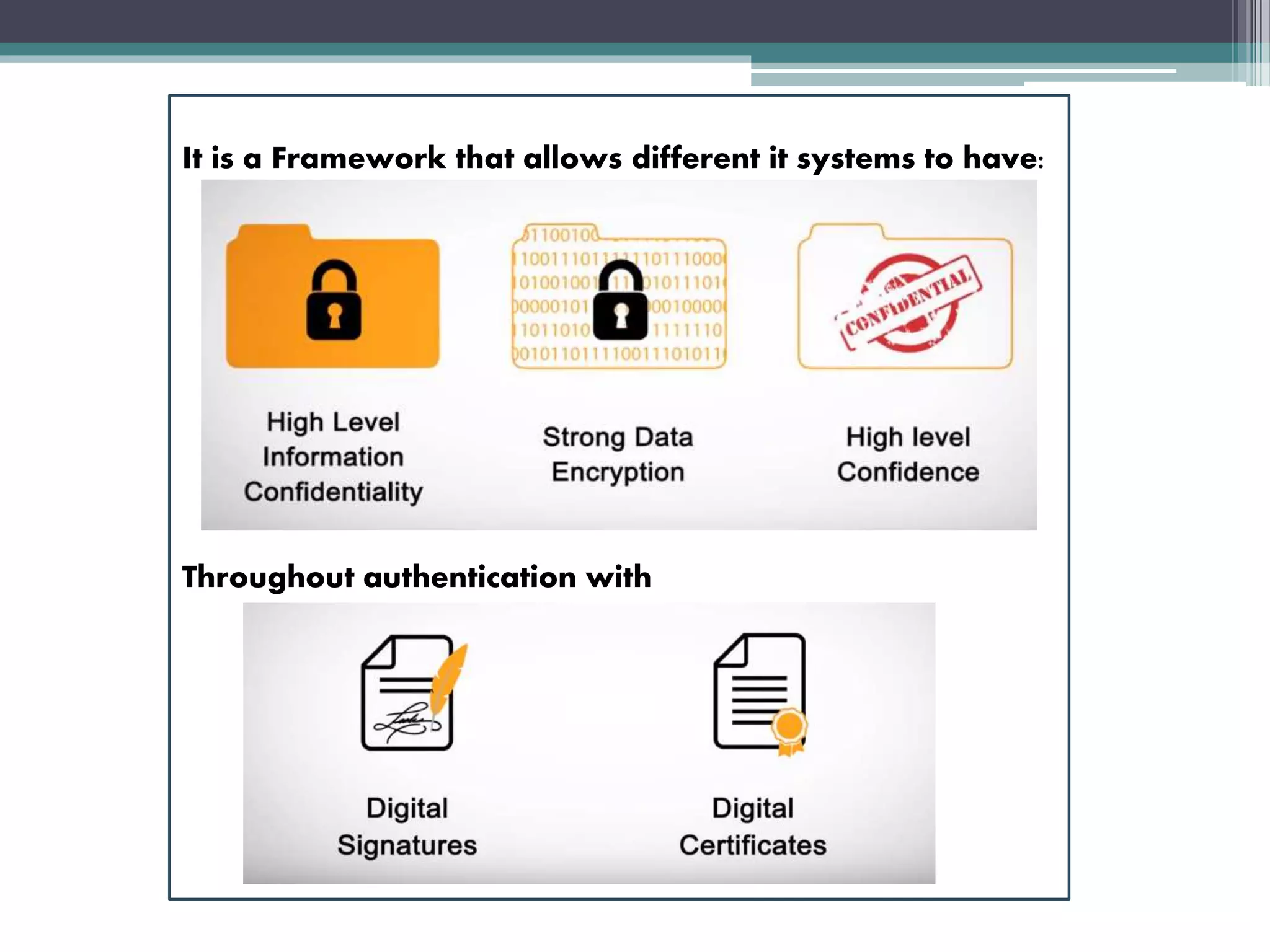
It is a Framework that allows different it systems to have:
Throughout authentication with
JOHN SUZZANE
Secure Message
REQUEST
SENDS HER KEY TO JOHN TO
ENCRYPT THE MESSAGE
Encrypted Message
Can be distributed
to anyone
Uses to Decrypt
the message and
read it.
Let’s take an example: -
How do we really know that John really got Suzzane Public key?
Someone could have pretended to be Suzzane and send John her/his
Public key.
This is where Digital Certificates come in.
SUZZANE
What is Digital Certificate?
• They are the data packages that Identifies the entity.
What is Digital Certificates?
• The Digital Certificates itself is protected by
asymmetric cryptography
A trusted party known as Certificate Authority(CA) issues these
Digital Certificates to the person once a certain confidence in the person's
identity has been established by the CA.
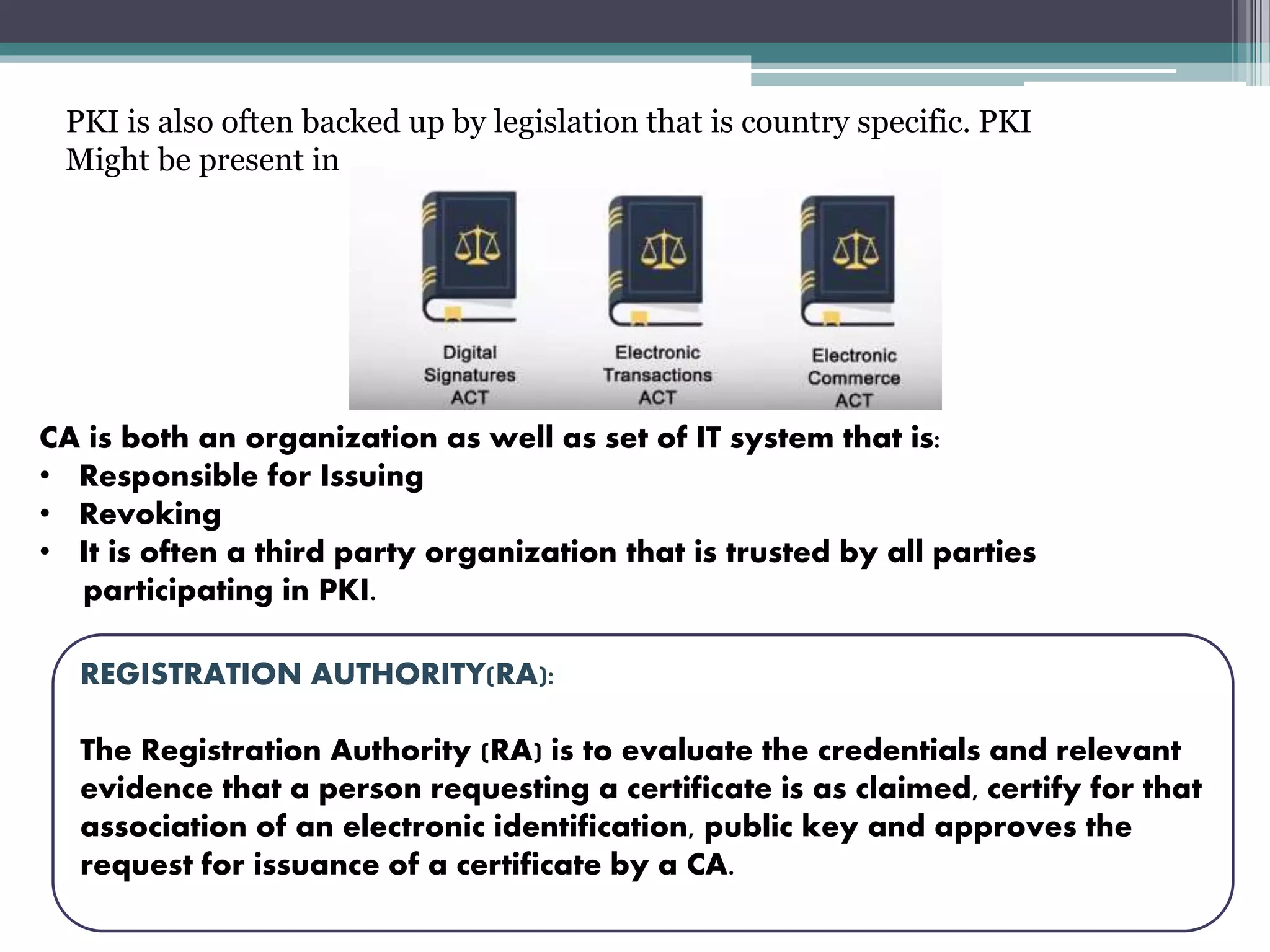
PKI is also often backed up by legislation that is country specific. PKI
Might be present in
CA is both an organization as well as set of IT system that is:
• Responsible for Issuing
• Revoking
• It is often a third party organization that is trusted by all parties
participating in PKI.
REGISTRATION AUTHORITY(RA):
The Registration Authority (RA) is to evaluate the credentials and relevant
evidence that a person requesting a certificate is as claimed, certify for that
association of an electronic identification, public key and approves the
request for issuance of a certificate by a CA.
Organizations can also have their In-house CA system. Secure matrix PKI in a BOX
Appliance allows organizations to exactly do that with ease and at a lower cost.
Now take that example again of John and Suzzane but this time with PKI:
JOHN
SUZZANE
Secure Message
The Digital Certificate contains suzzane’s particulars, Public Key, the CAS
particulars and cryptographic data all the information needed to identify
the entity with a high level of confidence. The process will remain same but
this time John make sure that the Public Key came from Suzzane by
validating DC.
• It allows the choice of trust provider.
• Users maintain their own certificates, and certificate authentication involves exchange of
data between client and server only. This means that no third party authentication server
needs to be online. There is thus no limit to the number of users who can be supported
using PKI.
• PKI allows delegated trust. That is, a user who has obtained a certificate from a
recognized and trusted certificate authority can authenticate himself to a server the very
first time he connects to that server, without having previously been registered with the
system.
Advantages of the PKI:
Disadvantages of the PKI
• Computer has to work very hard to both encrypt and decrypt data using the system.
In applications where we need to work with large quantities of encrypted data on a
regular basis, the computational overhead means that public key systems can be
very slow.
• The certification authority may be get compromised, the criminal could issue false
certificates and fool people into sending data to the wrong place.
• However, once you receive that credit card data, if you leave a computer with
access to your server out in the open, someone could sit down at the keyboard,
download all of the securely transferred data and steal it. Public key encryption
won't protect against that and, as such, it's only a part of an overall security system.
END!
SOURCE IS SECURED
for links send me your Digital Certificate.
Public key infrastructure

Public key infrastructure

  • 1.
    TOPIC- PUBLIC KEYINFRASTRUCTURE ADITYA NAMA
  • 2.
    What is PublicKey Infrastructure? A public key infrastructure (PKI) allows users of the Internet and other public networks to engage in secure communication, data exchange and money exchange. This is done through public and private cryptographic key pairs provided by a certificate authority. There are different types of systems in a PKI: • Private and Public Key Systems: Private systems are symmetric cryptography and a public systems are asymmetric cryptography. Currently, public key systems are the most common. • Symmetric Encryption Systems: The same key is used for both the processes of encryption and decryption. • Asymmetric Encryption Systems: A different key is used for each process. One key is the public key and the other key is the private key. If something is encrypted with the public key, then decryption can only be done with the private key. Alternatively, if something is encrypted with the private key, then decryption must be done only with the public key.
  • 3.
    It is aFramework that allows different it systems to have: Throughout authentication with
  • 4.
    JOHN SUZZANE Secure Message REQUEST SENDSHER KEY TO JOHN TO ENCRYPT THE MESSAGE Encrypted Message Can be distributed to anyone Uses to Decrypt the message and read it. Let’s take an example: -
  • 5.
    How do wereally know that John really got Suzzane Public key? Someone could have pretended to be Suzzane and send John her/his Public key. This is where Digital Certificates come in. SUZZANE
  • 6.
    What is DigitalCertificate? • They are the data packages that Identifies the entity. What is Digital Certificates? • The Digital Certificates itself is protected by asymmetric cryptography A trusted party known as Certificate Authority(CA) issues these Digital Certificates to the person once a certain confidence in the person's identity has been established by the CA.
  • 7.
    PKI is alsooften backed up by legislation that is country specific. PKI Might be present in CA is both an organization as well as set of IT system that is: • Responsible for Issuing • Revoking • It is often a third party organization that is trusted by all parties participating in PKI. REGISTRATION AUTHORITY(RA): The Registration Authority (RA) is to evaluate the credentials and relevant evidence that a person requesting a certificate is as claimed, certify for that association of an electronic identification, public key and approves the request for issuance of a certificate by a CA.
  • 8.
    Organizations can alsohave their In-house CA system. Secure matrix PKI in a BOX Appliance allows organizations to exactly do that with ease and at a lower cost. Now take that example again of John and Suzzane but this time with PKI:
  • 9.
    JOHN SUZZANE Secure Message The DigitalCertificate contains suzzane’s particulars, Public Key, the CAS particulars and cryptographic data all the information needed to identify the entity with a high level of confidence. The process will remain same but this time John make sure that the Public Key came from Suzzane by validating DC.
  • 10.
    • It allowsthe choice of trust provider. • Users maintain their own certificates, and certificate authentication involves exchange of data between client and server only. This means that no third party authentication server needs to be online. There is thus no limit to the number of users who can be supported using PKI. • PKI allows delegated trust. That is, a user who has obtained a certificate from a recognized and trusted certificate authority can authenticate himself to a server the very first time he connects to that server, without having previously been registered with the system. Advantages of the PKI: Disadvantages of the PKI • Computer has to work very hard to both encrypt and decrypt data using the system. In applications where we need to work with large quantities of encrypted data on a regular basis, the computational overhead means that public key systems can be very slow.
  • 11.
    • The certificationauthority may be get compromised, the criminal could issue false certificates and fool people into sending data to the wrong place. • However, once you receive that credit card data, if you leave a computer with access to your server out in the open, someone could sit down at the keyboard, download all of the securely transferred data and steal it. Public key encryption won't protect against that and, as such, it's only a part of an overall security system. END! SOURCE IS SECURED for links send me your Digital Certificate.