PKI Overview
Tim Polk, NIST
wpolk@nist.gov
Background
Secret key cryptography works, but key
management is a nightmare
Public key cryptography uses two keys
– one that is secret to the “owner”
– one that is widely available

And all our problems were solved?
– who’s key is this anyway?
– who says so?
Public Key Infrastructure
Secure, reliable, and scalable method for
distributing public keys for secrecy,
correctness, and sender verification
“Binds” the owner to the public key using a
digital certificate
Maintains and distributes status information
for the life of that binding
Roles of PKI Components
CA is like the DMV and issues and revokes
certificates
RA is the person that checks your identity
Client have and use certificates
Repository stores the certificate and status
information so clients don’t have to
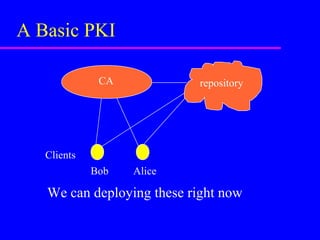
A Basic PKI
CA

repository

Clients
Bob

Alice

We can deploying these right now
Growing A PKI
bigger PKIs can be constructed by
connecting CAs
they issue certificates to remote CAs,
binding the remote CA to it’s public key
clients can construct “chains” of linked
bindings
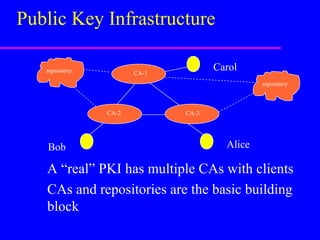
Public Key Infrastructure
repository

Carol

CA-1

repository

CA-2

Bob

CA-3

Alice

A “real” PKI has multiple CAs with clients
CAs and repositories are the basic building
block
PKIs are simple...
as long as you have just one CA and one
repository
– theoretically, they are like lego blocks
– in practice, they can be like a box of bicycle
parts on Christmas Eve

the complexity is the result of
– unstable standards
– non-interoperable products and applications
Standardization Activities
IETF (PKIX WG)
ISO JTC1/SC6 directory work
ANSI X9F and ISO TC68/SC 2/WG 8
IETF Public Key Infrastructure
Using X.509 (PKIX) WG
Formed in 1995
Five RFCs issued in ‘99, four more
approved in the last month
–
–
–
–

certificate and CRL formats
PKI transaction formats and protocols
Certificate Policy Statements
certificate and certificate status retrieval
mechanisms
Certificate and CRL Formats
Base profile is complete (RFC 2459)
– based on X.509, but adds semantics to Internetspecific fields and data

Supporting documents are (nearly)
complete
– KEA (RFC 2527) and ECDSA (I-D)
– enhanced CRLs (I-D)
– enhanced name semantics (I-D)
Transaction Formats and
Protocols
Three major specifications
– Certificate Request Message Format, or CRMF
(RFC 2511)
– Certificate Management Protocol, or CMP
(RFC 2510) [references 2511]
– Certificate Management Messages over CMS,
or CMC (I-D) [references 2511]

Is there room for CMP and CMC?
Certificate and Certificate Status
Retrieval
A wealth of choices
–
–
–
–

LDAP V2 schema
LDAP V2 profile
FTP and HTTP
OCSP
New PKIX Work
Timestamp service protocol
Data certification service protocol
Attribute certificates
ISO Directory Work
Three projects in the directory area were
assigned to JTC1/SC6
– X.509
» maintaining the public key certificate work
» new work in attribute certificates

– X.500 directory work
– ASN.1 (X.680?)
ANSI X9F
Provider of cryptographic standards
Developing certificate and certificate
extension profiles for banking community
– TC68 documents 15782-1 and 15782-3

Defining short certificates for bandwidth or
storage impaired environments
– smart cards, cell phones, etc.

Attribute certificate work (15782-2)
Standardization Summary
ISO, IETF and ANSI are making good
progress
Most of the work is complementary, or at
least well-aligned
There are still too many choices in some
areas (transaction and retrieval protocols)
Parallel attribute certificate projects may
result in divergent standards
Interoperability Testing
The new frontier
– PKI interoperability
– PKI component interoperability

Issues:
– are certificates and CRLs well-formed?
– can components request/revoke certificates?
– can clients build/validate paths?
NIST’s PKI Interoperability
Testbed
Project Goals:
– Creation of complex directory systems
– Creation of heterogeneous PKIs
– Determination of client functionality

Summary:
– the state of the art is a homogeneous PKI with
a very small number of CAs and exactly one
directory
PKI Component Interoperability
Testing
Three basic components
– CAs: X.509 certificate and CRL generation
– Clients: X.509 path validation
– CAs, RAs, clients: transaction message formats
and protocols

As protocols stabilize, interoperability
testing is the logical next step
Tools for Interoperability Testing
reference implementations
– MISPC Reference Implementation from NIST
(X.509, CMP, and CRMF)
– IBM (X.509, CMP, and CRMF)

Conformance tests
– NIST (CMP, CRMF)
PKI deployment
Many pilots ongoing or planned
– “many will play, few will win!”

Why?
– directory infrastructure
– application vacuum
– unreasonable expectations
Directories
Often the problem, instead of the solution!
– X.500 directories
– LDAP directories

Alternative solutions
– alternative retrieval protocols
– all-inclusive packaging
X.500
the global X.500 directory is a myth
– it would resolve most access problems
– it would introduce new problems
» DIT management

– shadowing, replication and chaining
» well specified
» not well tested (different implementations don’t
actually interoperate!)
LDAP
LDAP is ubiquitous, but:
– resolves localized access problems
– relies on referrals to scale
» performance bottleneck
» poor client support

– shadowing, replication and chaining
» proprietary solutions, if they exist at all
» may be addressed in LDAP V3 extensions
Alternative Solutions
Why rely on directories at all?
– FTP/HTTP/DNS retrieval
» we’ve already got these servers, and they work!
» requires a pointer in the certificate

– all-inclusive packaging (S/MIME)
» just include the certificate(s) and CRL(s) in each
transaction and the client doesn’t have to search
» not a complete solution because you can’t always
predict the path for the receiving client
The Application Vacuum
PKI-aware products are limited
– TLS and SSL (browsers), S/MIME

Why aren’t there more PKI-aware
products?
– chicken and egg problem (what PKI?)
– not a straightforward upgrade (e.g., adding
digital signatures to insecure applications)
– no standard API (rewrite for every product)
Unreasonable Expectations
PKI is a not going to solve all your
problems
– first and foremost, PKI is a key management
solution
– overloading with additional semantics (e.g.,
roles and complex policies) is beyond the state
of the art
Piloting for Success
choose an existing application with:
– a close-knit community of users
– security in place (esp. access control), but
– a known key management problem

use a single repository for all information
focus on the key management problem first
attempt to leverage certificates for access
control second (if at all)
Current Market Players
PKI product providers
– rudimentary assurance
– high assurance

Service providers
– certificate issuers
– status information providers

Community of Interest Groups
– ANX, Federal Government, financial
Community of Interest
Groups Rule
they determine the winners and losers
– communities of interest that use the PKI will
determine the features and protocols
– if no communities emerge to use PKI, it will all
disappear

they are emerging (ANX, US government,
SET, etc.) and PKI will appear in more
applications
Summary
The standards bodies have gotten their act
together, but a few thorns remain
The state of the art PKI products
– can support focused applications today
– can’t support a global infrastructure today
– aren’t interoperable, but will be “soon”

Application and directory solutions are
lagging, but vendors will respond to
communities of interest deploying PKIs
For More Information
http://csrc.nist.gov/pki
wpolk@nist.gov

PKI by Tim Polk

  • 1.
    PKI Overview Tim Polk,NIST wpolk@nist.gov
  • 2.
    Background Secret key cryptographyworks, but key management is a nightmare Public key cryptography uses two keys – one that is secret to the “owner” – one that is widely available And all our problems were solved? – who’s key is this anyway? – who says so?
  • 3.
    Public Key Infrastructure Secure,reliable, and scalable method for distributing public keys for secrecy, correctness, and sender verification “Binds” the owner to the public key using a digital certificate Maintains and distributes status information for the life of that binding
  • 4.
    Roles of PKIComponents CA is like the DMV and issues and revokes certificates RA is the person that checks your identity Client have and use certificates Repository stores the certificate and status information so clients don’t have to
  • 5.
  • 6.
    Growing A PKI biggerPKIs can be constructed by connecting CAs they issue certificates to remote CAs, binding the remote CA to it’s public key clients can construct “chains” of linked bindings
  • 7.
    Public Key Infrastructure repository Carol CA-1 repository CA-2 Bob CA-3 Alice A“real” PKI has multiple CAs with clients CAs and repositories are the basic building block
  • 8.
    PKIs are simple... aslong as you have just one CA and one repository – theoretically, they are like lego blocks – in practice, they can be like a box of bicycle parts on Christmas Eve the complexity is the result of – unstable standards – non-interoperable products and applications
  • 9.
    Standardization Activities IETF (PKIXWG) ISO JTC1/SC6 directory work ANSI X9F and ISO TC68/SC 2/WG 8
  • 10.
    IETF Public KeyInfrastructure Using X.509 (PKIX) WG Formed in 1995 Five RFCs issued in ‘99, four more approved in the last month – – – – certificate and CRL formats PKI transaction formats and protocols Certificate Policy Statements certificate and certificate status retrieval mechanisms
  • 11.
    Certificate and CRLFormats Base profile is complete (RFC 2459) – based on X.509, but adds semantics to Internetspecific fields and data Supporting documents are (nearly) complete – KEA (RFC 2527) and ECDSA (I-D) – enhanced CRLs (I-D) – enhanced name semantics (I-D)
  • 12.
    Transaction Formats and Protocols Threemajor specifications – Certificate Request Message Format, or CRMF (RFC 2511) – Certificate Management Protocol, or CMP (RFC 2510) [references 2511] – Certificate Management Messages over CMS, or CMC (I-D) [references 2511] Is there room for CMP and CMC?
  • 13.
    Certificate and CertificateStatus Retrieval A wealth of choices – – – – LDAP V2 schema LDAP V2 profile FTP and HTTP OCSP
  • 14.
    New PKIX Work Timestampservice protocol Data certification service protocol Attribute certificates
  • 15.
    ISO Directory Work Threeprojects in the directory area were assigned to JTC1/SC6 – X.509 » maintaining the public key certificate work » new work in attribute certificates – X.500 directory work – ASN.1 (X.680?)
  • 16.
    ANSI X9F Provider ofcryptographic standards Developing certificate and certificate extension profiles for banking community – TC68 documents 15782-1 and 15782-3 Defining short certificates for bandwidth or storage impaired environments – smart cards, cell phones, etc. Attribute certificate work (15782-2)
  • 17.
    Standardization Summary ISO, IETFand ANSI are making good progress Most of the work is complementary, or at least well-aligned There are still too many choices in some areas (transaction and retrieval protocols) Parallel attribute certificate projects may result in divergent standards
  • 18.
    Interoperability Testing The newfrontier – PKI interoperability – PKI component interoperability Issues: – are certificates and CRLs well-formed? – can components request/revoke certificates? – can clients build/validate paths?
  • 19.
    NIST’s PKI Interoperability Testbed ProjectGoals: – Creation of complex directory systems – Creation of heterogeneous PKIs – Determination of client functionality Summary: – the state of the art is a homogeneous PKI with a very small number of CAs and exactly one directory
  • 20.
    PKI Component Interoperability Testing Threebasic components – CAs: X.509 certificate and CRL generation – Clients: X.509 path validation – CAs, RAs, clients: transaction message formats and protocols As protocols stabilize, interoperability testing is the logical next step
  • 21.
    Tools for InteroperabilityTesting reference implementations – MISPC Reference Implementation from NIST (X.509, CMP, and CRMF) – IBM (X.509, CMP, and CRMF) Conformance tests – NIST (CMP, CRMF)
  • 22.
    PKI deployment Many pilotsongoing or planned – “many will play, few will win!” Why? – directory infrastructure – application vacuum – unreasonable expectations
  • 23.
    Directories Often the problem,instead of the solution! – X.500 directories – LDAP directories Alternative solutions – alternative retrieval protocols – all-inclusive packaging
  • 24.
    X.500 the global X.500directory is a myth – it would resolve most access problems – it would introduce new problems » DIT management – shadowing, replication and chaining » well specified » not well tested (different implementations don’t actually interoperate!)
  • 25.
    LDAP LDAP is ubiquitous,but: – resolves localized access problems – relies on referrals to scale » performance bottleneck » poor client support – shadowing, replication and chaining » proprietary solutions, if they exist at all » may be addressed in LDAP V3 extensions
  • 26.
    Alternative Solutions Why relyon directories at all? – FTP/HTTP/DNS retrieval » we’ve already got these servers, and they work! » requires a pointer in the certificate – all-inclusive packaging (S/MIME) » just include the certificate(s) and CRL(s) in each transaction and the client doesn’t have to search » not a complete solution because you can’t always predict the path for the receiving client
  • 27.
    The Application Vacuum PKI-awareproducts are limited – TLS and SSL (browsers), S/MIME Why aren’t there more PKI-aware products? – chicken and egg problem (what PKI?) – not a straightforward upgrade (e.g., adding digital signatures to insecure applications) – no standard API (rewrite for every product)
  • 28.
    Unreasonable Expectations PKI isa not going to solve all your problems – first and foremost, PKI is a key management solution – overloading with additional semantics (e.g., roles and complex policies) is beyond the state of the art
  • 29.
    Piloting for Success choosean existing application with: – a close-knit community of users – security in place (esp. access control), but – a known key management problem use a single repository for all information focus on the key management problem first attempt to leverage certificates for access control second (if at all)
  • 30.
    Current Market Players PKIproduct providers – rudimentary assurance – high assurance Service providers – certificate issuers – status information providers Community of Interest Groups – ANX, Federal Government, financial
  • 31.
    Community of Interest GroupsRule they determine the winners and losers – communities of interest that use the PKI will determine the features and protocols – if no communities emerge to use PKI, it will all disappear they are emerging (ANX, US government, SET, etc.) and PKI will appear in more applications
  • 32.
    Summary The standards bodieshave gotten their act together, but a few thorns remain The state of the art PKI products – can support focused applications today – can’t support a global infrastructure today – aren’t interoperable, but will be “soon” Application and directory solutions are lagging, but vendors will respond to communities of interest deploying PKIs
  • 33.