Certificate Authority
Network Security
PKI Concept
 An arrangement that binds public keys with
respective user identities by means of a certificate
authority (CA).
 Public Key Infrastructure based on asymmetric
cryptography. Relies on a key pair, one private and
one public
– Private key is secret
– Public key is freely available, linked to identity of
certificate owner
– Private key cannot be computed from public key
 Concept is then applied into applications
PKI Concept
PROBLEM?
Any intruder (Eve) can forge public key
and and can break the secrecy
between two parties (Alice, Bob)
Certification Authority
An Organization that binds public key to an
entity
Or an entity which issues digital certificates
for use by other parties.
Also called trusted third party (TTP).
Public Key Infrastructure
We want to use public key universally
Single CA is not sufficient to handle public
queries
Example Single DNS is not sufficient to
handle multiple clients request for IPs
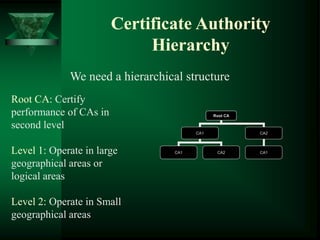
Certificate Authority
Hierarchy
We need a hierarchical structure
Root CA
CA1 CA2
CA1 CA2 CA1
Root CA: Certify
performance of CAs in
second level
Level 1: Operate in large
geographical areas or
logical areas
Level 2: Operate in Small
geographical areas
Certificate Authority Hierarchy
Every body trust Root CA
Not trust intermediate CAs
Alice may obtain bobs certificate from
some authority but not trust it and
ultimately ask next higher CA to certify the
original certificate
X.509 Certificate Format
A protocol used for PKI
X.509 describe certificate in a structural
way
Uses Abstract Syntax Notation 1 Standard.
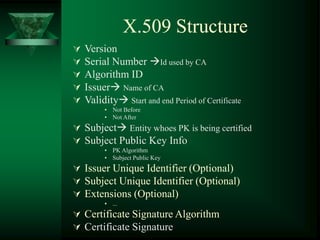
X.509 Structure
 Version
 Serial Number Id used by CA
 Algorithm ID
 Issuer Name of CA
 Validity Start and end Period of Certificate
• Not Before
• Not After
 Subject Entity whoes PK is being certified
 Subject Public Key Info
• PK Algorithm
• Subject Public Key
 Issuer Unique Identifier (Optional)
 Subject Unique Identifier (Optional)
 Extensions (Optional)
• ...
 Certificate Signature Algorithm
 Certificate Signature
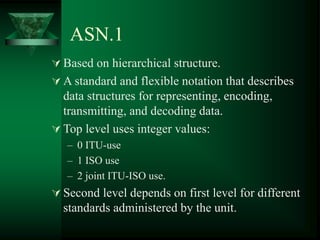
ASN.1
 Based on hierarchical structure.
 A standard and flexible notation that describes
data structures for representing, encoding,
transmitting, and decoding data.
 Top level uses integer values:
– 0 ITU-use
– 1 ISO use
– 2 joint ITU-ISO use.
 Second level depends on first level for different
standards administered by the unit.
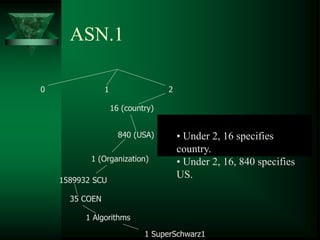
ASN.1
0 1 2
16 (country)
840 (USA)
1 (Organization)
1589932 SCU
35 COEN
1 Algorithms
1 SuperSchwarz1
• Under 2, 16 specifies
country.
• Under 2, 16, 840 specifies
US.
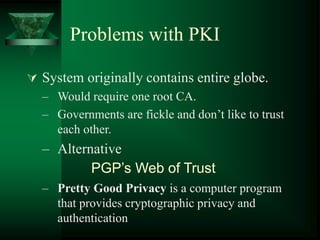
Problems with PKI
 System originally contains entire globe.
– Would require one root CA.
– Governments are fickle and don’t like to trust
each other.
– Alternative
– Pretty Good Privacy is a computer program
that provides cryptographic privacy and
authentication
PGP’s Web of Trust
PGP’s Web of Trust
 Public / private keys with an attached name, email
address, and optional photo.
 No centralized CA to sign keys.
– PGP users sign keys when they’ve verified the
owner’s identity, so in essence each PGP user is
acting as a CA.
– Your trust of a public key is related to how many
signing “hops” you are away from that key and how
much you trust each signer along the route.
 Decentralized key distribution – users send keys.
 Makes key management issues very apparent
– Web of trust depends on end users verifying and
signing large quantities of keys.
Trust model issues
Who to trust?
– Which certificates can be trusted
Source of Trust
– How it is established?
Limiting/controlling trust in a given
environment
Common Trust Models
CA Hierarchy (Monopoly)
Web (Oligarchy)
User-centric (Anarchy)
Distributed
CA Hierarchy
Tree architecture
Single Root CA
– Number of subordinate CA’s
• Etc…
– Parent certifies children
– Leaves are non-CA (end-) entities
Typically CA either certifies other CA’s or
end-entities, but not both
Everyone has Root CA PK
Distributed Trust Architecture
A set of independent hierarchies
Cross-certification or PKI networking
– Connect the hierarchies
Fully-meshed – all CAs are cross-certified
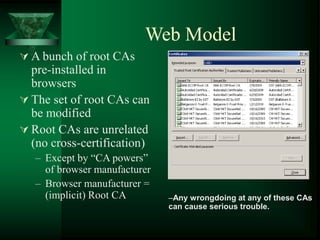
Web Model
 A bunch of root CAs
pre-installed in
browsers
 The set of root CAs can
be modified
 Root CAs are unrelated
(no cross-certification)
– Except by “CA powers”
of browser manufacturer
– Browser manufacturer =
(implicit) Root CA –Any wrongdoing at any of these CAs
can cause serious trouble.
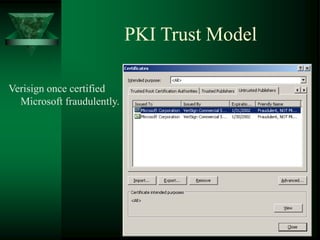
PKI Trust Model
Verisign once certified
Microsoft fraudulently.
User-Centric (Anarchy)
PGP
User = her own Root CA
– Webs of trust
Good
– User fully responsible for trust
Bad
– User fully responsible for trust
– Corporate/gov/etc. like to have central control
• User-centric not friendly to centralized trust policies

Crypto Analysis slides presentation slides

  • 1.
  • 2.
    PKI Concept  Anarrangement that binds public keys with respective user identities by means of a certificate authority (CA).  Public Key Infrastructure based on asymmetric cryptography. Relies on a key pair, one private and one public – Private key is secret – Public key is freely available, linked to identity of certificate owner – Private key cannot be computed from public key  Concept is then applied into applications
  • 3.
    PKI Concept PROBLEM? Any intruder(Eve) can forge public key and and can break the secrecy between two parties (Alice, Bob)
  • 4.
    Certification Authority An Organizationthat binds public key to an entity Or an entity which issues digital certificates for use by other parties. Also called trusted third party (TTP).
  • 5.
    Public Key Infrastructure Wewant to use public key universally Single CA is not sufficient to handle public queries Example Single DNS is not sufficient to handle multiple clients request for IPs
  • 6.
    Certificate Authority Hierarchy We needa hierarchical structure Root CA CA1 CA2 CA1 CA2 CA1 Root CA: Certify performance of CAs in second level Level 1: Operate in large geographical areas or logical areas Level 2: Operate in Small geographical areas
  • 7.
    Certificate Authority Hierarchy Everybody trust Root CA Not trust intermediate CAs Alice may obtain bobs certificate from some authority but not trust it and ultimately ask next higher CA to certify the original certificate
  • 8.
    X.509 Certificate Format Aprotocol used for PKI X.509 describe certificate in a structural way Uses Abstract Syntax Notation 1 Standard.
  • 9.
    X.509 Structure  Version Serial Number Id used by CA  Algorithm ID  Issuer Name of CA  Validity Start and end Period of Certificate • Not Before • Not After  Subject Entity whoes PK is being certified  Subject Public Key Info • PK Algorithm • Subject Public Key  Issuer Unique Identifier (Optional)  Subject Unique Identifier (Optional)  Extensions (Optional) • ...  Certificate Signature Algorithm  Certificate Signature
  • 10.
    ASN.1  Based onhierarchical structure.  A standard and flexible notation that describes data structures for representing, encoding, transmitting, and decoding data.  Top level uses integer values: – 0 ITU-use – 1 ISO use – 2 joint ITU-ISO use.  Second level depends on first level for different standards administered by the unit.
  • 11.
    ASN.1 0 1 2 16(country) 840 (USA) 1 (Organization) 1589932 SCU 35 COEN 1 Algorithms 1 SuperSchwarz1 • Under 2, 16 specifies country. • Under 2, 16, 840 specifies US.
  • 12.
    Problems with PKI System originally contains entire globe. – Would require one root CA. – Governments are fickle and don’t like to trust each other. – Alternative – Pretty Good Privacy is a computer program that provides cryptographic privacy and authentication PGP’s Web of Trust
  • 13.
    PGP’s Web ofTrust  Public / private keys with an attached name, email address, and optional photo.  No centralized CA to sign keys. – PGP users sign keys when they’ve verified the owner’s identity, so in essence each PGP user is acting as a CA. – Your trust of a public key is related to how many signing “hops” you are away from that key and how much you trust each signer along the route.  Decentralized key distribution – users send keys.  Makes key management issues very apparent – Web of trust depends on end users verifying and signing large quantities of keys.
  • 14.
    Trust model issues Whoto trust? – Which certificates can be trusted Source of Trust – How it is established? Limiting/controlling trust in a given environment
  • 15.
    Common Trust Models CAHierarchy (Monopoly) Web (Oligarchy) User-centric (Anarchy) Distributed
  • 16.
    CA Hierarchy Tree architecture SingleRoot CA – Number of subordinate CA’s • Etc… – Parent certifies children – Leaves are non-CA (end-) entities Typically CA either certifies other CA’s or end-entities, but not both Everyone has Root CA PK
  • 17.
    Distributed Trust Architecture Aset of independent hierarchies Cross-certification or PKI networking – Connect the hierarchies Fully-meshed – all CAs are cross-certified
  • 18.
    Web Model  Abunch of root CAs pre-installed in browsers  The set of root CAs can be modified  Root CAs are unrelated (no cross-certification) – Except by “CA powers” of browser manufacturer – Browser manufacturer = (implicit) Root CA –Any wrongdoing at any of these CAs can cause serious trouble.
  • 19.
    PKI Trust Model Verisignonce certified Microsoft fraudulently.
  • 20.
    User-Centric (Anarchy) PGP User =her own Root CA – Webs of trust Good – User fully responsible for trust Bad – User fully responsible for trust – Corporate/gov/etc. like to have central control • User-centric not friendly to centralized trust policies