Authorization Policy in a PKI Environment

Mary Thompson
Srilekha Mudumbai
Abdelilah Essiari
Willie Chin
Lawrence Berkeley National Laboratory

NIST PKI workshop
Distributed Environments
Widely distributed computing environments,
collaborative research environments
Resources, stakeholders and users are all distributed
Spanning organizational as well as geographical
boundaries, e.g., DOE Collaboratories, Grids, Portals
Requires a flexible and secure way for stakeholders to
remotely specify access control for their resources
Requires a flexible but secure way to identify users and
their attributes

NIST PKI workshop
Public Key Infrastructure
Provides a uniform way for different organizations to
identify people or other entities through X.509 identity
certificates containing public keys.
These certificates and keys can be used though secured
connections (SSL) to positively establish the identity of
the entities on the connection.
The keys can be used to provide digital signatures on
documents. The authors and contents of signed
documents can be verified at the time of use.
Mature Certificate Authority software packages are
available and widely deployed. Entrust, Verisign, iPlanet
RSA Keon and OpenSSL.

NIST PKI workshop
Goals for an Authorization system
Use Public Key Infrastructure standards to identify
users and create digitally signed certificates
Use existing SSL protocol to authenticate users
Access based on policy statements made by
stakeholders
Handle multiple independent stakeholders for a single
resource
Emphasize usability

NIST PKI workshop
Authorization Models
Access Control
User is authenticated by some means
The resource gatekeeper checks the user against a policy to
determine access
Application needs to pass only an identity token to resource

Capability
User goes to a policy manager and gets an unforgeable
token (capability) that grants the holder rights to some
resource
The resource gatekeeper verifies the capability and allows
the actions specified in the capability
Application must get the capability token (short-lived)
Application must pass identity token and capability token
to the resource
Facilitates delegation of rights

NIST PKI workshop
Akenti Authorization
Minimal local Policy certificates (self-signed)
Who to trust, where to look for certificates.

Based on the following digitally signed certificates:
X.509 certificates for user identity and authentication
UseCondition certificates containing stakeholder policy
Attribute certificates in which a trusted party attests that a
user possesses some attribute, e.g. training, group
membership

Can be called from any application that has an
authenticated user’s identity certificate and a unique
resource name, to return that user’s privileges with
respect to the resource.

NIST PKI workshop
Emphasis on usability
Usability is critical:
Policy and attributes must be easy for stakeholders to
generate and read
Minimal change to applications seeking use of resources
Simple API for resource gateway to check access

Akenti certificate generators provide a user friendly
interface for stakeholders to specify the use constraints
for their resources.
User or stakeholder can see a static view of the policy
that controls the use of a resource.
Akenti Monitor applet provides a Web interface for a
user to check his access to a resource to see why it
succeeded or failed.

NIST PKI workshop
Certificate Management
Users need to generate signed certificates and store them
in Web accessible places or be able to upload them
securely to the resource gateway.
Akenti needs to know where to search for certificates
Once a certificate is found, Akenti will cache it for a a
time not to exceed that specified by the stakeholder.
When an access decision is made, a capability certificate
containing the rights is cached and returned to the
requester.

NIST PKI workshop
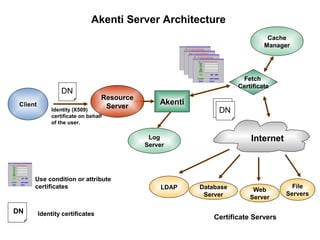
Akenti Server Architecture
Cache
Manager

DN
Client

Fetch
Certificate

Resource
Server

Akenti

Identity (X509)
certificate on behalf
of the user.

DN

DN

Internet

Log
Server

Use condition or attribute
certificates

DN

Identity certificates

LDAP

Database
Server

Web
Server

Certificate Servers

File
Servers
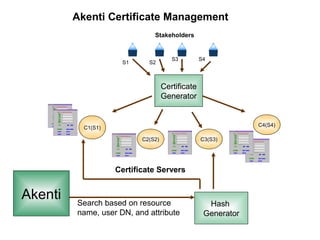
Akenti Certificate Management
Stakeholders

S1

S2

S3

S4

Certificate
Generator

C4(S4)

C1(S1)
C2(S2)

C3(S3)

Certificate Servers

Akenti

Search based on resource
name, user DN, and attribute

Hash
Generator
Required Infrastructure
Certificate Authority to issue identity certificates (required)
OpenSSL provides simple CA for testing
iPlanet CA - moderate cost and effort
Enterprise solutions - Entrust, Verisign, …

Method to check for revocation of identity certificates
(required)
LDAP server - free from Univ. of Mich.. Or comes with iPlanet CA
Certificate Revocation lists - supported by most CA’s
OCSP - not yet widely implemented

Network accessible ways for stakeholders to store their
certificates (optional)
Web servers
LDAP servers
NIST PKI workshop
Using Akenti for Authorization
C++ library that resource gatekeeper can link
with
Insecure server using TCP and returning rights
as strings
Use with thin client interface on the same machine

Secure server using SSL and returning signed
capability certificates containing the rights
As an authorization module with the SSLenabled Apache Web server

NIST PKI workshop
Mod-Akenti
The SSL-enabled Apache Web server can be
configured to require Client-side X.509
certificates.
Replaces mod-authorization
Calls out to Akenti with the user’s identity
Uses Akenti policy certificates to make the
access decision – allows policy to be set
remotely
Allows the same access policy to be used for
Web accessed resources as other resources

NIST PKI workshop
Vulnerabilities
Primarily denial of service.
Distributed certificates might not be available
when needed.
Independent stakeholders may create a policy
that is inconsistent with what they intend. Easy
to deny all access.

NIST PKI workshop
Attribute Certificates
IETF PKIX Attribute Certificates
ASN.1 certificate – holder, attributes, issuer
Attribute – type-value pair
Some standard types: group, access identity, role,
clearance, audit identity, charging identity
X.509 identities identified by CA and serial number
Optional targeting information

SAML (Security Assertion Markup Language)
OASIS
XML signed certificate asserting that a principal has certain
attributes
One of a set of XML certificates containing assertions,
authentication, authorization decision
<Audience Restriction Condition>

NIST PKI workshop
KeyNote Trust Management

Common language for policies and credentials (ASCII
Keyword-value)
Uses opaque strings or cryptographic identities –
separates secure naming from authorization.
Policy assertions are defined for a resource. Can be
signed and thus set remotely
Requestor provides an identity and credential(s)
Compliance checker checks the access
M Blaze, J. Feigenbaum, J. Ioannidis, A. Keromytis

NIST PKI workshop
Shibboleth
Internet2 Project
Users have a credential that is a handle back to
their home institutions
Resource providers ask the home institution for
the user’s attributes. E.g. student, facility
Need inter-domain trust and common
vocabulary
Users can get access to resources while
remaining anonymous to the resource provider.

NIST PKI workshop
CAS Community Authorization
Server
Globus Project
Resources grant bulk access rights to communities of
users
A CAS controls fine-grained access for community
members
CAS issues a short-lived delegated credential containing
the users rights (X.509 certificate)
Users connect to the resource with the CAS delegated
credential via GSI/SSL.
More scalable than current Globus grid-map-file

NIST PKI workshop
Experience
Akenti enabled Apache Web Server has been used at
LBNL and Sandia for the Diesel Combustion
Collaboratory.
Controlling Akenti code distribution, secure data/image
repository, ORNL electronic notebooks, PRE accessed
remote job executions

Used with CORBA applications
Used by the National Fusion Collaboratory
Access to remote code execution started by the Globus
job-manager

Easy to for applications to use if connections are made
over SSL
Runs on Solaris and RedHat Linux

NIST PKI workshop
Trust Models
Resource domain establishes one on one trust with all it
users
Difficult for users, doesn’t scale

Different domains establish mutual trust to allow users
of one domain to access resources in another
Cross-realm Kerberos trust
Shibboleth

Delegated trust – Resource trusts a few entities but
allows them to delegate their rights to others
CAS model

Resource domain would like to limit degree of trust
Limit actions
Audit actions
Revoke trust in a timely fasion

NIST PKI workshop
Future Directions
Further development of Use Conditions that use
dynamic variables such as time-of-day, originating IP
address, state variables.
Recognize restricted delegation credentials
Possibly use delegation credentials restricted by the
delegator to a specified role

Use the XML signature implementation to sign Akenti
certificates – XMLSec Library, Aleksey Sanin
Implement Akenti as a Web service acting as a trusted
third party.
Use signed SOAP messages or SOAP over SSL?

Consider using new SAML, WS-security standards
NIST PKI workshop
Conclusions
Leverages off the increasing use of X.509 identity
certificates.
Akenti/SSL overhead acceptable for medium grained
access checking. E.g , starting an operation, making a
authenticated connection.
Ease of use for stakeholders must be emphasized.
Transparency for users and applications is important

NIST PKI workshop

Authorization Policy in a PKI Environment Mary Thompson Srilekha Mudumbai Abdelilah Essiari Willie Chin

  • 1.
    Authorization Policy ina PKI Environment Mary Thompson Srilekha Mudumbai Abdelilah Essiari Willie Chin Lawrence Berkeley National Laboratory NIST PKI workshop
  • 2.
    Distributed Environments Widely distributedcomputing environments, collaborative research environments Resources, stakeholders and users are all distributed Spanning organizational as well as geographical boundaries, e.g., DOE Collaboratories, Grids, Portals Requires a flexible and secure way for stakeholders to remotely specify access control for their resources Requires a flexible but secure way to identify users and their attributes NIST PKI workshop
  • 3.
    Public Key Infrastructure Providesa uniform way for different organizations to identify people or other entities through X.509 identity certificates containing public keys. These certificates and keys can be used though secured connections (SSL) to positively establish the identity of the entities on the connection. The keys can be used to provide digital signatures on documents. The authors and contents of signed documents can be verified at the time of use. Mature Certificate Authority software packages are available and widely deployed. Entrust, Verisign, iPlanet RSA Keon and OpenSSL. NIST PKI workshop
  • 4.
    Goals for anAuthorization system Use Public Key Infrastructure standards to identify users and create digitally signed certificates Use existing SSL protocol to authenticate users Access based on policy statements made by stakeholders Handle multiple independent stakeholders for a single resource Emphasize usability NIST PKI workshop
  • 5.
    Authorization Models Access Control Useris authenticated by some means The resource gatekeeper checks the user against a policy to determine access Application needs to pass only an identity token to resource Capability User goes to a policy manager and gets an unforgeable token (capability) that grants the holder rights to some resource The resource gatekeeper verifies the capability and allows the actions specified in the capability Application must get the capability token (short-lived) Application must pass identity token and capability token to the resource Facilitates delegation of rights NIST PKI workshop
  • 6.
    Akenti Authorization Minimal localPolicy certificates (self-signed) Who to trust, where to look for certificates. Based on the following digitally signed certificates: X.509 certificates for user identity and authentication UseCondition certificates containing stakeholder policy Attribute certificates in which a trusted party attests that a user possesses some attribute, e.g. training, group membership Can be called from any application that has an authenticated user’s identity certificate and a unique resource name, to return that user’s privileges with respect to the resource. NIST PKI workshop
  • 7.
    Emphasis on usability Usabilityis critical: Policy and attributes must be easy for stakeholders to generate and read Minimal change to applications seeking use of resources Simple API for resource gateway to check access Akenti certificate generators provide a user friendly interface for stakeholders to specify the use constraints for their resources. User or stakeholder can see a static view of the policy that controls the use of a resource. Akenti Monitor applet provides a Web interface for a user to check his access to a resource to see why it succeeded or failed. NIST PKI workshop
  • 8.
    Certificate Management Users needto generate signed certificates and store them in Web accessible places or be able to upload them securely to the resource gateway. Akenti needs to know where to search for certificates Once a certificate is found, Akenti will cache it for a a time not to exceed that specified by the stakeholder. When an access decision is made, a capability certificate containing the rights is cached and returned to the requester. NIST PKI workshop
  • 9.
    Akenti Server Architecture Cache Manager DN Client Fetch Certificate Resource Server Akenti Identity(X509) certificate on behalf of the user. DN DN Internet Log Server Use condition or attribute certificates DN Identity certificates LDAP Database Server Web Server Certificate Servers File Servers
  • 10.
    Akenti Certificate Management Stakeholders S1 S2 S3 S4 Certificate Generator C4(S4) C1(S1) C2(S2) C3(S3) CertificateServers Akenti Search based on resource name, user DN, and attribute Hash Generator
  • 11.
    Required Infrastructure Certificate Authorityto issue identity certificates (required) OpenSSL provides simple CA for testing iPlanet CA - moderate cost and effort Enterprise solutions - Entrust, Verisign, … Method to check for revocation of identity certificates (required) LDAP server - free from Univ. of Mich.. Or comes with iPlanet CA Certificate Revocation lists - supported by most CA’s OCSP - not yet widely implemented Network accessible ways for stakeholders to store their certificates (optional) Web servers LDAP servers NIST PKI workshop
  • 12.
    Using Akenti forAuthorization C++ library that resource gatekeeper can link with Insecure server using TCP and returning rights as strings Use with thin client interface on the same machine Secure server using SSL and returning signed capability certificates containing the rights As an authorization module with the SSLenabled Apache Web server NIST PKI workshop
  • 13.
    Mod-Akenti The SSL-enabled ApacheWeb server can be configured to require Client-side X.509 certificates. Replaces mod-authorization Calls out to Akenti with the user’s identity Uses Akenti policy certificates to make the access decision – allows policy to be set remotely Allows the same access policy to be used for Web accessed resources as other resources NIST PKI workshop
  • 14.
    Vulnerabilities Primarily denial ofservice. Distributed certificates might not be available when needed. Independent stakeholders may create a policy that is inconsistent with what they intend. Easy to deny all access. NIST PKI workshop
  • 15.
    Attribute Certificates IETF PKIXAttribute Certificates ASN.1 certificate – holder, attributes, issuer Attribute – type-value pair Some standard types: group, access identity, role, clearance, audit identity, charging identity X.509 identities identified by CA and serial number Optional targeting information SAML (Security Assertion Markup Language) OASIS XML signed certificate asserting that a principal has certain attributes One of a set of XML certificates containing assertions, authentication, authorization decision <Audience Restriction Condition> NIST PKI workshop
  • 16.
    KeyNote Trust Management Commonlanguage for policies and credentials (ASCII Keyword-value) Uses opaque strings or cryptographic identities – separates secure naming from authorization. Policy assertions are defined for a resource. Can be signed and thus set remotely Requestor provides an identity and credential(s) Compliance checker checks the access M Blaze, J. Feigenbaum, J. Ioannidis, A. Keromytis NIST PKI workshop
  • 17.
    Shibboleth Internet2 Project Users havea credential that is a handle back to their home institutions Resource providers ask the home institution for the user’s attributes. E.g. student, facility Need inter-domain trust and common vocabulary Users can get access to resources while remaining anonymous to the resource provider. NIST PKI workshop
  • 18.
    CAS Community Authorization Server GlobusProject Resources grant bulk access rights to communities of users A CAS controls fine-grained access for community members CAS issues a short-lived delegated credential containing the users rights (X.509 certificate) Users connect to the resource with the CAS delegated credential via GSI/SSL. More scalable than current Globus grid-map-file NIST PKI workshop
  • 19.
    Experience Akenti enabled ApacheWeb Server has been used at LBNL and Sandia for the Diesel Combustion Collaboratory. Controlling Akenti code distribution, secure data/image repository, ORNL electronic notebooks, PRE accessed remote job executions Used with CORBA applications Used by the National Fusion Collaboratory Access to remote code execution started by the Globus job-manager Easy to for applications to use if connections are made over SSL Runs on Solaris and RedHat Linux NIST PKI workshop
  • 20.
    Trust Models Resource domainestablishes one on one trust with all it users Difficult for users, doesn’t scale Different domains establish mutual trust to allow users of one domain to access resources in another Cross-realm Kerberos trust Shibboleth Delegated trust – Resource trusts a few entities but allows them to delegate their rights to others CAS model Resource domain would like to limit degree of trust Limit actions Audit actions Revoke trust in a timely fasion NIST PKI workshop
  • 21.
    Future Directions Further developmentof Use Conditions that use dynamic variables such as time-of-day, originating IP address, state variables. Recognize restricted delegation credentials Possibly use delegation credentials restricted by the delegator to a specified role Use the XML signature implementation to sign Akenti certificates – XMLSec Library, Aleksey Sanin Implement Akenti as a Web service acting as a trusted third party. Use signed SOAP messages or SOAP over SSL? Consider using new SAML, WS-security standards NIST PKI workshop
  • 22.
    Conclusions Leverages off theincreasing use of X.509 identity certificates. Akenti/SSL overhead acceptable for medium grained access checking. E.g , starting an operation, making a authenticated connection. Ease of use for stakeholders must be emphasized. Transparency for users and applications is important NIST PKI workshop