Piano by D.H Lawrence (1918)
Some ideas for analysis
@BBAEnglish
www.bbaenglish.wordpress.com
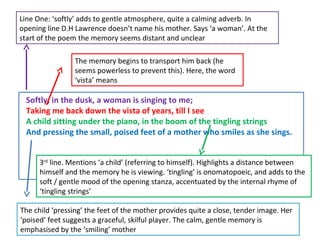
Softly, in the dusk, a woman is singing to me;
Taking me back down the vista of years, till I see
A child sitting under the piano, in the boom of the tingling strings 
And pressing the small, poised feet of a mother who smiles as she sings.
Line One: ‘softly’ adds to gentle atmosphere, quite a calming adverb. In 
opening line D.H Lawrence doesn’t name his mother. Says ‘a woman’. At the 
start of the poem the memory seems distant and unclear
The memory begins to transport him back (he 
seems powerless to prevent this). Here, the word 
‘vista’ means
3rd
 line. Mentions ‘a child’ (referring to himself). Highlights a distance between 
himself and the memory he is viewing. ‘tingling’ is onomatopoeic, and adds to the 
soft / gentle mood of the opening stanza, accentuated by the internal rhyme of 
‘tingling strings’
The child ‘pressing’ the feet of the mother provides quite a close, tender image. Her 
‘poised’ feet suggests a graceful, skilful player. The calm, gentle memory is 
emphasised by the ‘smiling’ mother
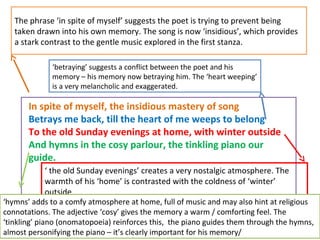
The phrase ‘in spite of myself’ suggests the poet is trying to prevent being
taken drawn into his own memory. The song is now ‘insidious’, which provides
a stark contrast to the gentle music explored in the first stanza.
In spite of myself, the insidious mastery of song
Betrays me back, till the heart of me weeps to belong
To the old Sunday evenings at home, with winter outside
And hymns in the cosy parlour, the tinkling piano our
guide.
‘betraying’ suggests a conflict between the poet and his
memory – his memory now betraying him. The ‘heart weeping’
is a very melancholic and exaggerated.
‘ the old Sunday evenings’ creates a very nostalgic atmosphere. The
warmth of his ‘home’ is contrasted with the coldness of ‘winter’
outside
‘hymns’ adds to a comfy atmosphere at home, full of music and may also hint at religious
connotations. The adjective ‘cosy’ gives the memory a warm / comforting feel. The
‘tinkling’ piano (onomatopoeia) reinforces this, the piano guides them through the hymns,
almost personifying the piano – it’s clearly important for his memory/
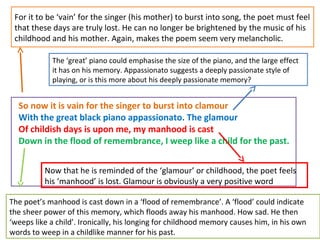
For it to be ‘vain’ for the singer (his mother) to burst into song, the poet must feel
that these days are truly lost. He can no longer be brightened by the music of his
childhood and his mother. Again, makes the poem seem very melancholic.
So now it is vain for the singer to burst into clamour
With the great black piano appassionato. The glamour
Of childish days is upon me, my manhood is cast
Down in the flood of remembrance, I weep like a child for the past.
The ‘great’ piano could emphasise the size of the piano, and the large effect
it has on his memory. Appassionato suggests a deeply passionate style of
playing, or is this more about his deeply passionate memory?
Now that he is reminded of the ‘glamour’ or childhood, the poet feels
his ‘manhood’ is lost. Glamour is obviously a very positive word
The poet’s manhood is cast down in a ‘flood of remembrance’. A ‘flood’ could indicate
the sheer power of this memory, which floods away his manhood. How sad. He then
‘weeps like a child’. Ironically, his longing for childhood memory causes him, in his own
words to weep in a childlike manner for his past.

Piano by D.H. Lawrence analysis

  • 1.
    Piano by D.HLawrence (1918) Some ideas for analysis @BBAEnglish www.bbaenglish.wordpress.com
  • 2.
    Softly, in thedusk, a woman is singing to me; Taking me back down the vista of years, till I see A child sitting under the piano, in the boom of the tingling strings  And pressing the small, poised feet of a mother who smiles as she sings. Line One: ‘softly’ adds to gentle atmosphere, quite a calming adverb. In  opening line D.H Lawrence doesn’t name his mother. Says ‘a woman’. At the  start of the poem the memory seems distant and unclear The memory begins to transport him back (he  seems powerless to prevent this). Here, the word  ‘vista’ means 3rd  line. Mentions ‘a child’ (referring to himself). Highlights a distance between  himself and the memory he is viewing. ‘tingling’ is onomatopoeic, and adds to the  soft / gentle mood of the opening stanza, accentuated by the internal rhyme of  ‘tingling strings’ The child ‘pressing’ the feet of the mother provides quite a close, tender image. Her  ‘poised’ feet suggests a graceful, skilful player. The calm, gentle memory is  emphasised by the ‘smiling’ mother
  • 3.
    The phrase ‘inspite of myself’ suggests the poet is trying to prevent being taken drawn into his own memory. The song is now ‘insidious’, which provides a stark contrast to the gentle music explored in the first stanza. In spite of myself, the insidious mastery of song Betrays me back, till the heart of me weeps to belong To the old Sunday evenings at home, with winter outside And hymns in the cosy parlour, the tinkling piano our guide. ‘betraying’ suggests a conflict between the poet and his memory – his memory now betraying him. The ‘heart weeping’ is a very melancholic and exaggerated. ‘ the old Sunday evenings’ creates a very nostalgic atmosphere. The warmth of his ‘home’ is contrasted with the coldness of ‘winter’ outside ‘hymns’ adds to a comfy atmosphere at home, full of music and may also hint at religious connotations. The adjective ‘cosy’ gives the memory a warm / comforting feel. The ‘tinkling’ piano (onomatopoeia) reinforces this, the piano guides them through the hymns, almost personifying the piano – it’s clearly important for his memory/
  • 4.
    For it tobe ‘vain’ for the singer (his mother) to burst into song, the poet must feel that these days are truly lost. He can no longer be brightened by the music of his childhood and his mother. Again, makes the poem seem very melancholic. So now it is vain for the singer to burst into clamour With the great black piano appassionato. The glamour Of childish days is upon me, my manhood is cast Down in the flood of remembrance, I weep like a child for the past. The ‘great’ piano could emphasise the size of the piano, and the large effect it has on his memory. Appassionato suggests a deeply passionate style of playing, or is this more about his deeply passionate memory? Now that he is reminded of the ‘glamour’ or childhood, the poet feels his ‘manhood’ is lost. Glamour is obviously a very positive word The poet’s manhood is cast down in a ‘flood of remembrance’. A ‘flood’ could indicate the sheer power of this memory, which floods away his manhood. How sad. He then ‘weeps like a child’. Ironically, his longing for childhood memory causes him, in his own words to weep in a childlike manner for his past.