Poetry Across Time: Character and voice


Key
Language: connotation, imagery, metaphor, simile
Structure and form: stanzas, type, patterns, contrast, juxtaposition
Poetic methods: alliteration, caesura, assonance, rhythm, rhyme
Character and voice: who is speaking and to whom? Tone of voice
Links: comparisons to other speakers, methods and themes
A mysterious
remoteness is set           Another name for Ramesses the Great,          Sonnet written in iambic
up – an unnamed             Pharaoh if ancient Egypt. He exemplified      pentameter
‘I’. The traveller is       the ‘mighty fallen’
from an ‘antique
land’. We do not                                                          Harsh, alliterative
know where the           Ozymandias                                       sounds – final stubborn
two met.                                                                  statement?

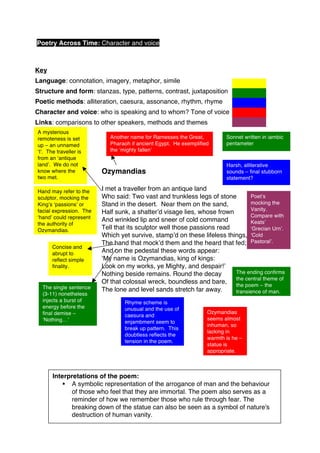
Hand may refer to the    I met a traveller from an antique land
sculptor, mocking the    Who said: Two vast and trunkless legs of stone        Poet’s
King’s ‘passions’ or     Stand in the desert. Near them on the sand,           mocking the
facial expression. The                                                         Vanity.
                         Half sunk, a shatter’d visage lies, whose frown
‘hand’ could represent                                                         Compare with
                         And wrinkled lip and sneer of cold command            Keats’
the authority of
Ozymandias.              Tell that its sculptor well those passions read       ‘Grecian Urn’.
                         Which yet survive, stamp’d on these lifeless things, ‘Cold
                         The hand that mock’d them and the heard that fed; Pastoral’.
       Concise and
       abrupt to         And on the pedestal these words appear:
       reflect simple    ‘My name is Ozymandias, king of kings:
       finality.         Look on my works, ye Mighty, and despair!’
                         Nothing beside remains. Round the decay         The ending confirms
                         Of that colossal wreck, boundless and bare, the central–theme of
                                                                         the poem the
  The single sentence    The lone and level sands stretch far away.
  (3-11) nonetheless                                                     transience of man.
  injects a burst of             Rhyme scheme is
  energy before the              unusual and the use of
  final demise –                                                   Ozymandias
                                 caesura and
  ‘Nothing…’                                                       seems almost
                                 enjambment seem to
                                                                   inhuman, so
                                 break up pattern. This
                                                                   lacking in
                                 doubtless reflects the
                                                                   warmth is he –
                                 tension in the poem.
                                                                   statue is
                                                                   appropriate.


       Interpretations of the poem:
           A symbolic representation of the arrogance of man and the behaviour
              of those who feel that they are immortal. The poem also serves as a
              reminder of how we remember those who rule through fear. The
              breaking down of the statue can also be seen as a symbol of nature's
              destruction of human vanity.

Ozymandias

  • 1.
    Poetry Across Time:Character and voice Key Language: connotation, imagery, metaphor, simile Structure and form: stanzas, type, patterns, contrast, juxtaposition Poetic methods: alliteration, caesura, assonance, rhythm, rhyme Character and voice: who is speaking and to whom? Tone of voice Links: comparisons to other speakers, methods and themes A mysterious remoteness is set Another name for Ramesses the Great, Sonnet written in iambic up – an unnamed Pharaoh if ancient Egypt. He exemplified pentameter ‘I’. The traveller is the ‘mighty fallen’ from an ‘antique land’. We do not Harsh, alliterative know where the Ozymandias sounds – final stubborn two met. statement? Hand may refer to the I met a traveller from an antique land sculptor, mocking the Who said: Two vast and trunkless legs of stone Poet’s King’s ‘passions’ or Stand in the desert. Near them on the sand, mocking the facial expression. The Vanity. Half sunk, a shatter’d visage lies, whose frown ‘hand’ could represent Compare with And wrinkled lip and sneer of cold command Keats’ the authority of Ozymandias. Tell that its sculptor well those passions read ‘Grecian Urn’. Which yet survive, stamp’d on these lifeless things, ‘Cold The hand that mock’d them and the heard that fed; Pastoral’. Concise and abrupt to And on the pedestal these words appear: reflect simple ‘My name is Ozymandias, king of kings: finality. Look on my works, ye Mighty, and despair!’ Nothing beside remains. Round the decay The ending confirms Of that colossal wreck, boundless and bare, the central–theme of the poem the The single sentence The lone and level sands stretch far away. (3-11) nonetheless transience of man. injects a burst of Rhyme scheme is energy before the unusual and the use of final demise – Ozymandias caesura and ‘Nothing…’ seems almost enjambment seem to inhuman, so break up pattern. This lacking in doubtless reflects the warmth is he – tension in the poem. statue is appropriate. Interpretations of the poem:  A symbolic representation of the arrogance of man and the behaviour of those who feel that they are immortal. The poem also serves as a reminder of how we remember those who rule through fear. The breaking down of the statue can also be seen as a symbol of nature's destruction of human vanity.