Bayonet Charge
Ted Hughes
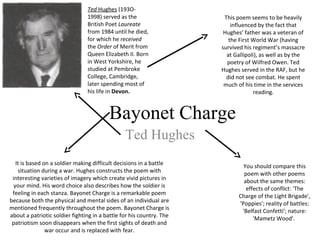
Ted Hughes (193O-
1998) served as the
British Poet Laureate
from 1984 until he died,
for which he received
the Order of Merit from
Queen Elizabeth II. Born
in West Yorkshire, he
studied at Pembroke
College, Cambridge,
later spending most of
his life in Devon.
This poem seems to be heavily
influenced by the fact that
Hughes’ father was a veteran of
the First World War (having
survived his regiment’s massacre
at Gallipoli), as well as by the
poetry of Wilfred Owen. Ted
Hughes served in the RAF, but he
did not see combat. He spent
much of his time in the services
reading.
It is based on a soldier making difficult decisions in a battle
situation during a war. Hughes constructs the poem with
interesting varieties of imagery which create vivid pictures in
your mind. His word choice also describes how the soldier is
feeling in each stanza. Bayonet Charge is a remarkable poem
because both the physical and mental sides of an individual are
mentioned frequently throughout the poem. Bayonet Charge is
about a patriotic soldier fighting in a battle for his country. The
patriotism soon disappears when the first sights of death and
war occur and is replaced with fear.
You should compare this
poem with other poems
about the same themes:
effects of conflict: 'The
Charge of the Light Brigade',
'Poppies'; reality of battles:
'Belfast Confetti'; nature:
'Mametz Wood'.
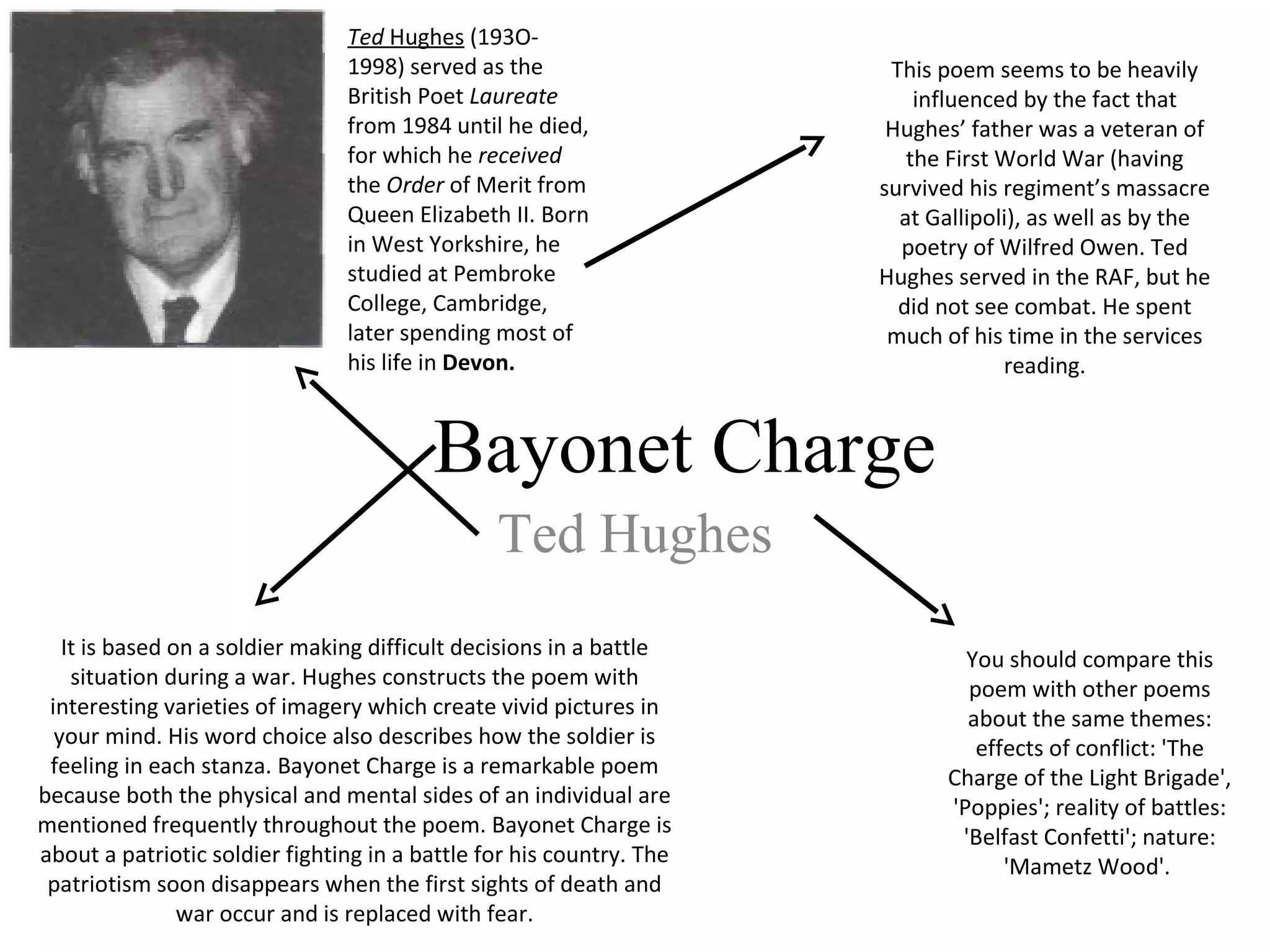
Bayonet Charge
Suddenly he awoke and was running – raw
In raw-seamed hot khaki, his sweat heavy,
Stumbling across a field of clods towards a green hedge
That dazzled with rifle fire, hearing
Bullets smacking the belly out of the air –
He lugged a rifle numb as a smashed arm;
The patriotic tear that had brimmed in his eye
Sweating like molten iron from the centre of his chest, –
In bewilderment then he almost stopped –
In what cold clockwork of the stars and the nations
Was he the hand pointing that second? He was running
Like a man who has jumped up in the dark and runs
Listening between his footfalls for the reason
Of his still running, and his foot hung like
Statuary in mid-stride. Then the shot-slashed furrows
Threw up a yellow hare that rolled like a flame
And crawled in a threshing circle, its mouth wide
Open silent, its eyes standing out.
He plunged past with his bayonet toward the green hedge,
King, honour, human dignity, etcetera
Dropped like luxuries in a yelling alarm
To get out of that blue crackling air
His terror’s touchy dynamite.
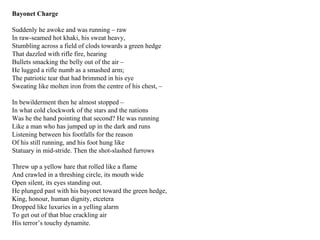
Suddenly he awoke and was running – raw
In raw-seamed hot khaki, his sweat heavy,
Stumbling across a field of clods towards a green hedge
That dazzled with rifle fire, hearing
Bullets smacking the belly out of the air –
He lugged a rifle numb as a smashed arm;
The patriotic tear that had brimmed in his eye
Sweating like molten iron from the centre of his chest, –
The poem is about a
soldier's experience of a
violent battle. It
describes his thoughts
and actions as he
desperately tries to
avoid being shot. The
opening words of the
poem sounds like he's
in a vulnerable
confused state. It also
proves this is real,
even though it seems
like a nightmare. The
opening suggests he
was trying to escape
from the reality he is in.
He's in uniform we can picture him as a
soldier. The poet uses the pronoun "he"
rather than naming the soldier to keep
him anonymous. It suggests that he is a
universal figure who could represent any
young soldier.
The word raw suggests his fear. This
word can have several connotations such
as pain/discomfort or inexperience, as if
he had been taken out of his peaceful life
and thrown into war.
On the fourth line we
are shows that he's
confused while facing
gunfire. The word
‘dazzled’ creates
imagery of the sparks
of the bullets
ricocheting around
him. The violent
imagery on the fifth
line further describes
the sound and impact
of the shots.
His rifle seems useless
further emphasising the
horror and physical pain of
the battle.
The contrast between patriotic
ideals and reality is seen
through a powerful image – the
reason he went to war. The
soldier's overriding emotion
and motivation is fear, which
has replaced the more patriotic
ideals that he held before the
violence began.
The end of the stanza highlights the instinctive
reaction of a soldier to firing from the enemy.
Dying for your country seems irrational and
therefore Hughes forces the reader to question
patriotism.
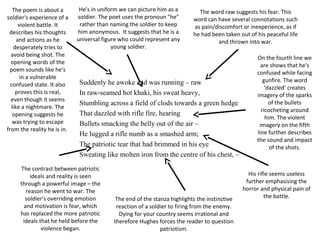
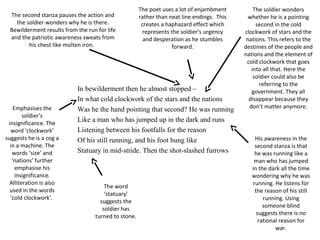
In bewilderment then he almost stopped –
In what cold clockwork of the stars and the nations
Was he the hand pointing that second? He was running
Like a man who has jumped up in the dark and runs
Listening between his footfalls for the reason
Of his still running, and his foot hung like
Statuary in mid-stride. Then the shot-slashed furrows
The second stanza pauses the action and
the soldier wonders why he is there.
Bewilderment results from the run for life
and the patriotic awareness sweats from
his chest like molten iron.
Emphasises the
soldier's
insignificance. The
word ‘clockwork’
suggests he is a cog a
in a machine. The
words ‘size’ and
‘nations’ further
emphasise his
insignificance.
Alliteration is also
used in the words
‘cold clockwork’.
The soldier wonders
whether he is a pointing
second in the cold
clockwork of stars and the
nations. This refers to the
destinies of the people and
nations and the element of
cold clockwork that goes
into all that. Here the
soldier could also be
referring to the
government. They all
disappear because they
don’t matter anymore.
His awareness in the
second stanza is that
he was running like a
man who has jumped
in the dark all the time
wondering why he was
running. He listens for
the reason of his still
running. Using
someone blind
suggests there is no
rational reason for
war.
The word
‘statuary’
suggests the
soldier has
turned to stone.
The poet uses a lot of enjambment
rather than neat line endings. This
creates a haphazard effect which
represents the soldier's urgency
and desperation as he stumbles
forward.
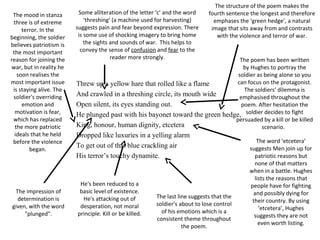
Threw up a yellow hare that rolled like a flame
And crawled in a threshing circle, its mouth wide
Open silent, its eyes standing out.
He plunged past with his bayonet toward the green hedge,
King, honour, human dignity, etcetera
Dropped like luxuries in a yelling alarm
To get out of that blue crackling air
His terror’s touchy dynamite.
The mood in stanza
three is of extreme
terror. In the
beginning, the soldier
believes patriotism is
the most important
reason for joining the
war, but in reality he
soon realises the
most important issue
is staying alive. The
soldier's overriding
emotion and
motivation is fear,
which has replaced
the more patriotic
ideals that he held
before the violence
began.
The poem has been written
by Hughes to portray the
soldier as being alone so you
can focus on the protagonist.
The soldiers’ dilemma is
emphasised throughout the
poem. After hesitation the
soldier decides to fight
persuaded by a kill or be killed
scenario.
The word ‘etcetera’
suggests Men join up for
patriotic reasons but
none of that matters
when in a battle. Hughes
lists the reasons that
people have for fighting
and possibly dying for
their country. By using
‘etcetera’, Hughes
suggests they are not
even worth listing.
Some alliteration of the letter ‘c’ and the word
‘threshing’ (a machine used for harvesting)
suggests pain and fear beyond expression. There
is some use of shocking imagery to bring home
the sights and sounds of war. This helps to
convey the sense of confusion and fear to the
reader more strongly.
The structure of the poem makes the
fourth sentence the longest and therefore
emphases the ‘green hedge’, a natural
image that sits away from and contrasts
with the violence and terror of war.
The impression of
determination is
given, with the word
"plunged".
He's been reduced to a
basic level of existence.
He's attacking out of
desperation, not moral
principle. Kill or be killed.
The last line suggests that the
soldier's about to lose control
of his emotions which is a
consistent theme throughout
the poem.
Threw up a yellow hare that rolled like a flame
And crawled in a threshing circle, its mouth wide
Open silent, its eyes standing out.
He plunged past with his bayonet toward the green hedge,
King, honour, human dignity, etcetera
Dropped like luxuries in a yelling alarm
To get out of that blue crackling air
His terror’s touchy dynamite.
The mood in stanza
three is of extreme
terror. In the
beginning, the soldier
believes patriotism is
the most important
reason for joining the
war, but in reality he
soon realises the
most important issue
is staying alive. The
soldier's overriding
emotion and
motivation is fear,
which has replaced
the more patriotic
ideals that he held
before the violence
began.
The poem has been written
by Hughes to portray the
soldier as being alone so you
can focus on the protagonist.
The soldiers’ dilemma is
emphasised throughout the
poem. After hesitation the
soldier decides to fight
persuaded by a kill or be killed
scenario.
The word ‘etcetera’
suggests Men join up for
patriotic reasons but
none of that matters
when in a battle. Hughes
lists the reasons that
people have for fighting
and possibly dying for
their country. By using
‘etcetera’, Hughes
suggests they are not
even worth listing.
Some alliteration of the letter ‘c’ and the word
‘threshing’ (a machine used for harvesting)
suggests pain and fear beyond expression. There
is some use of shocking imagery to bring home
the sights and sounds of war. This helps to
convey the sense of confusion and fear to the
reader more strongly.
The structure of the poem makes the
fourth sentence the longest and therefore
emphases the ‘green hedge’, a natural
image that sits away from and contrasts
with the violence and terror of war.
The impression of
determination is
given, with the word
"plunged".
He's been reduced to a
basic level of existence.
He's attacking out of
desperation, not moral
principle. Kill or be killed.
The last line suggests that the
soldier's about to lose control
of his emotions which is a
consistent theme throughout
the poem.

Bayonet Charge by Ted Hughes

  • 1.
    Bayonet Charge Ted Hughes TedHughes (193O- 1998) served as the British Poet Laureate from 1984 until he died, for which he received the Order of Merit from Queen Elizabeth II. Born in West Yorkshire, he studied at Pembroke College, Cambridge, later spending most of his life in Devon. This poem seems to be heavily influenced by the fact that Hughes’ father was a veteran of the First World War (having survived his regiment’s massacre at Gallipoli), as well as by the poetry of Wilfred Owen. Ted Hughes served in the RAF, but he did not see combat. He spent much of his time in the services reading. It is based on a soldier making difficult decisions in a battle situation during a war. Hughes constructs the poem with interesting varieties of imagery which create vivid pictures in your mind. His word choice also describes how the soldier is feeling in each stanza. Bayonet Charge is a remarkable poem because both the physical and mental sides of an individual are mentioned frequently throughout the poem. Bayonet Charge is about a patriotic soldier fighting in a battle for his country. The patriotism soon disappears when the first sights of death and war occur and is replaced with fear. You should compare this poem with other poems about the same themes: effects of conflict: 'The Charge of the Light Brigade', 'Poppies'; reality of battles: 'Belfast Confetti'; nature: 'Mametz Wood'.
  • 2.
    Bayonet Charge Suddenly heawoke and was running – raw In raw-seamed hot khaki, his sweat heavy, Stumbling across a field of clods towards a green hedge That dazzled with rifle fire, hearing Bullets smacking the belly out of the air – He lugged a rifle numb as a smashed arm; The patriotic tear that had brimmed in his eye Sweating like molten iron from the centre of his chest, – In bewilderment then he almost stopped – In what cold clockwork of the stars and the nations Was he the hand pointing that second? He was running Like a man who has jumped up in the dark and runs Listening between his footfalls for the reason Of his still running, and his foot hung like Statuary in mid-stride. Then the shot-slashed furrows Threw up a yellow hare that rolled like a flame And crawled in a threshing circle, its mouth wide Open silent, its eyes standing out. He plunged past with his bayonet toward the green hedge, King, honour, human dignity, etcetera Dropped like luxuries in a yelling alarm To get out of that blue crackling air His terror’s touchy dynamite.
  • 3.
    Suddenly he awokeand was running – raw In raw-seamed hot khaki, his sweat heavy, Stumbling across a field of clods towards a green hedge That dazzled with rifle fire, hearing Bullets smacking the belly out of the air – He lugged a rifle numb as a smashed arm; The patriotic tear that had brimmed in his eye Sweating like molten iron from the centre of his chest, – The poem is about a soldier's experience of a violent battle. It describes his thoughts and actions as he desperately tries to avoid being shot. The opening words of the poem sounds like he's in a vulnerable confused state. It also proves this is real, even though it seems like a nightmare. The opening suggests he was trying to escape from the reality he is in. He's in uniform we can picture him as a soldier. The poet uses the pronoun "he" rather than naming the soldier to keep him anonymous. It suggests that he is a universal figure who could represent any young soldier. The word raw suggests his fear. This word can have several connotations such as pain/discomfort or inexperience, as if he had been taken out of his peaceful life and thrown into war. On the fourth line we are shows that he's confused while facing gunfire. The word ‘dazzled’ creates imagery of the sparks of the bullets ricocheting around him. The violent imagery on the fifth line further describes the sound and impact of the shots. His rifle seems useless further emphasising the horror and physical pain of the battle. The contrast between patriotic ideals and reality is seen through a powerful image – the reason he went to war. The soldier's overriding emotion and motivation is fear, which has replaced the more patriotic ideals that he held before the violence began. The end of the stanza highlights the instinctive reaction of a soldier to firing from the enemy. Dying for your country seems irrational and therefore Hughes forces the reader to question patriotism.
  • 4.
    In bewilderment thenhe almost stopped – In what cold clockwork of the stars and the nations Was he the hand pointing that second? He was running Like a man who has jumped up in the dark and runs Listening between his footfalls for the reason Of his still running, and his foot hung like Statuary in mid-stride. Then the shot-slashed furrows The second stanza pauses the action and the soldier wonders why he is there. Bewilderment results from the run for life and the patriotic awareness sweats from his chest like molten iron. Emphasises the soldier's insignificance. The word ‘clockwork’ suggests he is a cog a in a machine. The words ‘size’ and ‘nations’ further emphasise his insignificance. Alliteration is also used in the words ‘cold clockwork’. The soldier wonders whether he is a pointing second in the cold clockwork of stars and the nations. This refers to the destinies of the people and nations and the element of cold clockwork that goes into all that. Here the soldier could also be referring to the government. They all disappear because they don’t matter anymore. His awareness in the second stanza is that he was running like a man who has jumped in the dark all the time wondering why he was running. He listens for the reason of his still running. Using someone blind suggests there is no rational reason for war. The word ‘statuary’ suggests the soldier has turned to stone. The poet uses a lot of enjambment rather than neat line endings. This creates a haphazard effect which represents the soldier's urgency and desperation as he stumbles forward.
  • 5.
    Threw up ayellow hare that rolled like a flame And crawled in a threshing circle, its mouth wide Open silent, its eyes standing out. He plunged past with his bayonet toward the green hedge, King, honour, human dignity, etcetera Dropped like luxuries in a yelling alarm To get out of that blue crackling air His terror’s touchy dynamite. The mood in stanza three is of extreme terror. In the beginning, the soldier believes patriotism is the most important reason for joining the war, but in reality he soon realises the most important issue is staying alive. The soldier's overriding emotion and motivation is fear, which has replaced the more patriotic ideals that he held before the violence began. The poem has been written by Hughes to portray the soldier as being alone so you can focus on the protagonist. The soldiers’ dilemma is emphasised throughout the poem. After hesitation the soldier decides to fight persuaded by a kill or be killed scenario. The word ‘etcetera’ suggests Men join up for patriotic reasons but none of that matters when in a battle. Hughes lists the reasons that people have for fighting and possibly dying for their country. By using ‘etcetera’, Hughes suggests they are not even worth listing. Some alliteration of the letter ‘c’ and the word ‘threshing’ (a machine used for harvesting) suggests pain and fear beyond expression. There is some use of shocking imagery to bring home the sights and sounds of war. This helps to convey the sense of confusion and fear to the reader more strongly. The structure of the poem makes the fourth sentence the longest and therefore emphases the ‘green hedge’, a natural image that sits away from and contrasts with the violence and terror of war. The impression of determination is given, with the word "plunged". He's been reduced to a basic level of existence. He's attacking out of desperation, not moral principle. Kill or be killed. The last line suggests that the soldier's about to lose control of his emotions which is a consistent theme throughout the poem.
  • 6.
    Threw up ayellow hare that rolled like a flame And crawled in a threshing circle, its mouth wide Open silent, its eyes standing out. He plunged past with his bayonet toward the green hedge, King, honour, human dignity, etcetera Dropped like luxuries in a yelling alarm To get out of that blue crackling air His terror’s touchy dynamite. The mood in stanza three is of extreme terror. In the beginning, the soldier believes patriotism is the most important reason for joining the war, but in reality he soon realises the most important issue is staying alive. The soldier's overriding emotion and motivation is fear, which has replaced the more patriotic ideals that he held before the violence began. The poem has been written by Hughes to portray the soldier as being alone so you can focus on the protagonist. The soldiers’ dilemma is emphasised throughout the poem. After hesitation the soldier decides to fight persuaded by a kill or be killed scenario. The word ‘etcetera’ suggests Men join up for patriotic reasons but none of that matters when in a battle. Hughes lists the reasons that people have for fighting and possibly dying for their country. By using ‘etcetera’, Hughes suggests they are not even worth listing. Some alliteration of the letter ‘c’ and the word ‘threshing’ (a machine used for harvesting) suggests pain and fear beyond expression. There is some use of shocking imagery to bring home the sights and sounds of war. This helps to convey the sense of confusion and fear to the reader more strongly. The structure of the poem makes the fourth sentence the longest and therefore emphases the ‘green hedge’, a natural image that sits away from and contrasts with the violence and terror of war. The impression of determination is given, with the word "plunged". He's been reduced to a basic level of existence. He's attacking out of desperation, not moral principle. Kill or be killed. The last line suggests that the soldier's about to lose control of his emotions which is a consistent theme throughout the poem.