A Mother in a Refugee Camp
Chinua Achebe
A Mother In A Refugee Camp
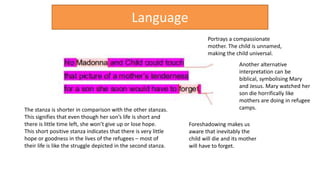
No Madonna and Child could touch
Her tenderness for a son
She soon would have to forget. . . .
The air was heavy with odors of diarrhea,
Of unwashed children with washed-out ribs
And dried-up bottoms waddling in labored steps
Behind blown-empty bellies. Other mothers there
Had long ceased to care, but not this one:
She held a ghost-smile between her teeth,
And in her eyes the memory
Of a mother’s pride. . . . She had bathed him
And rubbed him down with bare palms.
She took from their bundle of possessions
A broken comb and combed
The rust-colored hair left on his skull
And then—humming in her eyes—began carefully to part it.
In their former life this was perhaps
A little daily act of no consequence
Before his breakfast and school; now she did it
Like putting flowers on a tiny grave.
• He was a Nigerian novelist, poet, professor, and critic
• Interested in African politics
• He wrote the influential novel ‘Things Fall Apart’ which sold 12
million copies and is the most widely read book in modern
African literature.
Chinua Achebe
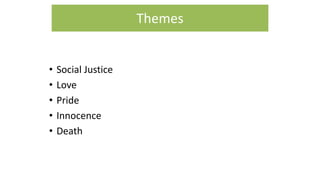
• Social Justice
• Love
• Pride
• Innocence
• Death
Themes
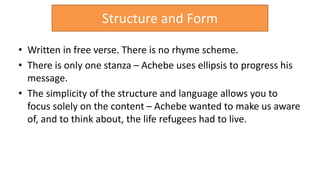
• Written in free verse. There is no rhyme scheme.
• There is only one stanza – Achebe uses ellipsis to progress his
message.
• The simplicity of the structure and language allows you to
focus solely on the content – Achebe wanted to make us aware
of, and to think about, the life refugees had to live.
Structure and Form
The stanza is shorter in comparison with the other stanzas.
This signifies that even though her son’s life is short and
there is little time left, she won’t give up or lose hope.
This short positive stanza indicates that there is very little
hope or goodness in the lives of the refugees – most of
their life is like the struggle depicted in the second stanza.
Portrays a compassionate
mother. The child is unnamed,
making the child universal.
Foreshadowing makes us
aware that inevitably the
child will die and its mother
will have to forget.
Language
Another alternative
interpretation can be
biblical, symbolising Mary
and Jesus. Mary watched her
son die horrifically like
mothers are doing in refugee
camps.
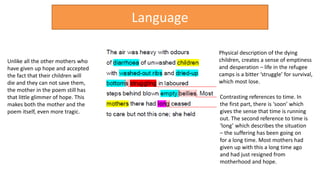
Unlike all the other mothers who
have given up hope and accepted
the fact that their children will
die and they can not save them,
the mother in the poem still has
that little glimmer of hope. This
makes both the mother and the
poem itself, even more tragic.
Language
Physical description of the dying
children, creates a sense of emptiness
and desperation – life in the refugee
camps is a bitter ‘struggle’ for survival,
which most lose.
Contrasting references to time. In
the first part, there is ‘soon’ which
gives the sense that time is running
out. The second reference to time is
‘long’ which describes the situation
– the suffering has been going on
for a long time. Most mothers had
given up with this a long time ago
and had just resigned from
motherhood and hope.
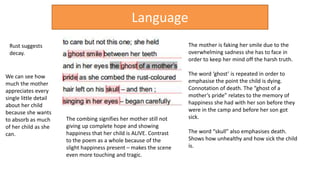
The combing signifies her mother still not
giving up complete hope and showing
happiness that her child is ALIVE. Contrast
to the poem as a whole because of the
slight happiness present – makes the scene
even more touching and tragic.
The mother is faking her smile due to the
overwhelming sadness she has to face in
order to keep her mind off the harsh truth.
The word ‘ghost’ is repeated in order to
emphasise the point the child is dying.
Connotation of death. The “ghost of a
mother’s pride” relates to the memory of
happiness she had with her son before they
were in the camp and before her son got
sick.
The word “skull” also emphasises death.
Shows how unhealthy and how sick the child
is.
Language
Rust suggests
decay.
We can see how
much the mother
appreciates every
single little detail
about her child
because she wants
to absorb as much
of her child as she
can.
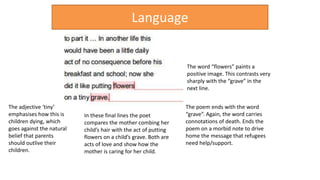
In these final lines the poet
compares the mother combing her
child’s hair with the act of putting
flowers on a child’s grave. Both are
acts of love and show how the
mother is caring for her child.
The poem ends with the word
“grave”. Again, the word carries
connotations of death. Ends the
poem on a morbid note to drive
home the message that refugees
need help/support.
The word “flowers” paints a
positive image. This contrasts very
sharply with the “grave” in the
next line.
Language
The adjective ‘tiny’
emphasises how this is
children dying, which
goes against the natural
belief that parents
should outlive their
children.
Throughout the poem, Achebe uses a variety of sensory descriptions to describe the
conditions and suffering that they have to face on a daily basis.
Examples are:
‘odours’
‘diarrhea’
‘unwashed children’
‘eyes’
‘blown empty bellies’
‘washed out’
‘dried up’
Achebe combines touch and smell by using the
technique synesthesia. An example of this is “the
air was heavy with “odours”, as “heavy” relates to
touch and “odours” relates to smell. Another
example is “singing in her eyes”. This is effective
as it emphasis the conditions that they have to
face at the camp.
Language - senses

A Mother in a Refugee Camp

  • 1.
    A Mother ina Refugee Camp Chinua Achebe
  • 2.
    A Mother InA Refugee Camp No Madonna and Child could touch Her tenderness for a son She soon would have to forget. . . . The air was heavy with odors of diarrhea, Of unwashed children with washed-out ribs And dried-up bottoms waddling in labored steps Behind blown-empty bellies. Other mothers there Had long ceased to care, but not this one: She held a ghost-smile between her teeth, And in her eyes the memory Of a mother’s pride. . . . She had bathed him And rubbed him down with bare palms. She took from their bundle of possessions A broken comb and combed The rust-colored hair left on his skull And then—humming in her eyes—began carefully to part it. In their former life this was perhaps A little daily act of no consequence Before his breakfast and school; now she did it Like putting flowers on a tiny grave.
  • 3.
    • He wasa Nigerian novelist, poet, professor, and critic • Interested in African politics • He wrote the influential novel ‘Things Fall Apart’ which sold 12 million copies and is the most widely read book in modern African literature. Chinua Achebe
  • 4.
    • Social Justice •Love • Pride • Innocence • Death Themes
  • 5.
    • Written infree verse. There is no rhyme scheme. • There is only one stanza – Achebe uses ellipsis to progress his message. • The simplicity of the structure and language allows you to focus solely on the content – Achebe wanted to make us aware of, and to think about, the life refugees had to live. Structure and Form
  • 6.
    The stanza isshorter in comparison with the other stanzas. This signifies that even though her son’s life is short and there is little time left, she won’t give up or lose hope. This short positive stanza indicates that there is very little hope or goodness in the lives of the refugees – most of their life is like the struggle depicted in the second stanza. Portrays a compassionate mother. The child is unnamed, making the child universal. Foreshadowing makes us aware that inevitably the child will die and its mother will have to forget. Language Another alternative interpretation can be biblical, symbolising Mary and Jesus. Mary watched her son die horrifically like mothers are doing in refugee camps.
  • 7.
    Unlike all theother mothers who have given up hope and accepted the fact that their children will die and they can not save them, the mother in the poem still has that little glimmer of hope. This makes both the mother and the poem itself, even more tragic. Language Physical description of the dying children, creates a sense of emptiness and desperation – life in the refugee camps is a bitter ‘struggle’ for survival, which most lose. Contrasting references to time. In the first part, there is ‘soon’ which gives the sense that time is running out. The second reference to time is ‘long’ which describes the situation – the suffering has been going on for a long time. Most mothers had given up with this a long time ago and had just resigned from motherhood and hope.
  • 8.
    The combing signifiesher mother still not giving up complete hope and showing happiness that her child is ALIVE. Contrast to the poem as a whole because of the slight happiness present – makes the scene even more touching and tragic. The mother is faking her smile due to the overwhelming sadness she has to face in order to keep her mind off the harsh truth. The word ‘ghost’ is repeated in order to emphasise the point the child is dying. Connotation of death. The “ghost of a mother’s pride” relates to the memory of happiness she had with her son before they were in the camp and before her son got sick. The word “skull” also emphasises death. Shows how unhealthy and how sick the child is. Language Rust suggests decay. We can see how much the mother appreciates every single little detail about her child because she wants to absorb as much of her child as she can.
  • 9.
    In these finallines the poet compares the mother combing her child’s hair with the act of putting flowers on a child’s grave. Both are acts of love and show how the mother is caring for her child. The poem ends with the word “grave”. Again, the word carries connotations of death. Ends the poem on a morbid note to drive home the message that refugees need help/support. The word “flowers” paints a positive image. This contrasts very sharply with the “grave” in the next line. Language The adjective ‘tiny’ emphasises how this is children dying, which goes against the natural belief that parents should outlive their children.
  • 10.
    Throughout the poem,Achebe uses a variety of sensory descriptions to describe the conditions and suffering that they have to face on a daily basis. Examples are: ‘odours’ ‘diarrhea’ ‘unwashed children’ ‘eyes’ ‘blown empty bellies’ ‘washed out’ ‘dried up’ Achebe combines touch and smell by using the technique synesthesia. An example of this is “the air was heavy with “odours”, as “heavy” relates to touch and “odours” relates to smell. Another example is “singing in her eyes”. This is effective as it emphasis the conditions that they have to face at the camp. Language - senses