My Last Duchess
Robert Browning
The poem is a dramatic monologue.
This poem is written in the voice of a male narrator - an imaginary Italian Duke.
When? Browning wrote the poem in 1842. However, it seems likely that his idea for the
poem was based on Alfonso II, Duke of Ferrara, whose first wife died after three years of
marriage in 1561. The subject matter of the poem – the ‘marriage market’ - would have
ensured that the poem was topical in 1850s Britain.
What? The Duke now wants to marry the Count’s daughter. He is discussing this with
the Count’s representative. As he does so, he shows his guest around his palace. During
the conversation and tour, he reveals a portrait of his previous wife – his ‘last duchess’.
Some key features:
Conversational tone – the language functions to direct, guide and command the
listener.
Disjointed thoughts – his thoughts are interrupted by his asides and commands to the
listener.
Fast rhythm – quite urgent movement from point to point – doesn’t dwell or expand at
length on any particular point.
Use of regular rhyme and rhythm.
Use of enjambment – his thoughts are not completed within a line, instead they carry
on the next line.
My Last Duchess
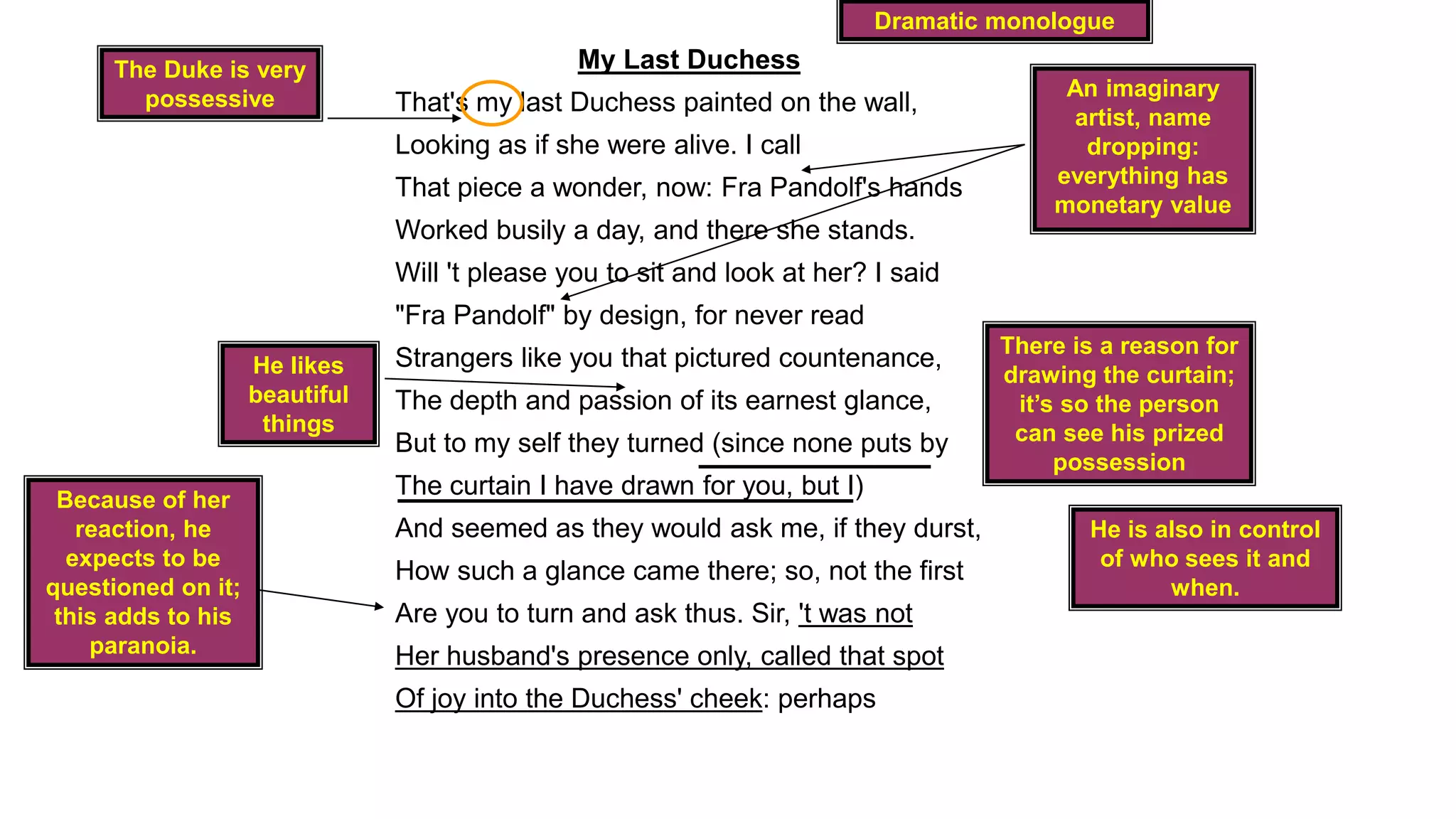
That's my last Duchess painted on the wall,
Looking as if she were alive. I call
That piece a wonder, now: Fra Pandolf's hands
Worked busily a day, and there she stands.
Will 't please you to sit and look at her? I said
"Fra Pandolf" by design, for never read
Strangers like you that pictured countenance,
The depth and passion of its earnest glance,
But to my self they turned (since none puts by
The curtain I have drawn for you, but I)
And seemed as they would ask me, if they durst,
How such a glance came there; so, not the first
Are you to turn and ask thus. Sir, 't was not
Her husband's presence only, called that spot
Of joy into the Duchess' cheek: perhaps
Dramatic monologue
The Duke is very
possessive
There is a reason for
drawing the curtain;
it’s so the person
can see his prized
possession
An imaginary
artist, name
dropping:
everything has
monetary value
He likes
beautiful
things
He is also in control
of who sees it and
when.
Because of her
reaction, he
expects to be
questioned on it;
this adds to his
paranoia.
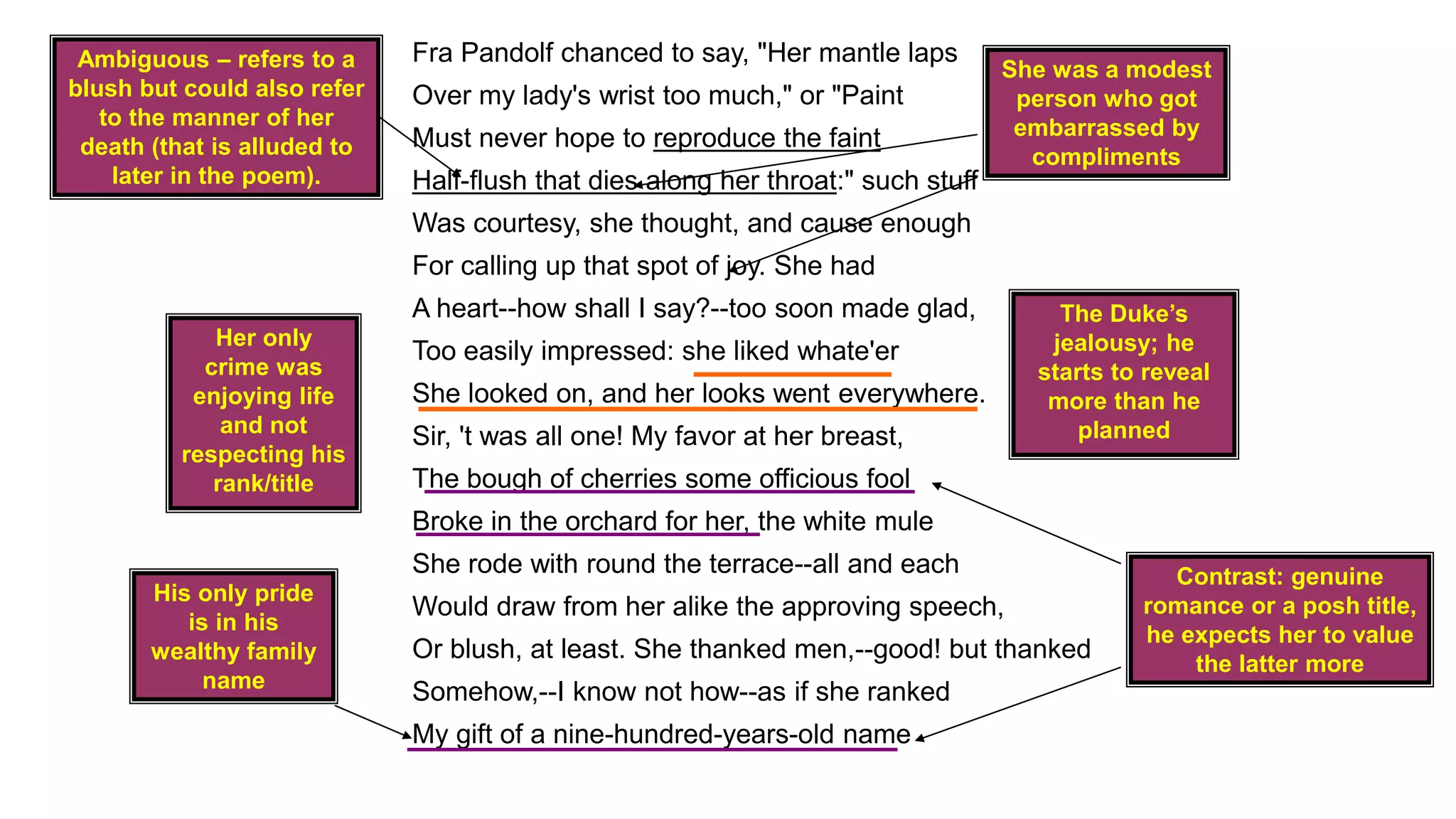
Fra Pandolf chanced to say, "Her mantle laps
Over my lady's wrist too much," or "Paint
Must never hope to reproduce the faint
Half-flush that dies along her throat:" such stuff
Was courtesy, she thought, and cause enough
For calling up that spot of joy. She had
A heart--how shall I say?--too soon made glad,
Too easily impressed: she liked whate'er
She looked on, and her looks went everywhere.
Sir, 't was all one! My favor at her breast,
The bough of cherries some officious fool
Broke in the orchard for her, the white mule
She rode with round the terrace--all and each
Would draw from her alike the approving speech,
Or blush, at least. She thanked men,--good! but thanked
Somehow,--I know not how--as if she ranked
My gift of a nine-hundred-years-old name
The Duke’s
jealousy; he
starts to reveal
more than he
planned
Her only
crime was
enjoying life
and not
respecting his
rank/title
Contrast: genuine
romance or a posh title,
he expects her to value
the latter more
His only pride
is in his
wealthy family
name
She was a modest
person who got
embarrassed by
compliments
Ambiguous – refers to a
blush but could also refer
to the manner of her
death (that is alluded to
later in the poem).
She thanked men,--good! but thanked
Somehow,--I know not how--as if she ranked
My gift of a nine-hundred-years-old name
With anybody's gift. Who'd stoop to blame
This sort of trifling? Even had you skill
In speech--(which I have not)--to make your will
Quite clear to such an one, and say, "Just this
Or that in you disgusts me; here you miss,
Or there exceed the mark"--and if she let
Herself be lessoned so, nor plainly set
Her wits to yours, forsooth, and made excuse,
--E'en then would be some stooping; and I choose
Never to stoop. Oh sir, she smiled, no doubt,
Whene'er I passed her; but who passed without
Much the same smile? This grew; I gave commands;
Then all smiles stopped together. There she stands
As if alive. Will 't please you rise? We'll meet
The company below, then. I repeat,
Ambiguous: suggests he
commanded her to stop smiling
and appreciating life; or, the
more common reading, he had
her killed.
The duke reveals his jealousy and paranoia
here by suggesting his duchess was having
an affair.
The repetition of stoop
highlights the Duke’s
belief that he is better
than everyone else
He admits he is not very good at talking
which suggests he didn’t discuss his
concerns with his wife – he let his
unconfirmed fears control him rather
than approach the real issue. Also
contrasts the fact that this is a very
eloquent speech to the Count’s envoy.
The dashes represent
pauses where the Duke gets
carried away and reveals
personal traits through the
internal thoughts.
He expects them to both be open
and honest with each other. But is
the Duke?
He believed that she
was treating all men the
same when she should
have placed him above
everyone else.
A reminder that they
have been sitting and
observing the painting.
The Count your master's known munificence
Is ample warrant that no just pretence
Of mine for dowry will be disallowed;
Though his fair daughter's self, as I avowed
At starting, is my object. Nay, we'll go
Together down, sir. Notice Neptune, though,
Taming a sea-horse, thought a rarity,
Which Claus of Innsbruck cast in bronze for me!
Robert Browning (1812-1889)
The Duchess's "faults" were qualities like compassion, modesty, humility,
delight in simple pleasures, and courtesy to those who served her.
The Duke doesn’t realise how
much of himself he has given
away in his criticism of his former
wife
As the Count is generous, the Duke knows
he doesn’t have to ask for money as he
knows he’ll receive it anyway – is this his
motivation to make the Count’s daughter
his next duchess?
Consider the setting
here again. Picture the
scene.
This entire monologue is
about the Duke
promoting himself to the
Count’s envoy as he
wants to marry the
Count’s daughter – has
he promoted himself
well though?
The Fresco and The Bronze
Look at the two pieces of art. One is an example of a fresco. The latter is a bronze of Neptune.
“… Notice Neptune, though,
Taming a sea-horse, thought a rarity,
Which Claus of Innsbruck cast in bronze for me!”
Why does the poem end with these lines? What is being suggested about the Duke, the Duchess and their
relationship? What might it suggest to the Count’s envoy?
The majority of the Duke’s monologue is spent telling
the Count’s envoy about his former wife – his ‘last
Duchess’. During this monologue, he talks about her
actions and personality and this, in turn, explains his
jealousy and anger.
What does the Duchess do which causes the Duke to
become jealous and angry?
What aspects of her personality upset him?

My Last Duchess

  • 1.
  • 2.
    The poem isa dramatic monologue. This poem is written in the voice of a male narrator - an imaginary Italian Duke. When? Browning wrote the poem in 1842. However, it seems likely that his idea for the poem was based on Alfonso II, Duke of Ferrara, whose first wife died after three years of marriage in 1561. The subject matter of the poem – the ‘marriage market’ - would have ensured that the poem was topical in 1850s Britain. What? The Duke now wants to marry the Count’s daughter. He is discussing this with the Count’s representative. As he does so, he shows his guest around his palace. During the conversation and tour, he reveals a portrait of his previous wife – his ‘last duchess’.
  • 3.
    Some key features: Conversationaltone – the language functions to direct, guide and command the listener. Disjointed thoughts – his thoughts are interrupted by his asides and commands to the listener. Fast rhythm – quite urgent movement from point to point – doesn’t dwell or expand at length on any particular point. Use of regular rhyme and rhythm. Use of enjambment – his thoughts are not completed within a line, instead they carry on the next line.
  • 4.
    My Last Duchess That'smy last Duchess painted on the wall, Looking as if she were alive. I call That piece a wonder, now: Fra Pandolf's hands Worked busily a day, and there she stands. Will 't please you to sit and look at her? I said "Fra Pandolf" by design, for never read Strangers like you that pictured countenance, The depth and passion of its earnest glance, But to my self they turned (since none puts by The curtain I have drawn for you, but I) And seemed as they would ask me, if they durst, How such a glance came there; so, not the first Are you to turn and ask thus. Sir, 't was not Her husband's presence only, called that spot Of joy into the Duchess' cheek: perhaps Dramatic monologue The Duke is very possessive There is a reason for drawing the curtain; it’s so the person can see his prized possession An imaginary artist, name dropping: everything has monetary value He likes beautiful things He is also in control of who sees it and when. Because of her reaction, he expects to be questioned on it; this adds to his paranoia.
  • 5.
    Fra Pandolf chancedto say, "Her mantle laps Over my lady's wrist too much," or "Paint Must never hope to reproduce the faint Half-flush that dies along her throat:" such stuff Was courtesy, she thought, and cause enough For calling up that spot of joy. She had A heart--how shall I say?--too soon made glad, Too easily impressed: she liked whate'er She looked on, and her looks went everywhere. Sir, 't was all one! My favor at her breast, The bough of cherries some officious fool Broke in the orchard for her, the white mule She rode with round the terrace--all and each Would draw from her alike the approving speech, Or blush, at least. She thanked men,--good! but thanked Somehow,--I know not how--as if she ranked My gift of a nine-hundred-years-old name The Duke’s jealousy; he starts to reveal more than he planned Her only crime was enjoying life and not respecting his rank/title Contrast: genuine romance or a posh title, he expects her to value the latter more His only pride is in his wealthy family name She was a modest person who got embarrassed by compliments Ambiguous – refers to a blush but could also refer to the manner of her death (that is alluded to later in the poem).
  • 6.
    She thanked men,--good!but thanked Somehow,--I know not how--as if she ranked My gift of a nine-hundred-years-old name With anybody's gift. Who'd stoop to blame This sort of trifling? Even had you skill In speech--(which I have not)--to make your will Quite clear to such an one, and say, "Just this Or that in you disgusts me; here you miss, Or there exceed the mark"--and if she let Herself be lessoned so, nor plainly set Her wits to yours, forsooth, and made excuse, --E'en then would be some stooping; and I choose Never to stoop. Oh sir, she smiled, no doubt, Whene'er I passed her; but who passed without Much the same smile? This grew; I gave commands; Then all smiles stopped together. There she stands As if alive. Will 't please you rise? We'll meet The company below, then. I repeat, Ambiguous: suggests he commanded her to stop smiling and appreciating life; or, the more common reading, he had her killed. The duke reveals his jealousy and paranoia here by suggesting his duchess was having an affair. The repetition of stoop highlights the Duke’s belief that he is better than everyone else He admits he is not very good at talking which suggests he didn’t discuss his concerns with his wife – he let his unconfirmed fears control him rather than approach the real issue. Also contrasts the fact that this is a very eloquent speech to the Count’s envoy. The dashes represent pauses where the Duke gets carried away and reveals personal traits through the internal thoughts. He expects them to both be open and honest with each other. But is the Duke? He believed that she was treating all men the same when she should have placed him above everyone else. A reminder that they have been sitting and observing the painting.
  • 7.
    The Count yourmaster's known munificence Is ample warrant that no just pretence Of mine for dowry will be disallowed; Though his fair daughter's self, as I avowed At starting, is my object. Nay, we'll go Together down, sir. Notice Neptune, though, Taming a sea-horse, thought a rarity, Which Claus of Innsbruck cast in bronze for me! Robert Browning (1812-1889) The Duchess's "faults" were qualities like compassion, modesty, humility, delight in simple pleasures, and courtesy to those who served her. The Duke doesn’t realise how much of himself he has given away in his criticism of his former wife As the Count is generous, the Duke knows he doesn’t have to ask for money as he knows he’ll receive it anyway – is this his motivation to make the Count’s daughter his next duchess? Consider the setting here again. Picture the scene. This entire monologue is about the Duke promoting himself to the Count’s envoy as he wants to marry the Count’s daughter – has he promoted himself well though?
  • 8.
    The Fresco andThe Bronze Look at the two pieces of art. One is an example of a fresco. The latter is a bronze of Neptune. “… Notice Neptune, though, Taming a sea-horse, thought a rarity, Which Claus of Innsbruck cast in bronze for me!” Why does the poem end with these lines? What is being suggested about the Duke, the Duchess and their relationship? What might it suggest to the Count’s envoy?
  • 9.
    The majority ofthe Duke’s monologue is spent telling the Count’s envoy about his former wife – his ‘last Duchess’. During this monologue, he talks about her actions and personality and this, in turn, explains his jealousy and anger. What does the Duchess do which causes the Duke to become jealous and angry? What aspects of her personality upset him?