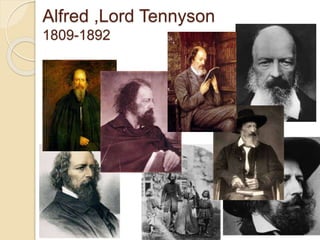
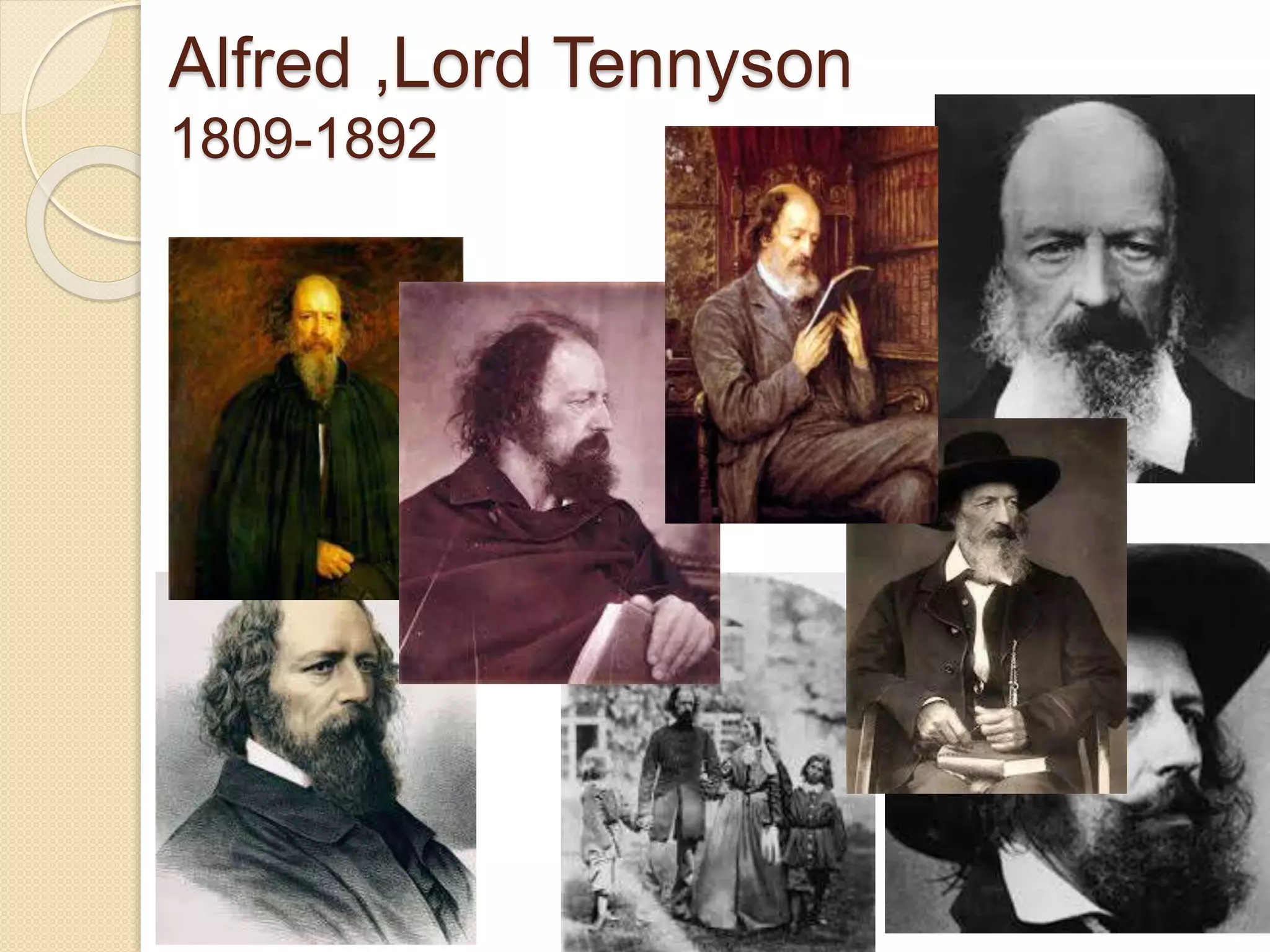
Alfred ,Lord Tennyson
1809-1892
Tennyson Quick Facts
o Victorian era British writer, novelist, poet.
o Poet Laureate of the UK during much of Queen
Victoria's reign.
o Remains one of the most popular poets in the
English language.
o Works include, “Crossing The Bar,” “The Eagle”
“In Memoriam.” , “Ulysses“ , “Idylls of the King”
“Tears, Idle Tears” and “Break, Break, Break”
Life in Full
The success of his 1842 Poems made
Tennyson a popular poet, and in 1845 he
received a Civil List (government) pension of
£200 a year, which helped relieve his financial
difficulties; the success of "The Princess" and In
Memoriam and his appointment in 1850 as Poet
Laureate finally established him as the most
popular poet of the Victorian era.
Literary Contributions of
Alfred Lord Tennyson
 Alfred’s poetry brought a new sense of
metrical variety, rich descriptive
imagery, and exquisite verbal
melodies to literature.
 Not only did his writing reflect upon
the Victorian Era, but they reflected
upon himself. His poetry is easily
understood by any generation.
Crossing The Bar
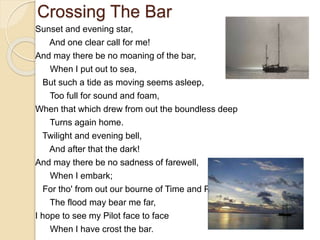
Sunset and evening star,
And one clear call for me!
And may there be no moaning of the bar,
When I put out to sea,
But such a tide as moving seems asleep,
Too full for sound and foam,
When that which drew from out the boundless deep
Turns again home.
Twilight and evening bell,
And after that the dark!
And may there be no sadness of farewell,
When I embark;
For tho' from out our bourne of Time and Place
The flood may bear me far,
I hope to see my Pilot face to face
When I have crost the bar.
Crossing the bar
 Title: “Crossing The Bar” : Entering into a new persona
 Paraphrase: The ocean & tide with sunsets crossing
spirits crossing over into heaven.
 Connotations:
“Sunset & evening star”= transition.
“Put out to sea” & “When I embark”= dying.
“Flood”= Noah and the ark. “Pilot”= God.
 Attitude: Sadness but without mourning- pride in death,
acceptance to meet God. [Not Afraid!]
 Theme: Death be not afraid, for the ocean brings new
tides of life.
In Memoriam
 Tennyson’s greatest poem
 Published in 1850
 Represents his struggle with Hallam’s death and with
the new developments in astronomy, biology, and
geology that were diminishing man’s stature in the
universe.
 After publication of this poem, Tennyson was named
Poet Laureate.
 Purpose – To explore the depths of grief and to
commemorate the loss of a friend
Selected text
Strong Son of God, immortal
Love,
Whom we, that have not seen thy
face,
By faith, and faith alone,
embrace,
Believing where we cannot
prove;
Thine are these orbs of light and
shade;
Thou madest Life in man and
brute;
Thou madest Death; and lo, thy
foot
Is on the skull which thou hast
made.
Thou wilt not leave us in the dust:
Thou madest man, he knows not
Thou seemest human and divine,
The highest, holiest manhood,
thou.
Our wills are ours, we know not
how;
Our wills are ours, to make them
thine.
Our little systems have their day;
They have their day and cease
to be:
They are but broken lights of
thee,
And thou, O Lord, art more than
they.
We have but faith: we cannot
know;
For knowledge is of things we
see
“In Memoriam” — TPCASTT
o Title:
Def-In memory of; as a memorial to.
o Paraphrase:
Alfred Lord Tennyson employs the imagery of natural elements in order to
portray his feelings and emotions after the death of his close friend, Arthur
Henry Hallam.
o Connotations:
In the line “Nature, red in tooth and claw”, Tennyson questions Man’s trust in
God’s love even after witnessing the brutality of nature. “Be blown about the
desert dust, Or sealed within the iron hills?” declares that life is useless and
has no purpose
o Attitude:
The attitude of the poem is mourning and questioning about God
o Shifts:
Throughout the poem Tennyson goes from questioning God to questioning
nature and then to question Man.
o Title (After Reading):
“In Loving Memory of Hallam
o Theme:
The theme is about nature, God, mourning and his best friend Arthur Hallam.
Comparison
The Poet vs. Time Era
 The Victorian Era was a major time of change and up
heal.
 Alfred’s poetry reflected more of his personal
melancholy and included mixtures of social and religious
doubts from the Victorian Era.
 Alfred was able to write poems in many different styles
and genres.
 He allowed the breakthrough into
modern/contemporary literature.
Ulysses
It little profits that an idle king,
By this still hearth, among these barren crags,
Match'd with an aged wife, I mete and dole
Unequal laws unto a savage race,
That hoard, and sleep, and feed, and know not me.
I cannot rest from travel: I will drink
Life to the lees: All times I have enjoy'd
Greatly, have suffer'd greatly, both with those
That loved me, and alone, on shore, and when
Thro' scudding drifts the rainy Hyades
Vext the dim sea: I am become a name;
For always roaming with a hungry heart
Much have I seen and known; cities of men
And manners, climates, councils, governments,
Myself not least, but honour'd of them all;
And drunk delight of battle with my peers,
Far on the ringing plains of windy Troy.
Analysis
 Blank Verse: The poem is written in blank verse or unrhymed
iambic pentameter.
 Dramatic Monologue: The dramatic monologue is a poetic
form in which the speaker of the poem is a character, distinct from
the poet, addresses a silent listener, revealing his or her character, in
a certain situation.
The Victorian period is the high point of this form. It is commonly used
by Tennyson, Robert Browning, Matthew Arnold, and others.
Ulysses is spoken by Ulysses, addressing an unidentified listener or
his fellow mariners, expressing his discontent with living without
adventures.
 Stanza form: The poem is divided into
three stanzas, or groups of lines, coinciding
with the division of thought.
 First stanza (lines 1-32): Ulysses is
speaking to himself expressing his
dissatisfaction with his idle life and his
longing for his former life of adventure.
 Second Stanza (lines 33-43): Ulysses
speaks to an unidentified listener about his
son.
 Third Stanza (lines 44-70): Ulysses is
speaking to his old crew about the need to
go again to the sea.
Idylls of the King
 Large-scale epic poem that occupied the
second half of his career.
 Uses the Arthurian legend to construct a
vision of the rise and fall of civilization
 Tennyson’s most extensive social vision.
 Two parts : “the last tournament” and “the
passing of “Arthur”
Tears ,idle tears
 Tennyson was inspired to write "Tears, Idle Tears"
upon a visit to Tintern Abbey in Monmouthshire , an
abbey that was abandoned in 1536
 the poem was about "the passion of the past, the
abiding in the transient”
 “Tears, Idle Tears" is noted for its lyric richness, and
for its tones of paradox and ambiguity—especially as
Tennyson did not often bring his doubts into the
grammar and symbolism of his works.
 The ambiguity occurs in the contrasting descriptions
of the tears: they are "idle", yet come from deep
within the narrator; the "happy autumn-fields" inspire
sadness.
Tears , idle tears
Tears, idle tears, I know not what
they mean,
Tears from the depth of some
divine despair
Rise in the heart, and gather to the
eyes,
In looking on the happy autumn-
fields,
And thinking of the days that are no
more.
Fresh as the first beam glittering
on a sail,
That brings our friends up from the
underworld,
Sad as the last which reddens over
one
That sinks with all we love below
the verge;
Ah, sad and strange as in dark
summer dawns
The earliest pipe of half-awaken'd
birds
To dying ears, when unto dying eyes
The casement slowly grows a
glimmering square;
So sad, so strange, the days that are
no more.
Dear as remembered kisses after
death,
And sweet as those by hopeless
fancy feign'd
On lips that are for others; deep as
love,
Deep as first love, and wild with all
regret;
Break, Break, Break
• The poem is an elegy that describes
Tennyson's feelings of loss after Arthur Hallam
died and his feelings of isolation while at
Mablethorpe, Lincolnshire.
• The poem is minimalistic in terms of detail and
style.
Break, Break, Break
Break, break, break,
On thy cold gray stones, O Sea!
And I would that my tongue could utter
The thoughts that arise in me.
O, well for the fisherman's boy,
That he shouts with his sister at play!
O, well for the sailor lad,
That he sings in his boat on the bay!
And the stately ships go on
To their haven under the hill;
But O for the touch of a vanished hand,
And the sound of a voice that is still!
Break, break, break,
At the foot of thy crags, O Sea!
But the tender grace of a day that is dead
Will never come back to me.

Alfred ,lord tennyson

  • 1.
  • 2.
    Tennyson Quick Facts oVictorian era British writer, novelist, poet. o Poet Laureate of the UK during much of Queen Victoria's reign. o Remains one of the most popular poets in the English language. o Works include, “Crossing The Bar,” “The Eagle” “In Memoriam.” , “Ulysses“ , “Idylls of the King” “Tears, Idle Tears” and “Break, Break, Break”
  • 3.
    Life in Full Thesuccess of his 1842 Poems made Tennyson a popular poet, and in 1845 he received a Civil List (government) pension of £200 a year, which helped relieve his financial difficulties; the success of "The Princess" and In Memoriam and his appointment in 1850 as Poet Laureate finally established him as the most popular poet of the Victorian era.
  • 4.
    Literary Contributions of AlfredLord Tennyson  Alfred’s poetry brought a new sense of metrical variety, rich descriptive imagery, and exquisite verbal melodies to literature.  Not only did his writing reflect upon the Victorian Era, but they reflected upon himself. His poetry is easily understood by any generation.
  • 5.
    Crossing The Bar Sunsetand evening star, And one clear call for me! And may there be no moaning of the bar, When I put out to sea, But such a tide as moving seems asleep, Too full for sound and foam, When that which drew from out the boundless deep Turns again home. Twilight and evening bell, And after that the dark! And may there be no sadness of farewell, When I embark; For tho' from out our bourne of Time and Place The flood may bear me far, I hope to see my Pilot face to face When I have crost the bar.
  • 6.
    Crossing the bar Title: “Crossing The Bar” : Entering into a new persona  Paraphrase: The ocean & tide with sunsets crossing spirits crossing over into heaven.  Connotations: “Sunset & evening star”= transition. “Put out to sea” & “When I embark”= dying. “Flood”= Noah and the ark. “Pilot”= God.  Attitude: Sadness but without mourning- pride in death, acceptance to meet God. [Not Afraid!]  Theme: Death be not afraid, for the ocean brings new tides of life.
  • 7.
    In Memoriam  Tennyson’sgreatest poem  Published in 1850  Represents his struggle with Hallam’s death and with the new developments in astronomy, biology, and geology that were diminishing man’s stature in the universe.  After publication of this poem, Tennyson was named Poet Laureate.  Purpose – To explore the depths of grief and to commemorate the loss of a friend
  • 8.
    Selected text Strong Sonof God, immortal Love, Whom we, that have not seen thy face, By faith, and faith alone, embrace, Believing where we cannot prove; Thine are these orbs of light and shade; Thou madest Life in man and brute; Thou madest Death; and lo, thy foot Is on the skull which thou hast made. Thou wilt not leave us in the dust: Thou madest man, he knows not Thou seemest human and divine, The highest, holiest manhood, thou. Our wills are ours, we know not how; Our wills are ours, to make them thine. Our little systems have their day; They have their day and cease to be: They are but broken lights of thee, And thou, O Lord, art more than they. We have but faith: we cannot know; For knowledge is of things we see
  • 9.
    “In Memoriam” —TPCASTT o Title: Def-In memory of; as a memorial to. o Paraphrase: Alfred Lord Tennyson employs the imagery of natural elements in order to portray his feelings and emotions after the death of his close friend, Arthur Henry Hallam. o Connotations: In the line “Nature, red in tooth and claw”, Tennyson questions Man’s trust in God’s love even after witnessing the brutality of nature. “Be blown about the desert dust, Or sealed within the iron hills?” declares that life is useless and has no purpose o Attitude: The attitude of the poem is mourning and questioning about God o Shifts: Throughout the poem Tennyson goes from questioning God to questioning nature and then to question Man. o Title (After Reading): “In Loving Memory of Hallam o Theme: The theme is about nature, God, mourning and his best friend Arthur Hallam.
  • 10.
    Comparison The Poet vs.Time Era  The Victorian Era was a major time of change and up heal.  Alfred’s poetry reflected more of his personal melancholy and included mixtures of social and religious doubts from the Victorian Era.  Alfred was able to write poems in many different styles and genres.  He allowed the breakthrough into modern/contemporary literature.
  • 11.
    Ulysses It little profitsthat an idle king, By this still hearth, among these barren crags, Match'd with an aged wife, I mete and dole Unequal laws unto a savage race, That hoard, and sleep, and feed, and know not me. I cannot rest from travel: I will drink Life to the lees: All times I have enjoy'd Greatly, have suffer'd greatly, both with those That loved me, and alone, on shore, and when Thro' scudding drifts the rainy Hyades Vext the dim sea: I am become a name; For always roaming with a hungry heart Much have I seen and known; cities of men And manners, climates, councils, governments, Myself not least, but honour'd of them all; And drunk delight of battle with my peers, Far on the ringing plains of windy Troy.
  • 12.
    Analysis  Blank Verse:The poem is written in blank verse or unrhymed iambic pentameter.  Dramatic Monologue: The dramatic monologue is a poetic form in which the speaker of the poem is a character, distinct from the poet, addresses a silent listener, revealing his or her character, in a certain situation. The Victorian period is the high point of this form. It is commonly used by Tennyson, Robert Browning, Matthew Arnold, and others. Ulysses is spoken by Ulysses, addressing an unidentified listener or his fellow mariners, expressing his discontent with living without adventures.
  • 13.
     Stanza form:The poem is divided into three stanzas, or groups of lines, coinciding with the division of thought.  First stanza (lines 1-32): Ulysses is speaking to himself expressing his dissatisfaction with his idle life and his longing for his former life of adventure.  Second Stanza (lines 33-43): Ulysses speaks to an unidentified listener about his son.  Third Stanza (lines 44-70): Ulysses is speaking to his old crew about the need to go again to the sea.
  • 14.
    Idylls of theKing  Large-scale epic poem that occupied the second half of his career.  Uses the Arthurian legend to construct a vision of the rise and fall of civilization  Tennyson’s most extensive social vision.  Two parts : “the last tournament” and “the passing of “Arthur”
  • 15.
    Tears ,idle tears Tennyson was inspired to write "Tears, Idle Tears" upon a visit to Tintern Abbey in Monmouthshire , an abbey that was abandoned in 1536  the poem was about "the passion of the past, the abiding in the transient”  “Tears, Idle Tears" is noted for its lyric richness, and for its tones of paradox and ambiguity—especially as Tennyson did not often bring his doubts into the grammar and symbolism of his works.  The ambiguity occurs in the contrasting descriptions of the tears: they are "idle", yet come from deep within the narrator; the "happy autumn-fields" inspire sadness.
  • 16.
    Tears , idletears Tears, idle tears, I know not what they mean, Tears from the depth of some divine despair Rise in the heart, and gather to the eyes, In looking on the happy autumn- fields, And thinking of the days that are no more. Fresh as the first beam glittering on a sail, That brings our friends up from the underworld, Sad as the last which reddens over one That sinks with all we love below the verge; Ah, sad and strange as in dark summer dawns The earliest pipe of half-awaken'd birds To dying ears, when unto dying eyes The casement slowly grows a glimmering square; So sad, so strange, the days that are no more. Dear as remembered kisses after death, And sweet as those by hopeless fancy feign'd On lips that are for others; deep as love, Deep as first love, and wild with all regret;
  • 17.
    Break, Break, Break •The poem is an elegy that describes Tennyson's feelings of loss after Arthur Hallam died and his feelings of isolation while at Mablethorpe, Lincolnshire. • The poem is minimalistic in terms of detail and style.
  • 18.
    Break, Break, Break Break,break, break, On thy cold gray stones, O Sea! And I would that my tongue could utter The thoughts that arise in me. O, well for the fisherman's boy, That he shouts with his sister at play! O, well for the sailor lad, That he sings in his boat on the bay! And the stately ships go on To their haven under the hill; But O for the touch of a vanished hand, And the sound of a voice that is still! Break, break, break, At the foot of thy crags, O Sea! But the tender grace of a day that is dead Will never come back to me.