SHIV KUMAR
M.PHARM(2ND
SEM)
DEPARTMENT OF PHARMACEUTICAL
SCIENCES AND TECHNOLOGY
MRSPTU,BHATINDA
1. INTRODUCTION
2. WHAT IS PHYTOSOMES?
3. MERITS OF PHYTOSOMES COMPLEX USES
4. DIFFERENCE BETWEEN PHYTOSOMES AND LIPOSOMES
5. METHOD OF PREPARATION
6. CHARACTERIZATION OF PHYTOSOMES
7. FORMULATION OF PHYTOSOMES
8. COMMERCIALLY AVAILABLE PHYTOSOMES
2
 Polyphenolics and terpenes are ubiquitous in plants, but their poor
solubility in water and organic solvents make the bioavailability of several
botanical extracts erratic and poor.
 The limited solubility , both in water and in lipophilic phases, as well as
hydrolytical instability at physiological pH values make several botanical
extracts containing polyphenolics and terpenes very poorly absorbed both
orally and topically.
 Bioavailability can be improved by using new delivery systems which can
enhance the rate and the extent of solubilization into aqueous intestinal fluids
and the capacity to cross biomembranes.
Department of pharmacognosy/LMCP/Mrugesh
Patel 3
 Polyphenolics exhibit a marked affinity for phospholipids via hydrogen
bondings and dipolar interactions with the charged phosphates groups of
phospholipids.
 By complexing the polyphenolic phytoconstituents in a definite ratio with
phosphatidylcholine,
 Indena has developed a delivery system named “Phytosome®”.
 First phytosomal preparation-Flavonognan Silybin(silymarin)obtained from
Milk thistle fruit having properties of antioxidant,liver detoxification,anti-
inflamatory.
Department of pharmacognosy/LMCP/Mrugesh
Patel 4
 Phytosomes are novel drug delivery system containing hydrophilic
bioactive phytoconstituents of herbs surround and bound by
phospholipids.
 The term “phyto” means plant while “some” means cell-like.
 Phytosomes are little cell like structure.
 This is advanced forms of herbal formulations which contains the bioactive
phytoconsituents of herb extract surrounds and bound by a lipid. Most of the
bioactive constituents of phytomedicines are water-soluble compounds like
flavonoids, glycosides.
Department of pharmacognosy/LMCP/Mrugesh
Patel 5
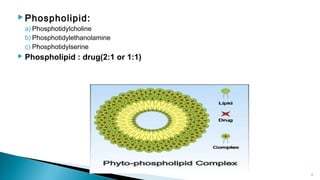
 Phospholipid:
a) Phosphotidylcholine
b) Phosphotidylethanolamine
c) Phosphotidylserine
 Phospholipid : drug(2:1 or 1:1)
Department of pharmacognosy/LMCP/Mrugesh
Patel 6
 There is a dramatic enhancement of the bioavailability of botanical extract
due to their complexation with phospholipid and improved absorption in
the intestinal tract.
 They permit the non-lipophilic botanical extract to allow better absorption
from the intestinal lumen, which is otherwise not possible.
 Phytosome process produces a little cell whereby the valuable component of
the herbal extracts are protected from destruction by digestive secretions
and gut bacteria.
 The formulation of phytosomes is safe and the components have all been
approved for pharmaceuticals and cosmetic use.
 Phytosomes shows better stability profile because chemical bond are
formed between phosphotidylcholine molecules and phytoconstituents.
Department of pharmacognosy/LMCP/Mrugesh
Patel 7
 They have been used to deliver liver protecting flavonoids because
they can be made easily bioavailable by phytosomes.
 Entrapment efficiency is high and more over predetermined because
drug itself in conjugation with lipids is forming vesicles.
 Phosphotidylcholine used in the phytosomes process besides acting as a
carrier also nourishes the skin because it is a essential part of cell
membrane.
 They can be also used for enhanced permeation of drug through skin
for transdermal and dermal delivery.
 Their low solubility in the aqueous media allows the formation of
stable emulsions or creams.
 Phytosomes are also superior to liposomes in the skin care products.
Department of pharmacognosy/LMCP/Mrugesh
Patel 8
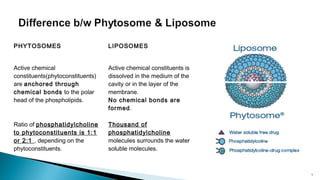
PHYTOSOMES LIPOSOMES
Active chemical
constituents(phytoconstituents)
are anchored through
chemical bonds to the polar
head of the phospholipids.
Active chemical constituents is
dissolved in the medium of the
cavity or in the layer of the
membrane.
No chemical bonds are
formed.
Ratio of phosphatidylcholine
to phytoconstituents is 1:1
or 2:1 , depending on the
phytoconstituents.
Thousand of
phosphatidylcholine
molecules surrounds the water
soluble molecules.
Department of pharmacognosy/LMCP/Mrugesh
Patel 9
 The most significant dietary source of the essential nutrient choline, is an
orthomolecule ubiquitous in known life form.
 Besides being an important emulsifier in the lungs,gastrointestinal tract,bile.
 PC is the principal molecular building block for circulating lipoproteins and
for cell membrane. They are making up the matrix into which fit a large
variety of proteins that are enzymes, transport proteins, receptors and
other biological energy converters.
 Manage the vast majority of life processes.
 As a carrier for both fat-miscible and water-miscible nutrient.
Department of pharmacognosy/LMCP/Mrugesh
Patel 10
 Phytosomes are prepared by reacting natural or synthetic phospholipids with active
components like bioflavonoid, flavolignan and polyphenolic constituents.
 Solvent Evaporation method is the most common technique used for the
preparation of phytosomes.(Refluxed at 50-60C for 2hr). Phytosomes of
ginsenoside, puerarin and kushenin are prepared in this manner.
 Mechanical Dispersion method is used for the preparation of marsupsin-
phospholipid complexes.
 Phospholipids is dissolved in a suitable solvent and active ingredient is added drop
by drop while sonicating the solution .Phospholipid complex is sometimes prepared
under reflux and stirring conditions to effect complete interaction.
 Prepared complex called phytosome can be isolated by precipitation with
nonsolvent,lyophilization,spray drying or vacuum drying.
11
 Visualization of particle size
 Transmission electron microscopy(TEM)
 Scanning electron microscopy(SEM)
 Spectroscopic evaluation
 1
H-NMR
 13
C-NMR
 FTIR(Chemical stability)
 Entrapment efficiency(Ultracentifugation)
 Spreadibility
 Percentage yield
 DSC
Department of pharmacognosy/LMCP/Mrugesh
Patel 12
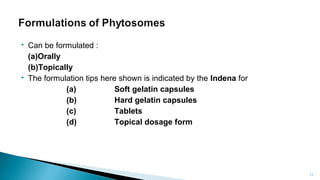
 Can be formulated :
(a)Orally
(b)Topically
 The formulation tips here shown is indicated by the Indena for
(a) Soft gelatin capsules
(b) Hard gelatin capsules
(c) Tablets
(d) Topical dosage form
Department of pharmacognosy/LMCP/Mrugesh
Patel 13
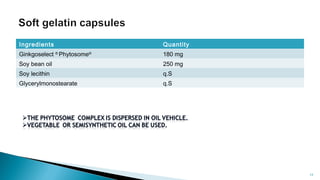
Ingredients Quantity
Ginkgoselect ®
Phytosome®
180 mg
Soy bean oil 250 mg
Soy lecithin q.S
Glycerylmonostearate q.S
Department of pharmacognosy/LMCP/Mrugesh
Patel 14
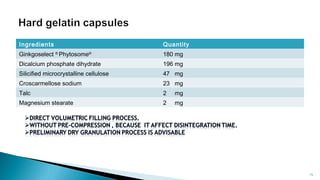
Ingredients Quantity
Ginkgoselect ®
Phytosome®
180 mg
Dicalcium phosphate dihydrate 196 mg
Silicified microcrystalline cellulose 47 mg
Croscarmellose sodium 23 mg
Talc 2 mg
Magnesium stearate 2 mg
Department of pharmacognosy/LMCP/Mrugesh
Patel 15
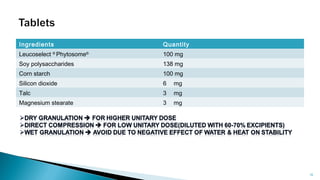
Ingredients Quantity
Leucoselect ®
Phytosome®
100 mg
Soy polysaccharides 138 mg
Corn starch 100 mg
Silicon dioxide 6 mg
Talc 3 mg
Magnesium stearate 3 mg
Department of pharmacognosy/LMCP/Mrugesh
Patel 16
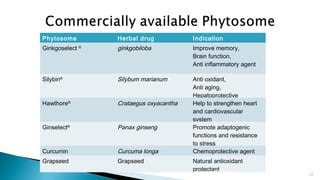
Phytosome Herbal drug Indication
Ginkgoselect ®
ginkgobiloba Improve memory,
Brain function,
Anti inflammatory agent
Silybin®
Silybum marianum Anti oxidant,
Anti aging,
Hepatoprotective
Hawthore®
Crataegus oxyacantha Help to strengthen heart
and cardiovascular
system
Ginselect®
Panax ginseng Promote adaptogenic
functions and resistance
to stress
Curcumin Curcuma longa Chemoprotective agent
Grapseed Grapseed Natural antioxidant
protectantDepartment of pharmacognosy/LMCP/Mrugesh
Patel 17
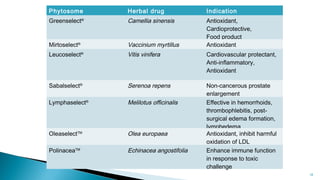
Phytosome Herbal drug Indication
Greenselect®
Camellia sinensis Antioxidant,
Cardioprotective,
Food product
Mirtoselect®
Vaccinium myrtillus Antioxidant
Leucoselect®
Vitis vinifera Cardiovascular protectant,
Anti-inflammatory,
Antioxidant
Sabalselect®
Serenoa repens Non-cancerous prostate
enlargement
Lymphaselect®
Melilotus officinalis Effective in hemorrhoids,
thrombophlebitis, post-
surgical edema formation,
lymphedema
OleaselectTM
Olea europaea Antioxidant, inhibit harmful
oxidation of LDL
PolinaceaTM
Echinacea angostifolia Enhance immune function
in response to toxic
challenge
Department of pharmacognosy/LMCP/Mrugesh
Patel 18
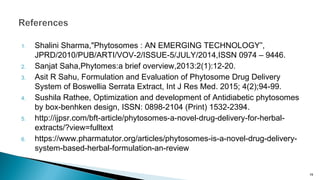
1. Shalini Sharma,"Phytosomes : AN EMERGING TECHNOLOGY”,
JPRD/2010/PUB/ARTI/VOV-2/ISSUE-5/JULY/2014,ISSN 0974 – 9446.
2. Sanjat Saha,Phytomes:a brief overview,2013:2(1):12-20.
3. Asit R Sahu, Formulation and Evaluation of Phytosome Drug Delivery
System of Boswellia Serrata Extract, Int J Res Med. 2015; 4(2);94-99.
4. Sushila Rathee, Optimization and development of Antidiabetic phytosomes
by box-benhken design, ISSN: 0898-2104 (Print) 1532-2394.
5. http://ijpsr.com/bft-article/phytosomes-a-novel-drug-delivery-for-herbal-
extracts/?view=fulltext
6. https://www.pharmatutor.org/articles/phytosomes-is-a-novel-drug-delivery-
system-based-herbal-formulation-an-review
19

Seminar on Phytosomes

  • 1.
    SHIV KUMAR M.PHARM(2ND SEM) DEPARTMENT OFPHARMACEUTICAL SCIENCES AND TECHNOLOGY MRSPTU,BHATINDA
  • 2.
    1. INTRODUCTION 2. WHATIS PHYTOSOMES? 3. MERITS OF PHYTOSOMES COMPLEX USES 4. DIFFERENCE BETWEEN PHYTOSOMES AND LIPOSOMES 5. METHOD OF PREPARATION 6. CHARACTERIZATION OF PHYTOSOMES 7. FORMULATION OF PHYTOSOMES 8. COMMERCIALLY AVAILABLE PHYTOSOMES 2
  • 3.
     Polyphenolics andterpenes are ubiquitous in plants, but their poor solubility in water and organic solvents make the bioavailability of several botanical extracts erratic and poor.  The limited solubility , both in water and in lipophilic phases, as well as hydrolytical instability at physiological pH values make several botanical extracts containing polyphenolics and terpenes very poorly absorbed both orally and topically.  Bioavailability can be improved by using new delivery systems which can enhance the rate and the extent of solubilization into aqueous intestinal fluids and the capacity to cross biomembranes. Department of pharmacognosy/LMCP/Mrugesh Patel 3
  • 4.
     Polyphenolics exhibita marked affinity for phospholipids via hydrogen bondings and dipolar interactions with the charged phosphates groups of phospholipids.  By complexing the polyphenolic phytoconstituents in a definite ratio with phosphatidylcholine,  Indena has developed a delivery system named “Phytosome®”.  First phytosomal preparation-Flavonognan Silybin(silymarin)obtained from Milk thistle fruit having properties of antioxidant,liver detoxification,anti- inflamatory. Department of pharmacognosy/LMCP/Mrugesh Patel 4
  • 5.
     Phytosomes arenovel drug delivery system containing hydrophilic bioactive phytoconstituents of herbs surround and bound by phospholipids.  The term “phyto” means plant while “some” means cell-like.  Phytosomes are little cell like structure.  This is advanced forms of herbal formulations which contains the bioactive phytoconsituents of herb extract surrounds and bound by a lipid. Most of the bioactive constituents of phytomedicines are water-soluble compounds like flavonoids, glycosides. Department of pharmacognosy/LMCP/Mrugesh Patel 5
  • 6.
     Phospholipid: a) Phosphotidylcholine b)Phosphotidylethanolamine c) Phosphotidylserine  Phospholipid : drug(2:1 or 1:1) Department of pharmacognosy/LMCP/Mrugesh Patel 6
  • 7.
     There isa dramatic enhancement of the bioavailability of botanical extract due to their complexation with phospholipid and improved absorption in the intestinal tract.  They permit the non-lipophilic botanical extract to allow better absorption from the intestinal lumen, which is otherwise not possible.  Phytosome process produces a little cell whereby the valuable component of the herbal extracts are protected from destruction by digestive secretions and gut bacteria.  The formulation of phytosomes is safe and the components have all been approved for pharmaceuticals and cosmetic use.  Phytosomes shows better stability profile because chemical bond are formed between phosphotidylcholine molecules and phytoconstituents. Department of pharmacognosy/LMCP/Mrugesh Patel 7
  • 8.
     They havebeen used to deliver liver protecting flavonoids because they can be made easily bioavailable by phytosomes.  Entrapment efficiency is high and more over predetermined because drug itself in conjugation with lipids is forming vesicles.  Phosphotidylcholine used in the phytosomes process besides acting as a carrier also nourishes the skin because it is a essential part of cell membrane.  They can be also used for enhanced permeation of drug through skin for transdermal and dermal delivery.  Their low solubility in the aqueous media allows the formation of stable emulsions or creams.  Phytosomes are also superior to liposomes in the skin care products. Department of pharmacognosy/LMCP/Mrugesh Patel 8
  • 9.
    PHYTOSOMES LIPOSOMES Active chemical constituents(phytoconstituents) areanchored through chemical bonds to the polar head of the phospholipids. Active chemical constituents is dissolved in the medium of the cavity or in the layer of the membrane. No chemical bonds are formed. Ratio of phosphatidylcholine to phytoconstituents is 1:1 or 2:1 , depending on the phytoconstituents. Thousand of phosphatidylcholine molecules surrounds the water soluble molecules. Department of pharmacognosy/LMCP/Mrugesh Patel 9
  • 10.
     The mostsignificant dietary source of the essential nutrient choline, is an orthomolecule ubiquitous in known life form.  Besides being an important emulsifier in the lungs,gastrointestinal tract,bile.  PC is the principal molecular building block for circulating lipoproteins and for cell membrane. They are making up the matrix into which fit a large variety of proteins that are enzymes, transport proteins, receptors and other biological energy converters.  Manage the vast majority of life processes.  As a carrier for both fat-miscible and water-miscible nutrient. Department of pharmacognosy/LMCP/Mrugesh Patel 10
  • 11.
     Phytosomes areprepared by reacting natural or synthetic phospholipids with active components like bioflavonoid, flavolignan and polyphenolic constituents.  Solvent Evaporation method is the most common technique used for the preparation of phytosomes.(Refluxed at 50-60C for 2hr). Phytosomes of ginsenoside, puerarin and kushenin are prepared in this manner.  Mechanical Dispersion method is used for the preparation of marsupsin- phospholipid complexes.  Phospholipids is dissolved in a suitable solvent and active ingredient is added drop by drop while sonicating the solution .Phospholipid complex is sometimes prepared under reflux and stirring conditions to effect complete interaction.  Prepared complex called phytosome can be isolated by precipitation with nonsolvent,lyophilization,spray drying or vacuum drying. 11
  • 12.
     Visualization ofparticle size  Transmission electron microscopy(TEM)  Scanning electron microscopy(SEM)  Spectroscopic evaluation  1 H-NMR  13 C-NMR  FTIR(Chemical stability)  Entrapment efficiency(Ultracentifugation)  Spreadibility  Percentage yield  DSC Department of pharmacognosy/LMCP/Mrugesh Patel 12
  • 13.
     Can beformulated : (a)Orally (b)Topically  The formulation tips here shown is indicated by the Indena for (a) Soft gelatin capsules (b) Hard gelatin capsules (c) Tablets (d) Topical dosage form Department of pharmacognosy/LMCP/Mrugesh Patel 13
  • 14.
    Ingredients Quantity Ginkgoselect ® Phytosome® 180mg Soy bean oil 250 mg Soy lecithin q.S Glycerylmonostearate q.S Department of pharmacognosy/LMCP/Mrugesh Patel 14
  • 15.
    Ingredients Quantity Ginkgoselect ® Phytosome® 180mg Dicalcium phosphate dihydrate 196 mg Silicified microcrystalline cellulose 47 mg Croscarmellose sodium 23 mg Talc 2 mg Magnesium stearate 2 mg Department of pharmacognosy/LMCP/Mrugesh Patel 15
  • 16.
    Ingredients Quantity Leucoselect ® Phytosome® 100mg Soy polysaccharides 138 mg Corn starch 100 mg Silicon dioxide 6 mg Talc 3 mg Magnesium stearate 3 mg Department of pharmacognosy/LMCP/Mrugesh Patel 16
  • 17.
    Phytosome Herbal drugIndication Ginkgoselect ® ginkgobiloba Improve memory, Brain function, Anti inflammatory agent Silybin® Silybum marianum Anti oxidant, Anti aging, Hepatoprotective Hawthore® Crataegus oxyacantha Help to strengthen heart and cardiovascular system Ginselect® Panax ginseng Promote adaptogenic functions and resistance to stress Curcumin Curcuma longa Chemoprotective agent Grapseed Grapseed Natural antioxidant protectantDepartment of pharmacognosy/LMCP/Mrugesh Patel 17
  • 18.
    Phytosome Herbal drugIndication Greenselect® Camellia sinensis Antioxidant, Cardioprotective, Food product Mirtoselect® Vaccinium myrtillus Antioxidant Leucoselect® Vitis vinifera Cardiovascular protectant, Anti-inflammatory, Antioxidant Sabalselect® Serenoa repens Non-cancerous prostate enlargement Lymphaselect® Melilotus officinalis Effective in hemorrhoids, thrombophlebitis, post- surgical edema formation, lymphedema OleaselectTM Olea europaea Antioxidant, inhibit harmful oxidation of LDL PolinaceaTM Echinacea angostifolia Enhance immune function in response to toxic challenge Department of pharmacognosy/LMCP/Mrugesh Patel 18
  • 19.
    1. Shalini Sharma,"Phytosomes: AN EMERGING TECHNOLOGY”, JPRD/2010/PUB/ARTI/VOV-2/ISSUE-5/JULY/2014,ISSN 0974 – 9446. 2. Sanjat Saha,Phytomes:a brief overview,2013:2(1):12-20. 3. Asit R Sahu, Formulation and Evaluation of Phytosome Drug Delivery System of Boswellia Serrata Extract, Int J Res Med. 2015; 4(2);94-99. 4. Sushila Rathee, Optimization and development of Antidiabetic phytosomes by box-benhken design, ISSN: 0898-2104 (Print) 1532-2394. 5. http://ijpsr.com/bft-article/phytosomes-a-novel-drug-delivery-for-herbal- extracts/?view=fulltext 6. https://www.pharmatutor.org/articles/phytosomes-is-a-novel-drug-delivery- system-based-herbal-formulation-an-review 19