1
PHYSIOLOGY OF
BALANCE
Deepika Somani
Moderator,
Dr. John Solomon
CONTENTS
 Definition of balance
 Definition of postural control
 Terms associated with postural control
 Theories of postural control
 Conceptual Systems involved in postural
control
 Motor control in quiet stance
 Motor control in pertubed stance( movement
strategies)
 Role of visual,somatosensory,vestibular
system in postural control
 Role of higher centers in postural control
 Anticipatory control
 Adaptive control
 Internal representation
4
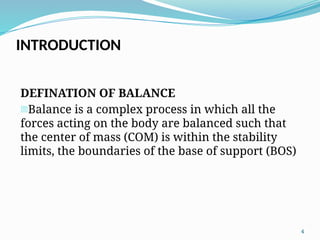
DEFINATION OF BALANCE
-Balance is a complex process in which all the
forces acting on the body are balanced such that
the center of mass (COM) is within the stability
limits, the boundaries of the base of support (BOS)
INTRODUCTION
5
 Postural control involves controlling and
maintaining the body’s position in space.
Two purpose of postural control:
1)Postural orientation
2)Postural stability
Postural control-
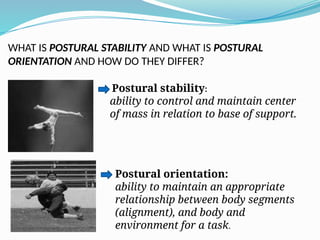
Postural stability:
ability to control and maintain center
of mass in relation to base of support.
WHAT IS POSTURAL STABILITY AND WHAT IS POSTURAL
ORIENTATION AND HOW DO THEY DIFFER?
Postural orientation:
ability to maintain an appropriate
relationship between body segments
(alignment), and body and
environment for a task.
7
 Center of mass
 Center of gravity
 Base of support
 Center of pressure
 Line of gravity
Center of mass - a point that is at the center of the
total body mass, which is determined by finding
the weighted average of the center of mass of
each segment.
Terms associated with postural stability.
8
 Center of gravity(COG)
- a vertical projection of center of mass
 Base of support (BOS)
- the area of the body that is in contact
with the support surface.
9
 Center of pressure(COP)
- center of the distribution of the total force
applied to the support surface,which helps to
maintain the COM over the BOS.
 Line of gravity (LOG)
- imaginary vertical line passing through the
COG down to a point in the base of support. From
vertex through the body of 2nd
sacral vertebrae.
10
 Reflex/Hierarchical Theory of Postural Control
- reflex response triggered by sensory
input.
 Systems theory of postural control
- interaction of individual with task and
environment.
- not only sensory input but also other system’s
interaction.
Theories of postural control
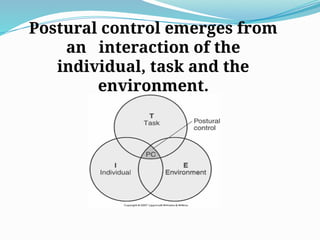
Postural control emerges from
an interaction of the
individual, task and the
environment.
POSTURAL CONTROL REQUIREMENTS
VARY WITH THE TASK &
ENVIRONMENT
 Varies with functional task.
 Examples:
1. sitting on chair + reading a book
2. standing + reading a book
3. standing + moving bus + reading
4. walking
13
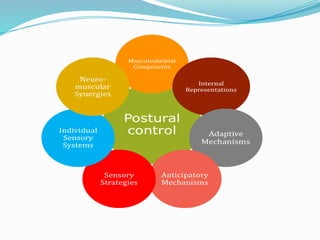
Conceptual model representing
systems contributing to postural
control
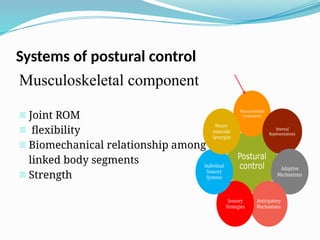
Systems of postural control
Musculoskeletal component
- Joint ROM
- flexibility
- Biomechanical relationship among
linked body segments
- Strength
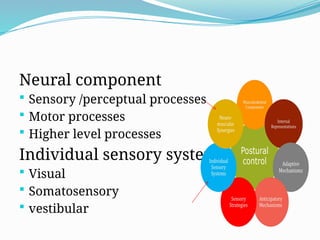
Neural component
 Sensory /perceptual processes
 Motor processes
 Higher level processes
Individual sensory system
 Visual
 Somatosensory
 vestibular
PERCEPTUAL / SENSORY
SYSTEMS IN POSTURAL
CONTROL
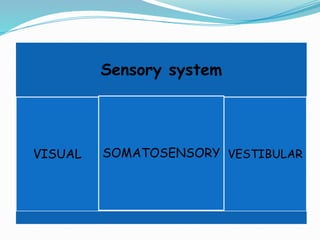
Sensory system
VISUAL SOMATOSENSORY VESTIBULAR
Perceptual/sensory systems in postural
control
In order to know,where the body is in space,
whether stationary or in motion, sensory
system is necessary.
Each of these senses provides CNS information
about position and motion of the body, thereby
providing a different frame of reference for
postural control.
Visual
 Provides information regarding position and
motion of head with respect to surrounding
objects.
 Also as a reference for verticality.
 It works with vestibular system to control eye
position.
 Children rely more on visual system for
maintaining balance.
DRAWBACK
Visual inputs are not always the accurate source
of orientation information about self motion
It has difficulty distinguishing between object
motion, referred to as exocentric motion and self
motion, referred to as egocentric.
VESTIBULAR SYSTEM
 Provides CNS information about the position
and movement of the head with respect to
gravity and inertial forces for postural
control.
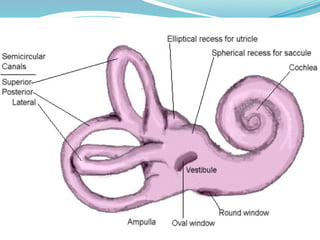
 Also called labyrinthine apparatus located in
inner ear.
 Consists of two parts:
 Semicircular canals and otolith organs
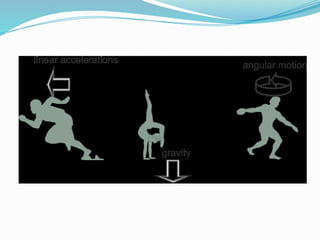
 Semicircular canals are responsible for motions
involving angular acceleration.
 Otolith organs are responsible for motions
involving linear acceleration and response to
gravity(head tilt)
 Reinforced by visual feedback
Reflexes involved in perceptual system.
 Vestibulo-occular reflex-maintain stable vision
during head movement.
 Vestibulospinal reflex-maintains the COG to
stabilize the body.
 Vestibulo-cervical reflex-maintains stability of
head during movement of torso.
Somatosensory
 Provides information to CNS regarding
position and motion of the body with
reference to supporting surface.
 Also reports information about the
relationship of body segments to one another.
 The somatosensory system receives
information from muscle spindles, joint
receptors, tendon organs, and
mechanoreceptors.
 Sends signals to vestibular system and brain
to maintain balance.
DRAWBACK
 In situations like standing on surfaces, which
are not horizontal, inputs reporting body’s
position with respect to the surface become
less helpful in establishing a vertical
orientation
Spinal
cord
Brainstem
level
cerebellu
m
Basal
ganglia
cortex
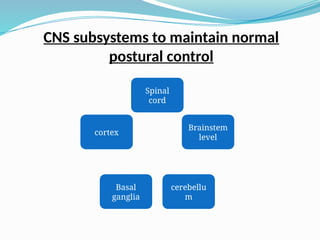
CNS subsystems to maintain normal
postural control
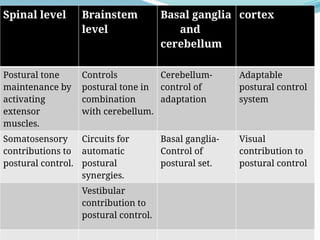
Spinal level Brainstem
level
Basal ganglia
and
cerebellum
cortex
Postural tone
maintenance by
activating
extensor
muscles.
Controls
postural tone in
combination
with cerebellum.
Cerebellum-
control of
adaptation
Adaptable
postural control
system
Somatosensory
contributions to
postural control.
Circuits for
automatic
postural
synergies.
Basal ganglia-
Control of
postural set.
Visual
contribution to
postural control
Vestibular
contribution to
postural control.
MOTOR SYSTEM
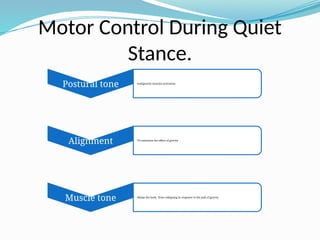
Motor Control During Quiet
Stance.
Postural tone •antigravity muscles activation
Alignment •To minimize the effect of gravity
Muscle tone •Keeps the body from collapsing in response to the pull of gravity
34
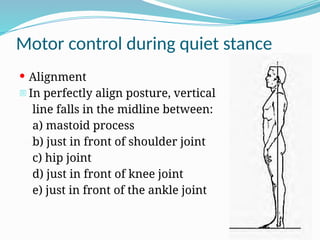
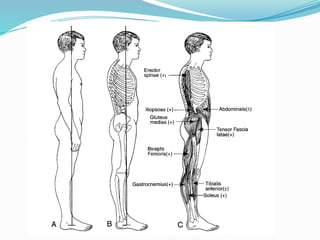
 Alignment
- In perfectly align posture, vertical
line falls in the midline between:
a) mastoid process
b) just in front of shoulder joint
c) hip joint
d) just in front of knee joint
e) just in front of the ankle joint
Motor control during quiet stance
35
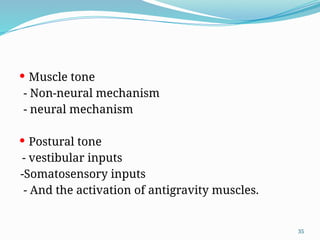
 Muscle tone
- Non-neural mechanism
- neural mechanism
 Postural tone
- vestibular inputs
-Somatosensory inputs
- And the activation of antigravity muscles.
Motor Control During Perturbed
Balance.
 The recovery of stability requires movement
strategies that control the COM over the BOS.
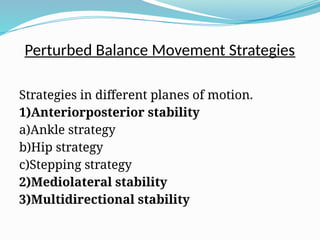
Perturbed Balance Movement Strategies
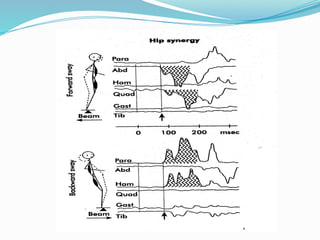
Strategies in different planes of motion.
1)Anteriorposterior stability
a)Ankle strategy
b)Hip strategy
c)Stepping strategy
2)Mediolateral stability
3)Multidirectional stability
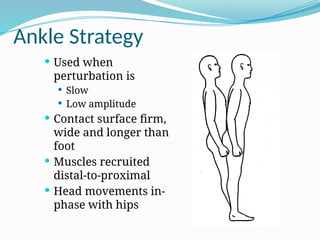
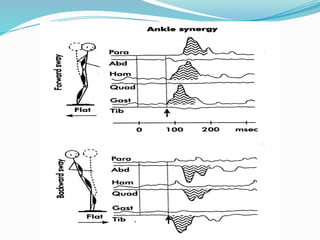
Ankle Strategy
 Used when
perturbation is
 Slow
 Low amplitude
 Contact surface firm,
wide and longer than
foot
 Muscles recruited
distal-to-proximal
 Head movements in-
phase with hips
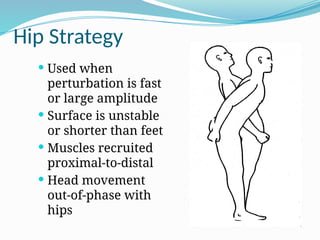
Hip Strategy
 Used when
perturbation is fast
or large amplitude
 Surface is unstable
or shorter than feet
 Muscles recruited
proximal-to-distal
 Head movement
out-of-phase with
hips
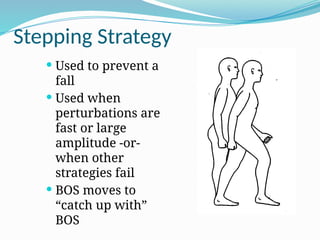
Stepping Strategy
 Used to prevent a
fall
 Used when
perturbations are
fast or large
amplitude -or-
when other
strategies fail
 BOS moves to
“catch up with”
BOS
Mediolateral stabilty
 Recent research has revealed that alternative
strategies are used to recover stability in ML
direction.
 ML control of balance occurs primarily at the
hip joint and trunk
 Hip muscles are activated first before the
ankle muscles.
 Mirror image
Multidirectional stability
 Traditional concept of synergy-each muscle
belongs to only one synergy and muscles
within that synergy are activated equally.
 Newer concept of synergies-each muscle
can belong to more than one synergy and has
a unique or fixed weighing factor that
represents the level of activation of that
muscle within the synergy.
Anticipatory control
 Anticipatory Postural Control” refers to postural
adjustments that are made before voluntary
movements to minimize disturbances in balance
(feed forward).
 This is based on previous experience and learning.
 E.g. Protective Strategy, such as covering your
head when you fall.
This does not correct the fall, but controls the
effects the fall.
Adaptive control
 Adaptive postural control involves modifying
sensory and motor systems in response to
changing task and environmental demands.
 Reactive control” is the response to a
disturbance in balance (feedback).
 E.g .Corrective Strategy, such as the “ ankle
strategy”
Internal Representation
 It is thought that an internal representation of body
posture exists within the CNS.
 This is often referred to as the “Postural Body
Schema.”
 Body Schema incorporates body geometry, kinetics .
 Mapping of sensations in CNS.
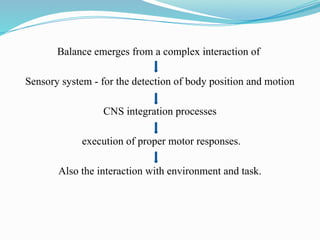
Balance emerges from a complex interaction of
Sensory system - for the detection of body position and motion
CNS integration processes
execution of proper motor responses.
Also the interaction with environment and task.
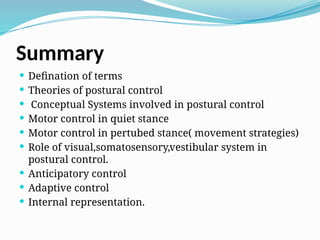
Summary
 Defination of terms
 Theories of postural control
 Conceptual Systems involved in postural control
 Motor control in quiet stance
 Motor control in pertubed stance( movement strategies)
 Role of visual,somatosensory,vestibular system in
postural control.
 Anticipatory control
 Adaptive control
 Internal representation.
51

Presentation on Balance and Postural Control.pptx

  • 1.
  • 2.
    CONTENTS  Definition ofbalance  Definition of postural control  Terms associated with postural control  Theories of postural control  Conceptual Systems involved in postural control  Motor control in quiet stance  Motor control in pertubed stance( movement strategies)
  • 3.
     Role ofvisual,somatosensory,vestibular system in postural control  Role of higher centers in postural control  Anticipatory control  Adaptive control  Internal representation
  • 4.
    4 DEFINATION OF BALANCE -Balanceis a complex process in which all the forces acting on the body are balanced such that the center of mass (COM) is within the stability limits, the boundaries of the base of support (BOS) INTRODUCTION
  • 5.
    5  Postural controlinvolves controlling and maintaining the body’s position in space. Two purpose of postural control: 1)Postural orientation 2)Postural stability Postural control-
  • 6.
    Postural stability: ability tocontrol and maintain center of mass in relation to base of support. WHAT IS POSTURAL STABILITY AND WHAT IS POSTURAL ORIENTATION AND HOW DO THEY DIFFER? Postural orientation: ability to maintain an appropriate relationship between body segments (alignment), and body and environment for a task.
  • 7.
    7  Center ofmass  Center of gravity  Base of support  Center of pressure  Line of gravity Center of mass - a point that is at the center of the total body mass, which is determined by finding the weighted average of the center of mass of each segment. Terms associated with postural stability.
  • 8.
    8  Center ofgravity(COG) - a vertical projection of center of mass  Base of support (BOS) - the area of the body that is in contact with the support surface.
  • 9.
    9  Center ofpressure(COP) - center of the distribution of the total force applied to the support surface,which helps to maintain the COM over the BOS.  Line of gravity (LOG) - imaginary vertical line passing through the COG down to a point in the base of support. From vertex through the body of 2nd sacral vertebrae.
  • 10.
    10  Reflex/Hierarchical Theoryof Postural Control - reflex response triggered by sensory input.  Systems theory of postural control - interaction of individual with task and environment. - not only sensory input but also other system’s interaction. Theories of postural control
  • 11.
    Postural control emergesfrom an interaction of the individual, task and the environment.
  • 12.
    POSTURAL CONTROL REQUIREMENTS VARYWITH THE TASK & ENVIRONMENT  Varies with functional task.  Examples: 1. sitting on chair + reading a book 2. standing + reading a book 3. standing + moving bus + reading 4. walking
  • 13.
    13 Conceptual model representing systemscontributing to postural control
  • 15.
    Systems of posturalcontrol Musculoskeletal component - Joint ROM - flexibility - Biomechanical relationship among linked body segments - Strength
  • 16.
    Neural component  Sensory/perceptual processes  Motor processes  Higher level processes Individual sensory system  Visual  Somatosensory  vestibular
  • 17.
    PERCEPTUAL / SENSORY SYSTEMSIN POSTURAL CONTROL
  • 18.
  • 19.
    Perceptual/sensory systems inpostural control In order to know,where the body is in space, whether stationary or in motion, sensory system is necessary. Each of these senses provides CNS information about position and motion of the body, thereby providing a different frame of reference for postural control.
  • 20.
    Visual  Provides informationregarding position and motion of head with respect to surrounding objects.  Also as a reference for verticality.  It works with vestibular system to control eye position.  Children rely more on visual system for maintaining balance.
  • 21.
    DRAWBACK Visual inputs arenot always the accurate source of orientation information about self motion It has difficulty distinguishing between object motion, referred to as exocentric motion and self motion, referred to as egocentric.
  • 22.
    VESTIBULAR SYSTEM  ProvidesCNS information about the position and movement of the head with respect to gravity and inertial forces for postural control.
  • 23.
     Also calledlabyrinthine apparatus located in inner ear.  Consists of two parts:  Semicircular canals and otolith organs  Semicircular canals are responsible for motions involving angular acceleration.  Otolith organs are responsible for motions involving linear acceleration and response to gravity(head tilt)  Reinforced by visual feedback
  • 26.
    Reflexes involved inperceptual system.  Vestibulo-occular reflex-maintain stable vision during head movement.  Vestibulospinal reflex-maintains the COG to stabilize the body.  Vestibulo-cervical reflex-maintains stability of head during movement of torso.
  • 27.
    Somatosensory  Provides informationto CNS regarding position and motion of the body with reference to supporting surface.  Also reports information about the relationship of body segments to one another.
  • 28.
     The somatosensorysystem receives information from muscle spindles, joint receptors, tendon organs, and mechanoreceptors.  Sends signals to vestibular system and brain to maintain balance.
  • 29.
    DRAWBACK  In situationslike standing on surfaces, which are not horizontal, inputs reporting body’s position with respect to the surface become less helpful in establishing a vertical orientation
  • 30.
  • 31.
    Spinal level Brainstem level Basalganglia and cerebellum cortex Postural tone maintenance by activating extensor muscles. Controls postural tone in combination with cerebellum. Cerebellum- control of adaptation Adaptable postural control system Somatosensory contributions to postural control. Circuits for automatic postural synergies. Basal ganglia- Control of postural set. Visual contribution to postural control Vestibular contribution to postural control.
  • 32.
  • 33.
    Motor Control DuringQuiet Stance. Postural tone •antigravity muscles activation Alignment •To minimize the effect of gravity Muscle tone •Keeps the body from collapsing in response to the pull of gravity
  • 34.
    34  Alignment - Inperfectly align posture, vertical line falls in the midline between: a) mastoid process b) just in front of shoulder joint c) hip joint d) just in front of knee joint e) just in front of the ankle joint Motor control during quiet stance
  • 35.
    35  Muscle tone -Non-neural mechanism - neural mechanism  Postural tone - vestibular inputs -Somatosensory inputs - And the activation of antigravity muscles.
  • 37.
    Motor Control DuringPerturbed Balance.  The recovery of stability requires movement strategies that control the COM over the BOS.
  • 38.
    Perturbed Balance MovementStrategies Strategies in different planes of motion. 1)Anteriorposterior stability a)Ankle strategy b)Hip strategy c)Stepping strategy 2)Mediolateral stability 3)Multidirectional stability
  • 39.
    Ankle Strategy  Usedwhen perturbation is  Slow  Low amplitude  Contact surface firm, wide and longer than foot  Muscles recruited distal-to-proximal  Head movements in- phase with hips
  • 41.
    Hip Strategy  Usedwhen perturbation is fast or large amplitude  Surface is unstable or shorter than feet  Muscles recruited proximal-to-distal  Head movement out-of-phase with hips
  • 43.
    Stepping Strategy  Usedto prevent a fall  Used when perturbations are fast or large amplitude -or- when other strategies fail  BOS moves to “catch up with” BOS
  • 44.
    Mediolateral stabilty  Recentresearch has revealed that alternative strategies are used to recover stability in ML direction.  ML control of balance occurs primarily at the hip joint and trunk  Hip muscles are activated first before the ankle muscles.  Mirror image
  • 45.
    Multidirectional stability  Traditionalconcept of synergy-each muscle belongs to only one synergy and muscles within that synergy are activated equally.  Newer concept of synergies-each muscle can belong to more than one synergy and has a unique or fixed weighing factor that represents the level of activation of that muscle within the synergy.
  • 46.
    Anticipatory control  AnticipatoryPostural Control” refers to postural adjustments that are made before voluntary movements to minimize disturbances in balance (feed forward).  This is based on previous experience and learning.  E.g. Protective Strategy, such as covering your head when you fall. This does not correct the fall, but controls the effects the fall.
  • 47.
    Adaptive control  Adaptivepostural control involves modifying sensory and motor systems in response to changing task and environmental demands.  Reactive control” is the response to a disturbance in balance (feedback).  E.g .Corrective Strategy, such as the “ ankle strategy”
  • 48.
    Internal Representation  Itis thought that an internal representation of body posture exists within the CNS.  This is often referred to as the “Postural Body Schema.”  Body Schema incorporates body geometry, kinetics .  Mapping of sensations in CNS.
  • 49.
    Balance emerges froma complex interaction of Sensory system - for the detection of body position and motion CNS integration processes execution of proper motor responses. Also the interaction with environment and task.
  • 50.
    Summary  Defination ofterms  Theories of postural control  Conceptual Systems involved in postural control  Motor control in quiet stance  Motor control in pertubed stance( movement strategies)  Role of visual,somatosensory,vestibular system in postural control.  Anticipatory control  Adaptive control  Internal representation.
  • 51.