8/22/2019 1
JANHAVI ATRE
MPT 1 (Neurosciences)
GUIDE – DR.SUVARNA GANVIR
DEPARTMENT OF NEUROPHYSIOTHERAPY
DVVPF’S COLLEGE OF PHYSIOTHERAPY
AHMEDNAGAR

 Introduction
 Definition of Motor Learning
 Basic forms of learning
Explicit (declarative)
Implicit (non declarative)
 Theories of motor learning
Adam’s closed loop theory
Schmidt’s schema theory
Ecological theory
 Theories related to stages of learning motor skills
Fitts and Posner 3 stage model
System’s 3 stage model
Gentile’s 2 stage model
 References
8/22/2019 2
CONTENTS

 Patient with stroke
 Speedy recovery within 5 weeks
 Functional ability – standing , walking and feeding
herself
 So importance of motor learning
8/22/2019 3
Introduction

 Motor learning is the study of acquisition and/or
modification of movement.
 Motor control-understanding the control of
movement already acquired.
 Motor learning- understanding modification of
movement.
 Motor recovery of function- reacquisition of
movement skills lost through injury.
8/22/2019 4
What is motor learning?

 Definition:
 A set of processes associated with practice or experience
leading to permanent changes in the capabilities to
produce a skilled action.
 4 components-
1.Aquiring capability for skilled action.
2.Learning results from experience or practice.
3.Learning cannot be measured directly, based on behavior.
4.Permanent change in behavior , so short term alterations
are not thought of as learning
8/22/2019 5
Motor learning

 Learning is a permanent change in the motor
behavior
 Performance is a temporary change seen in practice
sessions.
 Eg-patient bears weight on affected leg after therapy
but following day again walks with more weight
bearing on the non affected leg.
8/22/2019 6
Performance and Learning

8/22/2019 7
Forms of learning

 Non associative learning
 Occurs when animals are give single stimulus
repeatedly.
-Habituation
It is decrease in responsiveness that occurs as a result of
repeated exposure to non painful stimulus.
-Sensitization
It is increased responsiveness following a threatening
or noxious stimulus
8/22/2019 8
Implicit form of long term
memory/non declarative

8/22/2019 9
Associative learning
Classical conditioning

 Behaviors that are rewarded tend to be repeated at
the cost of other behaviors
Eg.
8/22/2019 10
Operant conditioning

 Develops slowly through repetition of act over many
trials and is expressed through improved
performance of the task that was practiced before.
 Does not require attention,awareness and higher
cognitive functions.
8/22/2019 11
Procedural learning

 It results in knowledge that can be consciously
recalled and thus requires processes such as
awareness , attention and reflection.
8/22/2019 12
Declarative/explicit
learning

 Group of abstract ideas about nature and control of
the acquisition or modification of movement.
 Adam’s closed loop theory
 Schmidt’s schema theory
 Ecological theory
8/22/2019 13
Theories of Motor
Learning

 Theory was given by Jack Adams in 1971
 Important aspect was concept of closed loop
processes in motor control.
 In closed loop process,sensory feedback is used for
the ongoing production of skilled movement.
8/22/2019 14
Adam’s closed loop
theory

 In closed loop theory two distinct types of memory
were important in the process.
 Memory trace-selection and initiation of movement.
 Perceptual trace- built up over a period of practice
and adjusts movement.
 He proposed that after movement is initiated by the
memory trace, the perceptual trace takes over to
carry out the movement and detect error.
8/22/2019 15

8/22/2019 16

 When a patient is learning an new movement skill
like picking up a glass ,with practice they develop
perceptual trace for the movement which serves as a
guide for later movements.
 Closed loop theory suggested that when retraining
motor skills , the patient should practice the same
movement repeatedly to accurate end point.
8/22/2019 17
Clinical implication

 It could not explain the accurate performance of
novel movements made in absence of sensory
feedback.
 It would be impossible to store a separate perceptual
trace for every movement ever performed because of
memory storage processes inside the brain.
8/22/2019 18
Limitations

 Schmidt in 1970 emphasized open loop control
processes and generalized motor program concept.
 Schema is referred to abstract representation of
things stored in memory.
8/22/2019 19
Schmidt’s schema
theory
 Schmidt proposed that after an individual makes a
movement , four things are available for brief storage
in short term memory
 a)initial movement conditions such as weight of the
body and position
b)parameters in generalized motor program
c)outcome of movement in terms of knowledge of
results.
d)sensory consequences of the movement i.e how it
felt,looked or sounded.
8/22/2019 20

 The recall schema is used to select a specific
response.
 The recognition schema is used to evaluate the
response.
 Thus learning consists of ongoing process of
updating the recognition and recall schemas with
each movement made.
8/22/2019 21

 Optimal learning occurs if a task is practiced in
different conditions
8/22/2019 22
Clinical implication

 It lacks specificity.
 Schema theory is not supported by research.
8/22/2019 23
Limitations

 Given by Newell in 1991.
 Motor learning increases coordination between
perception and action.
 Involves use of perceptual cues that are most relevant to
the performance of specific task
 Exploring motor workspace involves exploring range of
movements to select most appropriate movement
8/22/2019 24
Ecological theory

 Eg – cues for lifting a glass-how slippery the surface
is,what is the size of the glass, how heavy it is
 So patient has to develop strategies to identify that.
 If the glass is heavy, she’ll require more force to
apply. Or if it is large , will require firm grip
 If she is unable to judge that then the fluid within the
glass may spill or glass may slip.
8/22/2019 25
Clinical implication

 Another set of theories focuses on motor learning
from a temporal perspective and attempt to
characterize learning process.
 These theories basically describe initial stages of
acquiring skill and how learning occurs over a
period of time.
8/22/2019 26
Theories related to stages
of learning motor skills

 3 STAGES OF LEARNING
 Cognitive
 Associative
 Autonomous
8/22/2019 27
FITTS AND POSNER
THREE-STAGE MODEL

 Eg learning to reach for a glass of water,
lot of errors  spillage  refined movements -
able to reach while having conversation or being
engaged in other tasks.
8/22/2019 28
Clinical implication

 Given by Bernstein initially in 1967
 3 stages
 Novice stage - learner simplifies the movement in
order to reduce the degrees of freedom.
 Advanced stage – learner starts releasing additional
degrees of freedom by allowing movements at more
joints.
 Expert stage – learner has released all the degrees of
freedom necessary to perform a task in a coordinated
and efficient way.
8/22/2019 29
SYSTEMS THREE
STAGE MODEL

 Supporting oneself on all fours to kneeling to
independent standing can be seen as increasing
degrees of freedom.
 Egs (gradually releasing degrees of freedom)
 Coactivation of muscles in acquiring early stage of
movement
8/22/2019 30
Clinical implication

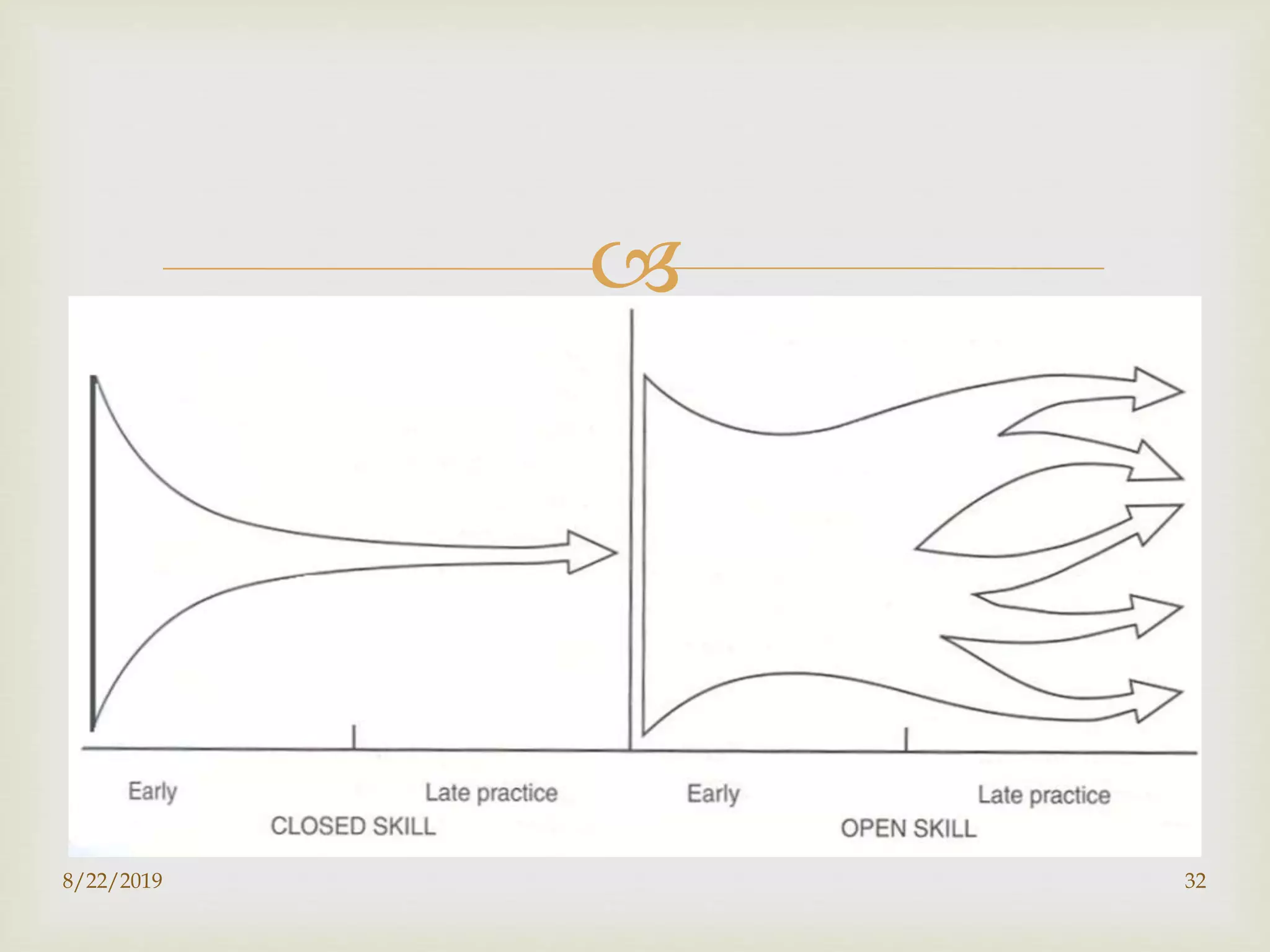
 Gentile (1972,87) proposed two stage model which
describes the goal of the learner in each stage.
 1st stage – goal is to understand the task dynamics.
And develop strategies appropriate to achieving
goal.
 2nd stage - goal of the learner is to refine the
acquired movement called as fixation/diversification
stage.
8/22/2019 31
GENTILE’S TWO
STAGE MODEL

8/22/2019 32

 Motor control translating research into clinical
practice,author-Anne Shumway Cook (pg 21-45)
 Physical rehabilitation – Susan O’Sullivan (pg
8/22/2019 33
References

Motor learning ppt

  • 1.
    8/22/2019 1 JANHAVI ATRE MPT1 (Neurosciences) GUIDE – DR.SUVARNA GANVIR DEPARTMENT OF NEUROPHYSIOTHERAPY DVVPF’S COLLEGE OF PHYSIOTHERAPY AHMEDNAGAR
  • 2.
      Introduction  Definitionof Motor Learning  Basic forms of learning Explicit (declarative) Implicit (non declarative)  Theories of motor learning Adam’s closed loop theory Schmidt’s schema theory Ecological theory  Theories related to stages of learning motor skills Fitts and Posner 3 stage model System’s 3 stage model Gentile’s 2 stage model  References 8/22/2019 2 CONTENTS
  • 3.
      Patient withstroke  Speedy recovery within 5 weeks  Functional ability – standing , walking and feeding herself  So importance of motor learning 8/22/2019 3 Introduction
  • 4.
      Motor learningis the study of acquisition and/or modification of movement.  Motor control-understanding the control of movement already acquired.  Motor learning- understanding modification of movement.  Motor recovery of function- reacquisition of movement skills lost through injury. 8/22/2019 4 What is motor learning?
  • 5.
      Definition:  Aset of processes associated with practice or experience leading to permanent changes in the capabilities to produce a skilled action.  4 components- 1.Aquiring capability for skilled action. 2.Learning results from experience or practice. 3.Learning cannot be measured directly, based on behavior. 4.Permanent change in behavior , so short term alterations are not thought of as learning 8/22/2019 5 Motor learning
  • 6.
      Learning isa permanent change in the motor behavior  Performance is a temporary change seen in practice sessions.  Eg-patient bears weight on affected leg after therapy but following day again walks with more weight bearing on the non affected leg. 8/22/2019 6 Performance and Learning
  • 7.
  • 8.
      Non associativelearning  Occurs when animals are give single stimulus repeatedly. -Habituation It is decrease in responsiveness that occurs as a result of repeated exposure to non painful stimulus. -Sensitization It is increased responsiveness following a threatening or noxious stimulus 8/22/2019 8 Implicit form of long term memory/non declarative
  • 9.
  • 10.
      Behaviors thatare rewarded tend to be repeated at the cost of other behaviors Eg. 8/22/2019 10 Operant conditioning
  • 11.
      Develops slowlythrough repetition of act over many trials and is expressed through improved performance of the task that was practiced before.  Does not require attention,awareness and higher cognitive functions. 8/22/2019 11 Procedural learning
  • 12.
      It resultsin knowledge that can be consciously recalled and thus requires processes such as awareness , attention and reflection. 8/22/2019 12 Declarative/explicit learning
  • 13.
      Group ofabstract ideas about nature and control of the acquisition or modification of movement.  Adam’s closed loop theory  Schmidt’s schema theory  Ecological theory 8/22/2019 13 Theories of Motor Learning
  • 14.
      Theory wasgiven by Jack Adams in 1971  Important aspect was concept of closed loop processes in motor control.  In closed loop process,sensory feedback is used for the ongoing production of skilled movement. 8/22/2019 14 Adam’s closed loop theory
  • 15.
      In closedloop theory two distinct types of memory were important in the process.  Memory trace-selection and initiation of movement.  Perceptual trace- built up over a period of practice and adjusts movement.  He proposed that after movement is initiated by the memory trace, the perceptual trace takes over to carry out the movement and detect error. 8/22/2019 15
  • 16.
  • 17.
      When apatient is learning an new movement skill like picking up a glass ,with practice they develop perceptual trace for the movement which serves as a guide for later movements.  Closed loop theory suggested that when retraining motor skills , the patient should practice the same movement repeatedly to accurate end point. 8/22/2019 17 Clinical implication
  • 18.
      It couldnot explain the accurate performance of novel movements made in absence of sensory feedback.  It would be impossible to store a separate perceptual trace for every movement ever performed because of memory storage processes inside the brain. 8/22/2019 18 Limitations
  • 19.
      Schmidt in1970 emphasized open loop control processes and generalized motor program concept.  Schema is referred to abstract representation of things stored in memory. 8/22/2019 19 Schmidt’s schema theory
  • 20.
     Schmidt proposedthat after an individual makes a movement , four things are available for brief storage in short term memory  a)initial movement conditions such as weight of the body and position b)parameters in generalized motor program c)outcome of movement in terms of knowledge of results. d)sensory consequences of the movement i.e how it felt,looked or sounded. 8/22/2019 20
  • 21.
      The recallschema is used to select a specific response.  The recognition schema is used to evaluate the response.  Thus learning consists of ongoing process of updating the recognition and recall schemas with each movement made. 8/22/2019 21
  • 22.
      Optimal learningoccurs if a task is practiced in different conditions 8/22/2019 22 Clinical implication
  • 23.
      It lacksspecificity.  Schema theory is not supported by research. 8/22/2019 23 Limitations
  • 24.
      Given byNewell in 1991.  Motor learning increases coordination between perception and action.  Involves use of perceptual cues that are most relevant to the performance of specific task  Exploring motor workspace involves exploring range of movements to select most appropriate movement 8/22/2019 24 Ecological theory
  • 25.
      Eg –cues for lifting a glass-how slippery the surface is,what is the size of the glass, how heavy it is  So patient has to develop strategies to identify that.  If the glass is heavy, she’ll require more force to apply. Or if it is large , will require firm grip  If she is unable to judge that then the fluid within the glass may spill or glass may slip. 8/22/2019 25 Clinical implication
  • 26.
      Another setof theories focuses on motor learning from a temporal perspective and attempt to characterize learning process.  These theories basically describe initial stages of acquiring skill and how learning occurs over a period of time. 8/22/2019 26 Theories related to stages of learning motor skills
  • 27.
      3 STAGESOF LEARNING  Cognitive  Associative  Autonomous 8/22/2019 27 FITTS AND POSNER THREE-STAGE MODEL
  • 28.
      Eg learningto reach for a glass of water, lot of errors  spillage  refined movements - able to reach while having conversation or being engaged in other tasks. 8/22/2019 28 Clinical implication
  • 29.
      Given byBernstein initially in 1967  3 stages  Novice stage - learner simplifies the movement in order to reduce the degrees of freedom.  Advanced stage – learner starts releasing additional degrees of freedom by allowing movements at more joints.  Expert stage – learner has released all the degrees of freedom necessary to perform a task in a coordinated and efficient way. 8/22/2019 29 SYSTEMS THREE STAGE MODEL
  • 30.
      Supporting oneselfon all fours to kneeling to independent standing can be seen as increasing degrees of freedom.  Egs (gradually releasing degrees of freedom)  Coactivation of muscles in acquiring early stage of movement 8/22/2019 30 Clinical implication
  • 31.
      Gentile (1972,87)proposed two stage model which describes the goal of the learner in each stage.  1st stage – goal is to understand the task dynamics. And develop strategies appropriate to achieving goal.  2nd stage - goal of the learner is to refine the acquired movement called as fixation/diversification stage. 8/22/2019 31 GENTILE’S TWO STAGE MODEL
  • 32.
  • 33.
      Motor controltranslating research into clinical practice,author-Anne Shumway Cook (pg 21-45)  Physical rehabilitation – Susan O’Sullivan (pg 8/22/2019 33 References