INTRODUCTIONINTRODUCTION
GENERAL PRINCIPLESGENERAL PRINCIPLES
MotionMotion
Motion is a fundamental property of most animal life. In the simpleMotion is a fundamental property of most animal life. In the simple
unicellular animals, motion and locomotion depend upon theunicellular animals, motion and locomotion depend upon the
contractility of protoplasm and the action of accessory organscontractility of protoplasm and the action of accessory organs
such as cilia, flagella, etc. The lowest multicellular animalssuch as cilia, flagella, etc. The lowest multicellular animals
possess rudimentary neuromuscular mechanisms; in higher forms,possess rudimentary neuromuscular mechanisms; in higher forms,
motion is based upon the transmission of impulses from a receptormotion is based upon the transmission of impulses from a receptor
through an afferent neuron and ganglion cell to muscle. This samethrough an afferent neuron and ganglion cell to muscle. This same
principle is found in the reflex arc of higher animals, includingprinciple is found in the reflex arc of higher animals, including
humans, in whom the anterior spinal cord has developed into ahumans, in whom the anterior spinal cord has developed into a
central regulating mechanism, the brain, which is concerned withcentral regulating mechanism, the brain, which is concerned with
initiating and integrating movements.initiating and integrating movements.
The inputs converging on the motor neurons subserveThe inputs converging on the motor neurons subserve 3 semidistinct3 semidistinct
functionsfunctions::
- they bring about voluntary activity;
- they adjust body posture to provide a stable background for movement;
- they coordinate the action of the various muscles to make movements
smooth and precise
The patterns of voluntary activity are planned within the brain, and theThe patterns of voluntary activity are planned within the brain, and the
commands are sent to the muscles primarily via the corticospinal andcommands are sent to the muscles primarily via the corticospinal and
corticobucorticobullbar system. Posture is continually adjusted not only before butbar system. Posture is continually adjusted not only before but
also during movement by posture-regulating systems. Movement isalso during movement by posture-regulating systems. Movement is
smoothed and coordinated by the medial and intermediate portions of thesmoothed and coordinated by the medial and intermediate portions of the
cerebellum (the spinocerebellum) and its connections. The basal gangliacerebellum (the spinocerebellum) and its connections. The basal ganglia
and the lateral portions of the cerebellum (neocerebellum) are part of aand the lateral portions of the cerebellum (neocerebellum) are part of a
feedback circuit to the premotor and motor cortex that is concerned withfeedback circuit to the premotor and motor cortex that is concerned with
planning and organizing voluntary movement.planning and organizing voluntary movement.
CORTICOSPINAL & CORTICOBULBAR SYSTEMCORTICOSPINAL & CORTICOBULBAR SYSTEM
ANATOMYANATOMY
The cortical areas from whichThe cortical areas from which
the corticospinal andthe corticospinal and
corticobulbar systemcorticobulbar system
originates are generally held tooriginates are generally held to
be those where stimulationbe those where stimulation
produces prompt discreteproduces prompt discrete
movement. The best known ismovement. The best known is
the motor cortex in thethe motor cortex in the
precentral gyrus.precentral gyrus.
30% of the fibers making up the corticospinal and corticobulbar30% of the fibers making up the corticospinal and corticobulbar
tracts come from the motor cortex but 30% come from thetracts come from the motor cortex but 30% come from the
premotor cortex and 40% from the parietal lobe, especially thepremotor cortex and 40% from the parietal lobe, especially the
somatic sensory area.somatic sensory area.
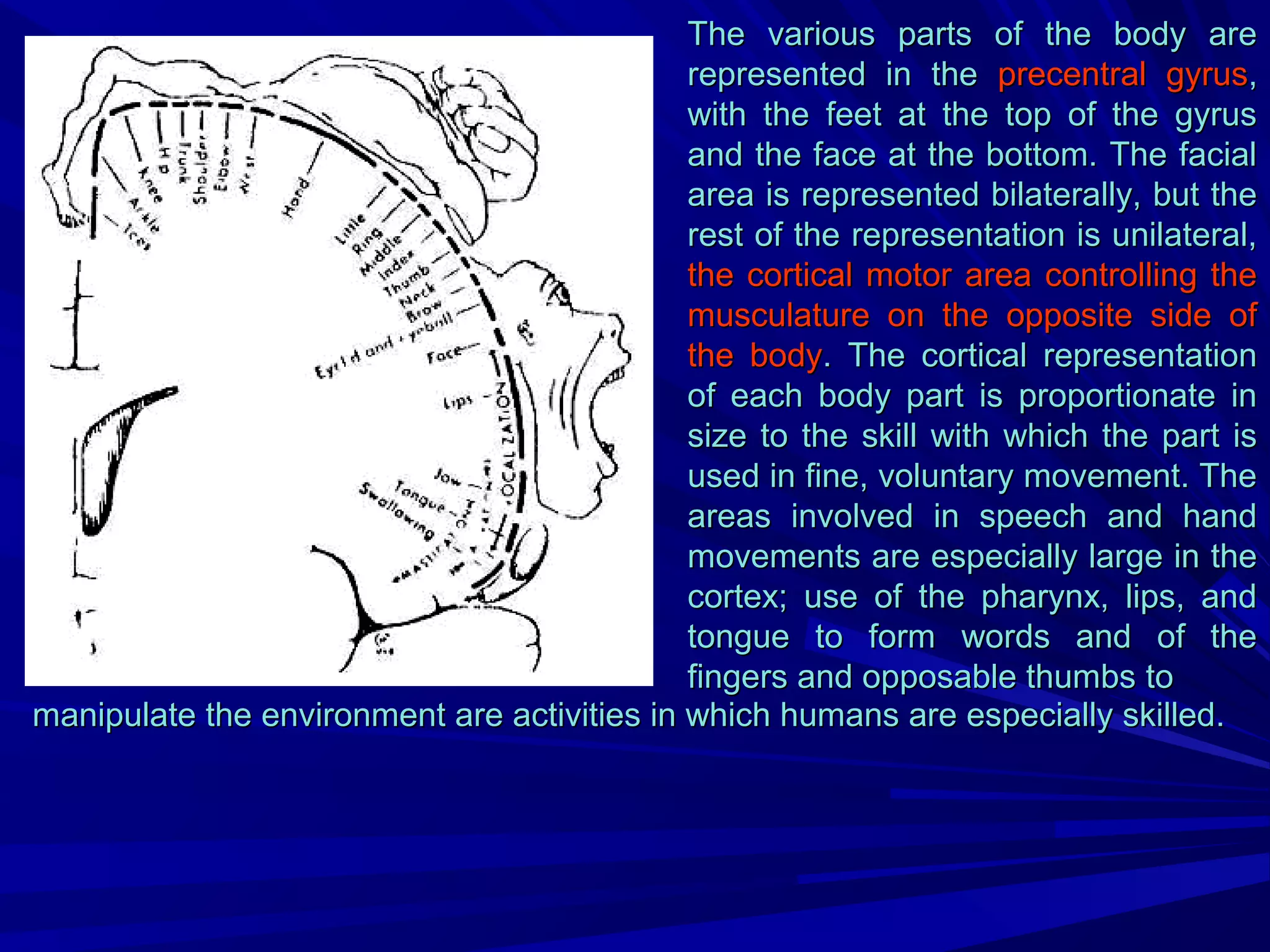
The various parts of the body areThe various parts of the body are
represented in therepresented in the precentral gyrusprecentral gyrus,,
with the feet at the top of the gyruswith the feet at the top of the gyrus
and the face at the bottom. The facialand the face at the bottom. The facial
area is represented bilaterally, but thearea is represented bilaterally, but the
rest of the representation is unilateral,rest of the representation is unilateral,
the cortical motor area controlling thethe cortical motor area controlling the
musculature on the opposite side ofmusculature on the opposite side of
the bodythe body. The cortical representation. The cortical representation
of each body part is proportionate inof each body part is proportionate in
size to the skill with which the part issize to the skill with which the part is
used in fine, voluntary movement. Theused in fine, voluntary movement. The
areas involved in speech and handareas involved in speech and hand
movements are especially large in themovements are especially large in the
cortex; use of the pharynx, lips, andcortex; use of the pharynx, lips, and
tongue to form words and of thetongue to form words and of the
fingers and opposable thumbsfingers and opposable thumbs toto
manipulate the environment are activities in which humans are especially skilled.manipulate the environment are activities in which humans are especially skilled.
The corticospinal tract originates as theThe corticospinal tract originates as the
axons of pyramidal neurons in the precentralaxons of pyramidal neurons in the precentral
gyrus. These neurons are especially largegyrus. These neurons are especially large
cells, calledcells, called Betz cells.Betz cells.
Deeper into the brain, all of these axonsDeeper into the brain, all of these axons
(slips of white matter) merge to form one(slips of white matter) merge to form one
large body of axons, thelarge body of axons, the corona radiatacorona radiata,,
"radiating crown"."radiating crown".
TractsTracts
As you get still deeper into the hemispheres, theAs you get still deeper into the hemispheres, the
corona radiata dives into the deep nuclei of thecorona radiata dives into the deep nuclei of the
brain, the caudate and putamen, splitting them inbrain, the caudate and putamen, splitting them in
two. At this point, all of these axons are calledtwo. At this point, all of these axons are called
thethe internal capsuleinternal capsule..
The internal capsule is a major two-wayThe internal capsule is a major two-way
highway, and very vulnerable to strokes.highway, and very vulnerable to strokes.
Sensory information travels up it on the waySensory information travels up it on the way
from the thalamus to the cortex, and motorfrom the thalamus to the cortex, and motor
information travels through on the way down toinformation travels through on the way down to
the spine. In the horizontal sections at thethe spine. In the horizontal sections at the
beginning of the course, the internal capsule hasbeginning of the course, the internal capsule has
an anterior and posterior limb. The motor andan anterior and posterior limb. The motor and
somatosensory information travels through thesomatosensory information travels through the
posterior limbposterior limb..
In theIn the medullamedulla, the fibers come together again as the, the fibers come together again as the
pyramidspyramids. The pyramids were actually named as. The pyramids were actually named as
landmarks on the surface of the brainstem - on a humanlandmarks on the surface of the brainstem - on a human
brainstem you can clearly see them as two ridgesbrainstem you can clearly see them as two ridges
running down the ventral midline. The pyramids run therunning down the ventral midline. The pyramids run the
entire length of the medulla, large uninterrupted axonentire length of the medulla, large uninterrupted axon
tracts on the ventral surface.tracts on the ventral surface.
At the caudal end of the medulla, right about at the pointAt the caudal end of the medulla, right about at the point
where you have to start calling it cervical spinal cord,where you have to start calling it cervical spinal cord, thethe
fibers in the pyramids crossfibers in the pyramids cross. The crossing event is called. The crossing event is called
thethe decussation of the pyramids.decussation of the pyramids.
The nerve fibres that cross the midline in theThe nerve fibres that cross the midline in the
medullary pyramids and form themedullary pyramids and form the lateral cortico­lateral cortico­
spinal tractspinal tract make up about 80% of the fibres inmake up about 80% of the fibres in
the corticospinal pathway. The remaining 20%the corticospinal pathway. The remaining 20%
make up themake up the anterior or ventral corticospinalanterior or ventral corticospinal
tracttract, which does not cross the midline until the, which does not cross the midline until the
level at which it synapses with motor neurons.level at which it synapses with motor neurons.
In addition, this tract contains corticospinalIn addition, this tract contains corticospinal
neurons that end on the same side of the body.neurons that end on the same side of the body.
The ventral pathway, which is the oldestThe ventral pathway, which is the oldest
phylogenetically, ends on neurons in the medialphylogenetically, ends on neurons in the medial
portion of the ventral horn that control axial andportion of the ventral horn that control axial and
proximal limb muscles. Conversely, the lateralproximal limb muscles. Conversely, the lateral
cortico­spinal pathway innervates lateralcortico­spinal pathway innervates lateral
neurons in the ventral horn that are concernedneurons in the ventral horn that are concerned
with distal limb muscles and hence with skilledwith distal limb muscles and hence with skilled
movements. In humans, the neurons of thismovements. In humans, the neurons of this
phylogenetically new system end directly on thephylogenetically new system end directly on the
lateral motor neurons.lateral motor neurons.
TractsTracts
TheThe corticobulbarcorticobulbar (or(or corticonuclearcorticonuclear)) tracttract
is a white matter pathway connecting theis a white matter pathway connecting the
cerebral cortex to the brainstem (the termcerebral cortex to the brainstem (the term
"bulbar" referring to the brainstem). The 'bulb'"bulbar" referring to the brainstem). The 'bulb'
is an archaic term for the medulla oblongata.is an archaic term for the medulla oblongata.
The muscles of the face, head and neck areThe muscles of the face, head and neck are
controlled by the corticobulbar system, whichcontrolled by the corticobulbar system, which
terminates on motor neurons withinterminates on motor neurons within
brainstem motor nuclei. This is in contrast tobrainstem motor nuclei. This is in contrast to
the corticospinal tract, which connects thethe corticospinal tract, which connects the
cerebral cortex to spinal motor neurons, andcerebral cortex to spinal motor neurons, and
controls movement of the torso, upper andcontrols movement of the torso, upper and
lower limbs. The corticobulbar tractlower limbs. The corticobulbar tract
innervates cranial motor nuclei bilaterally withinnervates cranial motor nuclei bilaterally with
the exception of the lower facial nucleusthe exception of the lower facial nucleus
which is innervated contralaterally.which is innervated contralaterally.
DISTURBANCES IN MOTOR POWERDISTURBANCES IN MOTOR POWER
Motor disturbances include weakness and paralysis.
It may be result from lesions of:
muscle,
myoneural junction,
peripheral nerve,
CNS: lower motor neuron and upper motor neuron.
The lower motor neuron (final common path­way) consists of a
cell body located in the anterior gray column of the spinal cord or
brain stem and an axon passing by way of the peripheral nerves to
the motor end­plates of the muscles. It is the essential motor cell
concerned with skeletal activity. It is called the "final common
pathway" because it is the ultimate pathway through which neural
impulses reach the muscle.
LesionsLesions of the lower motor neuronsof the lower motor neurons
may be located in the cells of themay be located in the cells of the
ventral gray column of the spinalventral gray column of the spinal
cord or brain stem or in their axons,cord or brain stem or in their axons,
which constitute the ventral roots ofwhich constitute the ventral roots of
the spinal nerves or the cranialthe spinal nerves or the cranial
nerves. Lesions may result fromnerves. Lesions may result from
trauma, toxins, infections, vasculartrauma, toxins, infections, vascular
disorders, degenerative processes,disorders, degenerative processes,
neoplasms, or congenitalneoplasms, or congenital
malformations. Main signs of lowermalformations. Main signs of lower
motor neuron lesions ­ it ismotor neuron lesions ­ it is flaccidflaccid
paralysisparalysis of the involved muscles:of the involved muscles:
­muscle atrophy (with muscles­muscle atrophy (with muscles
degeneration),degeneration),
­diminished or absent of reflexes,­diminished or absent of reflexes,
absent of pathologic reflexes.absent of pathologic reflexes.
TheThe upper motor neuronupper motor neuron – it is the– it is the
nerve cell of the motor cortex with itsnerve cell of the motor cortex with its
process that passes through theprocess that passes through the
internal capsule, brain stem, andinternal capsule, brain stem, and
spinal cord by way of the corticobulbarspinal cord by way of the corticobulbar
or corticospinal tract to the lower motoror corticospinal tract to the lower motor
neuron.neuron.
LesionsLesions of the upper motor neuronof the upper motor neuron
may be located in the cerebral cortex,may be located in the cerebral cortex,
the internal capsule, the cerebralthe internal capsule, the cerebral
peduncles, the brain stem, or thepeduncles, the brain stem, or the
spinal cord. Signs of upper motorspinal cord. Signs of upper motor
neuron lesions – it isneuron lesions – it is spastic paralysisspastic paralysis
oror paresisparesis of the involved muscles:of the involved muscles:
­no muscle atrophy (probably atrophy­no muscle atrophy (probably atrophy
dis­use),dis­use),
­hyperactive deep reflexes, diminished­hyperactive deep reflexes, diminished
or absent superficial reflexes,or absent superficial reflexes,
­pathologic reflexes.­pathologic reflexes.
Types of Paralysis or Paresis Based on LocationTypes of Paralysis or Paresis Based on Location
HemiplegiaHemiplegia is a spastic or flaccid paralysis of one side ofis a spastic or flaccid paralysis of one side of
the body and extremities limited by the median line in frontthe body and extremities limited by the median line in front
and in back.and in back.
MonoplegiaMonoplegia is a paralysis of one extremity only.is a paralysis of one extremity only.
DiplegiaDiplegia is a paralysis of any 2 corresponding extremities­is a paralysis of any 2 corresponding extremities­
both lower or both upper extremities).both lower or both upper extremities).
ParaplegiaParaplegia is a symmetric paralysis of both loweris a symmetric paralysis of both lower
extremities.extremities.
QuadriplegiaQuadriplegia, or, or tetraplegiatetraplegia, is a paralysis of all 4, is a paralysis of all 4
extremities.extremities.
Hemiplegia alternansHemiplegia alternans (crossed paralysis) is a paralysis of(crossed paralysis) is a paralysis of
one or more ipsilateral cranial nerves and contralateralone or more ipsilateral cranial nerves and contralateral
paralysis of the arm and leg.paralysis of the arm and leg.
ReflexesReflexes
Reflexes are inborn stimulus­response mechanisms. The
instinctive behavior of lower animals is governed largely by
reflexes; in humans, behavior is more a matter of conditioning,
and reflexes are subordinated as basic defense mechanisms.
The reflexes are, however, extremely important in the diagnosis
and localization of neurologic lesions.
ANATOMY OF REFLEXES (The Reflex Arc)ANATOMY OF REFLEXES (The Reflex Arc)
The essential neural portion of a reflex
includes a sensory and a motor neuron:
(1) A receptor, such as a special sense
organ, cutaneous end organ, or
neuromuscular spindle, stimulation of
which initiates an impulse.
(2) The afferent (or sensory) neuron,
which transmits the impulse through a
peripheral nerve to the CNS.
(3) The efferent (or motor) neuron,
which, passing outward in the nerve
trunk, delivers the impulse to an effector.
(4) An effector, such as a muscle or
gland that produces the response.
TYPES OF REFLEXESTYPES OF REFLEXES
The reflexes that are of importance to the clinical neurologist may
be divided into 4 groups:
• superficial (or skin and mucous membrane) reflexes,
• deep reflexes
• visceral (or organic) reflexes
• pathologic (or abnormal) reflexes.
Reflexes may also be classified according to the level of their
central representation, as spinal, bulbar (postural and righting
reflexes), midbrain, or cerebellar reflexes.
Superficial ReflexesSuperficial Reflexes
A. Mucous Membrane ReflexesA. Mucous Membrane Reflexes
1.1. Corneal (or conjunctival) reflexCorneal (or conjunctival) reflex – Blinking of the eye upon– Blinking of the eye upon
gentle irritation of the cornea or conjunctiva with a smallgentle irritation of the cornea or conjunctiva with a small
piece of absorbent cotton. This reflex is lost in lesions of thepiece of absorbent cotton. This reflex is lost in lesions of the
fifth or seventh cranial nerves or their central connections infifth or seventh cranial nerves or their central connections in
the pons. Corneal ulcers will often result when the reflex isthe pons. Corneal ulcers will often result when the reflex is
not present; this is because of the absence of the protectivenot present; this is because of the absence of the protective
mechanism.mechanism.
2.2. Pharyngeal (or gag) reflexPharyngeal (or gag) reflex – Retching or gagging when the– Retching or gagging when the
pharynx is irritated is absent in lesions of the ninth or tenthpharynx is irritated is absent in lesions of the ninth or tenth
cranial nerves or their nuclei and in hysteria.cranial nerves or their nuclei and in hysteria.
3.3. Uvular (or palatal) reflexUvular (or palatal) reflex – Raising of the uvula in– Raising of the uvula in
phonation or upon irritation of its mucous membrane is alsophonation or upon irritation of its mucous membrane is also
dependent upon the ninth and tenth nerves.dependent upon the ninth and tenth nerves.
B.B. Skin ReflexesSkin Reflexes
1.1. Upper and lower abdominal reflexesUpper and lower abdominal reflexes – (Tested on each– (Tested on each
side.) Tensing of the muscles beneath the skin area strokedside.) Tensing of the muscles beneath the skin area stroked
usually causes the umbilicus to move in the direction of the skinusually causes the umbilicus to move in the direction of the skin
area stimulated.area stimulated.
2.2. Cremasteric reflexCremasteric reflex – Elevation of the testicle upon stroking the– Elevation of the testicle upon stroking the
inner aspect of the thigh.inner aspect of the thigh.
3.3. Plantar reflexPlantar reflex – Plantar flexion of the toes upon stroking the– Plantar flexion of the toes upon stroking the
sole of the foot. In children there is usually also a retraction ofsole of the foot. In children there is usually also a retraction of
the foot.the foot.
4.4. Anal reflexAnal reflex – Contraction of the sphincter ani upon stroking the– Contraction of the sphincter ani upon stroking the
perianal area or upon inserting a gloved finger into the rectum.perianal area or upon inserting a gloved finger into the rectum.
Deep ReflexesDeep Reflexes
A. Important Deep ReflexesA. Important Deep Reflexes
1.1. Biceps reflexBiceps reflex – Flexion at the elbow when the biceps tendon– Flexion at the elbow when the biceps tendon
is struck.is struck.
2.2. Triceps reflexTriceps reflex – Extension at the elbow when the triceps– Extension at the elbow when the triceps
tendon is struck.tendon is struck.
3.3. Periosteoradial reflexPeriosteoradial reflex – Flexion and supination of the– Flexion and supination of the
forearm upon striking the styloid process of the radius.forearm upon striking the styloid process of the radius.
4.4. Periosteoulnar reflexPeriosteoulnar reflex – Extension and ulnar abduction of the– Extension and ulnar abduction of the
wrist when the styloid process of the ulna is struck.wrist when the styloid process of the ulna is struck.
5.5. Patellar (knee jerk) reflexPatellar (knee jerk) reflex – Extension at the knee when the– Extension at the knee when the
patellar tendon is struck.patellar tendon is struck.
6.6. Achilles tendon reflexAchilles tendon reflex – Plantar flexion of the foot when the– Plantar flexion of the foot when the
Achilles tendon is struck.Achilles tendon is struck.
Pathologic ReflexesPathologic Reflexes
In this group are found certain primitive defense responses
that occur only with lesions of the upper motor neuron.
Normally, they are suppressed by cerebral inhibition. When
the lower motor neuron is separated from the influence of
the higher centers, as in pyramidal tract lesions, they are
released. Not in frequently, they can be elicited in normal
infants up to age 5-7 months.
A. Lower ExtremityA. Lower Extremity
1.1. Babinski's signBabinski's sign – Extension of the large toe with fanning of the small– Extension of the large toe with fanning of the small
toes upon stimulation of the plantar surface of the foot.toes upon stimulation of the plantar surface of the foot.
2.2. Chaddock's toe signChaddock's toe sign – Babinski response obtained by stroking the– Babinski response obtained by stroking the
lateral malleolus.lateral malleolus.
3.3. Gordon's leg signGordon's leg sign - Babinski-like response upon squeezing the calf- Babinski-like response upon squeezing the calf
muscle.muscle.
4.4. Oppenheim's signOppenheim's sign – Babinski - like response elicited by firm– Babinski - like response elicited by firm
downward stroking of the tibia and tibialis anterior muscle.downward stroking of the tibia and tibialis anterior muscle.
5.5. Schaefer's signSchaefer's sign – Babinski-like response upon squeezing the Achilles– Babinski-like response upon squeezing the Achilles
tendon.tendon.
6.6. Rossolimo's signRossolimo's sign - Flexion of the toes upon tapping the ball of the- Flexion of the toes upon tapping the ball of the
foot.foot.
7.7. Mendel-Bechterew signMendel-Bechterew sign – Flexor movement of the 4 outer toes upon– Flexor movement of the 4 outer toes upon
striking the dorsum of the foot over the cuboid bone.striking the dorsum of the foot over the cuboid bone.
8.8. Ankle clonusAnkle clonus – A continued rapid flexion and extension of the foot– A continued rapid flexion and extension of the foot
obtained by forcibly and quickly dorsiflexing the foot while the leg isobtained by forcibly and quickly dorsiflexing the foot while the leg is
held up by the examiner's other hand placed under the popliteal space.held up by the examiner's other hand placed under the popliteal space.
A rapidly exhaustible clonus may be normal.A rapidly exhaustible clonus may be normal.
9.9. Patellar clonus (trepidation sign)Patellar clonus (trepidation sign) – A rapid up-and-down movement– A rapid up-and-down movement
of the patella when it is forcibly depressed with a quick movement whileof the patella when it is forcibly depressed with a quick movement while
the leg is in extension and relaxed.the leg is in extension and relaxed.
Methods of testing for extensor- plantarMethods of testing for extensor- plantar
reflexesreflexes
B. Upper ExtremityB. Upper Extremity
1.1. Finger flexion reflexFinger flexion reflex (Tromner's sign) – A(Tromner's sign) – A
sharp tap on the palmar surface or the tips ofsharp tap on the palmar surface or the tips of
the middle 3 fingers produces prompt flexion ofthe middle 3 fingers produces prompt flexion of
the fingers.the fingers.
2.2. Bechterew's signBechterew's sign – The patient flexes and– The patient flexes and
then relaxes both forearms. The paralyzedthen relaxes both forearms. The paralyzed
forearm falls back more slowly and in a jerkyforearm falls back more slowly and in a jerky
manner, even when contractures are mild.manner, even when contractures are mild.
3.3. Mayer's signMayer's sign – Absence of adduction and– Absence of adduction and
opposition of the thumb upon passive forcefulopposition of the thumb upon passive forceful
flexion of the proximal phalanges, especially offlexion of the proximal phalanges, especially of
the third and fourth fingers, of the supinatedthe third and fourth fingers, of the supinated
hand.hand.
C. HeadC. Head
1.1. Babinski's platysma signBabinski's platysma sign - If resistance is offered to flexion of- If resistance is offered to flexion of
the chin against the chest or to opening the mouth, thethe chin against the chest or to opening the mouth, the
platysma on the sound side will contract, whereas that on theplatysma on the sound side will contract, whereas that on the
affected side will not.affected side will not.
2.2. McCarthy's signMcCarthy's sign (glabella reflex) - Percussion of the(glabella reflex) - Percussion of the
supraorbital ridge results in a reflex contraction of the orbicularissupraorbital ridge results in a reflex contraction of the orbicularis
oculi muscle.oculi muscle.
3.3. Snout reflexSnout reflex – Sharp tapping of the middle of the upper lip– Sharp tapping of the middle of the upper lip
induces exaggerated reflex contraction of the lips.induces exaggerated reflex contraction of the lips.
4.4. Head retraction reflexHead retraction reflex – Sharp downward percussion upon the– Sharp downward percussion upon the
upper lip with the head inclined slightly forward produces headupper lip with the head inclined slightly forward produces head
bending followed by brisk head retraction.bending followed by brisk head retraction.

Lecture piramidal system

  • 1.
    INTRODUCTIONINTRODUCTION GENERAL PRINCIPLESGENERAL PRINCIPLES MotionMotion Motionis a fundamental property of most animal life. In the simpleMotion is a fundamental property of most animal life. In the simple unicellular animals, motion and locomotion depend upon theunicellular animals, motion and locomotion depend upon the contractility of protoplasm and the action of accessory organscontractility of protoplasm and the action of accessory organs such as cilia, flagella, etc. The lowest multicellular animalssuch as cilia, flagella, etc. The lowest multicellular animals possess rudimentary neuromuscular mechanisms; in higher forms,possess rudimentary neuromuscular mechanisms; in higher forms, motion is based upon the transmission of impulses from a receptormotion is based upon the transmission of impulses from a receptor through an afferent neuron and ganglion cell to muscle. This samethrough an afferent neuron and ganglion cell to muscle. This same principle is found in the reflex arc of higher animals, includingprinciple is found in the reflex arc of higher animals, including humans, in whom the anterior spinal cord has developed into ahumans, in whom the anterior spinal cord has developed into a central regulating mechanism, the brain, which is concerned withcentral regulating mechanism, the brain, which is concerned with initiating and integrating movements.initiating and integrating movements.
  • 2.
    The inputs convergingon the motor neurons subserveThe inputs converging on the motor neurons subserve 3 semidistinct3 semidistinct functionsfunctions:: - they bring about voluntary activity; - they adjust body posture to provide a stable background for movement; - they coordinate the action of the various muscles to make movements smooth and precise The patterns of voluntary activity are planned within the brain, and theThe patterns of voluntary activity are planned within the brain, and the commands are sent to the muscles primarily via the corticospinal andcommands are sent to the muscles primarily via the corticospinal and corticobucorticobullbar system. Posture is continually adjusted not only before butbar system. Posture is continually adjusted not only before but also during movement by posture-regulating systems. Movement isalso during movement by posture-regulating systems. Movement is smoothed and coordinated by the medial and intermediate portions of thesmoothed and coordinated by the medial and intermediate portions of the cerebellum (the spinocerebellum) and its connections. The basal gangliacerebellum (the spinocerebellum) and its connections. The basal ganglia and the lateral portions of the cerebellum (neocerebellum) are part of aand the lateral portions of the cerebellum (neocerebellum) are part of a feedback circuit to the premotor and motor cortex that is concerned withfeedback circuit to the premotor and motor cortex that is concerned with planning and organizing voluntary movement.planning and organizing voluntary movement.
  • 3.
    CORTICOSPINAL & CORTICOBULBARSYSTEMCORTICOSPINAL & CORTICOBULBAR SYSTEM ANATOMYANATOMY The cortical areas from whichThe cortical areas from which the corticospinal andthe corticospinal and corticobulbar systemcorticobulbar system originates are generally held tooriginates are generally held to be those where stimulationbe those where stimulation produces prompt discreteproduces prompt discrete movement. The best known ismovement. The best known is the motor cortex in thethe motor cortex in the precentral gyrus.precentral gyrus. 30% of the fibers making up the corticospinal and corticobulbar30% of the fibers making up the corticospinal and corticobulbar tracts come from the motor cortex but 30% come from thetracts come from the motor cortex but 30% come from the premotor cortex and 40% from the parietal lobe, especially thepremotor cortex and 40% from the parietal lobe, especially the somatic sensory area.somatic sensory area.
  • 4.
    The various partsof the body areThe various parts of the body are represented in therepresented in the precentral gyrusprecentral gyrus,, with the feet at the top of the gyruswith the feet at the top of the gyrus and the face at the bottom. The facialand the face at the bottom. The facial area is represented bilaterally, but thearea is represented bilaterally, but the rest of the representation is unilateral,rest of the representation is unilateral, the cortical motor area controlling thethe cortical motor area controlling the musculature on the opposite side ofmusculature on the opposite side of the bodythe body. The cortical representation. The cortical representation of each body part is proportionate inof each body part is proportionate in size to the skill with which the part issize to the skill with which the part is used in fine, voluntary movement. Theused in fine, voluntary movement. The areas involved in speech and handareas involved in speech and hand movements are especially large in themovements are especially large in the cortex; use of the pharynx, lips, andcortex; use of the pharynx, lips, and tongue to form words and of thetongue to form words and of the fingers and opposable thumbsfingers and opposable thumbs toto manipulate the environment are activities in which humans are especially skilled.manipulate the environment are activities in which humans are especially skilled.
  • 5.
    The corticospinal tractoriginates as theThe corticospinal tract originates as the axons of pyramidal neurons in the precentralaxons of pyramidal neurons in the precentral gyrus. These neurons are especially largegyrus. These neurons are especially large cells, calledcells, called Betz cells.Betz cells. Deeper into the brain, all of these axonsDeeper into the brain, all of these axons (slips of white matter) merge to form one(slips of white matter) merge to form one large body of axons, thelarge body of axons, the corona radiatacorona radiata,, "radiating crown"."radiating crown". TractsTracts
  • 6.
    As you getstill deeper into the hemispheres, theAs you get still deeper into the hemispheres, the corona radiata dives into the deep nuclei of thecorona radiata dives into the deep nuclei of the brain, the caudate and putamen, splitting them inbrain, the caudate and putamen, splitting them in two. At this point, all of these axons are calledtwo. At this point, all of these axons are called thethe internal capsuleinternal capsule.. The internal capsule is a major two-wayThe internal capsule is a major two-way highway, and very vulnerable to strokes.highway, and very vulnerable to strokes. Sensory information travels up it on the waySensory information travels up it on the way from the thalamus to the cortex, and motorfrom the thalamus to the cortex, and motor information travels through on the way down toinformation travels through on the way down to the spine. In the horizontal sections at thethe spine. In the horizontal sections at the beginning of the course, the internal capsule hasbeginning of the course, the internal capsule has an anterior and posterior limb. The motor andan anterior and posterior limb. The motor and somatosensory information travels through thesomatosensory information travels through the posterior limbposterior limb..
  • 7.
    In theIn themedullamedulla, the fibers come together again as the, the fibers come together again as the pyramidspyramids. The pyramids were actually named as. The pyramids were actually named as landmarks on the surface of the brainstem - on a humanlandmarks on the surface of the brainstem - on a human brainstem you can clearly see them as two ridgesbrainstem you can clearly see them as two ridges running down the ventral midline. The pyramids run therunning down the ventral midline. The pyramids run the entire length of the medulla, large uninterrupted axonentire length of the medulla, large uninterrupted axon tracts on the ventral surface.tracts on the ventral surface. At the caudal end of the medulla, right about at the pointAt the caudal end of the medulla, right about at the point where you have to start calling it cervical spinal cord,where you have to start calling it cervical spinal cord, thethe fibers in the pyramids crossfibers in the pyramids cross. The crossing event is called. The crossing event is called thethe decussation of the pyramids.decussation of the pyramids.
  • 8.
    The nerve fibresthat cross the midline in theThe nerve fibres that cross the midline in the medullary pyramids and form themedullary pyramids and form the lateral cortico­lateral cortico­ spinal tractspinal tract make up about 80% of the fibres inmake up about 80% of the fibres in the corticospinal pathway. The remaining 20%the corticospinal pathway. The remaining 20% make up themake up the anterior or ventral corticospinalanterior or ventral corticospinal tracttract, which does not cross the midline until the, which does not cross the midline until the level at which it synapses with motor neurons.level at which it synapses with motor neurons. In addition, this tract contains corticospinalIn addition, this tract contains corticospinal neurons that end on the same side of the body.neurons that end on the same side of the body. The ventral pathway, which is the oldestThe ventral pathway, which is the oldest phylogenetically, ends on neurons in the medialphylogenetically, ends on neurons in the medial portion of the ventral horn that control axial andportion of the ventral horn that control axial and proximal limb muscles. Conversely, the lateralproximal limb muscles. Conversely, the lateral cortico­spinal pathway innervates lateralcortico­spinal pathway innervates lateral neurons in the ventral horn that are concernedneurons in the ventral horn that are concerned with distal limb muscles and hence with skilledwith distal limb muscles and hence with skilled movements. In humans, the neurons of thismovements. In humans, the neurons of this phylogenetically new system end directly on thephylogenetically new system end directly on the lateral motor neurons.lateral motor neurons. TractsTracts
  • 9.
    TheThe corticobulbarcorticobulbar (or(orcorticonuclearcorticonuclear)) tracttract is a white matter pathway connecting theis a white matter pathway connecting the cerebral cortex to the brainstem (the termcerebral cortex to the brainstem (the term "bulbar" referring to the brainstem). The 'bulb'"bulbar" referring to the brainstem). The 'bulb' is an archaic term for the medulla oblongata.is an archaic term for the medulla oblongata. The muscles of the face, head and neck areThe muscles of the face, head and neck are controlled by the corticobulbar system, whichcontrolled by the corticobulbar system, which terminates on motor neurons withinterminates on motor neurons within brainstem motor nuclei. This is in contrast tobrainstem motor nuclei. This is in contrast to the corticospinal tract, which connects thethe corticospinal tract, which connects the cerebral cortex to spinal motor neurons, andcerebral cortex to spinal motor neurons, and controls movement of the torso, upper andcontrols movement of the torso, upper and lower limbs. The corticobulbar tractlower limbs. The corticobulbar tract innervates cranial motor nuclei bilaterally withinnervates cranial motor nuclei bilaterally with the exception of the lower facial nucleusthe exception of the lower facial nucleus which is innervated contralaterally.which is innervated contralaterally.
  • 10.
    DISTURBANCES IN MOTORPOWERDISTURBANCES IN MOTOR POWER Motor disturbances include weakness and paralysis. It may be result from lesions of: muscle, myoneural junction, peripheral nerve, CNS: lower motor neuron and upper motor neuron. The lower motor neuron (final common path­way) consists of a cell body located in the anterior gray column of the spinal cord or brain stem and an axon passing by way of the peripheral nerves to the motor end­plates of the muscles. It is the essential motor cell concerned with skeletal activity. It is called the "final common pathway" because it is the ultimate pathway through which neural impulses reach the muscle.
  • 11.
    LesionsLesions of thelower motor neuronsof the lower motor neurons may be located in the cells of themay be located in the cells of the ventral gray column of the spinalventral gray column of the spinal cord or brain stem or in their axons,cord or brain stem or in their axons, which constitute the ventral roots ofwhich constitute the ventral roots of the spinal nerves or the cranialthe spinal nerves or the cranial nerves. Lesions may result fromnerves. Lesions may result from trauma, toxins, infections, vasculartrauma, toxins, infections, vascular disorders, degenerative processes,disorders, degenerative processes, neoplasms, or congenitalneoplasms, or congenital malformations. Main signs of lowermalformations. Main signs of lower motor neuron lesions ­ it ismotor neuron lesions ­ it is flaccidflaccid paralysisparalysis of the involved muscles:of the involved muscles: ­muscle atrophy (with muscles­muscle atrophy (with muscles degeneration),degeneration), ­diminished or absent of reflexes,­diminished or absent of reflexes, absent of pathologic reflexes.absent of pathologic reflexes.
  • 12.
    TheThe upper motorneuronupper motor neuron – it is the– it is the nerve cell of the motor cortex with itsnerve cell of the motor cortex with its process that passes through theprocess that passes through the internal capsule, brain stem, andinternal capsule, brain stem, and spinal cord by way of the corticobulbarspinal cord by way of the corticobulbar or corticospinal tract to the lower motoror corticospinal tract to the lower motor neuron.neuron. LesionsLesions of the upper motor neuronof the upper motor neuron may be located in the cerebral cortex,may be located in the cerebral cortex, the internal capsule, the cerebralthe internal capsule, the cerebral peduncles, the brain stem, or thepeduncles, the brain stem, or the spinal cord. Signs of upper motorspinal cord. Signs of upper motor neuron lesions – it isneuron lesions – it is spastic paralysisspastic paralysis oror paresisparesis of the involved muscles:of the involved muscles: ­no muscle atrophy (probably atrophy­no muscle atrophy (probably atrophy dis­use),dis­use), ­hyperactive deep reflexes, diminished­hyperactive deep reflexes, diminished or absent superficial reflexes,or absent superficial reflexes, ­pathologic reflexes.­pathologic reflexes.
  • 13.
    Types of Paralysisor Paresis Based on LocationTypes of Paralysis or Paresis Based on Location HemiplegiaHemiplegia is a spastic or flaccid paralysis of one side ofis a spastic or flaccid paralysis of one side of the body and extremities limited by the median line in frontthe body and extremities limited by the median line in front and in back.and in back. MonoplegiaMonoplegia is a paralysis of one extremity only.is a paralysis of one extremity only. DiplegiaDiplegia is a paralysis of any 2 corresponding extremities­is a paralysis of any 2 corresponding extremities­ both lower or both upper extremities).both lower or both upper extremities). ParaplegiaParaplegia is a symmetric paralysis of both loweris a symmetric paralysis of both lower extremities.extremities. QuadriplegiaQuadriplegia, or, or tetraplegiatetraplegia, is a paralysis of all 4, is a paralysis of all 4 extremities.extremities. Hemiplegia alternansHemiplegia alternans (crossed paralysis) is a paralysis of(crossed paralysis) is a paralysis of one or more ipsilateral cranial nerves and contralateralone or more ipsilateral cranial nerves and contralateral paralysis of the arm and leg.paralysis of the arm and leg.
  • 14.
    ReflexesReflexes Reflexes are inbornstimulus­response mechanisms. The instinctive behavior of lower animals is governed largely by reflexes; in humans, behavior is more a matter of conditioning, and reflexes are subordinated as basic defense mechanisms. The reflexes are, however, extremely important in the diagnosis and localization of neurologic lesions.
  • 15.
    ANATOMY OF REFLEXES(The Reflex Arc)ANATOMY OF REFLEXES (The Reflex Arc) The essential neural portion of a reflex includes a sensory and a motor neuron: (1) A receptor, such as a special sense organ, cutaneous end organ, or neuromuscular spindle, stimulation of which initiates an impulse. (2) The afferent (or sensory) neuron, which transmits the impulse through a peripheral nerve to the CNS. (3) The efferent (or motor) neuron, which, passing outward in the nerve trunk, delivers the impulse to an effector. (4) An effector, such as a muscle or gland that produces the response.
  • 16.
    TYPES OF REFLEXESTYPESOF REFLEXES The reflexes that are of importance to the clinical neurologist may be divided into 4 groups: • superficial (or skin and mucous membrane) reflexes, • deep reflexes • visceral (or organic) reflexes • pathologic (or abnormal) reflexes. Reflexes may also be classified according to the level of their central representation, as spinal, bulbar (postural and righting reflexes), midbrain, or cerebellar reflexes.
  • 17.
    Superficial ReflexesSuperficial Reflexes A.Mucous Membrane ReflexesA. Mucous Membrane Reflexes 1.1. Corneal (or conjunctival) reflexCorneal (or conjunctival) reflex – Blinking of the eye upon– Blinking of the eye upon gentle irritation of the cornea or conjunctiva with a smallgentle irritation of the cornea or conjunctiva with a small piece of absorbent cotton. This reflex is lost in lesions of thepiece of absorbent cotton. This reflex is lost in lesions of the fifth or seventh cranial nerves or their central connections infifth or seventh cranial nerves or their central connections in the pons. Corneal ulcers will often result when the reflex isthe pons. Corneal ulcers will often result when the reflex is not present; this is because of the absence of the protectivenot present; this is because of the absence of the protective mechanism.mechanism. 2.2. Pharyngeal (or gag) reflexPharyngeal (or gag) reflex – Retching or gagging when the– Retching or gagging when the pharynx is irritated is absent in lesions of the ninth or tenthpharynx is irritated is absent in lesions of the ninth or tenth cranial nerves or their nuclei and in hysteria.cranial nerves or their nuclei and in hysteria. 3.3. Uvular (or palatal) reflexUvular (or palatal) reflex – Raising of the uvula in– Raising of the uvula in phonation or upon irritation of its mucous membrane is alsophonation or upon irritation of its mucous membrane is also dependent upon the ninth and tenth nerves.dependent upon the ninth and tenth nerves.
  • 18.
    B.B. Skin ReflexesSkinReflexes 1.1. Upper and lower abdominal reflexesUpper and lower abdominal reflexes – (Tested on each– (Tested on each side.) Tensing of the muscles beneath the skin area strokedside.) Tensing of the muscles beneath the skin area stroked usually causes the umbilicus to move in the direction of the skinusually causes the umbilicus to move in the direction of the skin area stimulated.area stimulated. 2.2. Cremasteric reflexCremasteric reflex – Elevation of the testicle upon stroking the– Elevation of the testicle upon stroking the inner aspect of the thigh.inner aspect of the thigh. 3.3. Plantar reflexPlantar reflex – Plantar flexion of the toes upon stroking the– Plantar flexion of the toes upon stroking the sole of the foot. In children there is usually also a retraction ofsole of the foot. In children there is usually also a retraction of the foot.the foot. 4.4. Anal reflexAnal reflex – Contraction of the sphincter ani upon stroking the– Contraction of the sphincter ani upon stroking the perianal area or upon inserting a gloved finger into the rectum.perianal area or upon inserting a gloved finger into the rectum.
  • 19.
    Deep ReflexesDeep Reflexes A.Important Deep ReflexesA. Important Deep Reflexes 1.1. Biceps reflexBiceps reflex – Flexion at the elbow when the biceps tendon– Flexion at the elbow when the biceps tendon is struck.is struck. 2.2. Triceps reflexTriceps reflex – Extension at the elbow when the triceps– Extension at the elbow when the triceps tendon is struck.tendon is struck. 3.3. Periosteoradial reflexPeriosteoradial reflex – Flexion and supination of the– Flexion and supination of the forearm upon striking the styloid process of the radius.forearm upon striking the styloid process of the radius. 4.4. Periosteoulnar reflexPeriosteoulnar reflex – Extension and ulnar abduction of the– Extension and ulnar abduction of the wrist when the styloid process of the ulna is struck.wrist when the styloid process of the ulna is struck. 5.5. Patellar (knee jerk) reflexPatellar (knee jerk) reflex – Extension at the knee when the– Extension at the knee when the patellar tendon is struck.patellar tendon is struck. 6.6. Achilles tendon reflexAchilles tendon reflex – Plantar flexion of the foot when the– Plantar flexion of the foot when the Achilles tendon is struck.Achilles tendon is struck.
  • 21.
    Pathologic ReflexesPathologic Reflexes Inthis group are found certain primitive defense responses that occur only with lesions of the upper motor neuron. Normally, they are suppressed by cerebral inhibition. When the lower motor neuron is separated from the influence of the higher centers, as in pyramidal tract lesions, they are released. Not in frequently, they can be elicited in normal infants up to age 5-7 months.
  • 22.
    A. Lower ExtremityA.Lower Extremity 1.1. Babinski's signBabinski's sign – Extension of the large toe with fanning of the small– Extension of the large toe with fanning of the small toes upon stimulation of the plantar surface of the foot.toes upon stimulation of the plantar surface of the foot. 2.2. Chaddock's toe signChaddock's toe sign – Babinski response obtained by stroking the– Babinski response obtained by stroking the lateral malleolus.lateral malleolus. 3.3. Gordon's leg signGordon's leg sign - Babinski-like response upon squeezing the calf- Babinski-like response upon squeezing the calf muscle.muscle. 4.4. Oppenheim's signOppenheim's sign – Babinski - like response elicited by firm– Babinski - like response elicited by firm downward stroking of the tibia and tibialis anterior muscle.downward stroking of the tibia and tibialis anterior muscle. 5.5. Schaefer's signSchaefer's sign – Babinski-like response upon squeezing the Achilles– Babinski-like response upon squeezing the Achilles tendon.tendon. 6.6. Rossolimo's signRossolimo's sign - Flexion of the toes upon tapping the ball of the- Flexion of the toes upon tapping the ball of the foot.foot. 7.7. Mendel-Bechterew signMendel-Bechterew sign – Flexor movement of the 4 outer toes upon– Flexor movement of the 4 outer toes upon striking the dorsum of the foot over the cuboid bone.striking the dorsum of the foot over the cuboid bone. 8.8. Ankle clonusAnkle clonus – A continued rapid flexion and extension of the foot– A continued rapid flexion and extension of the foot obtained by forcibly and quickly dorsiflexing the foot while the leg isobtained by forcibly and quickly dorsiflexing the foot while the leg is held up by the examiner's other hand placed under the popliteal space.held up by the examiner's other hand placed under the popliteal space. A rapidly exhaustible clonus may be normal.A rapidly exhaustible clonus may be normal. 9.9. Patellar clonus (trepidation sign)Patellar clonus (trepidation sign) – A rapid up-and-down movement– A rapid up-and-down movement of the patella when it is forcibly depressed with a quick movement whileof the patella when it is forcibly depressed with a quick movement while the leg is in extension and relaxed.the leg is in extension and relaxed.
  • 23.
    Methods of testingfor extensor- plantarMethods of testing for extensor- plantar reflexesreflexes
  • 24.
    B. Upper ExtremityB.Upper Extremity 1.1. Finger flexion reflexFinger flexion reflex (Tromner's sign) – A(Tromner's sign) – A sharp tap on the palmar surface or the tips ofsharp tap on the palmar surface or the tips of the middle 3 fingers produces prompt flexion ofthe middle 3 fingers produces prompt flexion of the fingers.the fingers. 2.2. Bechterew's signBechterew's sign – The patient flexes and– The patient flexes and then relaxes both forearms. The paralyzedthen relaxes both forearms. The paralyzed forearm falls back more slowly and in a jerkyforearm falls back more slowly and in a jerky manner, even when contractures are mild.manner, even when contractures are mild. 3.3. Mayer's signMayer's sign – Absence of adduction and– Absence of adduction and opposition of the thumb upon passive forcefulopposition of the thumb upon passive forceful flexion of the proximal phalanges, especially offlexion of the proximal phalanges, especially of the third and fourth fingers, of the supinatedthe third and fourth fingers, of the supinated hand.hand.
  • 25.
    C. HeadC. Head 1.1.Babinski's platysma signBabinski's platysma sign - If resistance is offered to flexion of- If resistance is offered to flexion of the chin against the chest or to opening the mouth, thethe chin against the chest or to opening the mouth, the platysma on the sound side will contract, whereas that on theplatysma on the sound side will contract, whereas that on the affected side will not.affected side will not. 2.2. McCarthy's signMcCarthy's sign (glabella reflex) - Percussion of the(glabella reflex) - Percussion of the supraorbital ridge results in a reflex contraction of the orbicularissupraorbital ridge results in a reflex contraction of the orbicularis oculi muscle.oculi muscle. 3.3. Snout reflexSnout reflex – Sharp tapping of the middle of the upper lip– Sharp tapping of the middle of the upper lip induces exaggerated reflex contraction of the lips.induces exaggerated reflex contraction of the lips. 4.4. Head retraction reflexHead retraction reflex – Sharp downward percussion upon the– Sharp downward percussion upon the upper lip with the head inclined slightly forward produces headupper lip with the head inclined slightly forward produces head bending followed by brisk head retraction.bending followed by brisk head retraction.