Maxillary Premolars Dr. Syed Sadatullah Ibnsina National College  Jeddah
Introduction  Premolars are so named because they are placed between the anterior teeth and the molars  Premolars assist the canines and the molars in tearing and chewing food   Maxillary premolars have two cusps and sometimes one or two roots Maxillary 1 st  premolar erupts between 10-11 years and maxillary 2 nd  premolar erupts between 10-12 years of age
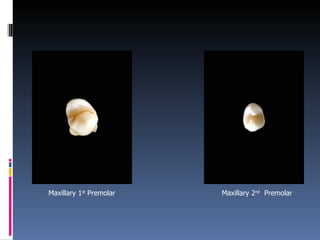
Maxillary 1 st  Premolar Maxillary 2 nd   Premolar
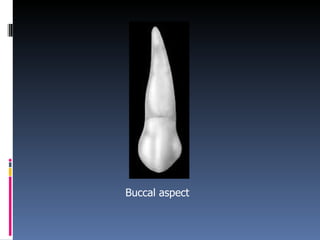
Maxillary 1 st  Premolar Buccal aspect This tooth has two cusps, buccal and lingual cusps. The buccal cusp is long with a pointed tip resembling the cusp of a canine The mesial slope of the buccal cusp is longer than the distal slope, which is the opposite of canine The buccal surface is convex, showing strong a strong buccal ridge The crown exhibits little cervical line curvature
Buccal aspect
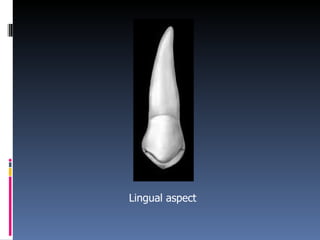
Lingual aspect The crown tapers towards the lingual aspect  The lingual cusp is shorter than the buccal cusp The lingual cusp is smooth from the cervical portion to the area near the cusp tip The cusp tip is pointed with mesial and distal slopes meeting at an angle of about 90 degrees Small portion of the buccal cusp can be seen from this aspect
Lingual aspect
Mesial aspect From the mesial and distal aspect both the buccal and lingual cusps are visible A well developed mesial marginal ridge and a mesial marginal developmental groove is present In the middle of the mesial surface is the mesial developmental depression which continues beyond the cervical line The contact area is near the halfway point ( JOM 3 )
Mesial aspect
Distal aspect There is no developmental depression or groove on this aspect, instead it is convex at almost all points The curvature of the cervical is less on this aspect The contact area is near the junction of occlusal and middle third Distal aspect
Occlusal aspect The occlusal aspect is roughly hexagonal in shape The buccolingual dimension of the crown is much greater than the mesiodistal dimension The occlusal surface is circumscribed by the cusp ridges and marginal ridges
Within the cusp ridges and marginal ridges the following are present  Central developmental groove Mesiobuccal and distobuccal developmental groove Mesial marginal developmental groove Mesial and distal developmental pit Mesial and distal triangular fossa Buccal and lingual triangular ridge
Occlusal aspect
Root  Most Maxillary first premolars have 2 roots, but one and three roots can also be seen. Two roots; buccal and lingual The buccal portion of the root resembles canine The root when viewed from the proximal side shows a big trunk and bifurcation area from where the buccal and lingual root separate A developmental depression is seen on the mesial aspect of the trunk.
1.0  0 8.0 9.0 5.0 7.0 14.0 8.5 Curvature of Cervical Line M  D Labiolingual Diameter at Cervical Line Labiolingual Diameter at Crest of Curvature Mesiodistal Diameter at Cervical Line Mesiodistal Diameter at Contact Area Root Length Crown Length Average Dimensions in millimeters
Maxillary 2 nd  Premolar Buccal aspect The maxillary second premolar resembles the maxillary first premolar in form and function The buccal cusp is not as long as that of maxillary 1 st  premolar It is less pointed. The mesial slope of the buccal cusp ridge is shorter than the distal cusp ridge
Lingual aspect The lingual cusp is more or less the same size as the buccal cusp Mesial and Distal aspects There is greater distance between the cusps No developmental depression is present nor any developmental groove crossing the marginal ridge on the mesial aspect On the distal aspect there is a developmental depression which is deeper than the depression on the mesial surface of maxillary 1 st  premolar
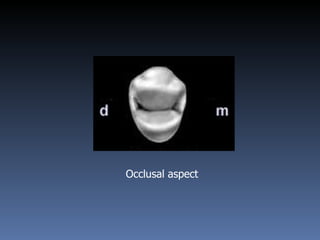
Occlusal aspect The occlusal aspect is more rounded The central developmental groove is shorter There are multiple supplementary grooves radiating from the central groove Root Maxillary 2 nd  premolar has one root, which is usually as long or a millimeter longer than the root of maxillary 1 st  premolar
Buccal aspect Lingual aspect Mesial aspect Distal aspect Occlusal aspect

Maxillary Premolars

  • 1.
    Maxillary Premolars Dr.Syed Sadatullah Ibnsina National College Jeddah
  • 2.
    Introduction Premolarsare so named because they are placed between the anterior teeth and the molars Premolars assist the canines and the molars in tearing and chewing food Maxillary premolars have two cusps and sometimes one or two roots Maxillary 1 st premolar erupts between 10-11 years and maxillary 2 nd premolar erupts between 10-12 years of age
  • 3.
    Maxillary 1 st Premolar Maxillary 2 nd Premolar
  • 4.
    Maxillary 1 st Premolar Buccal aspect This tooth has two cusps, buccal and lingual cusps. The buccal cusp is long with a pointed tip resembling the cusp of a canine The mesial slope of the buccal cusp is longer than the distal slope, which is the opposite of canine The buccal surface is convex, showing strong a strong buccal ridge The crown exhibits little cervical line curvature
  • 5.
  • 6.
    Lingual aspect Thecrown tapers towards the lingual aspect The lingual cusp is shorter than the buccal cusp The lingual cusp is smooth from the cervical portion to the area near the cusp tip The cusp tip is pointed with mesial and distal slopes meeting at an angle of about 90 degrees Small portion of the buccal cusp can be seen from this aspect
  • 7.
  • 8.
    Mesial aspect Fromthe mesial and distal aspect both the buccal and lingual cusps are visible A well developed mesial marginal ridge and a mesial marginal developmental groove is present In the middle of the mesial surface is the mesial developmental depression which continues beyond the cervical line The contact area is near the halfway point ( JOM 3 )
  • 9.
  • 10.
    Distal aspect Thereis no developmental depression or groove on this aspect, instead it is convex at almost all points The curvature of the cervical is less on this aspect The contact area is near the junction of occlusal and middle third Distal aspect
  • 11.
    Occlusal aspect Theocclusal aspect is roughly hexagonal in shape The buccolingual dimension of the crown is much greater than the mesiodistal dimension The occlusal surface is circumscribed by the cusp ridges and marginal ridges
  • 12.
    Within the cuspridges and marginal ridges the following are present Central developmental groove Mesiobuccal and distobuccal developmental groove Mesial marginal developmental groove Mesial and distal developmental pit Mesial and distal triangular fossa Buccal and lingual triangular ridge
  • 13.
  • 14.
    Root MostMaxillary first premolars have 2 roots, but one and three roots can also be seen. Two roots; buccal and lingual The buccal portion of the root resembles canine The root when viewed from the proximal side shows a big trunk and bifurcation area from where the buccal and lingual root separate A developmental depression is seen on the mesial aspect of the trunk.
  • 15.
    1.0 08.0 9.0 5.0 7.0 14.0 8.5 Curvature of Cervical Line M D Labiolingual Diameter at Cervical Line Labiolingual Diameter at Crest of Curvature Mesiodistal Diameter at Cervical Line Mesiodistal Diameter at Contact Area Root Length Crown Length Average Dimensions in millimeters
  • 16.
    Maxillary 2 nd Premolar Buccal aspect The maxillary second premolar resembles the maxillary first premolar in form and function The buccal cusp is not as long as that of maxillary 1 st premolar It is less pointed. The mesial slope of the buccal cusp ridge is shorter than the distal cusp ridge
  • 17.
    Lingual aspect Thelingual cusp is more or less the same size as the buccal cusp Mesial and Distal aspects There is greater distance between the cusps No developmental depression is present nor any developmental groove crossing the marginal ridge on the mesial aspect On the distal aspect there is a developmental depression which is deeper than the depression on the mesial surface of maxillary 1 st premolar
  • 18.
    Occlusal aspect Theocclusal aspect is more rounded The central developmental groove is shorter There are multiple supplementary grooves radiating from the central groove Root Maxillary 2 nd premolar has one root, which is usually as long or a millimeter longer than the root of maxillary 1 st premolar
  • 19.
    Buccal aspect Lingualaspect Mesial aspect Distal aspect Occlusal aspect