
Menatalla M. Elhindawy
Physiologic tooth form
protecting
Periodontium
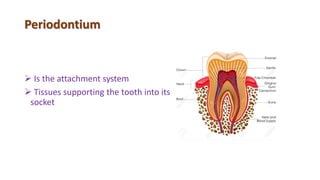
Periodontium
 Is the attachment system
 Tissues supporting the tooth into its
socket
Physiologic tooth form protecting Periodontium
Direct factors
I. Proximal contact relation.
II. Interproximal spaces.
III. Embrasures or spill ways.
IV. Facial and lingual contours
of the crown.
V. Curvature of cervical line.
Indirect factors
I. Crown form
II. Roof form
III. Angulation of crown and root
IV. The self-cleansing ability of the tooth.
V. Occlusal anatomy.
VI. Continuity of marginal ridges.
VII. Continuity of central grooves of post.
Teeth.
VIII. Facial line angles.
Physiologic tooth form protecting Periodontium
Direct factors
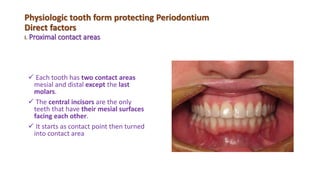
I. Proximal contact areas
 Each tooth has two contact areas
mesial and distal except the last
molars.
 The central incisors are the only
teeth that have their mesial surfaces
facing each other.
 It starts as contact point then turned
into contact area
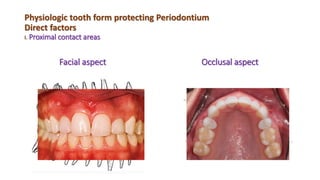
Facial aspect Occlusal aspect
Physiologic tooth form protecting Periodontium
Direct factors
I. Proximal contact areas
Physiologic tooth form protecting Periodontium
Direct factors
I. Proximal contact areas
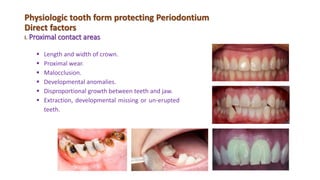
 Length and width of crown.
 Proximal wear.
 Malocclusion.
 Developmental anomalies.
 Disproportional growth between teeth and jaw.
 Extraction, developmental missing or un-erupted
teeth.
Importance
The whole dental arch functions as a single unit
and masticatory forces are well-distributed
Ensures occlusal stability.
Prevents food impaction.
Protect the interproximal gingival tissue.
 important for food flow pattern.
Physiologic tooth form protecting Periodontium
Direct factors
I. Proximal contact areas
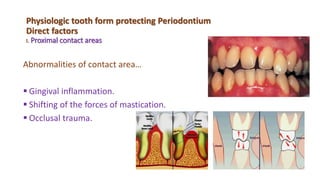
Abnormalities of contact area…
 Gingival inflammation.
 Shifting of the forces of mastication.
 Occlusal trauma.
Physiologic tooth form protecting Periodontium
Direct factors
I. Proximal contact areas
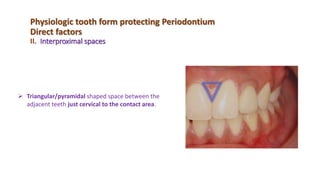
 Triangular/pyramidal shaped space between the
adjacent teeth just cervical to the contact area.
Physiologic tooth form protecting Periodontium
Direct factors
II. Interproximal spaces
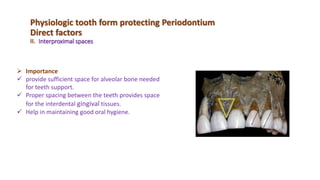
 Importance
 provide sufficient space for alveolar bone needed
for teeth support.
 Proper spacing between the teeth provides space
for the interdental gingival tissues.
 Help in maintaining good oral hygiene.
Physiologic tooth form protecting Periodontium
Direct factors
II. Interproximal spaces
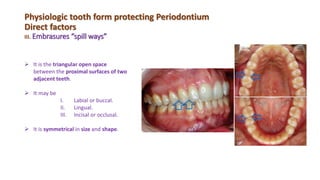
 It is the triangular open space
between the proximal surfaces of two
adjacent teeth.
 It may be
I. Labial or buccal.
II. Lingual.
III. Incisal or occlusal.
 It is symmetrical in size and shape.
Physiologic tooth form protecting Periodontium
Direct factors
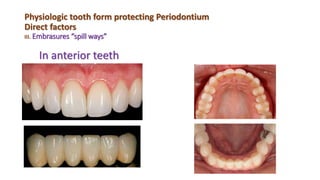
III. Embrasures “spill ways”
In anterior teeth
Physiologic tooth form protecting Periodontium
Direct factors
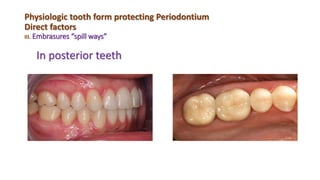
III. Embrasures “spill ways”
In posterior teeth
Physiologic tooth form protecting Periodontium
Direct factors
III. Embrasures “spill ways”
Importance
Spillway for the escape of food during mastication.
Tooth self-cleansing.
Protect the gingiva from undue trauma.
It allows proper stimulation for gingiva.
Reduction of occlusal forces.
Esthetics in anterior teeth.
Physiologic tooth form protecting Periodontium
Direct factors
III. Embrasures “spill ways”
“ crest of curvature”
Protects and stimulates gingiva
 Deflecting the food away from gingival tissue
during mastication.
 Hold the gingiva under definite tension.
 Allow some massage to the soft tissue.
Physiologic tooth form protecting Periodontium
Direct factors
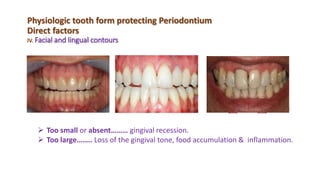
IV. Facial and lingual contours
 Too small or absent……… gingival recession.
 Too large…….. Loss of the gingival tone, food accumulation & inflammation.
Physiologic tooth form protecting Periodontium
Direct factors
IV. Facial and lingual contours
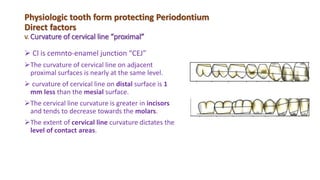
 Cl is cemnto-enamel junction “CEJ”
The curvature of cervical line on adjacent
proximal surfaces is nearly at the same level.
 curvature of cervical line on distal surface is 1
mm less than the mesial surface.
The cervical line curvature is greater in incisors
and tends to decrease towards the molars.
The extent of cervical line curvature dictates the
level of contact areas.
Physiologic tooth form protecting Periodontium
Direct factors
V. Curvature of cervical line “proximal”
It is stable
 Attachment epithelium follow its
curvature not necessary its level.
Physiologic tooth form protecting Periodontium
Direct factors
V. Curvature of cervical line “proximal”
Any questions??
Thank you..

Physiologic tooth from I

  • 1.
  • 2.
  • 3.
    Periodontium  Is theattachment system  Tissues supporting the tooth into its socket
  • 4.
    Physiologic tooth formprotecting Periodontium Direct factors I. Proximal contact relation. II. Interproximal spaces. III. Embrasures or spill ways. IV. Facial and lingual contours of the crown. V. Curvature of cervical line. Indirect factors I. Crown form II. Roof form III. Angulation of crown and root IV. The self-cleansing ability of the tooth. V. Occlusal anatomy. VI. Continuity of marginal ridges. VII. Continuity of central grooves of post. Teeth. VIII. Facial line angles.
  • 5.
    Physiologic tooth formprotecting Periodontium Direct factors I. Proximal contact areas  Each tooth has two contact areas mesial and distal except the last molars.  The central incisors are the only teeth that have their mesial surfaces facing each other.  It starts as contact point then turned into contact area
  • 6.
    Facial aspect Occlusalaspect Physiologic tooth form protecting Periodontium Direct factors I. Proximal contact areas
  • 7.
    Physiologic tooth formprotecting Periodontium Direct factors I. Proximal contact areas  Length and width of crown.  Proximal wear.  Malocclusion.  Developmental anomalies.  Disproportional growth between teeth and jaw.  Extraction, developmental missing or un-erupted teeth.
  • 8.
    Importance The whole dentalarch functions as a single unit and masticatory forces are well-distributed Ensures occlusal stability. Prevents food impaction. Protect the interproximal gingival tissue.  important for food flow pattern. Physiologic tooth form protecting Periodontium Direct factors I. Proximal contact areas
  • 9.
    Abnormalities of contactarea…  Gingival inflammation.  Shifting of the forces of mastication.  Occlusal trauma. Physiologic tooth form protecting Periodontium Direct factors I. Proximal contact areas
  • 10.
     Triangular/pyramidal shapedspace between the adjacent teeth just cervical to the contact area. Physiologic tooth form protecting Periodontium Direct factors II. Interproximal spaces
  • 11.
     Importance  providesufficient space for alveolar bone needed for teeth support.  Proper spacing between the teeth provides space for the interdental gingival tissues.  Help in maintaining good oral hygiene. Physiologic tooth form protecting Periodontium Direct factors II. Interproximal spaces
  • 12.
     It isthe triangular open space between the proximal surfaces of two adjacent teeth.  It may be I. Labial or buccal. II. Lingual. III. Incisal or occlusal.  It is symmetrical in size and shape. Physiologic tooth form protecting Periodontium Direct factors III. Embrasures “spill ways”
  • 13.
    In anterior teeth Physiologictooth form protecting Periodontium Direct factors III. Embrasures “spill ways”
  • 14.
    In posterior teeth Physiologictooth form protecting Periodontium Direct factors III. Embrasures “spill ways”
  • 15.
    Importance Spillway for theescape of food during mastication. Tooth self-cleansing. Protect the gingiva from undue trauma. It allows proper stimulation for gingiva. Reduction of occlusal forces. Esthetics in anterior teeth. Physiologic tooth form protecting Periodontium Direct factors III. Embrasures “spill ways”
  • 16.
    “ crest ofcurvature” Protects and stimulates gingiva  Deflecting the food away from gingival tissue during mastication.  Hold the gingiva under definite tension.  Allow some massage to the soft tissue. Physiologic tooth form protecting Periodontium Direct factors IV. Facial and lingual contours
  • 17.
     Too smallor absent……… gingival recession.  Too large…….. Loss of the gingival tone, food accumulation & inflammation. Physiologic tooth form protecting Periodontium Direct factors IV. Facial and lingual contours
  • 18.
     Cl iscemnto-enamel junction “CEJ” The curvature of cervical line on adjacent proximal surfaces is nearly at the same level.  curvature of cervical line on distal surface is 1 mm less than the mesial surface. The cervical line curvature is greater in incisors and tends to decrease towards the molars. The extent of cervical line curvature dictates the level of contact areas. Physiologic tooth form protecting Periodontium Direct factors V. Curvature of cervical line “proximal”
  • 19.
    It is stable Attachment epithelium follow its curvature not necessary its level. Physiologic tooth form protecting Periodontium Direct factors V. Curvature of cervical line “proximal”
  • 20.
  • 21.