Permanent Mandibular
Canine
By Dr Nesreen Nabil
1. The chronology of the tooth.
2. The morphology of the tooth.
3. Its clinical consideration.
4. Points of difference with the upper canine.
At the end of this lecture you must
know:
General characteristics of the
permanent canines
•All canines are the “Cornerstone” of the mouth
•Extra bulk of bone on the labial portion of root
called Canine eminence which help to support
facial muscles
•Longest root of any teeth making the canines the
most stable teeth
•In function, support the incisors and the premolars
(makes for a smooth transition)
•Longest tooth cervicoinsically
Chronology
• 1st. Evidence of calcification:
• Crown completed:
• Eruption:
• Root completion:
4 -5 monthes
6 -7 years.
9 – 10 years.
12 – 14 years.
Morphology
Labial Aspect:( Facial Aspect )
I ) Crown:
1. geometric outline:
2. surface outlines:
- mesial outline: ( including contact area )
- Distal outline: ( including contact area )
- cervical outline:
- incisal outline: ( including cusp tip )
3. surface describtion:
II) Root:
1. Mesial outline:
2. Distal outline:
3. Apex:
4. surface describtion:
⅓
⅔
⅓
⅓
⅓
Morphology
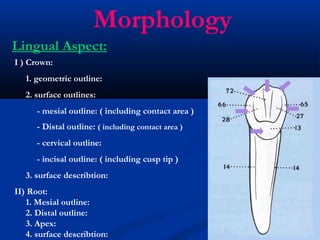
Lingual Aspect:
I ) Crown:
1. geometric outline:
2. surface outlines:
- mesial outline: ( including contact area )
- Distal outline: ( including contact area )
- cervical outline:
- incisal outline: ( including cusp tip )
3. surface describtion:
II) Root:
1. Mesial outline:
2. Distal outline:
3. Apex:
4. surface describtion:
Morphology
Mesial Aspect:( Proximal Aspect )
I ) Crown:
1. geometric outline:
2. surface outlines:
- Labial outline: ( including crest of curvature )
- Lingual outline: ( including crest of curvature )
- Cervical outline:
3. surface describtion.
II) Root:
1. Labialal outline.
2. Lingual outline.
3. Apex.
4. surface describtion.
⅓
⅔
Morphology
Distal Aspect: ( Proximal Aspect )
I ) Crown:
1. geometric outline:
2. surface outlines:
- Labial outline ( including crest of curvature )
- Lingual outline ( including crest of curvature )
- cervical outline.
3. surface describtion.
II) Root:
1. Labial outline.
2. Lingual outline.
3. Apex.
4. surface describtion.
Morphology
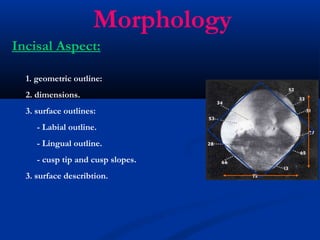
Incisal Aspect:
1. geometric outline:
2. dimensions.
3. surface outlines:
- Labial outline.
- Lingual outline.
- cusp tip and cusp slopes.
3. surface describtion.
Clinical consideration
So we must choose
conservative
treatment as first
choice as we can to
preserve the normal
facial shape
1. Anatomical
2. Esthetical
This tooth don’t appear much as the upper
canine but its esthetic must be considered.
3. Variations of the
mandibular canine
Shape
On occasion, the root is bifurcated near its tip.
The double root may, or may not be
accompanied by deep depressions in the root.
Size
On occasion, the root is unusually long or unusually short.
Position
The canine may be malposed or impacted.

Lower canine

  • 1.
  • 2.
    1. The chronologyof the tooth. 2. The morphology of the tooth. 3. Its clinical consideration. 4. Points of difference with the upper canine. At the end of this lecture you must know:
  • 3.
    General characteristics ofthe permanent canines •All canines are the “Cornerstone” of the mouth •Extra bulk of bone on the labial portion of root called Canine eminence which help to support facial muscles •Longest root of any teeth making the canines the most stable teeth •In function, support the incisors and the premolars (makes for a smooth transition) •Longest tooth cervicoinsically
  • 4.
    Chronology • 1st. Evidenceof calcification: • Crown completed: • Eruption: • Root completion: 4 -5 monthes 6 -7 years. 9 – 10 years. 12 – 14 years.
  • 5.
    Morphology Labial Aspect:( FacialAspect ) I ) Crown: 1. geometric outline: 2. surface outlines: - mesial outline: ( including contact area ) - Distal outline: ( including contact area ) - cervical outline: - incisal outline: ( including cusp tip ) 3. surface describtion: II) Root: 1. Mesial outline: 2. Distal outline: 3. Apex: 4. surface describtion: ⅓ ⅔ ⅓ ⅓ ⅓
  • 6.
    Morphology Lingual Aspect: I )Crown: 1. geometric outline: 2. surface outlines: - mesial outline: ( including contact area ) - Distal outline: ( including contact area ) - cervical outline: - incisal outline: ( including cusp tip ) 3. surface describtion: II) Root: 1. Mesial outline: 2. Distal outline: 3. Apex: 4. surface describtion:
  • 7.
    Morphology Mesial Aspect:( ProximalAspect ) I ) Crown: 1. geometric outline: 2. surface outlines: - Labial outline: ( including crest of curvature ) - Lingual outline: ( including crest of curvature ) - Cervical outline: 3. surface describtion. II) Root: 1. Labialal outline. 2. Lingual outline. 3. Apex. 4. surface describtion. ⅓ ⅔
  • 8.
    Morphology Distal Aspect: (Proximal Aspect ) I ) Crown: 1. geometric outline: 2. surface outlines: - Labial outline ( including crest of curvature ) - Lingual outline ( including crest of curvature ) - cervical outline. 3. surface describtion. II) Root: 1. Labial outline. 2. Lingual outline. 3. Apex. 4. surface describtion.
  • 9.
    Morphology Incisal Aspect: 1. geometricoutline: 2. dimensions. 3. surface outlines: - Labial outline. - Lingual outline. - cusp tip and cusp slopes. 3. surface describtion.
  • 10.
  • 11.
    So we mustchoose conservative treatment as first choice as we can to preserve the normal facial shape 1. Anatomical
  • 12.
    2. Esthetical This toothdon’t appear much as the upper canine but its esthetic must be considered.
  • 13.
    3. Variations ofthe mandibular canine
  • 14.
    Shape On occasion, theroot is bifurcated near its tip. The double root may, or may not be accompanied by deep depressions in the root. Size On occasion, the root is unusually long or unusually short.
  • 15.
    Position The canine maybe malposed or impacted.