This unit is scheduled for E-Learning.
S.I.Units & Dimensions 1 - 1
Statics & Dynamics (MM9400) Version 1.1
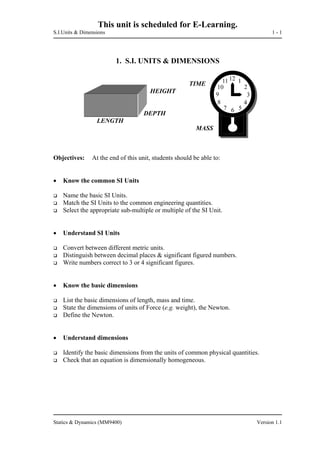
1. S.I. UNITS & DIMENSIONS
TIME
HEIGHT
DEPTH
LENGTH
MASS
Objectives: At the end of this unit, students should be able to:
 Know the common SI Units
 Name the basic SI Units.
 Match the SI Units to the common engineering quantities.
 Select the appropriate sub-multiple or multiple of the SI Unit.
 Understand SI Units
 Convert between different metric units.
 Distinguish between decimal places & significant figured numbers.
 Write numbers correct to 3 or 4 significant figures.
 Know the basic dimensions
 List the basic dimensions of length, mass and time.
 State the dimensions of units of Force (e.g. weight), the Newton.
 Define the Newton.
 Understand dimensions
 Identify the basic dimensions from the units of common physical quantities.
 Check that an equation is dimensionally homogeneous.
This unit is scheduled for E-Learning.
1 - 2 S.I. Units & Dimensions
Version 1.1 Statics & Dynamics (MM9400)
1.1 Physical Quantities
Mechanical causes and effects are measured in terms of quantities like distance,
velocity, acceleration, time, mass and force. Physical meanings are given by appending
units; for instance, 5 metres indicates a certain distance or length, while 5 kilograms
refers to the amount of matter possessed by a body. The numeral 5 gives a sense of
magnitude or size to the quantity but has no physical meaning by itself; units provide
the required physical meaning.
Most mechanical quantities comprise only 3 basic independent quantities called
dimensions: length, mass and time.
1.2 S.I. Units
The Systeme Internationale d' Units (or SI Units) is a widely adopted measurement
standard based on the metric system. The basic SI units, i.e. those used for the 3
dimensions, are metre (m), kilogram (kg) and second (s). Angles have no units and are
measured in radians. (See Chapter 4).
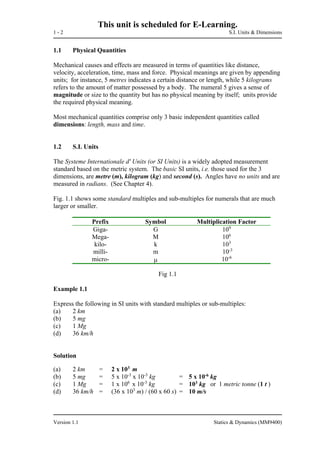
Fig. 1.1 shows some standard multiples and sub-multiples for numerals that are much
larger or smaller.
Prefix Symbol Multiplication Factor
Giga- G 109
Mega- M 106
kilo- k 103
milli- m 10-3
micro-  10-6
Fig 1.1
Example 1.1
Express the following in SI units with standard multiples or sub-multiples:
(a) 2 km
(b) 5 mg
(c) 1 Mg
(d) 36 km/h
Solution
(a) 2 km = 2 x 10³
m
(b) 5 mg = 5 x 10-3
x 10-3
kg = 5 x 10⁻⁶
kg
(c) 1 Mg = 1 x 106
x 10-3
kg = 103
kg or 1 metric tonne (1 t )
(d) 36 km/h = (36 x 103
m) / (60 x 60 s) = 10 m/s
This unit is scheduled for E-Learning.
S.I.Units & Dimensions 1 - 3
Statics & Dynamics (MM9400) Version 1.1
1.3 Significant Figures
The accuracy to which a quantity is calculated or measured is implied in the number of
significant figures it is rounded off to. For example, 12.3 is a three-significant-figure
number which can be any value between 12.25 and 12.34 inclusive; an acceptable error
of  0.05 is implied. Writing 12.30 (four significant figures) or even 12.300 (five
significant figures) implies a more accurate value; the trailing zeros are significant and
their inclusion conveys a greater accuracy.
For engineering purposes, quantities are rounded off either to 3 significant figures,
giving relative errors of no more than 1% (i.e. %100
100
1
), or to 4 significant figures, if
expected errors are to be less than 0.1 % (i.e. %100
1000
1 ).
Use of decimal places giving absolute errors are unsuitable. For example, an absolute
error of  10 mm may be good enough for the height of a tall building but definitely
unacceptable for the length of a writing pen! Hence, errors are preferably expressed in
percentages, i.e.
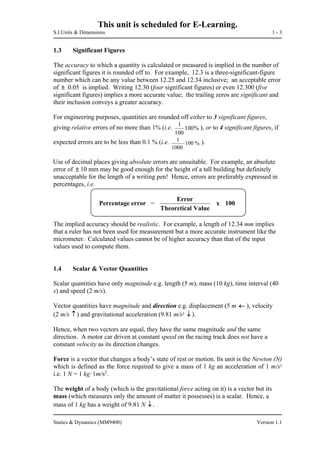
Percentage error = 100x
ValuelTheoretica
Error
The implied accuracy should be realistic. For example, a length of 12.34 mm implies
that a ruler has not been used for measurement but a more accurate instrument like the
micrometer. Calculated values cannot be of higher accuracy than that of the input
values used to compute them.
1.4 Scalar & Vector Quantities
Scalar quantities have only magnitude e.g. length (5 m), mass (10 kg), time interval (40
s) and speed (2 m/s).
Vector quantities have magnitude and direction e.g. displacement (5 m  ), velocity
(2 m/s  ) and gravitational acceleration (9.81 m/s2  ).
Hence, when two vectors are equal, they have the same magnitude and the same
direction. A motor car driven at constant speed on the racing track does not have a
constant velocity as its direction changes.
Force is a vector that changes a body’s state of rest or motion. Its unit is the Newton (N)
which is defined as the force required to give a mass of 1 kg an acceleration of 1 m/s2
i.e. 1 N = 1 kg. 1m/s2
.
The weight of a body (which is the gravitational force acting on it) is a vector but its
mass (which measures only the amount of matter it possesses) is a scalar. Hence, a
mass of 1 kg has a weight of 9.81 N  .
This unit is scheduled for E-Learning.
1 - 4 S.I. Units & Dimensions
Version 1.1 Statics & Dynamics (MM9400)
TUTORIAL: S.I. Units & Significant Figures
1.1 Express the following quantities in SI Units:
(a) 0.45 km
(b) 80.5 mm
(c) 63 g
(d) 0.06 Mg
( 450 m; 0.0805 m; 0.063 kg; 60 kg )
1.2 Express the following quantities prefixed with standard multiples or sub-
multiples :
(a) 12,500 m
(b) 4,600 kg
(c) 0.0036 m
(d) 85 x 103
kg
( 12.5 km; 4.6 Mg; 3.6 mm; 85 Mg)
1.3 Express the following quantities in SI units to 3 significant figures with standard
multiples or sub-multiples if required:
(a) 6 mm2
(b) 426,400 mm3
(c) 0.01356 g/mm3
(d) 90 km/h
( 6.00 x 10⁻⁶
m2
; 0.426 x 10⁻³
m3
; 13.6 x 10³
kg/m3
; 25.0 m/s )
1.4 Round up the following quantities in m2
to 3 significant figures:
(a) The area of a heating panel 650 mm long by 330 mm wide
(b) The cross sectional area of a circular rod of 150 mm diameter.
( 0.215 m2
; 0.0177 m2
)
1.5 Calculate the weight of a 650 kg vehicle, given the acceleration due to gravity is
9.81 m/s2
. Explain how your answer conveys the desired level of accuracy.
( 6.38 kN )
1.6 A cube has edges of 250 1 mm. Calculate the percentage error in:
(a) the length of an edge.
(b) the area of a face.
(c) the volume.
( 0.4%; 0.8%; 1.2% )
This unit is scheduled for E-Learning.
S.I.Units & Dimensions 1 - 5
Statics & Dynamics (MM9400) Version 1.1
1.5 Dimensional Homogeneity
A quantity can only be equal to, added to or subtracted from another when both
quantities have the same dimensions, e.g.
1 km = 1 000 m
20 kg + 0.5 t = 520 kg
13 hr  60 min = ½ day
However, a quantity may be multiplied or divided by another when both quantities have
different dimensions, provided the result has a physical meaning, e.g.
10 m2
x 5 m = 50 m3
(volume)
10 m  5 s = 2 m/s (speed)
Hence, an equation must be dimensionally homogeneous, i.e. every individual term to
be equated, added or subtracted must have the same dimensions. This enables us to
determine the units of a quantity or to check the correctness of an equation or formula.
Example 1.2
Find the basic SI units of the following quantities using the given equations.
(a) Moment = force x perpendicular distance (see Unit 2)
(b) Acceleration = velocity / time (see Unit 4)
(c) Force = mass x acceleration (see Unit 5)
(d) Momentum = mass x velocity (see Unit 5)
Solution [ ] = denotes “has the units”
(a) [Moment] = kg m/s2
x m
= kg m2
/s2
(b) [Acceleration] = m/s  s
= m/s2
(c) [Force] = kg m/s2
(d) [Momentum] = kg x m/s
= kg m/s
This unit is scheduled for E-Learning.
1 - 6 S.I. Units & Dimensions
Version 1.1 Statics & Dynamics (MM9400)
Example 1.3
The displacement s of a body with initial velocity vo and acceleration a after a time
interval of t is given by:
s = vo t + ½ at2
.
Show that this kinematics equation (see Chapter 4) is dimensionally homogeneous.
Solution
L.H.S.: [s] = m
R.H.S.: [vo t] = m/s x s = m
[at2
] = m/s2
x s2
= m
Example 1.4
Solution
 Volume of plastic replica vp  (n.L)(n.B)(n.H) ……... (n is reduction ratio)
 Volume of steel structure vs  (L)(B)(H)……… (Length x breadth x height)

s
p
m
m
ss
pp
v
v


The plastic replica’s mass, mp =
A 6-m high steel structure weighs 1 tonne.
A 1.5-m high plastic replica is fabricated in the
laboratory. If steel is 10 times heavier than
plastic, the replica weighs ________ kg.
Plastic
Replica
1 tonne
1.5m
6m
Steel
Structure
kg5625.11000
10
1
6
5.1
3












This unit is scheduled for E-Learning.
S.I.Units & Dimensions 1 - 7
Statics & Dynamics (MM9400) Version 1.1
TUTORIAL: Dimensional Homogeneity
1.7 Show that the following equations are dimensionally homogeneous.
(a) density = mass / volume
(b) pressure = force / area
(c) distance = speed x time
(d) force = mass x velocity / time
LHS RHS
(a)
(b)
(c)
(d)
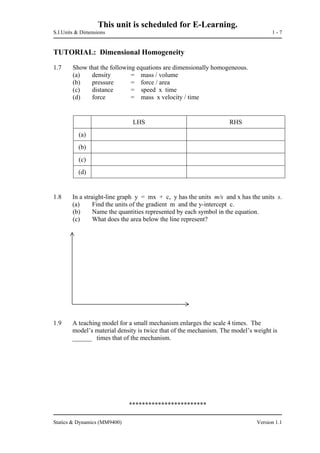
1.8 In a straight-line graph y = mx + c, y has the units m/s and x has the units s.
(a) Find the units of the gradient m and the y-intercept c.
(b) Name the quantities represented by each symbol in the equation.
(c) What does the area below the line represent?
1.9 A teaching model for a small mechanism enlarges the scale 4 times. The
model’s material density is twice that of the mechanism. The model’s weight is
______ times that of the mechanism.
************************

Unit 1 mm9400 ver 1.1(2014)

  • 1.
    This unit isscheduled for E-Learning. S.I.Units & Dimensions 1 - 1 Statics & Dynamics (MM9400) Version 1.1 1. S.I. UNITS & DIMENSIONS TIME HEIGHT DEPTH LENGTH MASS Objectives: At the end of this unit, students should be able to:  Know the common SI Units  Name the basic SI Units.  Match the SI Units to the common engineering quantities.  Select the appropriate sub-multiple or multiple of the SI Unit.  Understand SI Units  Convert between different metric units.  Distinguish between decimal places & significant figured numbers.  Write numbers correct to 3 or 4 significant figures.  Know the basic dimensions  List the basic dimensions of length, mass and time.  State the dimensions of units of Force (e.g. weight), the Newton.  Define the Newton.  Understand dimensions  Identify the basic dimensions from the units of common physical quantities.  Check that an equation is dimensionally homogeneous.
  • 2.
    This unit isscheduled for E-Learning. 1 - 2 S.I. Units & Dimensions Version 1.1 Statics & Dynamics (MM9400) 1.1 Physical Quantities Mechanical causes and effects are measured in terms of quantities like distance, velocity, acceleration, time, mass and force. Physical meanings are given by appending units; for instance, 5 metres indicates a certain distance or length, while 5 kilograms refers to the amount of matter possessed by a body. The numeral 5 gives a sense of magnitude or size to the quantity but has no physical meaning by itself; units provide the required physical meaning. Most mechanical quantities comprise only 3 basic independent quantities called dimensions: length, mass and time. 1.2 S.I. Units The Systeme Internationale d' Units (or SI Units) is a widely adopted measurement standard based on the metric system. The basic SI units, i.e. those used for the 3 dimensions, are metre (m), kilogram (kg) and second (s). Angles have no units and are measured in radians. (See Chapter 4). Fig. 1.1 shows some standard multiples and sub-multiples for numerals that are much larger or smaller. Prefix Symbol Multiplication Factor Giga- G 109 Mega- M 106 kilo- k 103 milli- m 10-3 micro-  10-6 Fig 1.1 Example 1.1 Express the following in SI units with standard multiples or sub-multiples: (a) 2 km (b) 5 mg (c) 1 Mg (d) 36 km/h Solution (a) 2 km = 2 x 10³ m (b) 5 mg = 5 x 10-3 x 10-3 kg = 5 x 10⁻⁶ kg (c) 1 Mg = 1 x 106 x 10-3 kg = 103 kg or 1 metric tonne (1 t ) (d) 36 km/h = (36 x 103 m) / (60 x 60 s) = 10 m/s
  • 3.
    This unit isscheduled for E-Learning. S.I.Units & Dimensions 1 - 3 Statics & Dynamics (MM9400) Version 1.1 1.3 Significant Figures The accuracy to which a quantity is calculated or measured is implied in the number of significant figures it is rounded off to. For example, 12.3 is a three-significant-figure number which can be any value between 12.25 and 12.34 inclusive; an acceptable error of  0.05 is implied. Writing 12.30 (four significant figures) or even 12.300 (five significant figures) implies a more accurate value; the trailing zeros are significant and their inclusion conveys a greater accuracy. For engineering purposes, quantities are rounded off either to 3 significant figures, giving relative errors of no more than 1% (i.e. %100 100 1 ), or to 4 significant figures, if expected errors are to be less than 0.1 % (i.e. %100 1000 1 ). Use of decimal places giving absolute errors are unsuitable. For example, an absolute error of  10 mm may be good enough for the height of a tall building but definitely unacceptable for the length of a writing pen! Hence, errors are preferably expressed in percentages, i.e. Percentage error = 100x ValuelTheoretica Error The implied accuracy should be realistic. For example, a length of 12.34 mm implies that a ruler has not been used for measurement but a more accurate instrument like the micrometer. Calculated values cannot be of higher accuracy than that of the input values used to compute them. 1.4 Scalar & Vector Quantities Scalar quantities have only magnitude e.g. length (5 m), mass (10 kg), time interval (40 s) and speed (2 m/s). Vector quantities have magnitude and direction e.g. displacement (5 m  ), velocity (2 m/s  ) and gravitational acceleration (9.81 m/s2  ). Hence, when two vectors are equal, they have the same magnitude and the same direction. A motor car driven at constant speed on the racing track does not have a constant velocity as its direction changes. Force is a vector that changes a body’s state of rest or motion. Its unit is the Newton (N) which is defined as the force required to give a mass of 1 kg an acceleration of 1 m/s2 i.e. 1 N = 1 kg. 1m/s2 . The weight of a body (which is the gravitational force acting on it) is a vector but its mass (which measures only the amount of matter it possesses) is a scalar. Hence, a mass of 1 kg has a weight of 9.81 N  .
  • 4.
    This unit isscheduled for E-Learning. 1 - 4 S.I. Units & Dimensions Version 1.1 Statics & Dynamics (MM9400) TUTORIAL: S.I. Units & Significant Figures 1.1 Express the following quantities in SI Units: (a) 0.45 km (b) 80.5 mm (c) 63 g (d) 0.06 Mg ( 450 m; 0.0805 m; 0.063 kg; 60 kg ) 1.2 Express the following quantities prefixed with standard multiples or sub- multiples : (a) 12,500 m (b) 4,600 kg (c) 0.0036 m (d) 85 x 103 kg ( 12.5 km; 4.6 Mg; 3.6 mm; 85 Mg) 1.3 Express the following quantities in SI units to 3 significant figures with standard multiples or sub-multiples if required: (a) 6 mm2 (b) 426,400 mm3 (c) 0.01356 g/mm3 (d) 90 km/h ( 6.00 x 10⁻⁶ m2 ; 0.426 x 10⁻³ m3 ; 13.6 x 10³ kg/m3 ; 25.0 m/s ) 1.4 Round up the following quantities in m2 to 3 significant figures: (a) The area of a heating panel 650 mm long by 330 mm wide (b) The cross sectional area of a circular rod of 150 mm diameter. ( 0.215 m2 ; 0.0177 m2 ) 1.5 Calculate the weight of a 650 kg vehicle, given the acceleration due to gravity is 9.81 m/s2 . Explain how your answer conveys the desired level of accuracy. ( 6.38 kN ) 1.6 A cube has edges of 250 1 mm. Calculate the percentage error in: (a) the length of an edge. (b) the area of a face. (c) the volume. ( 0.4%; 0.8%; 1.2% )
  • 5.
    This unit isscheduled for E-Learning. S.I.Units & Dimensions 1 - 5 Statics & Dynamics (MM9400) Version 1.1 1.5 Dimensional Homogeneity A quantity can only be equal to, added to or subtracted from another when both quantities have the same dimensions, e.g. 1 km = 1 000 m 20 kg + 0.5 t = 520 kg 13 hr  60 min = ½ day However, a quantity may be multiplied or divided by another when both quantities have different dimensions, provided the result has a physical meaning, e.g. 10 m2 x 5 m = 50 m3 (volume) 10 m  5 s = 2 m/s (speed) Hence, an equation must be dimensionally homogeneous, i.e. every individual term to be equated, added or subtracted must have the same dimensions. This enables us to determine the units of a quantity or to check the correctness of an equation or formula. Example 1.2 Find the basic SI units of the following quantities using the given equations. (a) Moment = force x perpendicular distance (see Unit 2) (b) Acceleration = velocity / time (see Unit 4) (c) Force = mass x acceleration (see Unit 5) (d) Momentum = mass x velocity (see Unit 5) Solution [ ] = denotes “has the units” (a) [Moment] = kg m/s2 x m = kg m2 /s2 (b) [Acceleration] = m/s  s = m/s2 (c) [Force] = kg m/s2 (d) [Momentum] = kg x m/s = kg m/s
  • 6.
    This unit isscheduled for E-Learning. 1 - 6 S.I. Units & Dimensions Version 1.1 Statics & Dynamics (MM9400) Example 1.3 The displacement s of a body with initial velocity vo and acceleration a after a time interval of t is given by: s = vo t + ½ at2 . Show that this kinematics equation (see Chapter 4) is dimensionally homogeneous. Solution L.H.S.: [s] = m R.H.S.: [vo t] = m/s x s = m [at2 ] = m/s2 x s2 = m Example 1.4 Solution  Volume of plastic replica vp  (n.L)(n.B)(n.H) ……... (n is reduction ratio)  Volume of steel structure vs  (L)(B)(H)……… (Length x breadth x height)  s p m m ss pp v v   The plastic replica’s mass, mp = A 6-m high steel structure weighs 1 tonne. A 1.5-m high plastic replica is fabricated in the laboratory. If steel is 10 times heavier than plastic, the replica weighs ________ kg. Plastic Replica 1 tonne 1.5m 6m Steel Structure kg5625.11000 10 1 6 5.1 3            
  • 7.
    This unit isscheduled for E-Learning. S.I.Units & Dimensions 1 - 7 Statics & Dynamics (MM9400) Version 1.1 TUTORIAL: Dimensional Homogeneity 1.7 Show that the following equations are dimensionally homogeneous. (a) density = mass / volume (b) pressure = force / area (c) distance = speed x time (d) force = mass x velocity / time LHS RHS (a) (b) (c) (d) 1.8 In a straight-line graph y = mx + c, y has the units m/s and x has the units s. (a) Find the units of the gradient m and the y-intercept c. (b) Name the quantities represented by each symbol in the equation. (c) What does the area below the line represent? 1.9 A teaching model for a small mechanism enlarges the scale 4 times. The model’s material density is twice that of the mechanism. The model’s weight is ______ times that of the mechanism. ************************