SACRED HEART DEGREE COLLEGE
MOMENT OF INERTIA
BY
SATYAM SRIVASTAVA
(M.Sc. second year math)
Contents
• Moment of Inertia of a body
• Parallel Axis Theorem
• Radius of Gyration
• Moment of Inertia of Composite Bodies
• Applications of moment of inertia
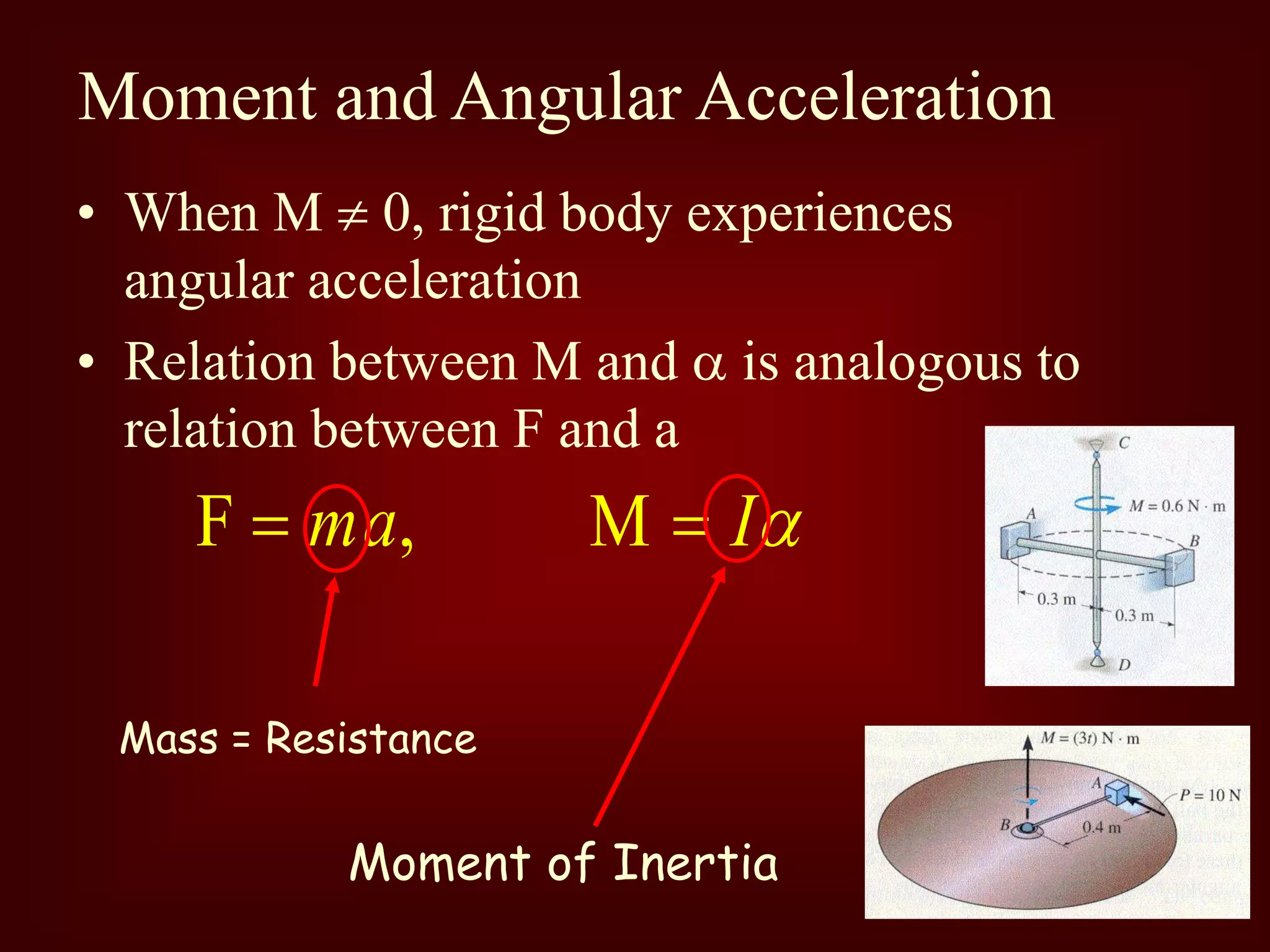
Moment and Angular Acceleration
• When M  0, rigid body experiences
angular acceleration
• Relation between M and a is analogous to
relation between F and a
a
I
ma 
 M
,
F
Moment of Inertia
Mass = Resistance
Moment of Inertia
• This mass analog is called the
moment of inertia, I, of the object
– r = moment arm
– SI units are kg m2


m
dm
r
I 2

 dz
dy
dx
r
I 2

dV
r
I
dV
dm



2
:
density
volume
the
is
where
,
Using



Shell Element
Disk Element
dy
z
y
dV )
2
( 

dz
y
dV )
( 2


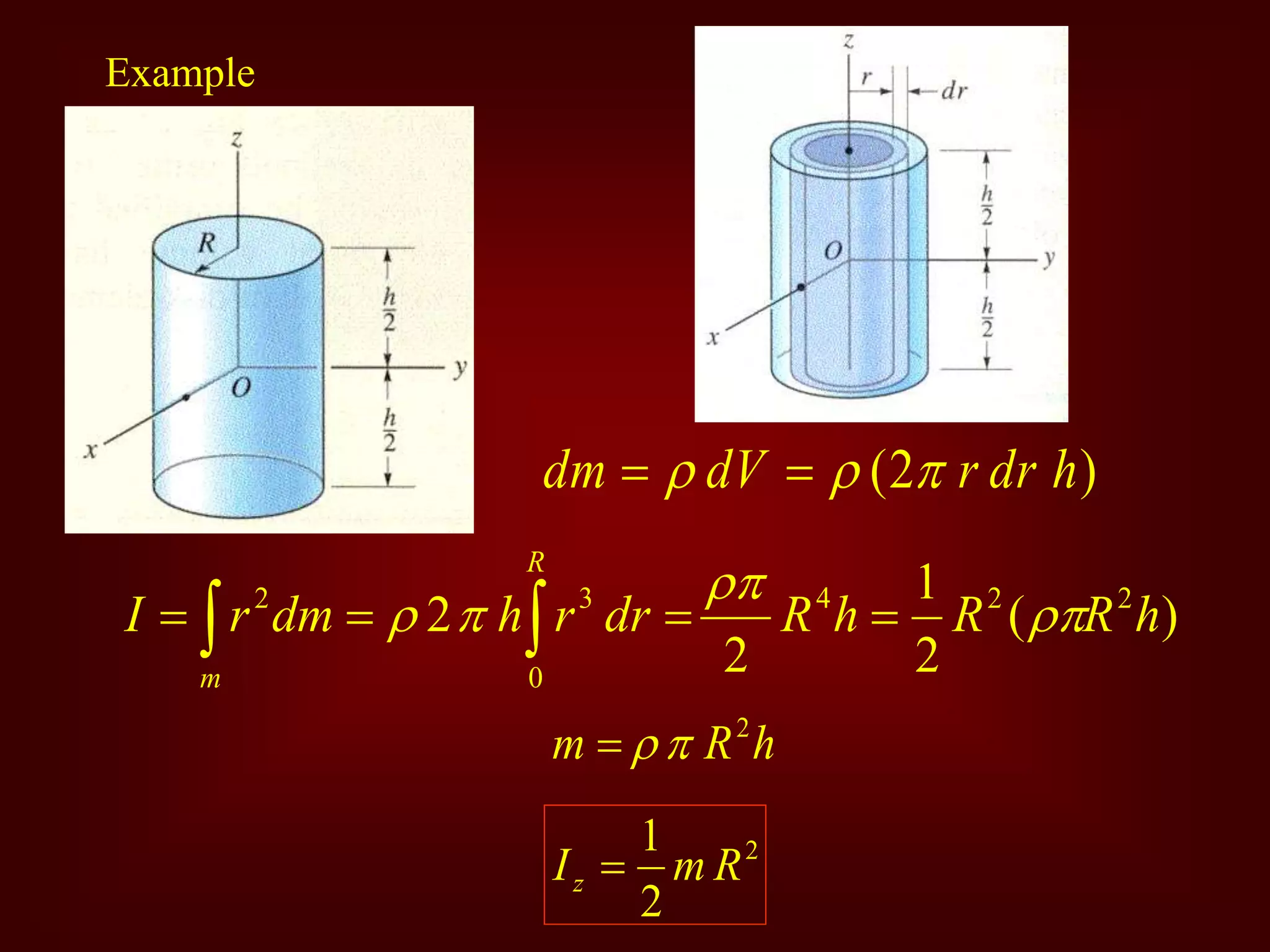
Example
)
2
( h
dr
r
dV
dm 

 

)
(
2
1
2
2 2
2
4
0
3
2
h
R
R
h
R
dr
r
h
dm
r
I
R
m



 


 

h
R
m 2



2
2
1
R
m
Iz 
Example
dy
x
dV
dm )
( 2


 

2
2
1
R
m
I 
dy
x
x
dy
x
R
m
Iy
4
2
2
2
2
1
]
)
(
[
2
1
2
1


 


3
2
slug/ft
5
, 
 
y
x
2
1
0
8
1
0
4
slug.ft
873
.
0
2
)
5
(
2


 
 dy
y
dy
x
Iy


Rod
Thin
12
1 2
ML
I 
L
end)
at
(axis
Rod
Thin
3
1 2
ML
I 
L
Disk
Solid
2
1 2
MR
I 
R
Cylinder
Hollow
)
(
2
1 2
2
2
1 R
R
M
I 

R2
R2
Cylinder
Hollow
d
Thin Walle
2
MR
I 
R
a
b
center)
(through
Plate
r
Rectangula
)
(
12
1 2
2
b
a
M
I 

a
b
edge)
(about
Plate
r
Rectangula
Thin
3
1 2
Ma
I 
Sphere
Solid
5
2 2
MR
I 
R
Sphere
Hollow
d
Thin Walle
3
2 2
MR
I 
R
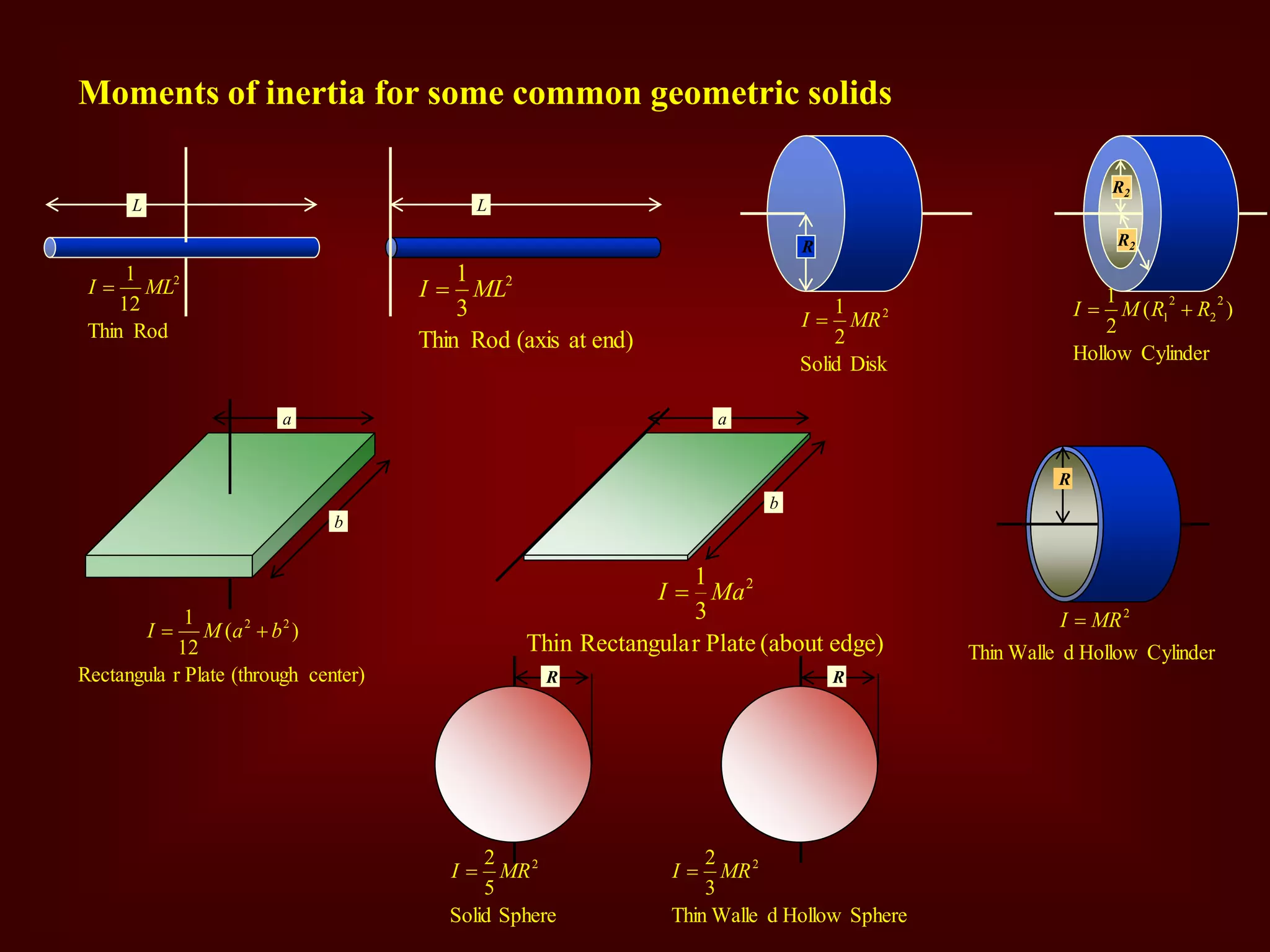
Moments of inertia for some common geometric solids
Parallel Axis Theorem
• The moment of inertia about any axis parallel to
and at distance d away from the axis that
passes through the centre of mass is:
• Where
– IG= moment of inertia for mass centre G
– m = mass of the body
– d = perpendicular distance between the parallel axes.
2
md
I
I G
O 

Radius of Gyration
Frequently tabulated data related to moments of inertia will be
presented in terms of radius of gyration.
m
I
k
or
mk
I 
 2
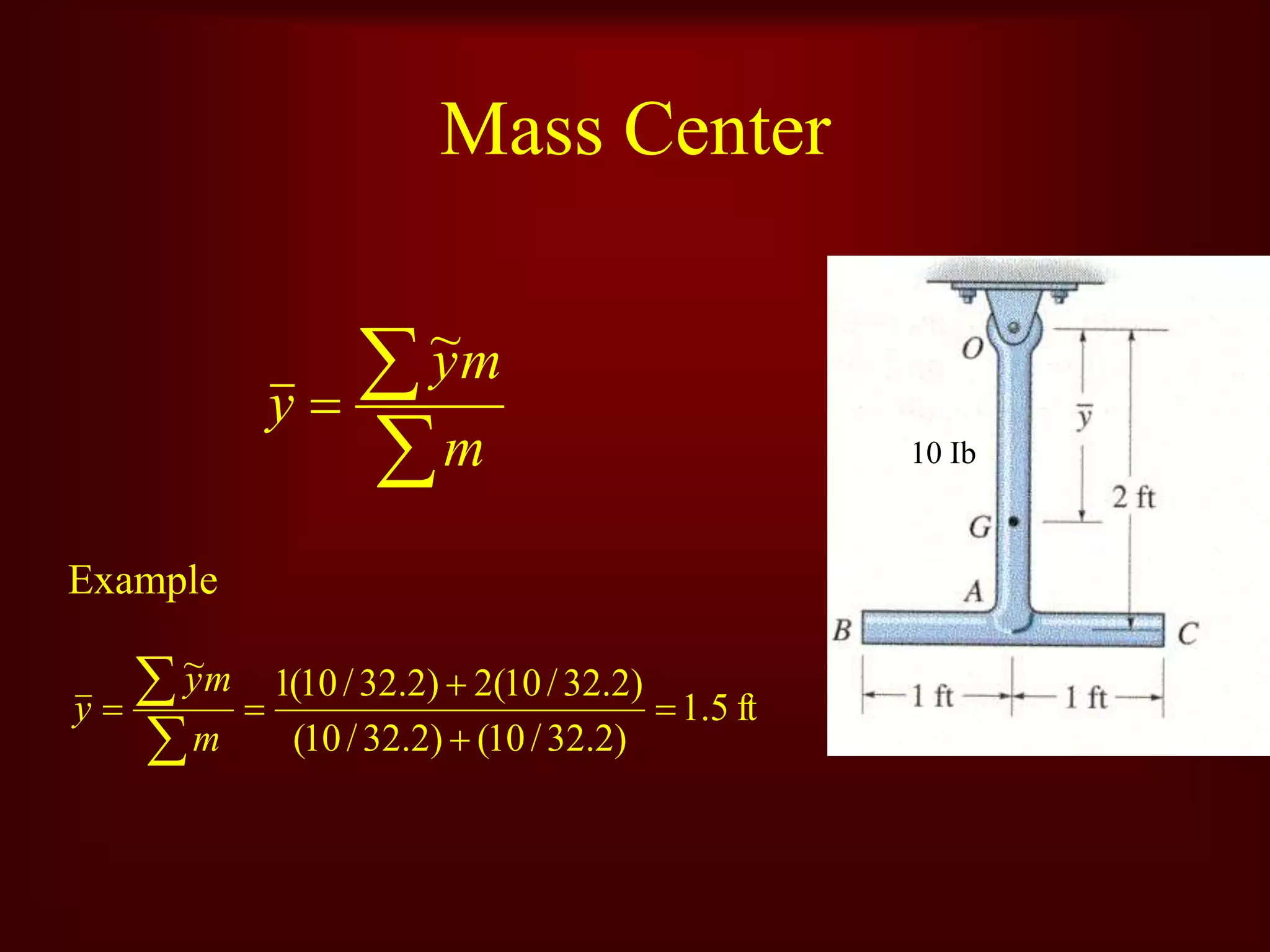
Mass Center



m
m
y
y
~
Example
ft
5
.
1
)
2
.
32
/
10
(
)
2
.
32
/
10
(
)
2
.
32
/
10
(
2
)
2
.
32
/
10
(
1
~







m
m
y
y
10 Ib
Moment of Inertia of Composite bodies
1. Divide the composite area into simple body.
2. Compute the moment of inertia of each simple body about its
centroidal axis from table.
3. Transfer each centroidal moment of inertia to a parallel reference axis
4. The sum of the moments of inertia for each simple body about the
parallel reference axis is the moment of inertia of the composite
body.
5. Any cutout area has must be assigned a negative moment; all others
are considered positive.
Applications of Moment of Inertia
1. A wheel in which most of the mass lie near the axle is easier to
speed up in comparison to the other wheel in which equal mass
is spread over a larger diameter.
moment_of_inertia.ppt

moment_of_inertia.ppt

  • 1.
    SACRED HEART DEGREECOLLEGE MOMENT OF INERTIA BY SATYAM SRIVASTAVA (M.Sc. second year math)
  • 2.
    Contents • Moment ofInertia of a body • Parallel Axis Theorem • Radius of Gyration • Moment of Inertia of Composite Bodies • Applications of moment of inertia
  • 3.
    Moment and AngularAcceleration • When M  0, rigid body experiences angular acceleration • Relation between M and a is analogous to relation between F and a a I ma   M , F Moment of Inertia Mass = Resistance
  • 4.
    Moment of Inertia •This mass analog is called the moment of inertia, I, of the object – r = moment arm – SI units are kg m2   m dm r I 2   dz dy dx r I 2  dV r I dV dm    2 : density volume the is where , Using   
  • 5.
    Shell Element Disk Element dy z y dV) 2 (   dz y dV ) ( 2  
  • 6.
    Example ) 2 ( h dr r dV dm     ) ( 2 1 2 2 2 2 4 0 3 2 h R R h R dr r h dm r I R m           h R m 2    2 2 1 R m Iz 
  • 7.
    Example dy x dV dm ) ( 2     2 2 1 R m I  dy x x dy x R m Iy 4 2 2 2 2 1 ] ) ( [ 2 1 2 1       3 2 slug/ft 5 ,    y x 2 1 0 8 1 0 4 slug.ft 873 . 0 2 ) 5 ( 2      dy y dy x Iy  
  • 9.
    Rod Thin 12 1 2 ML I  L end) at (axis Rod Thin 3 12 ML I  L Disk Solid 2 1 2 MR I  R Cylinder Hollow ) ( 2 1 2 2 2 1 R R M I   R2 R2 Cylinder Hollow d Thin Walle 2 MR I  R a b center) (through Plate r Rectangula ) ( 12 1 2 2 b a M I   a b edge) (about Plate r Rectangula Thin 3 1 2 Ma I  Sphere Solid 5 2 2 MR I  R Sphere Hollow d Thin Walle 3 2 2 MR I  R Moments of inertia for some common geometric solids
  • 10.
    Parallel Axis Theorem •The moment of inertia about any axis parallel to and at distance d away from the axis that passes through the centre of mass is: • Where – IG= moment of inertia for mass centre G – m = mass of the body – d = perpendicular distance between the parallel axes. 2 md I I G O  
  • 11.
    Radius of Gyration Frequentlytabulated data related to moments of inertia will be presented in terms of radius of gyration. m I k or mk I   2
  • 12.
  • 13.
    Moment of Inertiaof Composite bodies 1. Divide the composite area into simple body. 2. Compute the moment of inertia of each simple body about its centroidal axis from table. 3. Transfer each centroidal moment of inertia to a parallel reference axis 4. The sum of the moments of inertia for each simple body about the parallel reference axis is the moment of inertia of the composite body. 5. Any cutout area has must be assigned a negative moment; all others are considered positive.
  • 14.
    Applications of Momentof Inertia 1. A wheel in which most of the mass lie near the axle is easier to speed up in comparison to the other wheel in which equal mass is spread over a larger diameter.