Introduction to Engineering Mechanics II: Dynamics.pptx
The document outlines the curriculum for Engineering Mechanics II (ME 2209), focusing on mechanics, which is divided into statics, dynamics, and strength of materials. Key concepts include the study of forces, motion, and the application of Newton's laws for both particles and rigid bodies. It distinguishes between kinematics, which examines motion geometry without forces, and kinetics, which considers the forces and their effects on motion.
Introduction to Engineering Mechanics II: Dynamics.pptx
1.
Engineering Mechanics II
ME2209
Dr. Mohammad Ilias Inam
Professor
Department of Mechanical Engineering & Technology
Khulna University of Engineering & Technology
2.
2 - 2
References:
1.Engineering Mechanics Statics and Dynamics by R. C. Hibbler
2. Vector Mechanics for Engineering (Dynamics) by Ferdinand P. Beer and E.
Russel Jhston
3.
2 - 3
Mechanics:Mechanics is the study of force, deformation, motion and the
relation between them.
Mechanics traditionally partition into three course, such as:
1. Statics: ME 1209 – Acceleration is considered zero here.
2. Dynamics: ME 2209 - Dynamics deals with the non-
negligible acceleration of mass.
3. Strength of Material: ME 2211 – Strength of material, also
called Mechanics of Solid, is a subject which deal with the
behavior of solid objects, subject to stress and strain.
4.
Stati1209
2 - 4
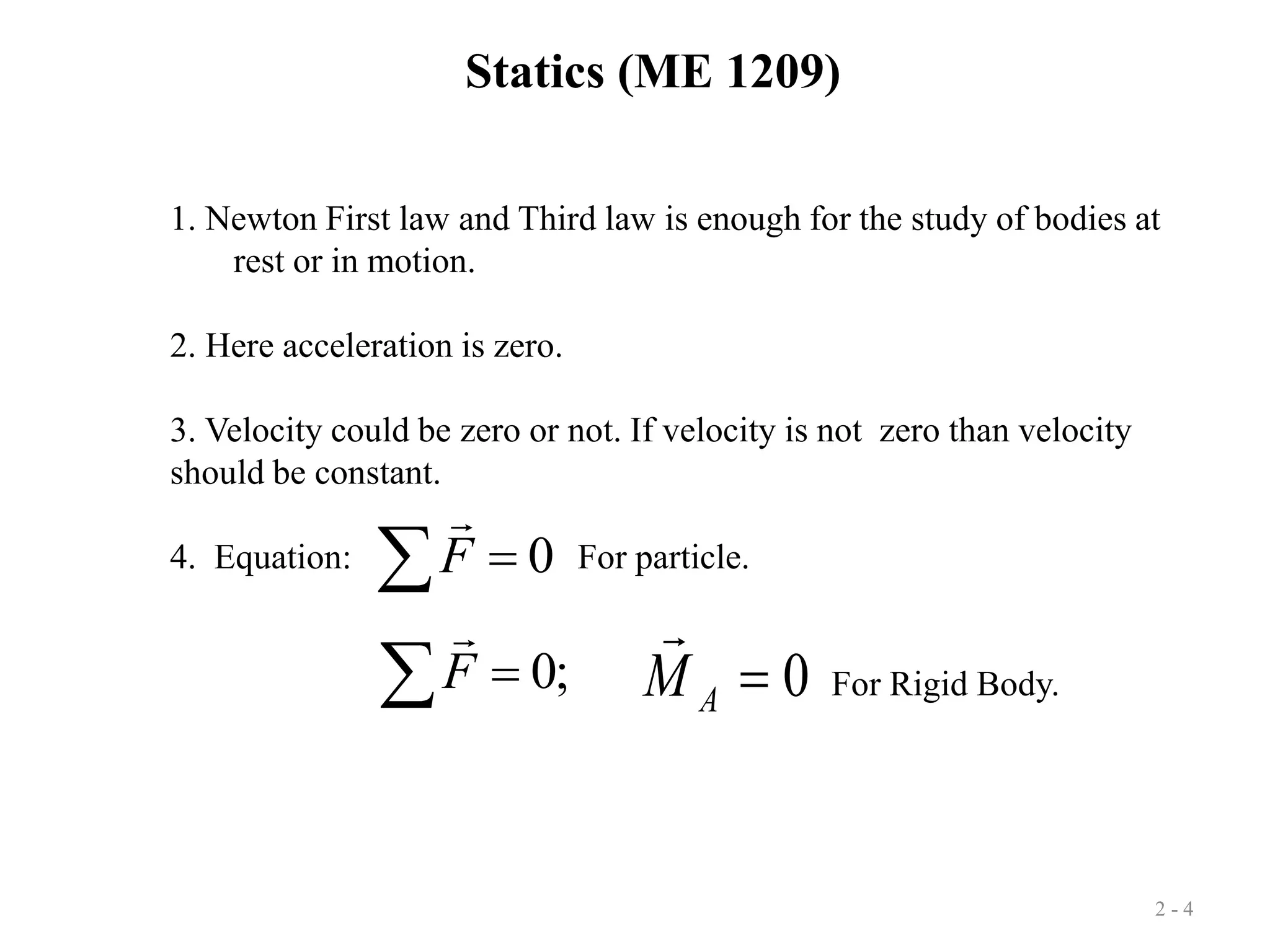
1.Newton First law and Third law is enough for the study of bodies at
rest or in motion.
2. Here acceleration is zero.
3. Velocity could be zero or not. If velocity is not zero than velocity
should be constant.
4. Equation: For particle.
For Rigid Body.
Statics (ME 1209)
0
F
;
0
F
0
A
M
5.
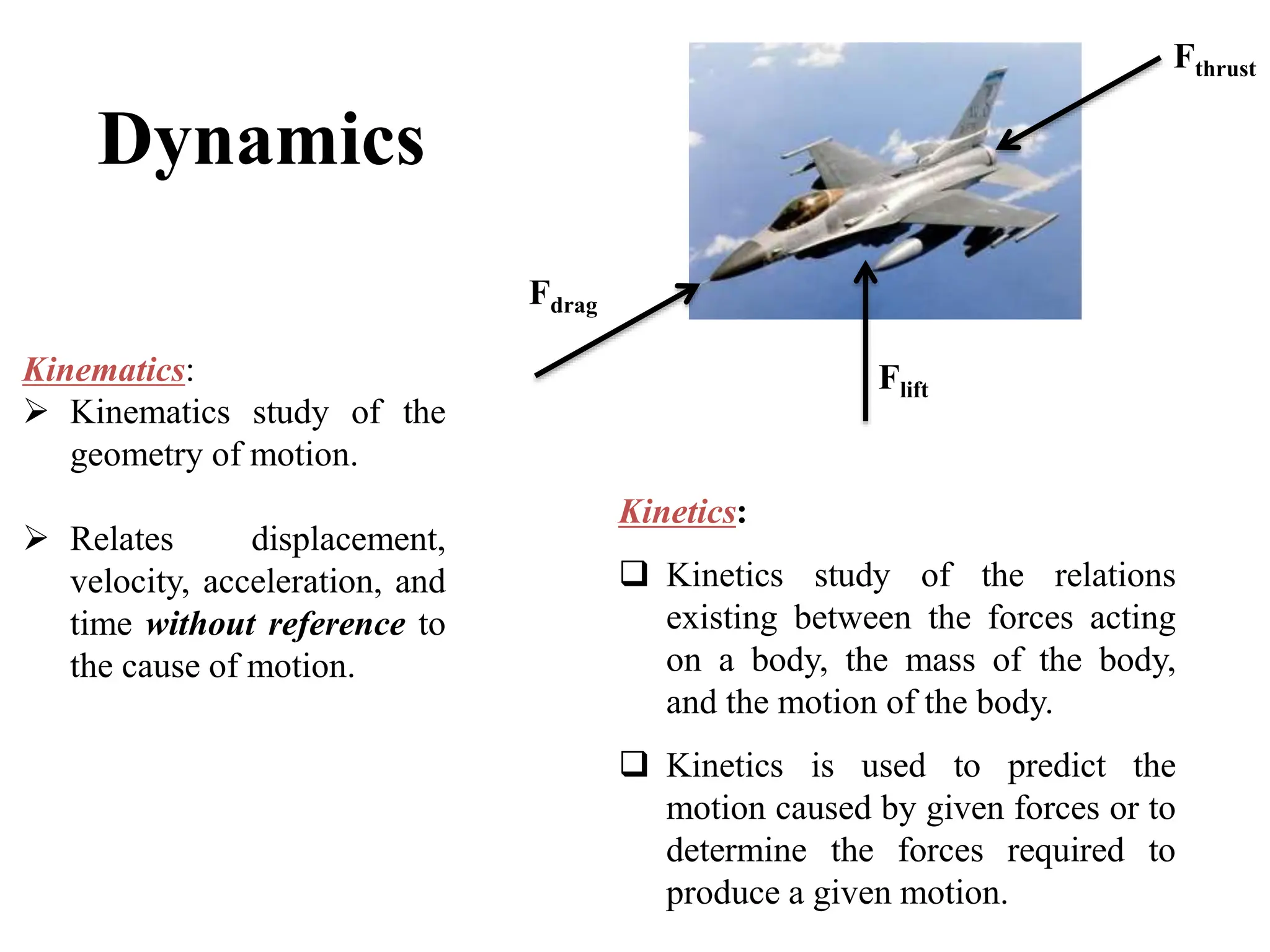
Kinetics:
Kinetics studyof the relations
existing between the forces acting
on a body, the mass of the body,
and the motion of the body.
Kinetics is used to predict the
motion caused by given forces or to
determine the forces required to
produce a given motion.
Kinematics:
Kinematics study of the
geometry of motion.
Relates displacement,
velocity, acceleration, and
time without reference to
the cause of motion.
Fthrust
Flift
Fdrag
Dynamics
6.
2 - 6
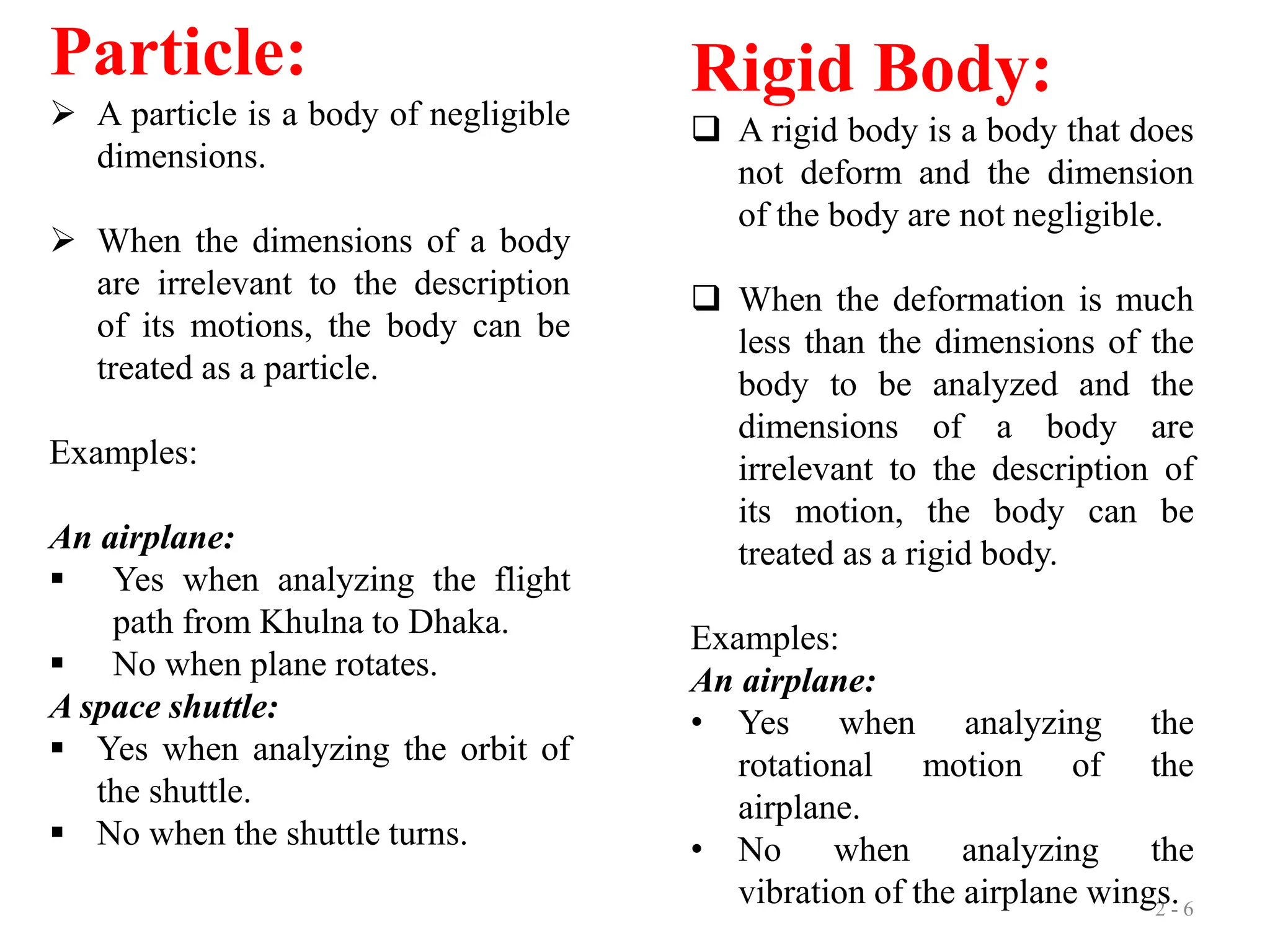
Particle:
A particle is a body of negligible
dimensions.
When the dimensions of a body
are irrelevant to the description
of its motions, the body can be
treated as a particle.
Examples:
An airplane:
Yes when analyzing the flight
path from Khulna to Dhaka.
No when plane rotates.
A space shuttle:
Yes when analyzing the orbit of
the shuttle.
No when the shuttle turns.
Rigid Body:
A rigid body is a body that does
not deform and the dimension
of the body are not negligible.
When the deformation is much
less than the dimensions of the
body to be analyzed and the
dimensions of a body are
irrelevant to the description of
its motion, the body can be
treated as a rigid body.
Examples:
An airplane:
• Yes when analyzing the
rotational motion of the
airplane.
• No when analyzing the
vibration of the airplane wings.
7.
2 - 7
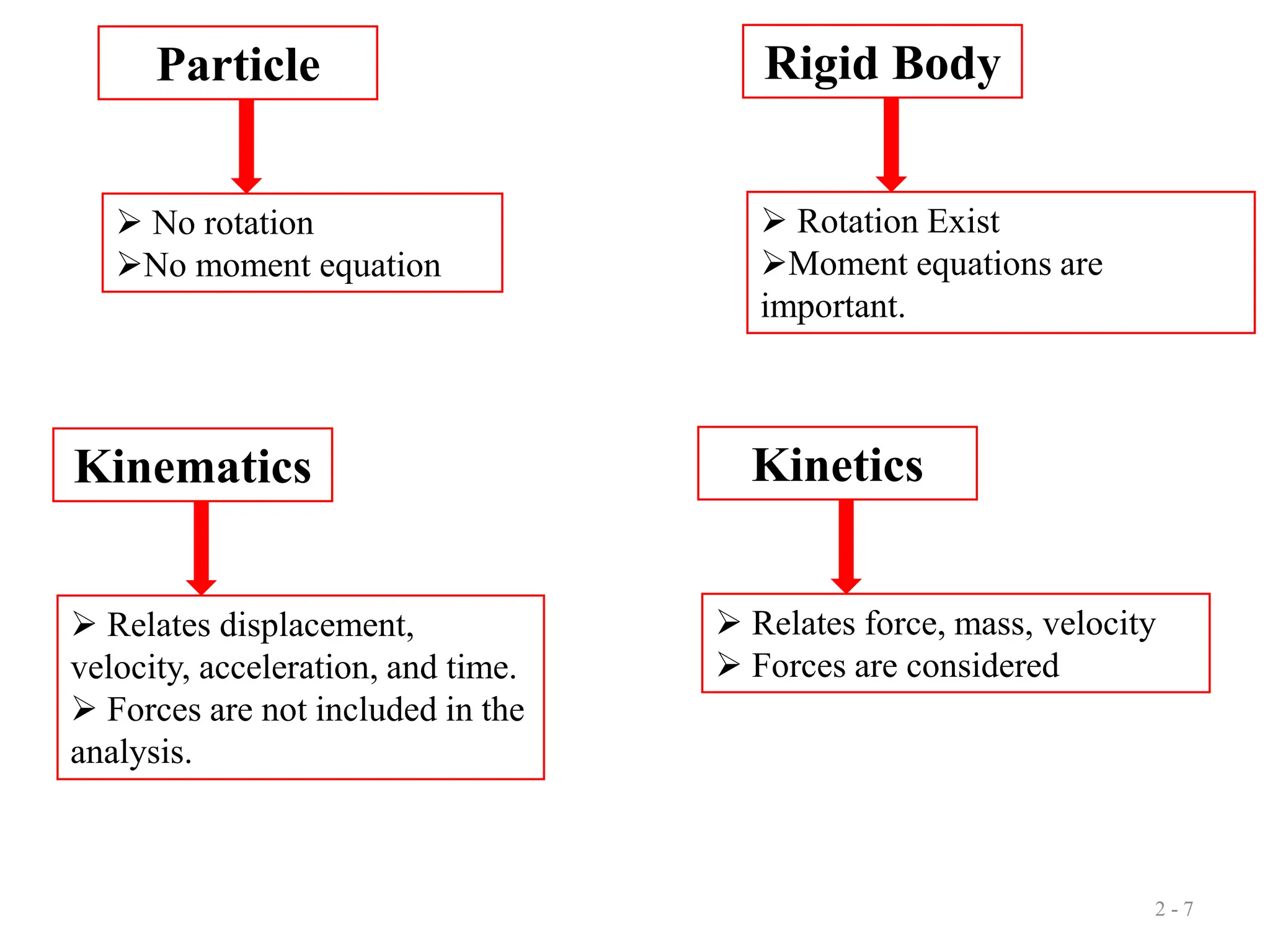
Particle
No rotation
No moment equation
Rigid Body
Rotation Exist
Moment equations are
important.
Kinematics
Relates displacement,
velocity, acceleration, and time.
Forces are not included in the
analysis.
Kinetics
Relates force, mass, velocity
Forces are considered
8.
2 - 8
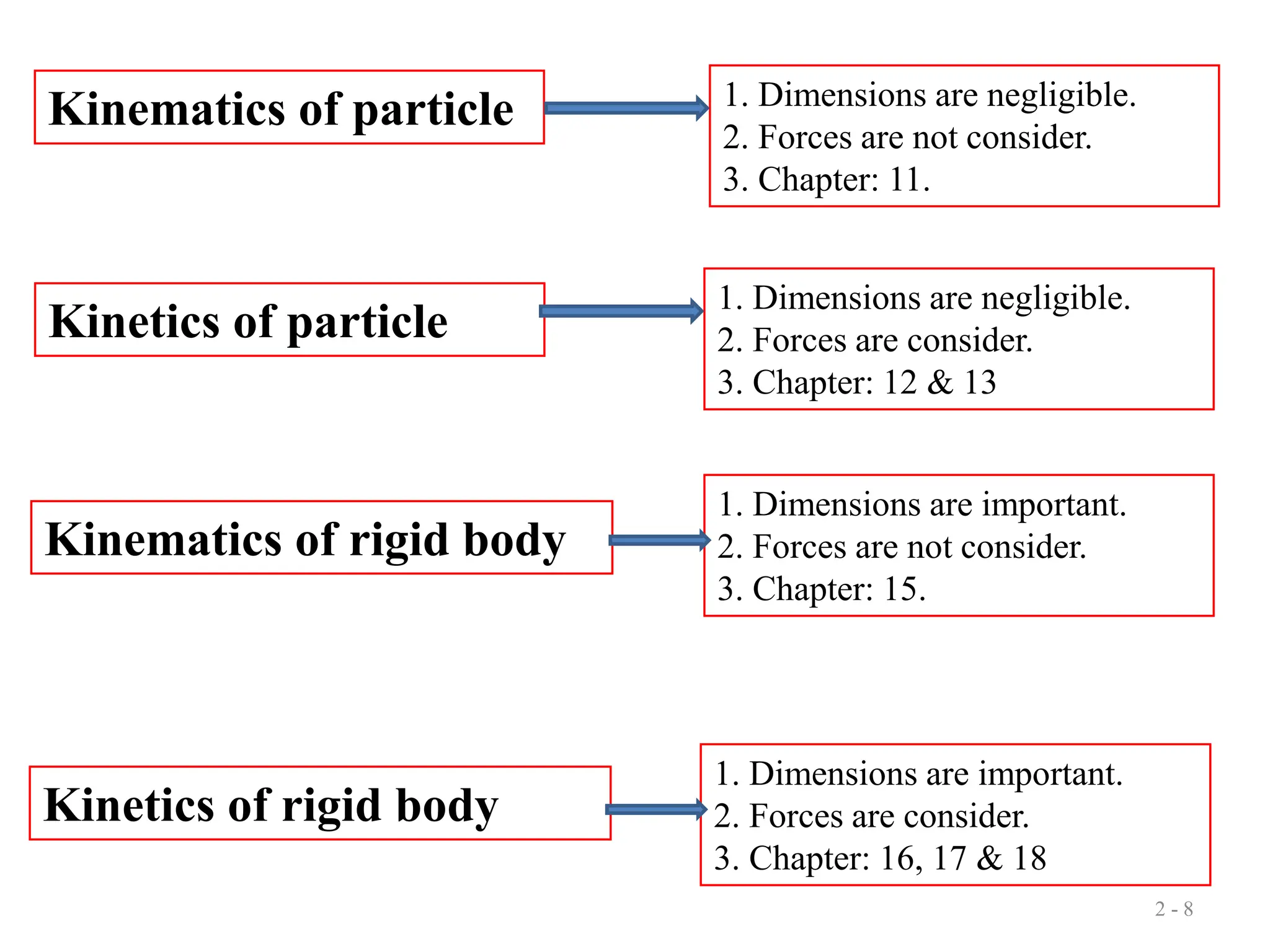
Kinematicsof particle
Kinematics of rigid body
Kinetics of particle
Kinetics of rigid body
1. Dimensions are negligible.
2. Forces are not consider.
3. Chapter: 11.
1. Dimensions are important.
2. Forces are not consider.
3. Chapter: 15.
1. Dimensions are negligible.
2. Forces are consider.
3. Chapter: 12 & 13
1. Dimensions are important.
2. Forces are consider.
3. Chapter: 16, 17 & 18